A SAF e R Approach to Child Custody Cases Involving Domestic - - PDF document

a saf e r approach
SMART_READER_LITE
LIVE PREVIEW

A SAF e R Approach to Child Custody Cases Involving Domestic - - PDF document

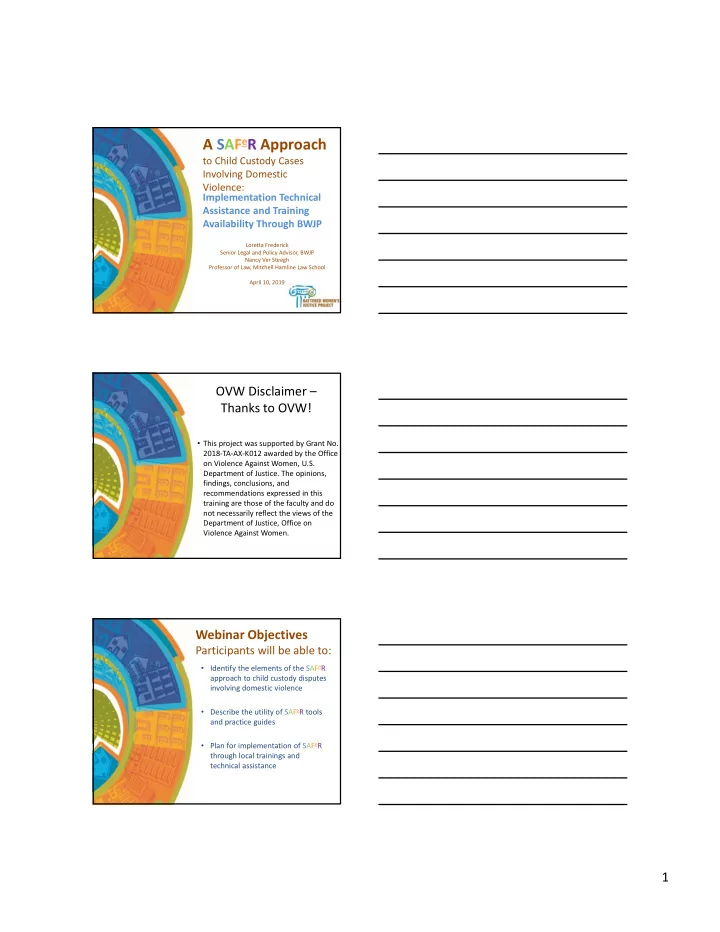
A SAF e R Approach to Child Custody Cases Involving Domestic Violence: Implementation Technical Assistance and Training Availability Through BWJP Loretta Frederick Senior Legal and Policy Advisor, BWJP Nancy Ver Steegh Professor of Law,


slide-1
SLIDE 1

1

A SAFeR Approach

to Child Custody Cases Involving Domestic Violence: Implementation Technical Assistance and Training Availability Through BWJP

Loretta Frederick Senior Legal and Policy Advisor, BWJP Nancy Ver Steegh Professor of Law, Mitchell Hamline Law School April 10, 2019

OVW Disclaimer – Thanks to OVW!

  • This project was supported by Grant No.

2018‐TA‐AX‐K012 awarded by the Office

  • n Violence Against Women, U.S.

Department of Justice. The opinions, findings, conclusions, and recommendations expressed in this training are those of the faculty and do not necessarily reflect the views of the Department of Justice, Office on Violence Against Women.

Webinar Objectives

Participants will be able to:

  • Identify the elements of the SAFeR

approach to child custody disputes involving domestic violence

  • Describe the utility of SAFeR tools

and practice guides

  • Plan for implementation of SAFeR

through local trainings and technical assistance

slide-2
SLIDE 2

2

The Problem

People’s Experience

  • f IPV

Institutional Responses to IPV

Background

Henry County

  • Case Files
  • Observations
  • Interviews
  • Focus Groups

Custody Evaluations

  • Reports
  • Facilitated

Analysis

Expert Interviews

  • Researchers
  • Advocates
  • Judges
  • Practitioners

Focus Groups

  • Battered

Parents

  • Batterer

Intervention

  • Attorneys
  • Guardians
  • CASAs

Emerging Themes

Ill‐defined terminology Inconsistent assessments/assumptions Lack of reliable information Poorly informed decision‐making Disconnected interventions and services

slide-3
SLIDE 3

3

Interconnections

Ill‐defined terms Inconsistent assessments Lack of reliable information Poorly informed decision‐ making Disconnected interventions & services

Research

  • Practitioners’ knowledge, assumptions, and

beliefs about IPV (and other concepts like alienation, gatekeeping, and high conflict) are more closely associated with their approach to (and outcomes of) these cases than what’s going

  • n in the real life of the parties.
  • Many of these concepts are being applied even

though there’s widespread disagreement in the field about what they mean and why they matter.

‐ Fidler, Bala, & Saini ‐ Saunders, et al.; Hardesty, et al.; Davis, et al.

Closing the gap between people’s experience of IPV and institutional responses to it.

slide-4
SLIDE 4

4

SAFeR

Screen for IPV Assess the Nature & Context of IPV Focus on the Effects

  • f IPV

Respond to IPV

Is abuse an issue here? What is actually going on? Why does it matter? What can be done about it?

Worksheets

Screening for IPV Assessing IPV Focusing on Effects of IPV Responding to IPV

S A Fe R

www.bwjp.org

Worksheets

S

slide-5
SLIDE 5

5 Screening Guide Interview Guide

Screening Assessing Focusing on Effects Responding

Worksheets

A

slide-6
SLIDE 6

6

Worksheets

Fe

Worksheets

R

Rest of the worksheets

Detailed worksheets Basic worksheets Specialized worksheets

www.bwjp.org

slide-7
SLIDE 7

7

SAFeR Approach

slide-8
SLIDE 8

8

slide-9
SLIDE 9

9

slide-10
SLIDE 10

10

slide-11
SLIDE 11

11

slide-12
SLIDE 12

12

slide-13
SLIDE 13

13

slide-14
SLIDE 14

14

slide-15
SLIDE 15

15

ABUSE OF VICTIM‐ PARENT

slide-16
SLIDE 16

16

slide-17
SLIDE 17

17 Focusing on the Effects: Child Custody and Parenting Time/Visitation

slide-18
SLIDE 18

18

SAFeR SAFeR SAFeR

slide-19
SLIDE 19

19

SAFeR SAFeR SAFeR

slide-20
SLIDE 20

20

Other specialized SAFeR worksheets

  • Accounting for Abuse in Orders for

Protection (child related relief)

  • Motions to Terminate or Modify CPOs
  • Mediation Discussion Guide

Recap….

  • SAFeR tools and worksheets are available to help:
  • Encourage safe and informed disclosure of domestic violence
  • Elicit detailed information about the nature, context, and impact of abuse
  • The key is to:
  • Assess the full nature and context of abuse
  • Focus on the impact abuse has on the issue or concern at hand
  • Develop strategies that account for the real life experience of abuse

How to Promote the Implementation of the SAFeR Approach in Your Community

slide-21
SLIDE 21

21

SAFeR Training Availability: Options

  • Standard or Customized
  • Multidisciplinary

Statewide Regional Local

SAFeR Training Availability: Options

  • Discipline‐specific
  • Advocates
  • Attorneys
  • Guardians ad Litem
  • Mediators
  • Judges
  • Custody Evaluators

SAFeR Training Availability: Options

The Minimum : Introduction to SAFeR 60‐90 minutes Standalone presentation OR Workshop offered at an existing conference OR Plenary At an existing conference At an annual or special meeting

slide-22
SLIDE 22

22

SAFeR Training Availability: Options

The Maximum #1: Intensive 2‐day skill‐building institute for a specific professional group advocates attorneys mediators guardians ad litem judicial officers custody evaluators etc.

SAFeR Training Availability: Options

The Maximum #2 Intensive 2‐day institute focused on application to one legal setting Civil protection order cases child custody cases mediations

SAFeR Training Availability: Options

In Between: Half day or full day in depth sessions

  • Profession specific
  • Case‐type specific
slide-23
SLIDE 23

23

SAFeR Implementation Technical Assistance

  • Map intervention points and practitioners
  • Identify challenges in SAFeR implementation
  • Choose challenge areas to address
  • Choose a range of strategies to address
  • each challenge areas
  • Customize tools and trainings
  • Consultations

SAFeR

Screen for IPV Assess the Nature & Context of IPV Focus on the Effects

  • f IPV

Respond to IPV

SAFeR Questions, Comments, Requests

Loretta Frederick lfrederick@bwjp.org

This project is supported by Award 2018‐TA‐AX‐K012 from the Office on Violence Against Women, US Department of Justice. The opinions, findings, conclusions, and recommendations expressed herein are those of the author(s) and do not necessarily reflect the views of the US Department of Justice.