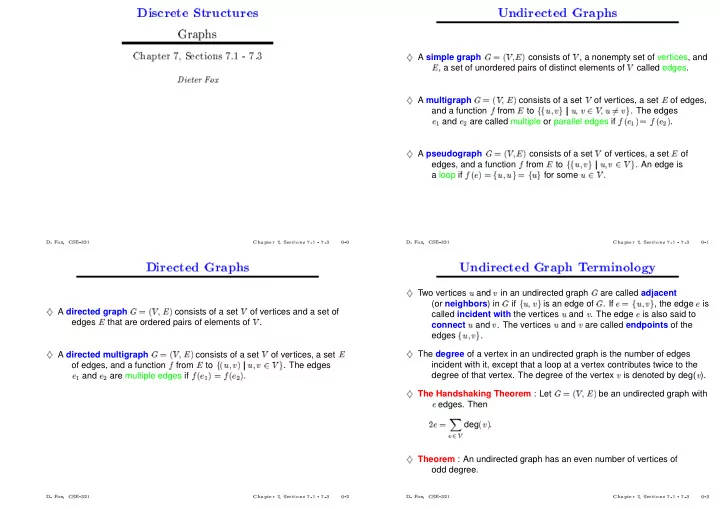

SLIDE 1 ✁ ✂✄ ☎ ✆✝ ✆ ✞ ✝ ☎ ✟ ✄ ✝ ✟ ☎ ✆ ✂ ✠ ✡ ☛ ☞✍✌ ✎ ✏ ✑ ✒ ✓ ✔✕ ✖ ✗ ✘ ✙ ✕ ✚ ✔ ✛ ✜ ✢ ✣ ✗ ✤✥ ✦ ✗ ✤ ✧ ★ ✩✪✫ ✪✬ ✭ ✮✯ ✰✱✲ ✳ ✴ ✵ ✶✷ ✸ ✹ ✺ ✻✼ ✶ ✽ ✾ ✿ ❀❁ ❂ ❃ ✵ ✷ ❁❄ ❀ ❅ ✳ ❆ ❇ ❃ ✱ ✼ ✹ ❃ ✱ ✺ ❈ ✹ ❈ ❉ ❊ ❋ ✁ ☎ ✆ ✄ ✝ ✆ ❋
- ☎
A simple graph
▲ ▼ ◆ ❖ P ◗ ❘consists of
❖, a nonempty set of vertices, and
◗, a set of unordered pairs of distinct elements of
❖called edges.
❑A multigraph
▲ ▼ ◆ ❖ P ◗ ❘consists of a set
❖- f vertices, a set
- f edges,
and a function
❙from
◗to
❚ ❚❱❯ P ❲ ❳❨ ❯ P ❲ ❩ ❖ P ❯ ❬ ▼ ❲ ❳. The edges
❭ ❪and
❭ ❫are called multiple or parallel edges if
❙ ◆ ❭ ❪ ❘ ▼ ❙ ◆ ❭ ❫ ❘.
❑A pseudograph
▲ ▼ ◆ ❖ P ◗ ❘consists of a set
❖- f vertices, a set
- f
edges, and a function
❙from
◗to
❚ ❚ ❯ P ❲ ❳❨ ❯ P ❲ ❩ ❖ ❳. An edge is a loop if
❙ ◆ ❭ ❘ ▼ ❚ ❯ P ❯ ❳ ▼ ❚❱❯ ❳for some
❯ ❩ ❖.
✰✱✲ ✳ ✴ ✵ ✶✷ ✸ ✹ ✺ ✻✼ ✶ ✽ ✾ ✿ ❀❁ ❂ ❃ ✵ ✷ ❁❄ ❀ ❅ ✳ ❆ ❇ ❃ ✱ ✼ ✹ ❃ ✱ ✺ ❈ ✹ ✼ ✁ ☎ ✆ ✄ ✝ ✆ ❋- ☎
A directed graph
▲ ▼ ◆ ❖ P ◗ ❘consists of a set
❖- f vertices and a set of
edges
◗that are ordered pairs of elements of
❖.
❑A directed multigraph
▲ ▼ ◆ ❖ P ◗ ❘consists of a set
❖- f vertices, a set
- f edges, and a function
from
◗to
❚ ◆ ❯ P ❲ ❘ ❨ ❯ P ❲ ❩ ❖ ❳. The edges
❭ ❪and
❭ ❫are multiple edges if
❙ ◆ ❭ ❪ ❘ ▼ ❙ ◆ ❭ ❫ ❘.
✰✱✲ ✳ ✴ ✵ ✶✷ ✸ ✹ ✺ ✻✼ ✶ ✽ ✾ ✿ ❀❁ ❂ ❃ ✵ ✷ ❁❄ ❀ ❅ ✳ ❆ ❇ ❃ ✱ ✼ ✹ ❃ ✱ ✺ ❈ ✹ ✻ ❉ ❊ ❋ ✁ ☎ ✆ ✄ ✝ ✆ ❋- ☎
Two vertices
❯and
❲in an undirected graph
▲are called adjacent (or neighbors) in
▲if
❚ ❯ P ❲ ❳is an edge of
▲. If
❭ ▼ ❚❱❯ P ❲ ❳, the edge
❭is called incident with the vertices
❯and
❲. The edge
❭is also said to connect
❯and
❲. The vertices
❯and
❲are called endpoints of the edges
❚ ❯ P ❲ ❳.
❑The degree of a vertex in an undirected graph is the number of edges incident with it, except that a loop at a vertex contributes twice to the degree of that vertex. The degree of the vertex
❲is denoted by deg(
❲).
❑The Handshaking Theorem : Let
▲ ▼ ◆ ❖ P ◗ ❘be an undirected graph with
❭- edges. Then
deg
◆ ❲ ❘❦❥ ❑Theorem : An undirected graph has an even number of vertices of
- dd degree.