A symmetry operation is a movement of a body (e.g. molecule, - - PDF document

a symmetry operation is a movement of a body e g molecule
SMART_READER_LITE
LIVE PREVIEW

A symmetry operation is a movement of a body (e.g. molecule, - - PDF document

9/7/2017 A symmetry operation is a movement of a body (e.g. molecule, orbital) such that, after the movement is carried out, every point of the body is coincident with an equivalent point (or the same point) of the body in its original


slide-1
SLIDE 1

9/7/2017 1

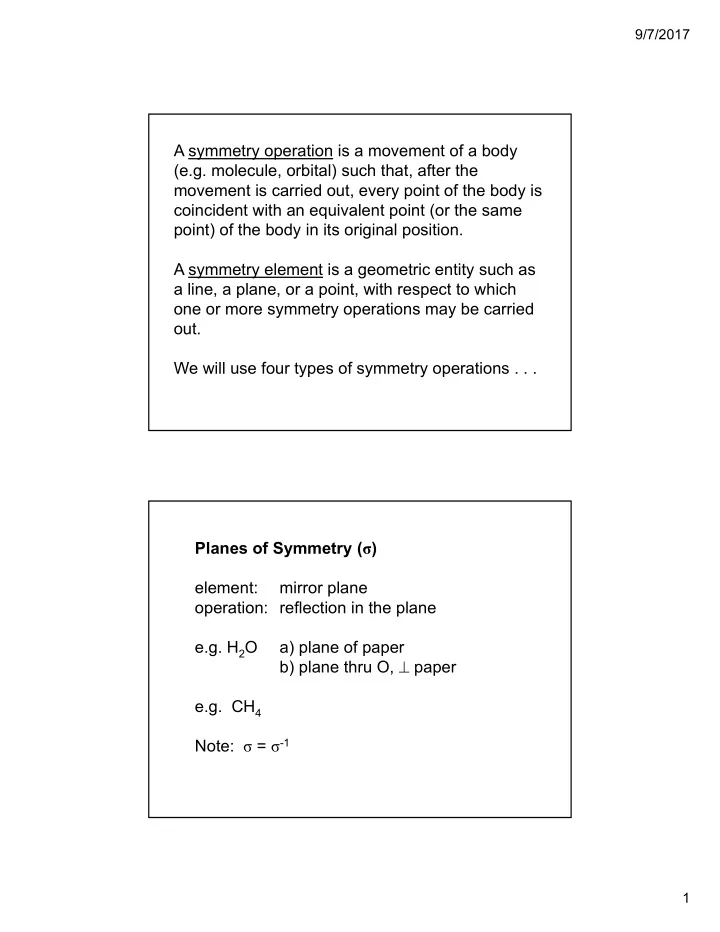
A symmetry operation is a movement of a body (e.g. molecule, orbital) such that, after the movement is carried out, every point of the body is coincident with an equivalent point (or the same point) of the body in its original position. A symmetry element is a geometric entity such as a line, a plane, or a point, with respect to which

  • ne or more symmetry operations may be carried
  • ut.

We will use four types of symmetry operations . . . Planes of Symmetry (σ) element: mirror plane

  • peration: reflection in the plane

e.g. H2O a) plane of paper b) plane thru O,  paper e.g. CH4 Note: σ = σ-1

slide-2
SLIDE 2

9/7/2017 2

Inversion Centers (i) element: point (center of inversion)

  • peration: inversion of all atoms through center

molecules with i: N2, O=C=O, H-CC-H, benzene, ferrocene (staggered) molecules without i: CH4, BF3, NH3, ruthenocene (eclipsed) Note: i = i-1 Proper Rotations (Cn

m)

element: line (rotation axis)

  • peration: one or more rotations about the axis

The symmerty element is a line, about which we rotate by an angle θ, such that nθ = 2π. ‘n’ is the

  • rder of the axis, symbol Cn.

convention is clockwise, looking down from top Note: (Cn

m)-1 = Cn n-m

slide-3
SLIDE 3

9/7/2017 3

Improper Rotations (Sn

m)

(also called rotoreflections) element: line (rotation axis)

  • peration: one or more rotations about the axis,

followed by reflection  to axis Consider again

H H H H H H

S4

1,3,5,7-tetramethylcyclooctatetraene

slide-4
SLIDE 4

9/7/2017 4

+ 2e S4 C4

http://bioportal.weizmann.ac.il/course/structbioinfo/databases/ CCDC_teaching_egs/teaching_examples.3.12.html

The set of all operations will constitute a group:

  • 1. The combination of any two operations must yield

another operation in the group.

  • 2. The operation E leaves all points in their original
  • position. E commutes with all operations.
  • 3. Each operation has a reciprocal such that

A A-1 = A-1 A = E

  • 4. The associative law holds, i.e. for any operations

A, B, and C A (B C) = (A B) C

slide-5
SLIDE 5

9/7/2017 5 Point Groups: elements:

  • perations:

symbol: 1. E E C1 2. E, σ E, σ Cs 3. E, i E, i Ci 4. E, Cn E, Cn

1,...,Cn n-1

Cn .... 7. E, Cn, nC2  Cn E, Cn

1,...,Cn n-1, n C2

Dn .... Special groups (most common) 11. E, C, σv Cv (e.g. linear A-B molecule) 12. E, C, nC2  Cn, σh,σv Dh (e.g. linear A-A molecule) 13. tetrahedral Td 14.

  • ctrahedral

Oh 15. icosahedral Ih Cotton’s Point Group Flowchart

No proper or improper rotation axes: C1, Cs, Ci (step 1) (step 2) (step 3) Special Groups (a) linear molecules: (b) multiple high-order axes: Cn axis (not a simple consequence of S2n) Only Sn (n even) axis: START No C2's perpendicular to Cn n C2's perpendicular to Cn no 's h h n v's n d's no 's Cn Cnh Dnh Cnv Dnd Dn

slide-6
SLIDE 6

9/7/2017 6 Table 3.1 Point groups of chiral and achiral molecules

Huheey, 4e

slide-7
SLIDE 7

9/7/2017 7

http://en.wikipedia.org/wiki/Meso_compound

Based on Table 3.2 from HK&K Dipole moment (polar): C1, Cs, Cn, Cnv No dipole moment (nonpolar): all others, i.e. those with Sn (, i, Sn>2), or Cn and n C2