
SLIDE 1
Fahrenheit Rollercoaster, Hershey, PA | max height = 121 ft | max speed = 58 mph
A Tale of Friction
Basic Rollercoaster Physics
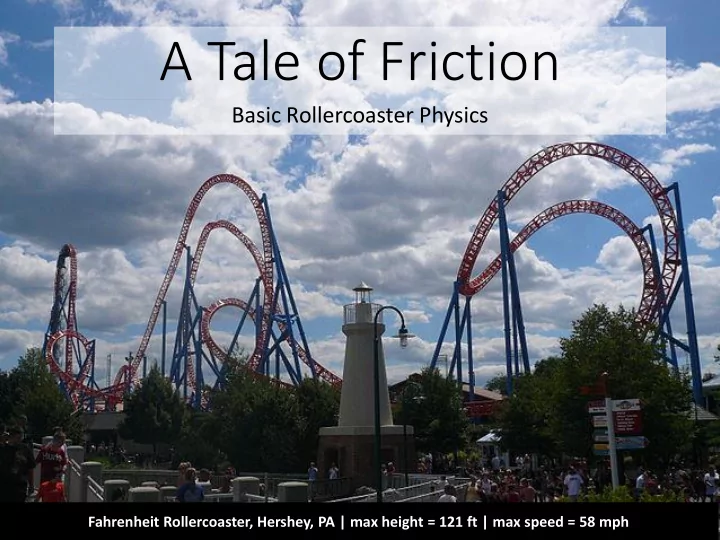
A Tale of Friction Basic Rollercoaster Physics Fahrenheit - - PowerPoint PPT Presentation
A Tale of Friction Basic Rollercoaster Physics Fahrenheit Rollercoaster, Hershey, PA | max height = 121 ft | max speed = 58 mph PLAY PLAY PLAY PLAY Rotational Movement Kinematics Similar to how linear velocity is defined, angular velocity is
Fahrenheit Rollercoaster, Hershey, PA | max height = 121 ft | max speed = 58 mph
Basic Rollercoaster Physics
PLAY PLAY PLAY PLAY
Similar to how linear velocity is defined, angular velocity is the angle swept by unit of time. Tangential velocity is the equivalent of linear velocity for a particle moving on a circumference.
dt d r vT r vT r s
dt d
dt dv a
T T 2 2
dt d
2 2
dt d r aT r aT
Tangential kinetic energy: Rotational kinetic energy:
2 2 1 T
mv K
2 2 1
I K
Momentum of inertia:
2
mr I
Momentum of inertia:
2 i
mr I
Momentum of inertia:
dm r I
2
d F
F r sin F r
Magnitude:
second law:
a m F dt v d m
Torque is a measure of how much a force acting on an object causes that
product of the position vector of the point of application of the force, and the force vector. Its magnitude depends on the angle between position and force vectors. If these vectors are parallel, the torque is zero.
v m P
v m dt d F dt v d m a m
p r L v r m
For m = constant:
Defining torque (force producing rotation) in a circular movement (r constant) as the change in time
T T
a r m dt dv r m dt dL
: F r If
T
v r m L
v m P
v m dt d F dt v d m a m
p r L v r m
For m = constant:
2
r m a r m
T
: F r If
T
v r m L
Taking aT= r, and making I = mr2:
I
The sphere rolls because of the torque produced by the friction force fs and the weight’s component parallel to the incline:
s
f g m a m F sin
I r fs
and If the sphere’s momentum of inertia is I = 2/5mr2 and = a/r:
r a r m r fs
2
5 2
a m fs 5 2
With this value:
a m g m a m 5 2 sin
Solving for a in the above equation, the acceleration of the sphere rolling on the incline is:
sin 7 5 g a
Combining: and
a m fs 5 2
the static friction force is now:
sin 7 5 g a
sin 7 2 g m fs
But by definition, the static friction force is proportional to the normal force the body exerts on the surface :
n s s
F f
Taking Fn from the free-body diagram:
cos g m f
s s
Combining the two expressions for fs:
sin 7 2 sin g m g m
s
the coefficient of static friction can be expressed as:
tan 7 2
s
This expression states that the coefficient of static friction is a function of the incline’s angle only, specifically, a function of the slope of this surface.
At any point of a curved path f (x), a tangent line can be visualized as a portion of an incline. The slope m of this incline is the tangent of the angle between this line and the horizontal, tan . In calculus, this slope is given by the value of f’(x), the derivative of the function f (x) at that point.
Let f (x) a differentiable function. If:
tan ) ( ' m and x f dx dy m
then: tan f ’(x)
The coefficient of static friction s can be expressed as:
) ( ' 7 2 x f
s
The static friction force fs is now:
cos ) ( ' 7 2 x f g m fs
Because tan = f ’(x), it is possible to define a right triangle with sides in terms of f ’(x):
)) ( ' arctan( x f
, then:
))) ( ' ( cos(arctan ) ( ' 7 2 x f x f g m fs adjacent
x f 1 ) ( ' tan
If: Using basic trigonometry:
2
)) ( ' ( 1 1 cos x f hypotenuse adjacent
The static friction force is now:
2
)) ( ' ( 1 ) ( ' 7 2 x f x f g m fs
But, something needs to be fixed in this procedure. By definition, the static friction coefficient s must always be positive, while the slope of a path may be positive or negative.
) ( ' 7 2 x f
s
So the required corrections must be:
2
)) ( ' ( 1 ) ( ' 7 2 x f x f g m fs
Where: denotes the absolute value of the function f ’(x)
) ( ' x f
The work-energy theorem states that the mechanical energy (kinetic energy + potential energy) of an isolated system under only conservative forces remains constant:
U K E
E U K U K E
i i i f f f
In a system under non-conservative forces, like friction, the work-energy theorem states that work done by these forces is equivalent to the change in the mechanical energy:
U K E Wf
Additionally, the work done by non-conservative forces depends on the path or trajectory of the system, or in the time these forces affect the system.
By definition, mechanical work is the product of the displacement and the force component along the displacement:
For a variable slope path y = f (x), the work done by the friction fs over a portion s of the path is:
s x f x f g m s f W
s
2
)) ( ' ( 1 ) ( ' 7 2
For a differential portion of the path:
ds x f x f g m dW
2
)) ( ' ( 1 ) ( ' 7 2
Expressing ds in terms of the differentials dx and dy, the differential arc can be expressed in terms of the f ’(x):
dx x f dx dx dy dy dx ds
2 2 2 2 2
) ( ' 1 1
The work along the differential portion of the path can be expressed as:
dx x f x f x f g m ds x f x f g m dW
2 2 2
)) ( ' ( 1 )) ( ' ( 1 ) ( ' 7 2 )) ( ' ( 1 ) ( ' 7 2 dx x f g m dW ) ( ' 7 2
Because dx > 0, using properties of the absolute value and the definition
) ( 7 2 ) ( ' 7 2 ) ( ' 7 2 x df g m dx x f g m dx x f g m dW
Friction forces always acts against the movement, so the work done by them must always be negative:
) ( 7 2 x df g m dW
Taking small displacements instead differentials:
) ( 7 2 x f g m W
Using this expression in the work-energy theorem:
U K Wf
i f i f
h g m h g m v m v m x f g m
2 2 1 2 2 1
) ( 7 2 This expression relates the work done by friction with the mechanical energy of a sphere rolling on a little portion of a curved path. Visualize this portion as a little incline. Height h is given by the function f (x).
Then, dividing by m:
) ( ) ( ) ( ) ( 7 2
2 2 1 2 2 1 i f i f i f
x f g x f g v v x f x f g From this expression, we can determine final velocity at the end of the incline:
) ( ) ( 7 4 ) ( ) ( 2
2 2 1 i f i f i f
x f x f g x f x f g v v
The final velocity at the end of one incline is the initial velocity at the beginning of the next incline.
We can approximate the friction of a spherical body on a curved path as the rolling of this body on a sequence of inclines.