
SLIDE 1
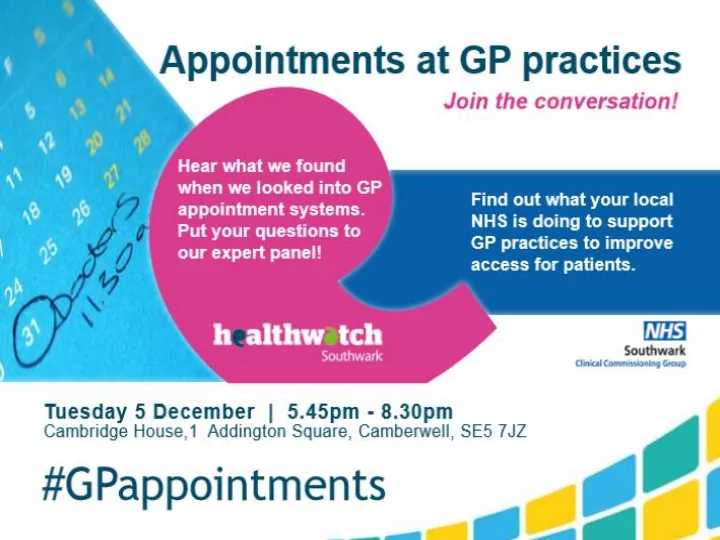
About this event Key findings from the Healthwatch Southwark report - - PowerPoint PPT Presentation
About this event Key findings from the Healthwatch Southwark report Appointment systems at GP practices are they working? What the NHS Southwark CCG is doing to support general practice services and how they are going to use the
Appointment systems at GP practices – are they working?
services and how they are going to use the HWS report
residents what should be our priority areas in 2017/18. – Frustrations with appointment systems. – Every practice has a different system. – Time to wait for an appointment.
lower than the national average when it comes to the experience of making or ability to get an appointment.
Southwark GP practice.
registered with Southwark GP practices.
least one from each practice)
an online survey.
What is Enter and View? When trained authorised representatives visit publicly funded health and social care services to talk to service users, their relatives and carers, as well as staff.
systems
advance
appointments
patient’s condition
redirecting patients
receptionists
appointments
Practitioners (ANPs)
systems
advance
appointments
patient’s condition
redirecting patients
receptionists
appointments
Practitioners (ANPs)
Managers, receptionists, and patients.
system, or to rank practices.
Southwark’s GP registered population and practice staff.
conversations with them.
“...the waiting time was about 5 weeks to see my Doctor and about 4 weeks to see ANY Doctor. By that time, any ailment will probably have cleared up
less that 1 week for their last GP appointment.
and 5% waiting longer than 4 weeks.
not being able to book appointments far enough ahead, for convenience.
“...Their booking system is the biggest problem, e.g. if you call on a Monday, they’ll only offer you an appointment for the next Monday – or they say there’s no appointment and tell you to call back the next day at 8am, maybe then there’ll be one for the Tuesday a week later.” (Patient)
ahead practices release their appointments.
stagger the release of their appointments e.g. every few days
“…the practice release appointments at least 3 times a week which they call embargo appointments but are for when patients want to book an appointment sooner than 4 weeks” (Receptionist) “When I was told that there was a minimum 4 week wait, I was told to ring at 8am and then somehow there might be appointments available? I'm really not sure how that can be the case...” (Patient)
appointment system.
purpose and that there is a rationale for the system.
get a same-day appointment
mentioned need to call at certain times and difficulty getting through on the phone.
“You have to call immediately after 8am and redial repeatedly – but all the slots tend to go within 20 minutes or so, before the surgery
“You have to programme yourself to get up and get an appointment.” (Patient) “There will not be any appointments in the day if they miss the morning call in times.” (Receptionist)
made available e.g. if two release times (morning and afternoon) might work for patients.
triaged.
appointment up to a certain point, and then triage is used once all/certain number of appointments have run out.
each patient based on description provided to reception.
can be dealt with quickly over the phone as it may not require them to come in to be seen.
that need them.
“The duty doctor calls urgent cases first and leaves sick notes and blood results to the end of the day.” (Receptionist) “They get an advisor to call you back to decide if you need to be seen that day.” (Patient)
GP to call them.
and others don’t (e.g. if they call in
Extended Primary Care Service, this could involve another phone call.
“It just creates more work for everyone. Often I have to call the patient back a few times to get through and book them in [at EPCS], or the patient keeps calling back. One of the GPs just booked them in himself which is much easier, its just time-wasting otherwise” (Receptionist) “They usually do call back. It’s ok – what I want gets dealt with. [But] if it’s a real emergency I don’t want to have to have to wait for the GP to call me back to find out I’ll get an appointment – I’ll just go to A&E.” (Patient)
system on an ongoing basis, from both a staff and patient perspective.
different triage systems in operation to determine: – How practices can share learning about their triage systems. – What systems work well and why. – Whether practices should adopt any good practice identified.
systems could be improved from both a staff and patient perspective.
for same-day appointments, for others it is a final option (when their own slots have run out).
staff refer to the EPCS in quite different ways. What is the Extended Primary Care Service (EPCS)? We have an EPCS in the north and south of the borough – at Bermondsey Spa and at Lister Primary Care Centre. Patients who can’t get an appointment at their own practice can be offered an appointment the EPCS. It is open 7 days a week, 8am – 8pm.
“QHS” “IHL” “The hub” “EPCS hub” “Peckham overflow” “A central hub location in North Southwark” “The Lister”
said they had used the EPCS.
people’s experience of the EPCS and about the promotion of the service.
have been helpful.
“Please do check with all the GP practices, their websites, their literature and what receptionists are told to tell patients. I think you will find inconsistency.” (Patient) “Went to the Waldron Centre when I couldn’t get an appointment. It was for my baby who was 5 days old. Would have been good to have been offered an appointment at EPCS.” (Patient) “Surgery NEVER give me this and tell me to go to Deptford walk-in, but to phone them first for an urgent appointment that day, or I go to King’s A&E!” (Patient) “A practice would have to get past the receptionist first...I saw a poster about EPCS in the chemist. When I asked about it at my GP the receptionist said they knew nothing about it!” (Patient)
“I’d go because it provides for same-day when needed – it doesn’t matter who you seen then.” (Patient)
continuity.
“London is a 24-hour city – I’m pro that.” (Patient) “I was told to go to Bermondsey Spa but I was pregnant at the time. It was too far and my child needed to be collected from school.” (Patient) “The whole point is that the GP is local to me and the Lister isn’t near to me at all.” (Patient) “I want to see my doctor as I find explaining each time to a different doctor draining.” (Patient)
the upcoming EPCS communications campaign.
look at flexibility of using either north or south service.
to EPCS could be further streamlined.
and explore further options to avoid:
Inconsistent explanations about the service.
Patients being referred to out-of-borough services.
Patients feeling they have no choice.
Not giving patients important information about EPCS.
Inappropriate referrals being made
questions about their condition when they want a same-day appointment.
appointments in advance.
and 63% of patients said they did not mind if receptionists asked.
embarrassed, or findings questions intrusive.
“On the phone this works fine. But until not long ago patients at the desk had to answer personal questions with other patients hanging on every word. This has now been resolved by having patients queue up a yard
“I understand why they ask it but things don’t stay as hush hush as they should.” (Patient)
“We do a little bit of triage though we’re
“Reception triage even though we’re not supposed to.” (Receptionist)
– In many cases, only to give information to the triage clinician. – So they can use the information to re- direct patients away from same-day appointments, e.g. filtering out admin, seeing a non-GP clinician, suggesting routine appointment or another service.
“[We ask] because we have a wide range of clinicians – pharmacists, CPN, doctors, nurses, HCA. Only the GP is triage though.” (Receptionist) “Anything meds related, we see if patient is aware we have a pharmacist on offer – they can do minor ailments...” (Receptionist)
thought this information was being used by reception staff:
Enable better decision-making
Allowed for patients to be prioritised
the problem, would determine whether you get an appointment.
“I think everyone who requests an appointment needs it; no need to ask why.” (Patient) “Last week...I was able to communicate a symptom which triggered an emergency response and I was seen within two hours by the GP .” (Patient) “It is silly to be asked, you can just manipulate the system to be seen.” (Patient) “I normally request appointments for a reason and know how to persuade the
the same level of confidence” (Patient)
includes techniques for how to ask patients about their condition:
Explaining to the patient why they are asking.
Ensuring patients understand that they do not have to give this information.
reception desk.
explaining under what circumstances receptionists might (or might not) suggest: – Routine rather than urgent appointments – Services external to the practice It should also be made clear at which point a clinician’s decision is necessary.
would accept an online video chat, and 21% would accept an online typed chat.
getting to know Doctor, poor hearing/eyesight, not having internet.
“I work full time so anything else would be good!” (Patient) “Talking to a computer is not as quick, you can’t express yourself and the urgency.” (Patient) “It might not be clear who is on the
conversation.” (Patient)
they explore alternatives to face-to-face appointments.
challenges.
system.
receive appointments.
this.
plans to enable clinical commissioning groups (CCGs) to commission and fund additional capacity across England to ensure that, by 2020 everyone has improved access to GP services including sufficient routine appointments at evenings and weekends to meet locally determined demand, alongside effective access to out of hours and urgent care services.
response to local needs.
years
and national average for a number of Southwark practices.
Framework).
population basis through GP federations (Population Health Management Contract).
high levels of patient experience; however, general awareness of the service and how to access it could be improved.
are:
Where improvements are required the CCG is working with practices, the LMC and to support practices with the implementation of their improvement plans.
patients did not attend (DNAs), in order to determine whether it should be rolled
people booking online bypass triage?)
those available via reception.
CCG’s response
provide additional GP and nurse appointments 8am – 8pm, 7 days per week.
the right place first and reduce number of ways to access services, which patients told us was confusing.
day appointments as well as routine appointments e.g. dressings.
care e.g. those with long term conditions, complex needs.
practices to inform how best to offer access to patients for local needs.
CCG’s response
and patients.
support practices put in processes to make appointments available to book
practices and support patients with online services.
practice.
line or via reception directly at the same time i.e. certain appointments are not
CCG’s response
using processes such as text message reminders. In January 2018 EMIS Web (the system practices) will provide automated data to practices on DNAs within the practice. The CCG does not receive this information and would not be able to review this across the borough.
nationally e.g. patient online.
Healthwatch recommendations:
for flexible use of north and south EPCS
in light of our recommendations around triage generally
signposting to other services.
CCG’s response
patients.
patients are seen at the right place, at the right time by the right person.
including the review of pathways to access the service. This includes 111 being able to book patients appointments directly and training of practice staff.
patients
CCG’s response
extended primary care services sites but the recommendation is being explored.
Healthwatch recommendations:
Healthwatch recommendations:
this.
CCG’s response
contract monitoring meetings with GP federations. This information informs commissioning decisions.
Lewisham is currently engaging on the future of the WIC.
in Southwark. The CCG is reviewing the use of the Pharmacy First Scheme.
CCG’s response
receptionists to become care navigators.
patients that may support improved health and social outcomes.
process - Locality Patient Participation Groups, Practice Manager’s Forum, the CCG’s Engagement and Patient Experience Committee (EPEC) and the CCG’s Primary Care Commissioning Committee which meets in public
practice’s appointments / extended access includes further patient engagement
federations as access is a priority area
Caroline Gilmartin, Director for Integrated Commissioning, NHS Southwark CCG Dr Emily Gibbs, Clinical Lead for Community Based Care, NHS Southwark CCG Nigel Smith, Managing Director of the South Southwark GP federation (Improving Health Ltd) Tilly Wright, Practice Manager and Chair of the Practice Manager’s Forum Rebecca Dallmeyer, Executive Director of the North Southwark GP federation (Quay Health Solutions)