SLIDE 1 Abstract Session B2: Health Disparities/Vulnerable Populations Moderator: Chinazo Cunningham, MD, MS
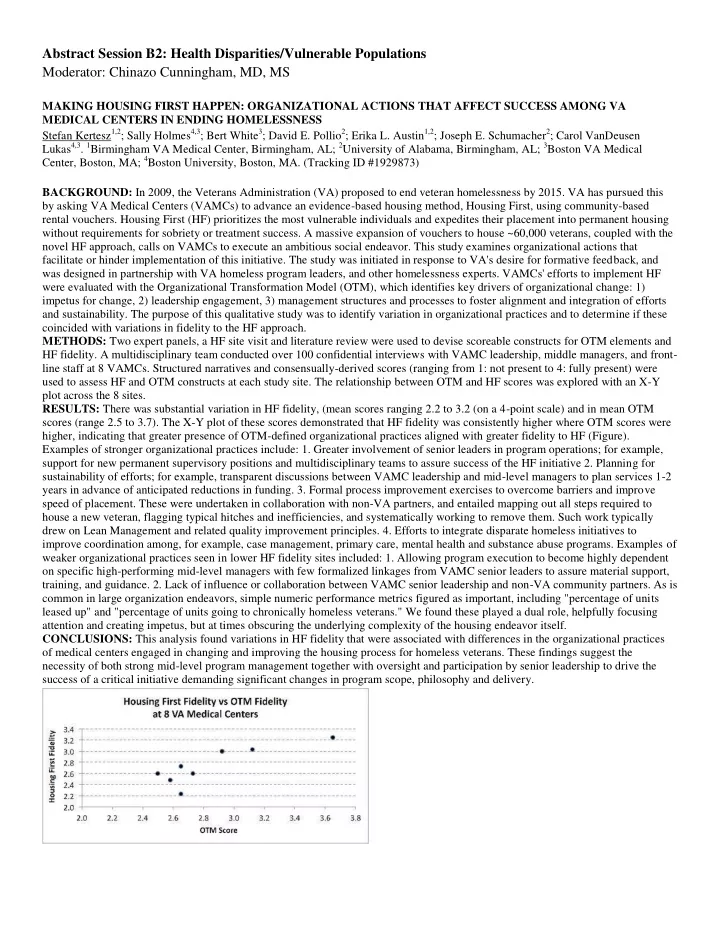
MAKING HOUSING FIRST HAPPEN: ORGANIZATIONAL ACTIONS THAT AFFECT SUCCESS AMONG VA MEDICAL CENTERS IN ENDING HOMELESSNESS Stefan Kertesz1,2; Sally Holmes4,3; Bert White3; David E. Pollio2; Erika L. Austin1,2; Joseph E. Schumacher2; Carol VanDeusen Lukas4,3. 1Birmingham VA Medical Center, Birmingham, AL; 2University of Alabama, Birmingham, AL; 3Boston VA Medical Center, Boston, MA; 4Boston University, Boston, MA. (Tracking ID #1929873) BACKGROUND: In 2009, the Veterans Administration (VA) proposed to end veteran homelessness by 2015. VA has pursued this by asking VA Medical Centers (VAMCs) to advance an evidence-based housing method, Housing First, using community-based rental vouchers. Housing First (HF) prioritizes the most vulnerable individuals and expedites their placement into permanent housing without requirements for sobriety or treatment success. A massive expansion of vouchers to house ~60,000 veterans, coupled with the novel HF approach, calls on VAMCs to execute an ambitious social endeavor. This study examines organizational actions that facilitate or hinder implementation of this initiative. The study was initiated in response to VA's desire for formative feedback, and was designed in partnership with VA homeless program leaders, and other homelessness experts. VAMCs' efforts to implement HF were evaluated with the Organizational Transformation Model (OTM), which identifies key drivers of organizational change: 1) impetus for change, 2) leadership engagement, 3) management structures and processes to foster alignment and integration of efforts and sustainability. The purpose of this qualitative study was to identify variation in organizational practices and to determine if these coincided with variations in fidelity to the HF approach. METHODS: Two expert panels, a HF site visit and literature review were used to devise scoreable constructs for OTM elements and HF fidelity. A multidisciplinary team conducted over 100 confidential interviews with VAMC leadership, middle managers, and front- line staff at 8 VAMCs. Structured narratives and consensually-derived scores (ranging from 1: not present to 4: fully present) were used to assess HF and OTM constructs at each study site. The relationship between OTM and HF scores was explored with an X-Y plot across the 8 sites. RESULTS: There was substantial variation in HF fidelity, (mean scores ranging 2.2 to 3.2 (on a 4-point scale) and in mean OTM scores (range 2.5 to 3.7). The X-Y plot of these scores demonstrated that HF fidelity was consistently higher where OTM scores were higher, indicating that greater presence of OTM-defined organizational practices aligned with greater fidelity to HF (Figure). Examples of stronger organizational practices include: 1. Greater involvement of senior leaders in program operations; for example, support for new permanent supervisory positions and multidisciplinary teams to assure success of the HF initiative 2. Planning for sustainability of efforts; for example, transparent discussions between VAMC leadership and mid-level managers to plan services 1-2 years in advance of anticipated reductions in funding. 3. Formal process improvement exercises to overcome barriers and improve speed of placement. These were undertaken in collaboration with non-VA partners, and entailed mapping out all steps required to house a new veteran, flagging typical hitches and inefficiencies, and systematically working to remove them. Such work typically drew on Lean Management and related quality improvement principles. 4. Efforts to integrate disparate homeless initiatives to improve coordination among, for example, case management, primary care, mental health and substance abuse programs. Examples of weaker organizational practices seen in lower HF fidelity sites included: 1. Allowing program execution to become highly dependent
- n specific high-performing mid-level managers with few formalized linkages from VAMC senior leaders to assure material support,
training, and guidance. 2. Lack of influence or collaboration between VAMC senior leadership and non-VA community partners. As is common in large organization endeavors, simple numeric performance metrics figured as important, including "percentage of units leased up" and "percentage of units going to chronically homeless veterans." We found these played a dual role, helpfully focusing attention and creating impetus, but at times obscuring the underlying complexity of the housing endeavor itself. CONCLUSIONS: This analysis found variations in HF fidelity that were associated with differences in the organizational practices
- f medical centers engaged in changing and improving the housing process for homeless veterans. These findings suggest the
necessity of both strong mid-level program management together with oversight and participation by senior leadership to drive the success of a critical initiative demanding significant changes in program scope, philosophy and delivery.
SLIDE 2
MASSACHUSETTS HEALTH CARE REFORM REDUCED RACIAL/ETHNIC DISPARITIES IN ELECTIVE PERCUTANEOUS CORONARY INTERVENTION AND CORONARY ARTERY BYPASS GRAFT SURGERY Amresh D. Hanchate1,2; Steven M. Bradley3,4; Alok Kapoor2; Danny McCormick5; Karen E. Lasser2; Chen Feng2; Nancy R. Kressin1,2. 1VA Boston Healthcare System, Boston, MA; 2Boston University School of Medicine, Boston, MA; 3VA Eastern Colorado Healthcare System, Denver, CO; 4University of Colorado, Denver, Denver, CO; 5Cambridge Health Alliance, Cambridge, MA. (Tracking ID #1937646) BACKGROUND: Percutaneous coronary intervention (PCI) and coronary artery bypass graft (CABG), arguably the most commonly examined surgical procedures in the literature on racial and ethnic disparities, are documented to be used less often among racial/ethnic minorities. The differences in use have been associated with factors other than clinical need. Large-scale insurance coverage expansions, such as the Massachusetts (MA) reform of 2006 and the Affordable Care Act of 2010, have the potential to reduce disparities in access to health care, particularly outpatient care. Thus, they provide an unique quasi-experimental setting to examine the causal impact of insurance coverage expansion on disparities in use of elective PCI and CABG. METHODS: We applied a difference-in-differences design to estimate the impact of MA reform on use of elective and non-elective PCI and CABG among adults aged 40 to 64 (those most at risk for these procedures among the target beneficiaries of reform) by race/ethnicity (Whites, Blacks and Hispanics). We estimated population rates of procedure use (# procedures per 100,000 census population) during the 2 years prior to the start of reform (7/1/2006) and the 2 years following coverage expansion (1/1/2008). To isolate the impact of reform, we adjusted for secular changes unrelated to reform based on a comparison of the pre-post change in the target subpopulation (MA residents aged 40 to 64) with corresponding changes among (a) residents of three comparison states (New Jersey, New York and Pennsylvania) aged 40 to 64, and (b) residents of MA aged 65 and older. We obtained comprehensive counts of elective and non-elective PCI and CABG procedures from 2004-2010 state discharge data files. Population counts were obtained from the census data files. Stratifying the population by race/ethnicity, age and sex, we estimated Poisson regression models with fixed effects for state and time. RESULTS: During the pre-reform period the total combined numbers of elective PCI and CABG procedures, by race/ethnicity, were: 11,919 (Whites), 227 (Blacks) and 251 (Hispanics). Pre-reform procedure rates (# procedures per 100,000) were significantly lower among Blacks (71) and Hispanics (80) compared to Whites (139). There was a secular decrease in overall rates of elective PCI and CABG, with a larger decrease among the target cohort of MA residents aged 40 to 64 (-41%) than among comparison-state residents aged 40-64 (- 28%) and MA residents aged 65 and older (-32%). Adjusted for secular trends, MA reform was associated with an increase in elective procedures among Blacks (7%, 95% confidence interval [CI]=[3%, 11%]) and Hispanics (4%, 95% CI=[2%, 6%]), but a decrease among Whites (-7%, 95% CI=[-8%, -6%]). For non-elective PCI and CABG procedures, MA reform was associated with no change among Whites, Blacks and Hispanics. CONCLUSIONS: MA health reform may have increased the use of elective PCI and CABG among Blacks and Hispanics, thereby indicating possible improved access to outpatient care and reduction of disparities. Despite a sizable secular decrease in procedure use among all subpopulations, procedure use may have increased among minority groups with previously unmet need or with newly identified need. While this finding might suggest similar potential for ACA nationwide, the role of other facilitating factors, such as adequate provider availability, also need to be taken into account.
SLIDE 3 RANDOMIZED CONTROLLED TRIAL OF A CULTURALLY ADAPTED, AUTOMATED TELEPHONE EXERCISE COACH TO IMPROVE PHYSICAL ACTIVITY AMONG HYPERTENSIVE AFRICAN-AMERICANS Julien J. Dedier1; Julie A. Wright3; Robert H. Friedman1; Timothy Heeren2. 1Boston University, Boston, MA;
2Boston University, Boston, MA; 3University of Massachusetts, Boston, MA. (Tracking ID #1939226)
BACKGROUND: Regular physical activity (PA) of moderate or greater intensity (MOD+PA) can reduce blood pressure (BP). However, hypertensive urban minority patients may face logistical obstacles to participation in brick-and-mortar PA programs. Automated PA programs delivered by telephone can mitigate these obstacles. We conducted an RCT to test the ability of an automated, interactive, culturally adapted telephone exercise coach to (1) increase PA and (2) lower BP in urban African-Americans (AA) with poorly controlled hypertension (HTN). METHODS: Subjects were sedentary, hypertensive, AA adult primary care patients at an urban safety net hospital or 2 affiliated health centers. Potential subjects were identified in the electronic medical record database and sent an invitation letter from the practice. Study staff called patients to confirm eligibility and enroll them. The intervention was Telephone-Linked Care for PA (TLC-PA) - a computerized system that ‘converses' with patients by telephone using pre-recorded human speech. It helps patients set PA goals, devise a plan to meet them, monitors their progress toward these goals, and helps patients overcome barriers that arise. Guided by Social Cognitive Theory and the Transtheoretical Model of behavioral change, TLC-PA conversations were tailored to the user's level of behavior and motivation. Content was also culturally adapted to aspects of PA relevant to urban AA in Boston. Patients randomized to TLC-PA were schedule to receive 12 weekly TLC-PA calls of roughly 10 minutes each. Control participants received usual primary care and an educational brochure on HTN. The primary study outcomes were (1) change in minutes of MOD+PA from baseline to 3 months; and (2) change in SBP from baseline to 3 months. PA was measured using 2 validated surveys: (1) the 7-question PA set from the 2009 Behavioral Risk Factor Surveillance System (BRFSS) survey; and (2) the 7-Day Physical Activity Recall (PAR). RESULTS: 253 patients completed the baseline assessment (123 TLC-PA, 130 control). Mean age was 58
- years. 73% were female and 20% partnered. 83% reported highschool/GED-level education. 28% were
employed full- or part-time, and the median annual household income was $10K-$20K. Baseline BP in the TLC-PA and control groups were 136.4/83.5 mmHg and 138.9/81.5 mmHg, respectively. Among patients who completed the final 3-month assessment, self-reported minutes of MOD+PA/wk increased significantly more in the TLC-PA group than controls from baseline to 3 months on both the BRFSS survey (143.2 min. TLC-PA vs. 110.2 min. controls, p=.007) and the 7-day PAR (55.1 min. TLC-PA vs. 28.1 min. controls, p=.022). The odds
- f meeting the national recommendation of ≥ 150 min/wk of MOD+PA at 3 months was statistically greater in
the TLC-PA group than in controls on the BRFSS (OR 2.9, p=.001), but not on the PAR (OR 1.7, p=.098). Despite these increases in MOD+PA, change in SBP from baseline to 3 months did not differ significantly between experimental groups. CONCLUSIONS: TLC-PA was associated with a significant increase in self-reported MOD+PA compared to usual primary care alone. Patients also rated TLC-PA highly on content, convenience and user-friendliness. Given their convenience, scalability, and ability to deliver tailored messages, automated telecommunications systems can promote PA self-management in urban African-Americans with HTN.
SLIDE 4 ESTIMATING TOBACCO-, ALCOHOL-, AND DRUG-ATTRIBUTABLE DEATHS AND THEIR CONTRIBUTION TO MORTALITY DISPARITIES AMONG HOMELESS ADULTS Travis P. Baggett1,2; Yuchiao Chang1; Bianca Porneala1; Jessie M. Gaeta2,3; James J. O'Connell2,1; Nancy A.
- Rigotti1. 1Massachusetts General Hospital, Harvard Medical School, Boston, MA; 2Boston Health Care for the
Homeless Program, Boston, MA; 3Boston University School of Medicine, Boston, MA. (Tracking ID #1939356) BACKGROUND: Homeless individuals have a high prevalence of substance use disorders and experience excess mortality rates in comparison to non-homeless people. Our objective was to estimate the burden of deaths attributable to tobacco, alcohol, and drug use in a large cohort of homeless adults, and to assess the contribution of substance-attributable mortality to the disparity in all-cause mortality with the general population. METHODS: We assembled a cohort of 28,033 adults aged ≥18 years who were seen at Boston Health Care for the Homeless Program in 2003-08. We used probabilistic methods to cross-link this cohort with Massachusetts mortality files spanning the same years. For decedents, we based causes of death on ICD-10 underlying cause codes in the death occurrence files. We used accepted epidemiologic methods to estimate population attributable fractions (PAFs) for causes of death that high-quality studies have demonstrated to be causally related to the use of tobacco, alcohol, or drugs. For each cause of death, the PAF represents the proportion of these deaths that would not have occurred in the absence of tobacco, alcohol, or drug use. We used Monte Carlo simulation methods to generate 95% confidence intervals for our PAF estimates. For each condition, we multiplied the PAF by the count of deaths to estimate the number of deaths attributable to tobacco, alcohol, or drug use. For conditions related to more than one substance, we used standard methods to account for
- verlapping attribution. We divided the number of attributable deaths by the person-time at risk to generate
attributable rates. As a basis for comparison, we used the same methods to estimate substance-attributable mortality rates for the 2003-08 Massachusetts general population. RESULTS: Of 1302 deaths, 236 (95% CI 215-254) were tobacco-attributable, 215 (95% CI 199-232) were alcohol-attributable, and 286 (95% CI 285-287) were drug-attributable. After accounting for overlap, about 52% (N=676, [95% CI 655-698]) of all deaths were attributable to any of these substances. Drug use was the predominant contributor to substance-attributable deaths under the age of 50 years (63%), while tobacco use was the major contributor to substance-attributable deaths over the age of 50 years (55%). In comparison to the Massachusetts general population, age- and sex-stratified mortality rates in the homeless cohort were 3-4 times higher for tobacco-attributable causes, 6-12 times higher for alcohol-attributable causes, 8-17 times higher for drug-attributable causes, and 5-11 times higher for all substance-attributable causes combined. Disparities in substance-attributable deaths accounted for nearly 60% of the age- and sex-standardized mortality rate difference between the homeless cohort and the Massachusetts general population. CONCLUSIONS: Over half of all deaths among homeless people are attributable to tobacco, alcohol, or drug
- use. Substance-attributable deaths are a major contributor to mortality disparities between homeless adults and
the general population, but they do not fully explain the mortality gap between these groups of people. Efforts to reduce mortality among homeless individuals should focus on the expansion of substance abuse treatment services in conjunction with comprehensive health care and social policy interventions to address non-addiction sources of excess mortality in this vulnerable population.
SLIDE 5
US CENSUS DATA NO LONGER ACCURATELY PREDICTS INCOME FOR CONTEMPORARY HEALTH DISPARITIES RESEARCH Rachel J. Stern1; Hilary K. Seligman1,2; David Guzman2; Melanie Levy3. 1UCSF, San Francisco, CA; 2San Francisco General Hospital, San Francisco, CA; 3University of California, Los Angeles, Los Angeles, CA. (Tracking ID #1939573) BACKGROUND: When individual-level income data is not available, for example with large, administrative datasets, investigators devise proxy measures to approximate income. In health disparities research, the most common income proxy measure is derived by linking zip code with US Census data for average income. We examined the performance of multiple proxy measures of income (US Census, American Community Survey (ACS) or Internal Revenue Service (IRS)) because 1) there is not clear consensus on the most accurate one (eg, economists use IRS data as a gold-standard proxy), and 2) the US Census stopped collecting income data in 2000. METHODS: We determined individual-level, self-reported income and health measures for a population-based sample of >40,000 non-institutionalized Californians using the 2003 and 2009 California Health Interview survey (CHIS). We chose two health measures which historically have shown clear income gradients: self- reported health status (very good/excellent vs all other) and current smoking. Using multivariate logistic regression adjusted for age, sex, and race, we examined whether proxy measures of income (US Census 2000, ACS 2009, and IRS 2000 & 2009), linked by patient zip code to the CHIS dataset, replicated gradients observed using individual-level income from CHIS. We divided income into quintiles (common practice in health disparities research) and compared the lowest quintile with each of the measures using kappa statistics for agreement and Spearman's Rank Correlation. RESULTS: Comparing proxy variables to the CHIS' individual income measurement, the Census 2000 income proxy and IRS 2000 income proxy were weakly correlated with individual income in 2003 (kappa 0.24 for both; no ACS available). Proxy income in ACS 2009 (kappa 0.24) and IRS 2009 (0.25) was weakly correlated with individual income in CHIS 2009, but better correlated than Census 2000 (0.22, p<0.01) was with CHIS 2009. IRS variables performed incrementally better than census and ACS both years (IRS vs census 0.36 vs 0.34 in 2003, 0.36 vs 0.33 in 2009). In the health outcomes analysis, IRS and Census data both replicated the income gradient in smoking prevalence, but IRS better replicated the income gradient in self-reported health status (figure 1). CONCLUSIONS: All proxy measures of income commonly used show only poor to fair correlation with individual income, reinforcing their inferiority to individual-level measures. Differences in the performance of the various proxy meaures were small. However, Census 2000 performance deteriorated over time and failed to demonstrate known relationships between income-sensitive health conditions and income by 2009. Census 2000 data should no longer be used to estimate income in contemporary health disparities research. When proxy measures of income are necessary, IRS- or ACS-derived measures of income are superior.
SLIDE 6 REVISITING DISPARITIES IN QUALITY OF CARE AMONG U.S. ADULTS WITH DIABETES IN THE ERA OF INDIVIDUALIZED TARGETS, NHANES 2005-2010 Neda Laiteerapong; Paige Fairchild; Chia-Hung Chou; Marshall Chin; Elbert S. Huang. University of Chicago, Chicago, IL. (Tracking ID #1940849) BACKGROUND: Health disparities in diabetes care have been traditionally characterized using universal goals for glycemic, blood pressure, and cholesterol control. In 2008, evidence from major diabetes trials found that intensive glycemic control may cause worse outcomes among older patients with cardiovascular disease and high comorbidity. Since the publication of these trials, diabetes guidelines have made specific recommendations for individualized glycemic goals based on age, duration of disease, and complications. These individualized goals may have important implications for assessments of disparities in diabetes quality of care because minorities differ from non-Hispanic whites on a number of variables that are the basis for
- individualization. We reassess disparities in diabetes care using new individualized care goals in order to
determine 1) the degree to which diabetes recommendations differ by race/ethnicity and 2) if diabetes disparities are altered with new care goals. METHODS: We analyzed a nationally-representative sample of non-Hispanic whites (W), non-Hispanic blacks (B), and Mexican American/Hispanic (MA) adults with self-reported diabetes aged ≥20 years in the National Health and Nutrition Examination Survey (NHANES), 2005-2010 (N=1840; weighted N=16.5 million). Individualized glycemic goals (A1C<6.5%, <7%, or <8%) were specified based on age (20-44, 45-64, 65-75, or >75 years), duration (<= 10 vs. >10 years), self-reported complications, and comorbidity, defined using the weighted combined Charlson Comorbidity Index. Individualized cholesterol goals (LDL<100 or <70 mg/dL) were identified based on cardiovascular history. We assigned participants individualized glycemic goals and compared the proportions assigned to each individualized glycemic goal by race/ethnicity. Then we compared the proportions who had met their individualized glycemic, cholesterol, and comprehensive care goals (glycemic, cholesterol, blood pressure (<140/80 mmHg), and non-smoking) by race/ethnicity. RESULTS: Blacks and Mexican Americans were younger than Whites (B: 58, MA: 55, W: 61 years, p<.001). Mexican Americans had fewer complications than blacks and whites (MA: 33%, B: 47%, W: 45%; p=.01). The population-wide distribution of individualized glycemic goals differed for Mexican Americans (p<.001), but not blacks (p=.55), compared to whites. Nearly one in five (17%) Mexican Americans should be recommended an A1C<6.5% compared to one in ten (10%) whites and blacks; 43% of Mexican Americans should be recommended an A1C<7% compared to 31% of whites and 34% of blacks. Fewer Mexican Americans (55%, p<.001) and blacks (60%, p=.004) had adequate individualized glycemic control compared to whites (70%). In contrast, using a universal glycemic target of <7%, Mexican Americans (46%, p=.01), but not blacks (50%, p=.12) were less likely to have adequate control, compared to whites (56%). Blacks were less likely to have comprehensive individualized quality of care compared to whites (4% vs. 17%, p<.001), a difference which approached significance for Mexican Americans (10%, p=.06). CONCLUSIONS: Compared to universal goals, individualized goals for diabetes care actually accentuate disparities in diabetes care, especially for blacks. Individualized glycemic goals are necessary in evaluating disparities in quality of care, otherwise disparities will be underappreciated and worse diabetes outcomes will persist for blacks and Mexican Americans. Significant disparities exist in individualized glycemic, cholesterol, and comprehensive quality of care.