
Acceleration Targets: A Study of Popular Benchmark Suites
Lisa Wu and Martha A. Kim, Department of Computer Science, Columbia University {lisa,martha}@cs.columbia.edu
1 Introduction
Using dark silicon [14, 3] to deploy specialized ac- celerators is an idea that is gaining traction in the architecture community [4, 5, 6, 1]. The underlying rationale is that specialized hardware and its atten- dant efficiency is the most effective way to draw per- formance in the anticipated power-limited scenarios. Given the cost associated with designing, verifying, and deploying an accelerator, conventional wisdom dictates that a particular operation becomes an eco- nomical and realistic acceleration target when it is used across a range of applications. In this study, we survey a set of popular benchmark suites, assessing the potential of several acceleration targets within them. In particular, we explore the following three questions:
- Do the benchmarks exhibit any common func-
tionality at or above the function level?
- What impact does the language or programming
environment have on the potential acceleration
- f a suite of applications?
- How many unique accelerators would be required
to see benefits across a particular benchmark suite? Does this change across suites and source programming languages?
2 Methodology
To explore these questions, we profile four bench- mark suites: SPEC2006 (C) [11], SPECJVM (Java) [12], Dacapo (Java) [2], and Unladen-Swallow (Python) [13]. Each source language provides a slightly different set of potential acceleration targets. For example, SPEC2006 is written in C and offers two target granularities: individual functions or en- tire applications. In contrast, a Java benchmark of- fers three granularities: methods, classes (i.e., all of the methods for a particular class), and entire appli-
- cations. We classify each of these potential targets
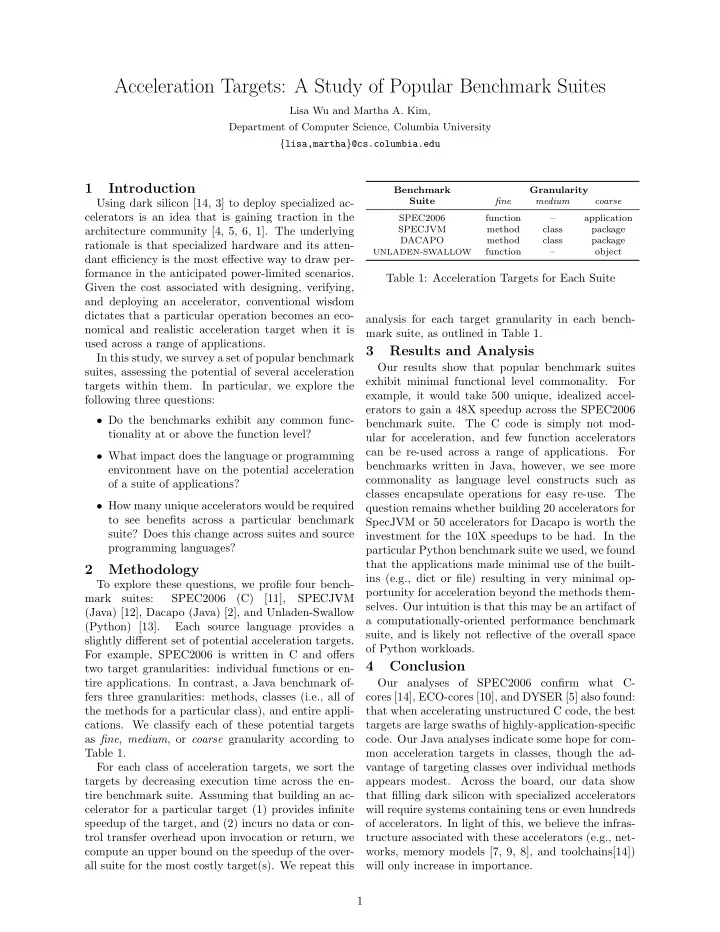
as fine, medium, or coarse granularity according to Table 1. For each class of acceleration targets, we sort the targets by decreasing execution time across the en- tire benchmark suite. Assuming that building an ac- celerator for a particular target (1) provides infinite speedup of the target, and (2) incurs no data or con- trol transfer overhead upon invocation or return, we compute an upper bound on the speedup of the over- all suite for the most costly target(s). We repeat this
Benchmark Granularity Suite fine medium coarse SPEC2006 function – application SPECJVM method class package DACAPO method class package
UNLADEN-SWALLOW
function –
- bject
Table 1: Acceleration Targets for Each Suite analysis for each target granularity in each bench- mark suite, as outlined in Table 1.
3 Results and Analysis
Our results show that popular benchmark suites exhibit minimal functional level commonality. For example, it would take 500 unique, idealized accel- erators to gain a 48X speedup across the SPEC2006 benchmark suite. The C code is simply not mod- ular for acceleration, and few function accelerators can be re-used across a range of applications. For benchmarks written in Java, however, we see more commonality as language level constructs such as classes encapsulate operations for easy re-use. The question remains whether building 20 accelerators for SpecJVM or 50 accelerators for Dacapo is worth the investment for the 10X speedups to be had. In the particular Python benchmark suite we used, we found that the applications made minimal use of the built- ins (e.g., dict or file) resulting in very minimal op- portunity for acceleration beyond the methods them-
- selves. Our intuition is that this may be an artifact of
a computationally-oriented performance benchmark suite, and is likely not reflective of the overall space
- f Python workloads.
4 Conclusion
Our analyses of SPEC2006 confirm what C- cores [14], ECO-cores [10], and DYSER [5] also found: that when accelerating unstructured C code, the best targets are large swaths of highly-application-specific
- code. Our Java analyses indicate some hope for com-
mon acceleration targets in classes, though the ad- vantage of targeting classes over individual methods appears modest. Across the board, our data show that filling dark silicon with specialized accelerators will require systems containing tens or even hundreds
- f accelerators. In light of this, we believe the infras-
tructure associated with these accelerators (e.g., net- works, memory models [7, 9, 8], and toolchains[14]) will only increase in importance. 1