ACCOMMODATION YOUR GUIDE TO THE REASONABLE ACCOMMODATION PROCESS - - PowerPoint PPT Presentation

accommodation
SMART_READER_LITE
LIVE PREVIEW

ACCOMMODATION YOUR GUIDE TO THE REASONABLE ACCOMMODATION PROCESS - - PowerPoint PPT Presentation

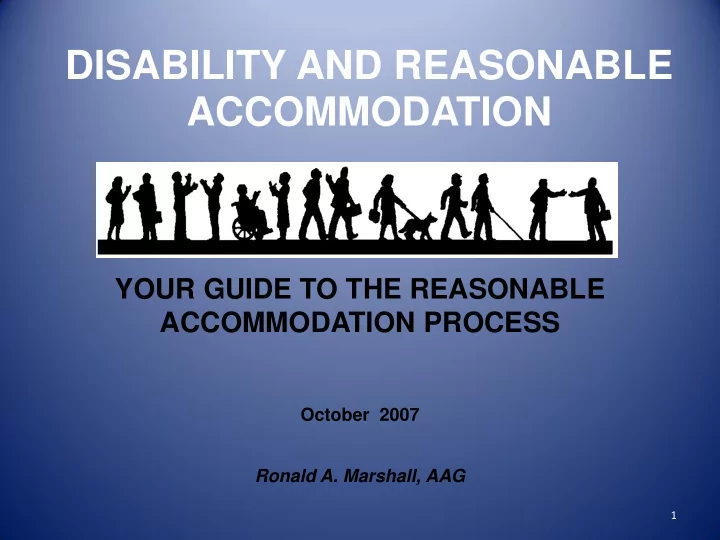
DISABILITY AND REASONABLE ACCOMMODATION YOUR GUIDE TO THE REASONABLE ACCOMMODATION PROCESS October 2007 Ronald A. Marshall, AAG 1 Americans with Disabilities Act (ADA) & Washington Law Against Discrimination (WLAD) Prohibit

slide-1
SLIDE 1

DISABILITY AND REASONABLE ACCOMMODATION

YOUR GUIDE TO THE REASONABLE ACCOMMODATION PROCESS

October 2007 Ronald A. Marshall, AAG

1

slide-2
SLIDE 2

Americans with Disabilities Act (ADA) & Washington Law Against Discrimination (WLAD)

  • Prohibit discrimination against disabled persons; persons

having a history of being disabled; and persons perceived as being disabled.

  • Require employers to reasonably accommodate the known

limitations of a qualified individual with a disability.

  • Restrict disability-related inquires and medical

examinations in the pre-offer, post-offer, and employment stages

2 Reasonable Accommodation Training

slide-3
SLIDE 3

Definition of Disability

Under the WLAD – Chapter 49.60 RCW

  • The presence of a sensory, mental or physical impairment

that is medically cognizable or diagnosable; or exists as a record or history; or is perceived to exist whether or not it exists in fact.

  • A disability exists whether it is temporary or permanent,

common or uncommon, mitigated or unmitigated, or whether or not it limits the ability to work generally or work at a particular job.

  • No specific exclusions in the statute.

Reasonable Accommodation Training 3

slide-4
SLIDE 4

Definition of Disability

Under the ADA (1) A physical or mental impairment that substantially limits one or more major life activities; or (2) A record of such impairment; or (3) Being regarded as having such impairment. Short-term and minor conditions are likely not disabilities under the ADA because they are generally not substantially limiting to major life activities. The list of impairments and major life activities is growing almost daily under federal case law Specific Exclusions:

  • The ADA contains specific exclusions such as drug use, transvestitism,

transsexuality, exhibitionism, voyeurism, kleptomania, compulsive gambling, and pyromania.

4 Reasonable Accommodation Training

slide-5
SLIDE 5

IMPAIRMENTS

  • Any physiological disorder or condition, cosmetic

disfigurement, or anatomical loss affecting the following body systems:

  • Neurological
  • Musculoskeletal
  • Special sense organs
  • Respiratory, including speech organs
  • Cardiovascular
  • Reproductive
  • Digestive
  • Genitor-urinary
  • Hemic
  • Lymphatic
  • Endocrine
  • Skin

5 Reasonable Accommodation Training

slide-6
SLIDE 6

IMPAIRMENTS

  • Also includes any mental, developmental, traumatic, or

psychological disorders including, but not limited to:

  • Cognitive limitations
  • Organic brain syndrome, emotional or mental illness
  • Specific learning disabilities

6 Reasonable Accommodation Training

slide-7
SLIDE 7

Character or physical traits may not be disabilities.

Simple physical characteristics

  • hair color
  • weight — within normal range

Physical conditions

  • normal pregnancy
  • predisposition to disease

Personality traits

  • poor judgment
  • quick temper
  • Irritability

HOWEVER, characteristics and traits may be disabilities if they result from a physiological condition. For example, it may be necessary to provide reasonable accommodations that minimize an employee’s exposure to stress when an employee’s Multiple Sclerosis is exacerbated by stress.

7 Reasonable Accommodation Training

slide-8
SLIDE 8

REGARDED AS HAVING AN IMPAIRMENT

  • Focus is on the employer’s perception of the individual.
  • The individual has no impairment but is treated as if they are

impaired.

  • Impairment does not substantially limit the employee’s ability to

perform the functions of their position, but the employer perceives it to substantially limit performance of job functions.

  • Impairment is only limiting because of the attitudes of others.
  • This type of claim is becoming more and more common.
  • Lack of knowledge about an employee’s impairment or alleged

impairment is helpful to the employer’s defense.

8 Reasonable Accommodation Training

slide-9
SLIDE 9

RECORD OF AN IMPAIRMENT

  • Protection for individuals who have a history of a disability or

who have been either classified or misclassified as having a disability.

  • Traditionally, these claims were less common, but are growing

in number.

  • Becomes more important in cases where the impairment has been

mitigated.

  • EEOC has instructed its investigators to examine whether an employee

has a record of a disability for the period before the employee began using mitigating measures.

  • Most courts agree that the employer must have knowledge of

the record.

9 Reasonable Accommodation Training

slide-10
SLIDE 10

Qualified Individual with a Disability

Can perform the essential functions of the job with or without a reasonable accommodation. Satisfies the requisite skill, experience, education, and

  • ther job-related requirements of the employment

position. An individual may be required to have basic licenses or certifications required for a job, BUT they must truly be necessary to perform the job.

10 Reasonable Accommodation Training

slide-11
SLIDE 11

Types of Claims

  • Disparate Treatment
  • When the employer discharges, reassigns, or

harasses an employee because of the disability.

  • The employee must show that they have a

disability, they were subject to an adverse employment action, were doing satisfactory work, discharged under circumstances that raise a reasonable inference of unlawful discrimination.

11 Reasonable Accommodation Training

slide-12
SLIDE 12

Types of Claims

  • Failure to Accommodate
  • When the employer fails to reasonably

accommodate an employee with a disability.

  • The employee must show that:
  • they have a disability,
  • the disability either currently, or will in the

future substantially limit their ability to perform their job,

  • put the employer on notice of the disability,
  • were qualified to perform the essential

functions of the position in question,

  • employer failed to reasonably accommodate.

12 Reasonable Accommodation Training

slide-13
SLIDE 13

Types of Claims

  • Hostile Work Environment
  • The employee must show:
  • They are disabled
  • The harassment was unwelcome
  • The harassment affected the terms and

conditions of employment

  • The harassment was imputable to the employer
  • The employer authorized, knew, or should

have known of the harassment and failed to take reasonably prompt and adequate corrective action.

13 Reasonable Accommodation Training

slide-14
SLIDE 14

Reasonable Accommodation

RCW 49.60.040 (25)

  • To qualify for reasonable accommodation in employment under the WLAD, the

impairment must be shown through the interactive process to exist in fact and:

  • The impairment must have a substantially limiting effect upon the individual’s

ability to perform their job, apply and be considered for the job, or access to equal pay, benefits, or terms and conditions of employment OR

  • The employee has put the employer on notice of the impairment and medical

documentation establishes the reasonable likelihood that engaging in job functions without an accommodation would aggravate the impairment to the extent that it would create a substantially limiting effect.

  • There must be a medical nexus between the disability and the need for

accommodation.

14 Reasonable Accommodation Training

slide-15
SLIDE 15

Reasonable Accommodation

Reasonable accommodations are adjustments or changes to a job or work environment, policy, procedure or practice that allows a qualified individual with a disability equal employment opportunity. Reasonable accommodations generally involve the removal of workplace barriers to successful accomplishment of job tasks. Reasonable Accommodations are required to:

  • Provide access to the recruitment and application process.
  • Allow an employee with a disability to perform the essential functions
  • f the job.
  • Ensure that employees have an equal opportunity to participate in and

benefit from the benefits and privileges of employment.

15 Reasonable Accommodation Training

slide-16
SLIDE 16

Requesting Reasonable Accommodations

Generally, the individual informs the employer that she/he has:

  • An impairment.
  • A need for an adjustment or change at work because of the

impairment. Requests DO NOT have to:

  • Be made by the individual employee.
  • Include medical or legal terms.
  • Be in writing.

Reasonable Accommodation Training 16

slide-17
SLIDE 17

Requesting Reasonable Accommodations

  • Under Washington law, the duty of an employer

to reasonably accommodate an employee’s disability does not arise until the employer is “aware of the employee’s disability and physical limitations.” Unlike the general ADA rule, the Washington notice requirement does not necessarily require the employee to request an accommodation in order for the employer’s duty to accommodate to arise.

Reasonable Accommodation Training 17

slide-18
SLIDE 18

Requesting Reasonable Accommodations (continued)

  • In order to satisfy the “notice” element, an

employee is not required to tell the employer about the full nature and extent of the disability,

  • nly that a disability requiring accommodation
  • exists. Once the employee has met his or her

burden of providing the employer with notice of the disability, the employer is required to take positive steps to accommodate the disability. As long as the employer is on notice that an employee suffers from a serious medical condition, the employer has a legal duty to begin the interactive process.

Reasonable Accommodation Training 18

slide-19
SLIDE 19

Interactive Reasonable Accommodation Process

―How can we help you?‖ Following the request for a reasonable accommodation, the employer engages the individual in an informal interactive process to.

  • Obtain documentation (if needed) to verify the individual has the claimed

impairment, and/or there is a medical nexus between the disability and the requested accommodation.

  • Determine the essential functions of the particular job involved.
  • Identify workplace barriers related to the impairment, and the individual’s

specific abilities.

  • Identify possible accommodations and evaluate each for effectiveness.
  • If more than one effective accommodation exists:

1)Consider the preference of the individual. 2)Select the accommodation that best serves the needs of the individual and the employer.

  • Document the process at every stage.

Reasonable Accommodation Training 19

slide-20
SLIDE 20

Medical Inquiries and Examinations

Pre-Offer (Recruitment/Application)

  • General Prohibition – even if job related
  • Exceptions

1) Requests for reasonable accommodation. 2) Individual self-discloses disability. 3) Obvious disability. Post-Offer Stage (After conditional offer of employment)

  • Unrestricted with limitations -

1) Same inquiries made to all selected candidates for the job class 2) Limits on how information is used. Employment

  • Limited
  • Exceptions

1) Requests for reasonable accommodation. 2) Determine if a reasonable accommodation is needed

Reasonable Accommodation Training 20

slide-21
SLIDE 21

Pre–Offer Recruitment/Application

All hiring decisions should be based on an applicant’s qualifications for the position. Never ask questions that elicit, or could likely elicit, information about the existence, nature, severity or duration of a disability even if those questions are job related. Pre-Offer Questions - Permitted, when asked of all applicants

  • May state the physical and mental requirements of the job.
  • Can you perform the essential functions of the job?
  • Please describe or demonstrate how you would perform an essential function of the

job?

  • How many days were you absent from work last year?

Permitted when an applicant has a known disability or has self-disclosed his/her disability:

  • Please describe or demonstrate how you would perform (name specific essential

function).

  • Please describe the types of accommodations you may need to perform (name

specific essential function).

Reasonable Accommodation Training 21

slide-22
SLIDE 22

What questions can you ask during a Job Interview?

If the following questions were asked of all applicants, which questions would be prohibited because they are disability related? Mark Y if you can ask the question, and N if the question is prohibited. 1. Y N Can you perform any or all job functions, with or without reasonable accommodation? 2. Y N Do you need a reasonable accommodation to perform any of the duties of the job? 3. Y N Briefly describe any relevant work history and education. 4. Y N Can you meet the attendance requirements for this job?

  • 5. Y N How many days were you absent from your last job?
  • 6. Y N

How many days were you sick last year?

  • 7. Y N How many Mondays or Fridays were you absent last year other than on authorized

leave?

  • 8. Y N Do you have a physical condition that prevents you from lifting 40 lbs?

Reasonable Accommodation Training 22

slide-23
SLIDE 23

9. Y N Do you have a medical condition that affects your regular attendance at work? 10. Y N Please list any prescription drugs you are currently taking. 11. Y N Have you used illegal drugs during the past six- months? 12. Y N How often do you use illegal drugs? 13. Y N Have you ever experienced black-outs while drinking? 14. Y N Demonstrate how you would use a computer to display the following statistical data. 15. Y N Do you have a physical condition that prevents you from lifting 40 lbs?

Reasonable Accommodation Training 23

slide-24
SLIDE 24

Post Conditional Job Offer

  • Conditional

Job Offer: Only extended after candidate has met all prerequisites for the desired position. All non-medical inquiries should be complete at this point.

  • Medical Inquiries/Examinations: No restrictions as long as required of all

selected candidates in the job class.

  • Rescind a Conditional Job Offer: It is the agency’s burden to demonstrate

that the reason for rescinding the offer was job related and consistent with business necessity and candidate could not be reasonably accommodated.

  • In
  • rder

to ask disability-related questions and conduct medical examinations, the offer must be a ―real‖ offer of employment. An offer is ―real‖ if the employer has completed all non-medical components of the application process that it reasonably could have completed and analyzed prior to giving the offer.

Reasonable Accommodation Training 24

slide-25
SLIDE 25

Current Employee Inquiries

  • An employer may ask disability-related questions and request

medical examinations only if they are job-related and consistent with business necessity.

  • Employer must have a reasonable belief, based on objective

evidence that:

  • An employee’s ability to perform essential job functions will be

impaired by a medical condition; or

  • An employee will pose a direct threat due to a medical condition.

Purpose is to verify that the:

  • Individual has the disability claimed and/or
  • Disability necessitates the requested accommodation.

DO NOT request medical information if:

  • Disability is obvious
  • Need for accommodation is apparent or
  • Agency already has sufficient documentation.

Reasonable Accommodation Training 25

slide-26
SLIDE 26

Independent Medical Examination

  • An IME may be used for permissible medical inquiries when the

employee has no treating physician or when the documentation from the employee’s treating physician is insufficient.

  • IME is at the employer’s expense.

Reasonable Accommodation Training 26

slide-27
SLIDE 27

Confidential Information

Disability-related information includes:

  • Documentation from a health care professional.
  • Information volunteered by the employee/applicant.
  • Information about the reasonable accommodation process.

Employer’s responsibilities include:

  • Contacting, corresponding with, and receiving information from

health care professionals.

  • Maintaining medical information in a secure manner apart from

personnel files.

  • Disseminating confidential information on a need-to-know basis.

Reasonable Accommodation Training 27

slide-28
SLIDE 28

Confidential Medical Records

Reasonable Accommodation Training 28

Who What Supervisor Restrictions on work or duties, and provisions of reasonable accommodation. First Aid/Safety Person Possible emergency treatment related to disability. Government Investigators Documents or data regarding compliance with state and federal laws.

Who needs to know what?

slide-29
SLIDE 29

Confidential Medical Records

  • Only tell other employees that the employer is complying with

federal and state law.

  • Do not under any circumstances discuss the disability or medical

information.

  • All medical information should be maintained with Human

Resources and not in a “working” or “supervisory” file.

  • Any documentation concerning an employee’s disability should be

forwarded to Human Resources for inclusion in a reasonable accommodation file.

Reasonable Accommodation Training 29

slide-30
SLIDE 30

Essential Functions

Essential Functions – What:

  • Fundamental job duties of the position.
  • The term does NOT include marginal functions of the position.
  • A function may be essential because:
  • The position exists to perform that function;
  • There are a limited number of employees available who could perform

that function;

  • The function is highly specialized.

Essential Functions – When:

  • If a reasonable accommodation is being considered essential

functions MUST be identified.

  • As a best practice, essential functions should be identified: i.)

when a position is established; ii.) while a position is vacant; iii.) prior to interviewing; iv.) prior to any conditional offer medical examinations.

Reasonable Accommodation Training 30

slide-31
SLIDE 31

Determining Essential Functions

Essential functions are WHAT the completed task is, not HOW the task is completed. An essential function must really be a function, not merely a way of performing a function.

  • Criteria to consider:
  • Employer’s judgment.
  • Written job description.
  • Most important piece of evidence.
  • Amount of time spent performing the function/consequences of

not performing the function.

  • Collective bargaining agreement.
  • Work experience of both past and current incumbents.

Reasonable Accommodation Training 31

slide-32
SLIDE 32

Essential Functions – General

Common Issues:

  • Percentage allocations for determining essential functions is not

good practice.

  • Employment decisions based on essential functions must be based
  • n the applicant’s current ability to perform the essential functions,

not their ability at some point in the future.

Other Relevant Standards: Eligibility Criteria: Education, experience, skills, licenses, certificates, etc. Conduct Standards: Violence, threat of violence, theft, destruction

  • f property, dress, interaction with peers and/or customers, etc.

Performance/productivity Standards: Quality and quantity of work.

Reasonable Accommodation Training 32

slide-33
SLIDE 33

Essential Functions – General

Below are functions that are NOT always essential.

  • Attendance
  • Schedules
  • Overtime
  • Lifting
  • Supervising
  • Standing
  • Ability to travel

Reasonable Accommodation Training 33

slide-34
SLIDE 34

What are Reasonable Accommodations?

Reasonable Accommodations are adjustments or changes to a job or work environment, policy, procedure or practice that allows a qualified individual with a disability an equal employment

  • pportunity.

Focus is on what is accomplished, not how it is accomplished. Obligation to provide reasonable accommodation:

  • Affects all candidates for employment and current employees.
  • Is ongoing and may arise any time a qualified individual’s disability

changes or the duties of the job change.

  • Applies to all aspects of the job, including recruitment, application,

hiring, firing, training, etc.

Reasonable Accommodation Training 34

slide-35
SLIDE 35

Reasonable Accommodations

Examples of what might not be reasonable accommodations:

  • Eyeglasses
  • Hearing aids
  • Wheelchairs
  • Personal assistants

Types of reasonable accommodations related to job performance:

  • Job Restructuring
  • Leave
  • Modified or part-time schedule
  • Modified workplace policies
  • Reassignment – the accommodation of last resort

Reasonable Accommodation Training 35

slide-36
SLIDE 36

RA – Job Restructuring

Job restructuring includes modifications such as:

  • Reallocating or redistributing marginal job functions that an

employee is unable to perform because of a disability, and

  • Altering when and/or how a function, essential or marginal, is

performed.

An employer never has to reallocate essential functions as a reasonable accommodation, but can do so if it wishes. An employer may switch the marginal functions of two (or more) employees in order to restructure a job as reasonable accommodation.

Reasonable Accommodation Training 36

slide-37
SLIDE 37

RA - Leave

Permitting the use of paid or unpaid leave may be a reasonable

  • accommodation. Granting shared leave may also be a reasonable

accommodation and should be documented as such. Examples of reasons an employee with a disability may require leave:

  • Obtaining medical treatment (e.g., surgery, psychotherapy,

substance abuse treatment, or dialysis); rehabilitation services; or physical or occupational therapy.

  • Recuperating from an illness or an episodic manifestation of the

disability.

  • Obtaining repairs on a wheelchair, accessible van, or prosthetic

device.

  • Avoiding temporary adverse conditions in the work environment

(for example, an air- conditioning breakdown causing unusually warm temperatures that could seriously harm an employee with multiple sclerosis).

Reasonable Accommodation Training 37

slide-38
SLIDE 38

Reasonable Accommodation Training 38

RA - Leave

  • Training a service animal (e.g., a guide dog) or
  • Receiving training in the use of Braille or to learn sign

language. Keep in mind that there may be overlapping disability and FMLA / WFLA issues. Granting FMLA / WFLA leave, either for a period of time or on an intermittent basis, may be a reasonable

  • accommodation. If so, be sure it is documented as such.

With regard to an employee on approved FMLA, remember that:

  • You may not communicate with the employee’s health care

provider about the employee’s need for FMLA. (There may be an exception for suspected leave abuse).

  • An employee on approved intermittent FMLA may not be

placed on medical verification for FMLA absences.

slide-39
SLIDE 39

RA – Modified or Part-Time Schedule

An employer may consider a modified or part-time schedule when required as a reasonable

  • accommodation. A modified schedule may involve:
  • Adjusting arrival or departure times.
  • Providing periodic breaks.
  • Altering when certain functions are performed.
  • Allowing an employee to use accrued paid leave.
  • Or providing additional unpaid leave.

Reasonable Accommodation Training 39

slide-40
SLIDE 40

RA – Modified Workplace Policies

It is a reasonable accommodation to modify a workplace policy when necessitated by an individual’s disability-related limitations. Examples include, but are not limited to:

  • Dress code.
  • Hours of work.
  • Animals in the workplace.

Reasonable Accommodation Training 40

slide-41
SLIDE 41

RA - Reassignment

Reassignment to a vacant position must be provided to an employee who:

  • Can no longer perform the essential functions of his/her

current position, with or without reasonable accommodation.

  • Is “qualified” for the new position.

Vacant means that the position is available when the individual asks for reasonable accommodation, or will become available within a reasonable amount of time. Reassignment is the accommodation of last resort.

Reasonable Accommodation Training 41

slide-42
SLIDE 42

Defenses for not providing a Reasonable Accommodation

  • Individual does not have an impairment.
  • Individual’s impairment does not substantially limit their

ability to perform their job – either currently or in the future.

  • Individual is not a qualified individual with a disability.
  • No effective accommodations.
  • Only effective accommodation poses an undue hardship.

Reasonable Accommodation Training 42

slide-43
SLIDE 43

Undue Hardship

  • Undue hardship is defined as something that is unduly costly or

extensive or disruptive or fundamentally alters the nature or operation

  • f the agency.
  • Balance the cost vs. the benefit
  • Employer need only establish the undue hardship if it makes no

reasonable accommodation.

  • Factors considered from Wheeler v. Catholic Archdiocese, 65 Wn.App.

552 (1992), and WAC 162.22.075

  • Size of the employer’s business
  • Value of the employee’s work
  • Whether cost can be included in planned remodeling or maintenance
  • Requirements of other laws and contracts
  • Other appropriate considerations
  • Undue hardship is the defense of last resort and has a very high
  • threshold. This defense is rarely successful.

Reasonable Accommodation Training 43

slide-44
SLIDE 44

OBLIGATIONS AFTER DISABILITY SEPARATION

  • WAC 357-19-465 requires reemployment services to employees separated due to disability

for two years following separation.

  • WAC 357-19-470 provides examples of the assistance – this is not an exhaustive list!
  • WAC 357-19-475 provides eligibility requirements for the former employee in order to

qualify for the assistance.

  • WAC 357-46-095 provides eligibility to former permanent classified employees to

participate in the transition pool. This is an obligation separate from that in WAC 357-19- 465!

  • WLAD Requirements:
  • Under Wheeler v. Catholic Archdiocese of Seattle, 65 Wash. App. 552, 829 P.2d 196

(1992), as an accommodation, the employer has a duty toward a former disabled employee to inform them of job openings for which they might be qualified. This duty continues beyond the end of the employment relationship for a reasonable period of

  • time. The period of time is not imposed as a matter of law, but is for the trier of fact

to determine at what point continued attempts to accommodate became an undue burden as opposed to a reasonable accommodation.

  • Collective Bargaining Agreement

Reasonable Accommodation Training 44