Actors Origins Hewitt, early 1970s (1973 paper) Around the same - - PowerPoint PPT Presentation

actors
SMART_READER_LITE
LIVE PREVIEW

Actors Origins Hewitt, early 1970s (1973 paper) Around the same - - PowerPoint PPT Presentation

Actors for Reactive Programming Actors Origins Hewitt, early 1970s (1973 paper) Around the same time as Smalltalk Concurrency plus Scheme Agha, early 1980s (1986 book) Erlang (Ericsson), 1990s Akka, 2010s Munindar P. Singh


slide-1
SLIDE 1

Actors for Reactive Programming

Actors

Origins

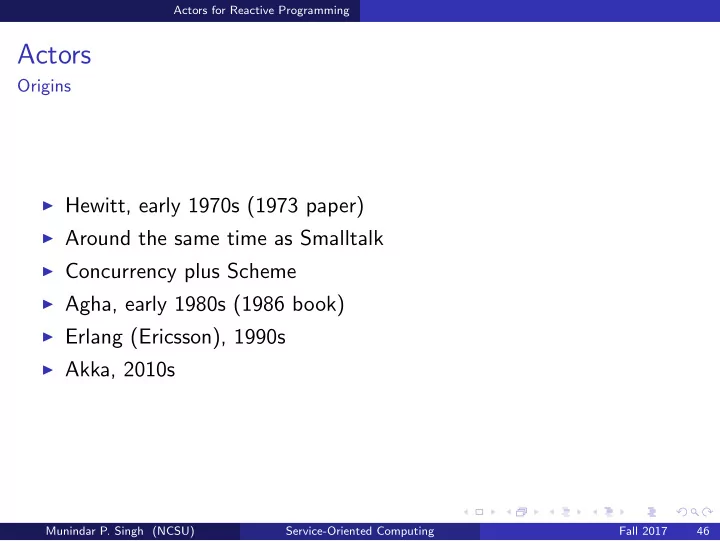
◮ Hewitt, early 1970s (1973 paper) ◮ Around the same time as Smalltalk ◮ Concurrency plus Scheme ◮ Agha, early 1980s (1986 book) ◮ Erlang (Ericsson), 1990s ◮ Akka, 2010s

Munindar P. Singh (NCSU) Service-Oriented Computing Fall 2017 46

slide-2
SLIDE 2

Actors for Reactive Programming

Actors: Way of Thinking

◮ Key idea: support for autonomy

◮ Designed for concurrency ◮ Equally good for distribution

◮ Shared nothing

◮ Style of thinking ◮ Architecture: no longer a single locus of control and storage ◮ Programming: reacting to events propagated via messages ◮ Eschew states, visibility of internal information, synchronization

primitives (locks)

◮ Forget threads as a programming abstraction—threads may implicitly

do the work but not to program them

◮ Messaging and no shared memory

◮ Resource management

◮ Start additional actors as needed for work and resources available ◮ Stop actors when not needed ◮ Migrate actors when needed, taking advantage of a universal actor

reference

◮ Handle exceptions through monitoring and supervision Munindar P. Singh (NCSU) Service-Oriented Computing Fall 2017 47
slide-3
SLIDE 3

Actors for Reactive Programming

Actor Basics

◮ An actor

◮ Encapsulates local state (memory)—hence, the state may not be

directly accessed from outside an actor

◮ Encapsulates a thread ◮ Mailbox (incoming) ◮ Processed in order of arrival, though could be reordered (e.g.,

PriorityMailbox)

◮ ActorRef: globally unique ID (serializable) ◮

◮ To create an actor class in Akka,

◮ Extend appropriate abstract class (or, in Scala, trait) ◮ Define a receive method ◮ Define corresponding Props configuration class Munindar P. Singh (NCSU) Service-Oriented Computing Fall 2017 48

slide-4
SLIDE 4

HelloAkkaJava.java (Messages)

p u b l i c c l a s s HelloAkkaJava { //MPS: The f i r s t message i s Greet ; i t has no parameters ; i t s // expected

  • utcome

i s to send a g r e e t i n g p u b l i c s t a t i c c l a s s Greet implements S e r i a l i z a b l e {} //MPS: The second message i s WhoToGreet ; i t has

  • ne

parameter , // the t a r g e t

  • f

the g r e e t i n g ; i t s expected

  • utcome

i s f o r // the r e c i p i e n t to change the t a r g e t p u b l i c s t a t i c c l a s s WhoToGreet implements S e r i a l i z a b l e { p u b l i c f i n a l S t r i n g who ; p u b l i c WhoToGreet ( S t r i n g who) { t h i s . who = who ; } } //MPS: The t h i r d message i s G r e e t i n g ; i t has

  • ne

parameter , the // g r e e t i n g message ; i t i s a message to be sent p u b l i c s t a t i c c l a s s G r e e t i n g implements S e r i a l i z a b l e { p u b l i c f i n a l S t r i n g message ; p u b l i c G r e e t i n g ( S t r i n g message ) { t h i s . message = message ; } }

Munindar P. Singh (NCSU) Service-Oriented Computing Fall 2017 49

slide-5
SLIDE 5

HelloAkkaJava.java (Actor)

p u b l i c s t a t i c c l a s s G r e e t e r extends AbstractActor { S t r i n g g r e e t i n g = ””; // i n t e r n a l s t a t e

  • f

the a c t o r @Override //MPS: Mapping

  • f

messages to b e h a v i o r s . This s n i p p e t // handles the two incoming messages ; i t doesn ’ t mention // the

  • utgoing

message ( G r e e t i n g ) p u b l i c Receive c r e a t e R e c e i v e ( ) { r e t u r n r e c e i v e B u i l d e r ( ) . match ( WhoToGreet . c l a s s , t h i s : : onWhoToGreet ) . match ( Greet . c l a s s , t h i s : : onGreet ) . b u i l d () ; } // MPS: Update i n t e r n a l s t a t e

  • n

r e c e i v i n g a WhoToGreet message p r i v a t e void

  • nWhoToGreet ( WhoToGreet whoToGreet )

{ g r e e t i n g = ” h e l l o , ” + whoToGreet . who ; } // MPS: Send g r e e t i n g message

  • n

r e c e i v i n g a Greet message p r i v a t e void

  • nGreet ( Greet

g r e e t ) { // Send the c u r r e n t g r e e t i n g back to the sender getSender () . t e l l ( new G r e e t i n g ( g r e e t i n g ) , g e t S e l f () ) ; } }

Munindar P. Singh (NCSU) Service-Oriented Computing Fall 2017 50

slide-6
SLIDE 6

HelloAkkaJava.java (Main 1)

p u b l i c s t a t i c void main ( S t r i n g [ ] args ) { t r y { // Create the helloAkka a c t o r system and the g r e e t e r a c t o r f i n a l ActorSystem system = ActorSystem . c r e a t e (” helloAkka ”) ; f i n a l ActorRef g r e e t e r = system . actorOf ( Props . c r e a t e ( G r e e t e r . c l a s s ) , ” g r e e t e r ”) ; // MPS: The inbox ( apparent misnomer ) f u n c t i o n s as an a c t o r to // communicate with a c t o r s ; s o r t

  • f

a ”main” f o r a c t o r s to use // as a p l a c e f o r send and r e c e i v e f i n a l Inbox inbox = Inbox . c r e a t e ( system ) ; // T e l l the g r e e t e r to change i t s ’ g r e e t i n g ’ message g r e e t e r . t e l l ( new WhoToGreet (” akka ”) , ActorRef . noSender ( ) ) ; // Ask f o r the c u r r e n t g r e e t i n g ; r e p l y to go to inbox inbox . send ( g r e e t e r , new Greet () ) ; // Wait 5 seconds f o r the r e p l y with the ’ g r e e t i n g ’ message f i n a l G r e e t i n g g r e e t i n g 1 = ( G r e e t i n g ) inbox . r e c e i v e ( Duration . c r e a t e (5 , TimeUnit .SECONDS) ) ; System . out . p r i n t l n (” G r e e t i n g

  • ne :

” + g r e e t i n g 1 . message ) ;

Munindar P. Singh (NCSU) Service-Oriented Computing Fall 2017 51

slide-7
SLIDE 7

HelloAkkaJava.java (Main 2)

// I n i t i a l l y a f t e r seconds , send a Greet message e v e r y second to the g r e e t e r ; Spoof sender as G r e e t P r i n t e r ( new Actor below ) f i n a l ActorRef g r e e t P r i n t e r = system . actorOf ( Props . c r e a t e ( G r e e t P r i n t e r . c l a s s ) ) ; system . s c h e d u l e r ( ) . s c h e d u l e ( Duration . Zero ( ) , Duration . c r e a t e (1 , TimeUnit .SECONDS) , g r e e t e r , new Greet ( ) , system . d i s p a t c h e r () , g r e e t P r i n t e r ) ; } catch ( TimeoutException ex ) { System . out . p r i n t l n (” Got a timeout w a i t i n g f o r r e p l y from an a c t o r ”) ; ex . p r i n t S t a c k T r a c e ( ) ; } } p u b l i c s t a t i c c l a s s G r e e t P r i n t e r extends AbstractActor { @Override p u b l i c Receive c r e a t e R e c e i v e ( ) { r e t u r n r e c e i v e B u i l d e r ( ) . match ( G r e e t i n g . c l a s s , ( g r e e t i n g ) − > System . out . p r i n t l n ( g r e e t i n g . message ) ) . b u i l d () ; } } }

Munindar P. Singh (NCSU) Service-Oriented Computing Fall 2017 52

slide-8
SLIDE 8

Actors for Reactive Programming

The Receive Method

◮ A reaction rule for each type of message to be handled ◮ In Akka, the set of rules must be exhaustive in that all other messages

will publish an UnhandledMessage to the ActorSystem’s EventStream

◮ Best practice is to include a default rule (using matchAny in Java)

for unexpected messages

◮ Good practice to

◮ Separately describe the allowed message types, e.g., as static classes in

Java

◮ Write each message’s handler as a separate little method

◮ An actor’s receive method

◮ A (partial) function object stored within the actor

◮ Hot swapping the receive: Avoid unless essential

◮ Changed through context.become method ◮ Alternative: push new behavior and use unbecome to post Munindar P. Singh (NCSU) Service-Oriented Computing Fall 2017 53

slide-9
SLIDE 9

Actors for Reactive Programming

Messages

◮ Immutable objects

◮ Not enforced by Java, so beware

◮ No delivery guarantees, pairwise FIFO

◮ May be lost ◮ May be duplicated ◮ Option to ensure at least once delivery

◮ Pairwise FIFO

◮ If ◮ An actor A sends two messages to actor B and ◮ Both messages arrive ◮ Then ◮ They arrive in order

◮ Messages to same recipient from distinct originating actors are

unrelated

◮ May be arbitrarily interleaved

◮ If your application requires some assumptions of delivery

◮ Verify them yourself: use acknowledgments ◮ Achieve them yourself: use retries Munindar P. Singh (NCSU) Service-Oriented Computing Fall 2017 54

slide-10
SLIDE 10

Actors for Reactive Programming

Messages: Programming

◮ tell

◮ Asynchronous ◮ Send message and return immediately ◮ Preferable to maximize decoupling

◮ ask

◮ Asynchronous ◮ Send message and return a Future what will contain the reply ◮ Greater overhead in maintaining the context than for tell

Timeout t = new Timeout ( Duration . c r e a t e (5 , TimeUnit .SECONDS) ) ; CompletableFuture <Object> f u t u r e 2 = ask ( actorB , ” another r e q u e s t ” , t ) . toCompletableFuture () ; ◮ The CompletableFuture class supports joining futures, piping, and

so on

Munindar P. Singh (NCSU) Service-Oriented Computing Fall 2017 55

slide-11
SLIDE 11

Actors for Reactive Programming

ActorSystem

/ root (and its guardian or supervisor) /user user space (and its guardian or supervisor), called Guardian /system system space (and its guardian or supervisor)

◮ Any actors we create are under /user, although we create actors

through

◮ system.actorOf: children (called “top-level” actors) of /user ◮ context.actorOf: their descendants (all levels)

◮ Every actor has a parent or supervisor in whose scope it is created ◮ Stopping an actor: recursively: children first; then self

◮ getContext().stop(child) ◮ getContext().stop(getSelf()) ◮ PoisonPill message to stop an actor in its tracks after the previously

arrived (enqueued) messages are processed

Munindar P. Singh (NCSU) Service-Oriented Computing Fall 2017 56

slide-12
SLIDE 12

Actors for Reactive Programming

Exceptions

◮ Current message

◮ Already removed from mailbox and potentially lost ◮ Unless explicit action to save the message or process it again

◮ Mailbox

◮ Preserved, as remaining after the current message was removed ◮ Available to the restarted actor, if any

◮ Supervision: An exception throwing actor is suspended and control

passed to its supervisor

◮ The supervisor decides the fate of the actor

◮ Resume: back to where it was when the exception occurred ◮ Restart: reset its internal state to initial ◮ Stop: end it

◮ Akka provides a rich set of hooks through which to customize

behavior

◮ Pre and post of the major events ◮ Start, Stop, Restart ◮ For example, preRestart() Munindar P. Singh (NCSU) Service-Oriented Computing Fall 2017 57

slide-13
SLIDE 13

Actors for Reactive Programming

Exceptions: Supervisor Strategy

◮ No call stack to pass an exception

◮ Traditional idea doesn’t work ◮ Not clear which past or future caller should get the exception

◮ Therefore, pass to supervisor

◮ Can apply its strategy ◮ A couple of strategies are predefined

◮ One for One Strategy

◮ If a child (supervisee) actor produces an exception, deal with that actor

◮ All for One Strategy

◮ If the child actors are performing pieces of the same transaction and

those not throwing an exception may be affected

◮ Predefined (fixed set of) directives on how to deal with a spoiled child

◮ Resume ◮ Stop ◮ Restart ◮ Escalate Munindar P. Singh (NCSU) Service-Oriented Computing Fall 2017 58

slide-14
SLIDE 14

Exception Handling: Throwing

c l a s s MadeUpException (msg : S t r i n g ) extends Exception (msg) {} c l a s s JustBecauseException (msg : S t r i n g ) extends Exception (msg) {} c l a s s S u p e r v i s e e A c t o r ( i d : I n t ) extends Actor with ActorLogging { . . .

  • v e r r i d e

def r e c e i v e : Receive = { case S u p e r v i s e e A c t o r . F a i l = > log . i n f o ( s ” $ s e l f f a i l s now , i d e n t i f i e r = $ i d e n t i f i e r ; ActorRef = $ t h i s ”) throw new JustBecauseException ( s ” $ s e l f , i d e n t i f i e r = $ i d e n t i f i e r , upon r e c e i v i n g a F a i l message ”) case S u p e r v i s e e A c t o r . Nudge = > import u t i l . Random i f (Random . nextBoolean ( ) ) throw new MadeUpException ( s ” $ s e l f , i d e n t i f i e r = $ i d e n t i f i e r , random e f f e c t

  • n a Nudge message ”)

log . i n f o ( s ” $ s e l f r e c e i v e s nudge from $sender , i d e n t i f i e r = $ i d e n t i f i e r ; ActorRef = $ t h i s ”) } }

Munindar P. Singh (NCSU) Service-Oriented Computing Fall 2017 59

slide-15
SLIDE 15

Exception Handling: “Catching”

c l a s s S u p e r v i s o r A c t o r extends Actor with ActorLogging { . . . v a l c h i l d = context . actorOf ( . . . )

  • v e r r i d e

def r e c e i v e : Receive = { case S u p e r v i s o r A c t o r . F a i l C h i l d = > c h i l d ! S u p e r v i s e e A c t o r . F a i l case S u p e r v i s o r A c t o r . NudgeChild = > c h i l d ! S u p e r v i s e e A c t o r . Nudge }

  • v e r r i d e

v a l s u p e r v i s o r S t r a t e g y = OneForOneStrategy ( maxNrOfRetries = 1 , withinTimeRange = 5 second ) { case : A r i t h m e t i c E x c e p t i o n = > Resume case : N u l l P o i n t e r E x c e p t i o n = > R e s t a r t case : I l l e g a l A r g u m e n t E x c e p t i o n = > Stop case : IOException = > Stop case x : JustBecauseException = > { log . e r r o r ( s ” JustBecauseException

  • ccurred

f o r the most

  • utrageous

reason ;\ n< < <$x>>>\n R e s t a r t i n g ”) R e s t a r t } case : MadeUpException = > { log . e r r o r ( s ”MadeUpException

  • ccurred ;\ n Resuming ”)

Resume } case : Exception = > E s c a l a t e }

slide-16
SLIDE 16

Actors for Reactive Programming

End-to-End Principle

Popularized by Jerome Saltzer, David Reed, and David Clark

◮ Originally formulated for computer network protocols

◮ Usual examples pertain to error checking and performance ◮ A similar case could be made for encryption

◮ Applies to (distributed) computing more generally

◮ Any functionality that reflects application meaning must be verified at

the end points

◮ Such functionality ◮ Does not need to be provided in the interior of the network, because it

would need to be repeated at the end points

◮ Functionality that is not needed for a layer should not be provided in

that layer because it is

◮ Either superfluous—hence wastes resources ◮ Or is replicated—hence wastes resources

◮ In the case of actors

◮ Ignoring message reliability and ordering is wise ◮ But why not also discard pairwise FIFO Munindar P. Singh (NCSU) Service-Oriented Computing Fall 2017 61

slide-17
SLIDE 17

Actors for Reactive Programming

Actors and Protocols

Protocols to be introduced later

◮ Actors

◮ Separate business logic from infrastructure

◮ Protocols

◮ Separate reasoning from coordination

◮ Concordance: Protocols are geared for coordination of actor-like

computational entities

◮ Asynchronous (nonblocking) messaging ◮ Shared nothing representation of local state

◮ Complementarity

◮ Actors assume pairwise FIFO ◮ Actors lack a model of multiparty interactions ◮ Actors lack an explicit model of causality for messages ◮ Actors don’t provide an information model for messages ◮ Protocols deal with interactions; actors deal with computations that

can interact

Munindar P. Singh (NCSU) Service-Oriented Computing Fall 2017 62