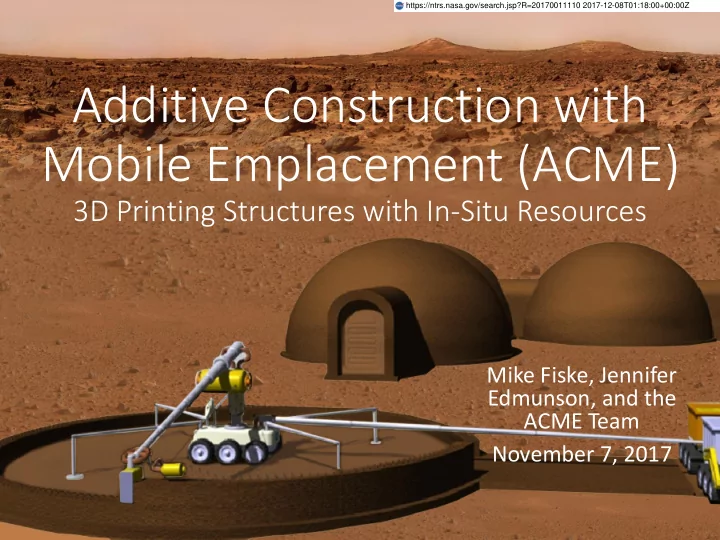
Additive Construction with Mobile Emplacement (ACME)
3D Printing Structures with In-Situ Resources
Mike Fiske, Jennifer Edmunson, and the ACME Team November 7, 2017
https://ntrs.nasa.gov/search.jsp?R=20170011110 2017-12-08T01:18:00+00:00Z
Additive Construction with Mobile Emplacement (ACME) 3D Printing - - PowerPoint PPT Presentation
https://ntrs.nasa.gov/search.jsp?R=20170011110 2017-12-08T01:18:00+00:00Z Additive Construction with Mobile Emplacement (ACME) 3D Printing Structures with In-Situ Resources Mike Fiske, Jennifer Edmunson, and the ACME Team November 7, 2017
Mike Fiske, Jennifer Edmunson, and the ACME Team November 7, 2017
https://ntrs.nasa.gov/search.jsp?R=20170011110 2017-12-08T01:18:00+00:00Z
Corporation (NR-SAA with Caterpillar)
Khoshnevis) beginning in 2004.
Arkansas in Little Rock, East Carolina University, and the Pacific International Space Center for Exploration Systems (PISCES) ACME-1 System
concrete or water-based binders
at MSFC by Dr.’s Sen and Edmunson
MSFC/UAH
for full-scale structures
that will help:
less than 2.5 tons
avoid becoming a target
to identify construction materials and techniques that do not require materials imported from the mainland. KSC is working closely with PISCES on this effort.
berms, landing pads, radiation shielding, etc. (Deep Space Mission Infrastructure)
(estimated savings between 60% and 90%)
Roadmap areas TA04, TA07, TA12
Undertook effort in 2005 to add a 3rd dimension of travel to allow fabrication of different
experimenting with different nozzle configurations. USC as-delivered “2-D” system in 2004 that translated in X & Z directions and head rotated, allowing for long, slender wall fabrication. Also undertook a significant effort to match concrete composition using COTS products that are different in Alabama from those in California (Portland cement, stucco, additives).
Completed conversion to “3-D” system, resolved composition issues, and began programming and printing various simple geometries. Experimented with translation rate vs concrete cure time and strength to
Focus was on converting from a “batch” system to a “continuous feed” system.
bonding from batch to batch
batches Removed extrusion chamber and plunger hardware, replaced with large mixer, continuous pump, accumulator, hoses, fittings, etc. Incorporated use of slump measurements and viscosity measurements (Germann Instruments) to characterize concrete properties/pump performance.
Gantry Mobility System (good x, y, z positioning) Mixer Pump Accumulator (allows pump to stay on when nozzle closes for doors/windows) Hose Nozzle Control System
Focus was on transition from sub-scale to full-scale. Issues included:
truck/boom arm vs robotic arm, etc)
volumes (Army Conex box or PLS) – 10,000 lbs/PLS
rate of up to 800 in3/min
printing
Dry Good Storage Subsystem Liquid Storage Subsystem
Continuous Feedstock Mixing Delivery Subsystem (CFDMS)
Dry Goods & Liquid Goods parked on side
Mixer Pump Hoses and Accumulator Gantry Nozzle
inadequately mix
size)
properly
air bubbles
concrete
vibration)
distribution
position (vertical and horizontal drops, kinks in hose)
structure
easy to use
dictate flowability and extrusion
(friction/ abrasion)
water, and a rheology control admixture
JSC Mars-1A simulant
environment
constraint in the materials we choose for additive construction
Parameter Mars Moon Gravity 1/3 that of Earth 1/6 that of Earth Pressure at surface 3-10 Torr (4x10⁻³ to 1x10⁻² ATM) 2x10-12 Torr (3x10-15 ATM) Surface Temperatures
Radiation (solar wind particles, galactic cosmic rays) Some protection offered by atmosphere Some protection offered by Earth’s magnetic field Surface reactivity Perchlorates (highly oxidizing) Reduced material (nanophase iron, elemental sulfur)
http://nssdc.gsfc.nasa.gov/planetary/planetfact.html
material in a pressurized or ambient environment
must place the material in compression (e.g., inverted aluminum can and/or regolith cover)
shielding materials
environment while withstanding heating/cooling of the interior
micrometeorites by design or material
exposed to water, oxygen, or carbon dioxide (unless a liner/skin is used)
interested in creating construction materials from basalt; all Portland cement, asphalt, etc. building material has to be brought in from the continental US.
Rock?
Mineral Other Materials Major minerals Present everywhere (“dew”) Feldspar (CaAl2Si2O8-(Na,K)AlSi3O8) Perchlorates (ClO4
Pyroxene ((Ca,Mg,Fe)Si2O6) Atmosphere Olivine ((Mg,Fe)2SiO4) CO2 (95.32%) Minor minerals N2 (2.7%) Hematite (Fe2O3) Ar (1.6%) Magnetite (Fe3O4) O2 (0.13%) Clays (Fe-Mg silicates, K-Al silicates) CO (0.08%) Sulfates (gypsum-Ca; jarosite-K,Fe; epsomite-Mg) H2O (210ppm) Carbonates (calcite-Ca, dolomite-Mg) NO (100ppm) Poles – solid CO2 (both) and H2O (northern pole)
Minerals Permanently Shadowed Regions Highlands (Major Minerals) LCROSS (ejected material)* Anorthite (CaAl2Si2O8) Regolith (~85%) Pyroxene ((Ca,Mg,Fe)Si2O6) CO (5.70%) Olivine ((Mg,Fe)2SiO4) H2O (5.50%) Mare (Major Minerals) H2 (1.39%) Feldspar (CaAl2Si2O8-(Na,K)AlSi3O8) H2S (0.92%) Pyroxene ((Ca,Mg,Fe)Si2O6) Ca (0.79%) Olivine ((Mg,Fe)2SiO4) Hg (0.48%) Minor / Trace Minerals NH3 (0.33%) Baddeleyite (Zr oxide) Mg (0.19%) Apatite (Ca phosphate) SO2 (0.18%) Zircon (Zr, Si oxide) C2H4 (0.17%) Spinel (metal oxide) CO2 (0.12%) Ilmenite (Fe, Ti oxide) CH3OH (0.09%) Whitlockite (Ca phosphate) CH4 (0.04) Troilite (Fe sulfide) OH (0.002%) Other phase of note – nanophase iron
* Larson et al. (2013)
regolith; not require a very precise mix
produce from in-situ resources
loose regolith when possible)
with lunar simulant (R. Grugel, H. Toutanji)
Sample prep in 4739 Test in 4602
Sample prep in 4711 and 4464 Test in 4602
2.54cm molds
Martian simulant JSC Mars-1A, stucco mix, Portland cement, and water Martian simulant JSC Mars-1A, MgO-MKP cement, boric acid (set retardant*) and water – sample fractured during shipping to JSC prior to testing Lunar simulant JSC-1A, stucco mix, Portland cement, and water
*Set retardant used because this cement sets up very quickly and would solidify within the ACME system prior to extrusion
Martian simulant JSC Mars-1A, stucco mix, Portland cement, rheology control admixture, and water
25.40cm tall, 76.20cm long, 5.72cm thick wall 2 vertical layers and 2 horizontal layers printed per day; material was allowed to dry between prints
Martian simulant JSC Mars-1A, stucco mix, Portland cement, rheology control admixture, and water
Sample delaminated during shipping to JSC on a boundary between prints made on different days
performed at the White Sands Test Facility in Las Cruces, NM
caliber light gas gun, 0° impact angle, 1Torr N2 in chamber during test
velocity of micrometeorites at the surface of Mars, and higher than expected velocity for bullets on Earth)
density of 1g/cm3 and a diameter of 0.1mm traveling at a velocity of 10.36km/s, as well as a 9x17mm Browning Short bullet.
JSC Mars-1A Portland cement Stucco Mix Water JSC Mars-1A Portland cement Stucco Mix Admixture (Rheology Control) Water
Photos courtesy of the Johnson Space Center Hypervelocity Impact Technology Group
JSC Mars-1A Sorel cement (MgO + MKP) Boric Acid (Set Retardant) Water JSC-1A Portland cement Stucco Mix Water
Photos courtesy of the Johnson Space Center Hypervelocity Impact Technology Group
Mars; optimize binder/regolith mixes for those sites
available in-situ resources through remote sensing
mixes
binders
additive construction
https://bradley.edu/sites/challenge/