Addressing Homeowner and Client Concerns [NCLBGC 2 Hours Elective - - PDF document

addressing homeowner and client concerns
SMART_READER_LITE
LIVE PREVIEW

Addressing Homeowner and Client Concerns [NCLBGC 2 Hours Elective - - PDF document

7/20/2020 Addressing Homeowner and Client Concerns [NCLBGC 2 Hours Elective C.E.] Course Objectives After completing this course, you will be able to: -Understand the necessary steps to ensure being hired as a Contractor. -Understand


slide-1
SLIDE 1

7/20/2020 1

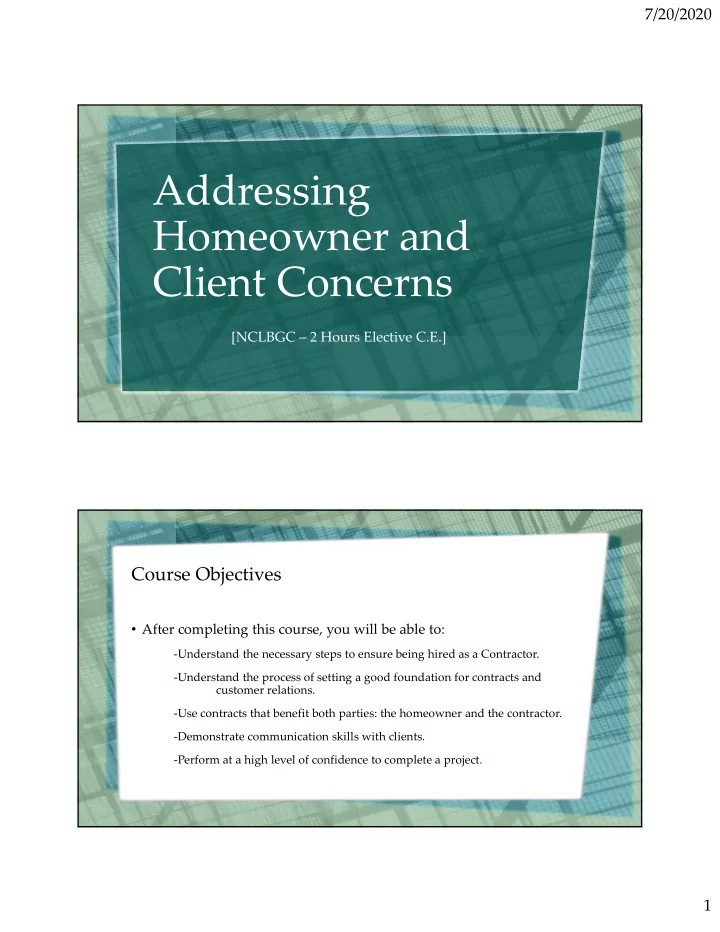
Addressing Homeowner and Client Concerns

[NCLBGC – 2 Hours Elective C.E.]

Course Objectives

  • After completing this course, you will be able to:
  • Understand the necessary steps to ensure being hired as a Contractor.
  • Understand the process of setting a good foundation for contracts and

customer relations.

  • Use contracts that benefit both parties: the homeowner and the contractor.
  • Demonstrate communication skills with clients.
  • Perform at a high level of confidence to complete a project.
slide-2
SLIDE 2

7/20/2020 2

Being the Right Contractor for Hire

  • Building a dream home or building out a business location is one of the most

exciting things a homeowner/client will ever do.

  • Bringing in the right contractor early on in the design process is one of the most

important ingredients in staying both on budget and on schedule during construction.

– Hiring the best Contractor – Determining the quality of craftsmanship – Minimizing emotional stress – Keeping unexpected cost in line – Staying on schedule

Homeowner Referral Requests

Homeowners will ask for referrals. They will talk with people they know and trust. They are going to get their rundown on you as a contractor. Here are a few sources they will be reaching out to:

– Your Architect – Family and Friends – Neighbors – Lawyers – Real Estate Agents

slide-3
SLIDE 3

7/20/2020 3

Licenses and Insurance Policies

  • Verify your Licenses and Insurance Policies and have them readily available for

the homeowner/client. This should be a company’s best practice to management.

– Hiring a licensed contractor will make the homeowner feel protected – Worker’s compensation insurance is a contractor’s responsibility – Make sure your contractor’s license is in good standing with the state licensing board – Always keep a copy of your GC license and insurance readily available

Showcasing Past Work

  • Most clients are going to want to view recent work completed. A live website will

typically be the best way to check this box.

  • A second option is a portfolio book containing photos of your past work.
  • Clients may ask:
  • Does the work carry a warranty, and how are problems corrected?
  • How does the construction site look?
  • Have older finished projects stood the test of time?
slide-4
SLIDE 4

7/20/2020 4

Checking References

  • All homeowners/clients are going to want to check references. In

private, they are going to discuss how their experiences were working with you the contractor.

– Was it a pleasant working relationship? – Did they and the contractor communicate well? – Was the contractor fair and honest? – Was the project completed on schedule and within budget? – Were there extra costs or surprises? – How were problems handled/resolved? – How was the quality of craftsmanship and follow-up?

A Physical Address

  • Is location a P.O Box or

physical space?

  • You should always have a

place of business where a client can visit and drop off a check, pickup or leave samples, etc.

slide-5
SLIDE 5

7/20/2020 5

Understand the Contract

  • Help your Client understand the contract
  • Discuss the different kinds of contracts available and have them ready for review
  • Share the updates of the construction bid if plans change for any reason
  • Let your Client know that there are always unknowns in the construction process

that create change orders and additional costs

  • Remember: There are more of us hardworking contractors than the “fly-by-

night” operations. Putting your Client at ease and explaining the process will put you in position to be the perfect contractor for the project

Scope of Work

There are many details that need to be highlighted, whether it be a new build or a renovation project:

  • Write everything down so everyone is on the same page
  • Reference the architect or designer of the project
  • Date the plan
slide-6
SLIDE 6

7/20/2020 6

Duration of Work

  • Projects often take longer than predicted for many legitimate

reasons

  • Some are caused by the client
  • Some outside of the contractor’s control…
  • Regardless, put the expected duration in writing
  • Put together a timeline.
  • This will help calm the nerves of the client if progress is slowed

and grants you the right to explain why?

Exclusions

  • A good contract should include a list of exclusions
  • These might be related to areas that will not be visible until opened up during
  • demolition. e.g. likelihood of asbestos behind walls
  • Level of cleanup
  • Contingency budget
  • Matching existing finishes
slide-7
SLIDE 7

7/20/2020 7

Payment Schedule

  • Payment schedules can vary by the job; they should always be agreeable to both

parties involved

  • Types of payment schedules:
  • Payments tied to milestones in the projects
  • Payments tied to percentages of completion

**All payments should cover a certain amount of labor and material

What We as Contractors Really Mean

  • Translating contractor’s lingo and communicating it to the client
  • Let’s look at a few common said phrases from the lens of a client
slide-8
SLIDE 8

7/20/2020 8

What We as Contractors Really Mean - Continued

  • (Nothing):
  • We do not call the client back
  • We are not interested in the job
  • Too busy to return their call

What We as Contractors Really Mean - Continued

  • “Let’s do it my way instead”:
  • Contractors have the experience doing things a certain way
  • Recommend the process that you know works
  • Listen to the client and be ready to explain
slide-9
SLIDE 9

7/20/2020 9

What We as Contractors Really Mean - Continued

  • “I’ll get started late next week”:
  • Juggling several different jobs
  • Material and supply delays (special orders)
  • Delay with the tradesmen (plumbers, electricians, etc.)
  • Keep the client informed

What We as Contractors Really Mean - Continued

  • “The Price is…”:
  • Unless the scope of work changes the price is firm, don’t cheat

yourself

  • Contractor prices vary because of different approaches to the

project

  • You won’t stay in business unless jobs are priced

competitively

slide-10
SLIDE 10

7/20/2020 10

What We as Contractors Really Mean - Continued

  • “I will do my best”:
  • If a homeowner hears this there is a good chance a contract

will fall short of expectations.

  • This is a case of the client asking for too much on a small budget.
  • The client added work to the scope of the project but wants it

completed by same date.

  • Are looking for a brand-new look from existing elements.

Famous thought of a contractor:

“If you need everything perfect by a certain date, be prepared to pay more. If you have a fixed budget but want a certain look give the contractor time to be creative and make it work.”

  • Bob Therman
slide-11
SLIDE 11

7/20/2020 11

Project Elements

  • There are three elements to any project:

1) The level of quality 2) The price 3) The time it takes to complete the project

What We as Contractors Really Mean - Continued

  • “The design needs some tweaking”
  • Often this means the plans were unbuildable
  • What is on paper just can’t be built
  • A staircase
  • Existing spaces that don’t exist
  • A pocket door that won’t slide through a switch
slide-12
SLIDE 12

7/20/2020 12

What We as Contractors Really Mean - Continued

  • “I don’t think this is a good fit”- If we as contractors

decline to quote a project it could be for a lot of reasons:

  • Concerns about the budget
  • Contractor and client will be talking a lot….
  • Too busy
  • Won’t be able to devote enough time to the project to do it

right

What We as Contractors Really Mean - Continued

  • “We are going to need to do some value engineering” –

Client has a caviar dream on a tuna fish budget.

What to do:

  • Value engineering is when the team thinks creatively.
  • Reworking the project.
  • Giving the same with similar scope for less.
  • Changing material selections.
slide-13
SLIDE 13

7/20/2020 13

Punch List Session

  • “Lets walk through and make a punch list”: As a contractor we

want to know everything that needs to be done to satisfy the clients scope of work.

  • Every trip to the job costs us a contractor
  • Make every effort to come up with a complete punch list
  • A list of to-do items that need to be completed for the project to be

considered complete. (Instead of doing it bit by bit over time as you go along)

Question

Homeowners are not inclined to check referrals?

  • True
  • False
slide-14
SLIDE 14

7/20/2020 14

Question – Answer

Homeowners are not inclined to check referrals?

  • True
  • False

False is the correct answer

2 Things To Do After the Project is Complete

  • Here’s how to make the most of your project ensuring the quality is

maintained over time. Cover the maintenance tips with your client and you will be greatly appreciated.

– Register any warranty items – Discuss maintenance items that may be applicable

slide-15
SLIDE 15

7/20/2020 15

Register Any Warranty Items

  • Give all the warranty cards to your client
  • Take a few minutes to go through the warranty cards
  • Be sure to explain the key points
  • This will also cover you for any abuse to the product

Explain to Your Client About Maintenance

  • General cleaning
  • TLC to keep installed

items functioning the way they should

slide-16
SLIDE 16

7/20/2020 16

Explain to Your Client About Maintenance - Continued

Common Maintenance Items:

  • Natural materials to make sure they don’t fall prey to stains and
  • mildew. It is imperative to seal and protect these types of materials:
  • Teak shower benches
  • Tile grout
  • Stone and marble
  • Exterior decks

Explain to Your Client About Maintenance - Continued Filters

  • Such as those in water purification systems and air conditioners
  • Filters should be changed regularly
  • Equipment will not function at high performance with

neglect

slide-17
SLIDE 17

7/20/2020 17

Explain to Your Client About Maintenance - Continued

  • Certain plumbing fixtures:
  • Shower rain heads should be deep cleaned to prevent

buildup

  • Jetted tubs
  • Proper cleaning products for fiberglass units

Explain to Your Client About Maintenance - Continued

  • Wood floor protection:
  • Felt pads for legs and

chairs

  • Water and food spills
  • Dogs and floor scratches
  • Entrance floor mats
slide-18
SLIDE 18

7/20/2020 18

Contracts and the Preconstruction Conference Form

  • An agreement to the Client for how the project will be run.
  • Can consist of many different forms and details. Some examples of what it should

encompass:  Job-Site Procedures  Sanitation Use  Security / Access  Working Hours  Work Site Logistics  Inspections  Owner-Selected Materials

Contracts and the Preconstruction Conference Form

  • Continued

Job-Site Procedures:

“No matter how much the Owner and the Contractor prepare for it, construction is disruptive in certain ways. However, to help us minimize this disruption, please read our company policies.”

  • Children and pet safety

– Keep children and pets away from work areas at all times, including construction trenches and the debris pile.

  • Owner and Visitor Safety

– Please do not enter work area without proper P-P-E.

slide-19
SLIDE 19

7/20/2020 19

Contracts and the Preconstruction Conference Form

  • Continued

Sanitation Use:

“It is understood that unless portable sanitation has been specifically included in the bid amount, employees and subcontractors may use the bathroom located at ________________.”

Contracts and the Preconstruction Conference Form

  • Continued

Security:

  • Will a lockbox be used? If not, the contractor or subcontractor cannot be held

responsible for security breaches.

  • If a key is to be hidden on site, Owner wants key to be hidden in the following

location and contractor is not responsible for mishaps.

  • Key is to be issued to Contractor to keep during the project.
slide-20
SLIDE 20

7/20/2020 20

Contracts and the Preconstruction Conference Form

  • Continued

Work Hours:

  • We normally work during the winter from ____ a.m. to ____p.m.
  • During the summer we normally work form ____ a.m. to ____ p.m.

We rarely have crews working on weekends.

Contracts and the Preconstruction Conference Form

  • Continued

Work Site Logistics:

  • Parking
  • Contractor’s Sign
  • Required signage for abatement jobs or dangerous work site conditions
  • Necessary barricades or other means of containment for public safety
  • Dust in the work area/debris piles or dumpster
  • Remodeling will be dusty at times
  • Cover items (e.g., computers, stereo and TV equipment)
  • The best place for a debris pile or dumpster is: ___________________
slide-21
SLIDE 21

7/20/2020 21

Contracts and the Preconstruction Conference Form

  • Continued

Inspections:

  • Please inspect our work on a regular basis.
  • Let us the Contractor know about any desired changes

immediately.

  • Let us know as early in each phase of the work as possible

any anticipated or developing critical matters that may affect construction.

Contracts and the Preconstruction Conference Form

  • Continued

Owner Selected Materials:

  • ”Should be given to Contractor no later than ______ weeks of

commencement of the work to avoid schedule delays.”

slide-22
SLIDE 22

7/20/2020 22

Pre-Construction Customer Information Letter

This should be in letter form addressed to the homeowner/client. An example:

  • “The purpose of this letter is not to

cast a shadow of doubt on your project before it starts, but rather to simply point out some of these high and low points that naturally occur in the course of most remodeling

  • projects. This way, you will have a

realistic idea of what to expect.”

  • Every remodeling job creates some

degree of disorder, dust, uncertainty, and inconvenience.

  • Crews and subcontractors are to

respect the fact that this is your home they are working in and not a vacant warehouse.

  • Remodeling proceeds in stages,

working through the plan and permit process.

Pre-Construction Customer Information Letter – Continued

  • Information about the demolition phase and framing
  • How the house may be exposed
  • Electrical, heating, or plumbing services intermittently interrupted
  • Dust and dirt debris piles that will be visible
  • All of this will build a stress level, so it’s best to address it upfront
  • Once framing nears completion – see the light at the end of the tunnel
slide-23
SLIDE 23

7/20/2020 23

Pre-Construction Customer Information Letter – Continued

  • Subcontractors in the building to complete the plumbing, electrical,

and mechanical work

  • Project can appear to slow down and progress is not as dramatic.
  • A lot of detail work is done at this time.
  • Required inspections by building officials.

Pre-Construction Customer Information Letter – Continued

  • You will need to explain the drywall stage:
  • Most people are excited
  • Suddenly the rooms take on their true proportions
  • People start to imagine
slide-24
SLIDE 24

7/20/2020 24

Pre-Construction Customer Information Letter – Continued

  • Lastly, cover the final phase of the project:
  • The finishing processes
  • Finish woodwork, interior trim, doors, painting, mirrors,

hardware etc.

  • Grading and exterior concrete flatwork

Addendum for Matching Existing Finishes

“This contract if not signed can be a serious conflict

between contractor and client.”

slide-25
SLIDE 25

7/20/2020 25

Addendum for Matching Existing Finishes – Continued

  • Contractor will use his best efforts to match existing finishes and

materials

  • Exact match is not guaranteed due to such factors as discoloration from

aging.

  • Difference in dye lots, discontinuation of product lines.
  • Difficulty of exactly matching (suppliers often allow 10% color factor from

dye lots).

Change Order Contingency Fund

  • Nobody likes change orders! For the owner they present a

somewhat unanticipated expense. For the contractor they delay the project schedule.

  • Understand what leads to change orders
  • How to budget for them
  • Share a sample change order form before project start
slide-26
SLIDE 26

7/20/2020 26

Change Order Contingency Fund – Continued

  • Based on my experience with projects we anticipate that change
  • rders may arise.
  • They are the result of both owner-requested upgrades e.g. changing

vinyl floor to tile flooring, and contractor-requested changes arising from concealed conditions or actual site conditions that were unknown until the present.

Change Order Contingency Fund – Continued

  • “We recommend an initially budget approximately ____ % of the

estimated project cost as a contingency fund for both owner- requested and contractor-requested change orders. This can be determined upfront prior to the start of construction.”

slide-27
SLIDE 27

7/20/2020 27

Question

In the addendum to matching existing finishes, which of the following does not apply?

  • A) 10% color factor
  • B) Difference in dye lot
  • C) Exact match is not guaranteed
  • D) Customer wants upgraded product

Question – Answer

In the addendum to matching existing finishes, which of the following does not apply?

  • A) 10% color factor
  • B) Difference in dye lot
  • C) Exact match is not guaranteed
  • D) Customer wants upgraded product

D) Customer wants upgraded product is the correct answer

slide-28
SLIDE 28

7/20/2020 28

Summary:

  • What you learned today is the necessary steps to help you as a contractor to

secure a job, and to use contracts that are beneficial to the client and contractor.

  • Making use of good contracts and customer relationships helps set a good

foundation.

  • Furthermore, using superb communication skills and performing at a high level

will help build upon for future projects and references.

Q & A

Any final questions

  • r requested items of

clarity?