Addressing Malnutrition in Southeast Asia: Priorities and - - PowerPoint PPT Presentation

addressing malnutrition in southeast asia priorities and
SMART_READER_LITE
LIVE PREVIEW

Addressing Malnutrition in Southeast Asia: Priorities and - - PowerPoint PPT Presentation

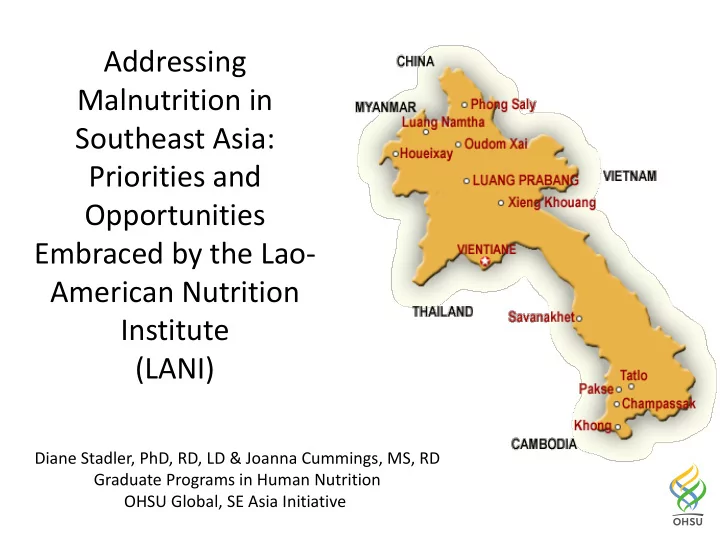
Addressing Malnutrition in Southeast Asia: Priorities and Opportunities Embraced by the Lao- American Nutrition Vientiane, Laos Institute (LANI) Diane Stadler, PhD, RD, LD & Joanna Cummings, MS, RD Graduate Programs in Human Nutrition


slide-1
SLIDE 1

Addressing Malnutrition in Southeast Asia: Priorities and Opportunities Embraced by the Lao- American Nutrition Institute (LANI)

Vientiane, Laos

Diane Stadler, PhD, RD, LD & Joanna Cummings, MS, RD Graduate Programs in Human Nutrition OHSU Global, SE Asia Initiative

slide-2
SLIDE 2

“To make duck soup, I set I pot of water on the fire and then go to the pond where the ducks are eating. I pick the best duck and put it under my arm and bring it back to the fire. Now the water in the pot is boiling and I add lemon grass, tamarind leaves, bamboo shoots and whatever vegetables I picked from the garden. and put into the pot,

The Children of Sticky Rice

A young Hmong woman in juxtaposition of plenty amidst poverty, and ease amidst great difficulties.

I chop up the duck and add it to the pot and then soup is ready to eat, with sticky rice. We eat until sticky rice is gone.”

slide-3
SLIDE 3
  • Sticky rice is used as a utensil at each meal, provides

sustenance and plays an important role in cementing social relations and linking the Lao with the spirit world.

  • However, under certain

conditions (crop loss, extreme poverty or flooding during the rainy season) and at certain times (late pregnancy and the early postpartum period) sticky rice may be the only food available or permitted due to long standing traditions and food taboos.

The Lao consume more sticky rice per capita than anywhere else in the world

slide-4
SLIDE 4
  • Although unintentional, this

dependence on sticky rice is associated with severe acute malnutrition, perpetuation of chronic malnutrition, and risk of overt vitamin and mineral deficiencies.

  • The short and long-term

consequences of malnutrition that result from poor dietary diversity and food insecurity is especially concerning for high risk groups such as infants and young children, women during pregnancy, and the elderly.

  • Deficiency in vitamins and minerals, such as thiamine,

is deadly in infants, young children and new mothers.

slide-5
SLIDE 5
  • Immense diversity and complexity of food

practices

  • Overwhelming reliance upon the land for

resources, and a daily necessity of searching for food or tending to rice that involves all members of the household.

  • In remote villages edible plants (shoots,

mushrooms, nuts, berries) and small animals (frog, fish, lizards, insects, birds, squirrels, wild boar) make up 50% of their diet.

  • The lack of food prohibitions and

inhibitions allows for limitless options; constrained only by what people cannot grow, catch or gather and by seasonal availability.

“We will eat anything with wings except airplanes and anything with legs except tables and chairs, and everything else in between.”
slide-6
SLIDE 6
  • As in western countries,

malnutrition in Lao PDR also manifests in older children and adults who are overweight, less physically active, and who are at higher risk of chronic diseases due to malnutrition experienced prenatally or as a young child.

  • Chronic disease is on the rise in

Lao PDR while malnutrition remains endemic.

The double burden of malnutrition

slide-7
SLIDE 7

Stunting Prevalence (%)

(Height/Age; z-score ≤ -2)

Wasting Prevalence (%)

(Weight/Height; z-score ≤ -2)

48% → 44% → 36% → 34% 2006 2011 2015 2020 7% → 6% → 9% → <5% 2006 2011 2015 2020

Exceed WHO “serious” 10% threshold

slide-8
SLIDE 8

Most Common Chronic Medical Conditions Among Adult and Pediatric Patients

10 20 30 40 50 60 70 80 90 100 10 20 30 40 50 60 70 80 90 100

Adult Patients Pediatric Patients

Percent of Respondents (n=85) Percent of Respondents (n=85)

slide-9
SLIDE 9
slide-10
SLIDE 10

Mission of the Lao-American Nutrition Institute

  • To build capacity and initiate new

approaches to improve the state

  • f nutrition for all Lao people.
  • To develop international academic

relationships and exchanges.

  • To support collaborative research

activities.

slide-11
SLIDE 11

Lao American Nutrition Institute Partnership

Financial Support from the BDMS Foundation OHSU Foundation US Department of Defense

President Joe Robertson

slide-12
SLIDE 12

Proposed Campus of the Lao-American Nutrition Institute with anticipated completion October 2018

Funded by the US Department of Defense as part of a Global Health Diplomacy Initiative

slide-13
SLIDE 13

President Obama visits Lao

September 2016 Additional Funding for UXO clearance LANI November 2016 Groundbreaking Ceremony

  • Joanna Cummings, MS, RD,

Coordinator and Instructor, LANI, Vientiane, Lao PDR

  • Sara Schwanke Khilji, MD

OHSU Global Director of Interprofessional Education Bangkok, Thailand

slide-14
SLIDE 14

Proposed Student Learning Outcomes

Public Health Nutrition Program Manager

Conduct a needs assessment Design and administer surveys Assess food security status Identify resources Use statistical analysis Behavioral change counseling Work with governmental sectors Effective communication Conduct nutritional assessments Nutrition Diagnosis and Interventions Apply knowledge

  • f nutrient

metabolism Counseling skills Implementation, Monitor, Evaluate Teach and Mentor

Hospital-based Clinical Nutrition & Dietetics Community-based Nutrition Program Management

slide-15
SLIDE 15

The Clinical Nutrition & Dietetics Track

  • Graduate Certificate degree that can transition into a Diploma and

possibly a Masters degree

  • Continuous intensive 6 month training program with didactic,

clinical skills labs, clinical rounds & case studies, research projects

  • First cohort: 2 representatives from 3 central hospitals
  • Mahasot

Setthathirat Oudomxay

  • “Train the Trainer” model

– Graduates become instructors/trainers/mentors/preceptors for future cohorts of students – Host to health professional exchange students from OHSU – 1st two dietetic intern/nutrition graduate students received travel awards for the Summer 2017

slide-16
SLIDE 16
  • Bachelor’s degree, agriculture, education
  • At least 2 years of medical/healthcare experience
  • Passed entrance examination and interviews
  • Current position in central, provincial, or district level

hospital or health centers

  • Currently enrolled in or graduated with a science or

healthcare related undergraduate degree

  • Strong interpersonal skills
  • Not over age of 45 years
  • Proficiency of English language

Ideal Candidate Characteristics

slide-17
SLIDE 17

Clinical Nutrition Program Timeline

Start Date: 6 February End Date: 31 July

slide-18
SLIDE 18

Our 1st cohort of students

Classes started February 6, 2017

slide-19
SLIDE 19

Our LANI faculty

slide-20
SLIDE 20

Children of Lao

slide-21
SLIDE 21

“As a little girl I watched my mother cook

  • chicken. She would pluck it and then chop

its head off and put it in the pot. Now that I am an adult and have my own home, I invited her over for dinner one evening. She watched as I prepared chicken for

  • dinner. I plucked it and chopped its head
  • ff and put it in the pot.

There is an underlying current of transition and innovation evolving at a rapid pace in Lao

My mother said, ‘Why did you cut the head off the chicken?’ I responded, ‘because this is the way you taught me mother’ and my mother cackled in laughter. She said ‘I only cut the head off the chicken because it would not fit in the pot. You have different pots and larger pots, you can do things differently.”

slide-22
SLIDE 22
slide-23
SLIDE 23

Diane Stadler, PhD, RD, LD Graduate Programs in Human Nutrition Oregon Health & Science University stadlerd@ohsu.edu