Adjusting your volume Select between two options: Telephone Mic - - PowerPoint PPT Presentation

adjusting your volume
SMART_READER_LITE
LIVE PREVIEW

Adjusting your volume Select between two options: Telephone Mic - - PowerPoint PPT Presentation

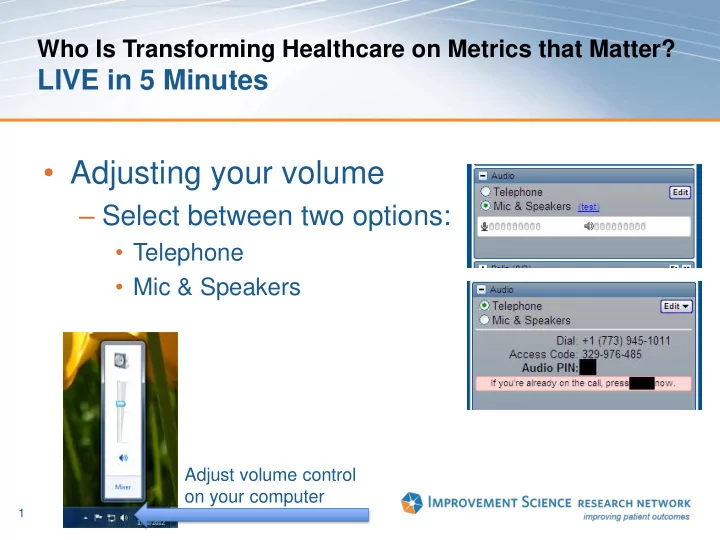
Who Is Transforming Healthcare on Metrics that Matter? LIVE in 5 Minutes Adjusting your volume Select between two options: Telephone Mic & Speakers Adjust volume control on your computer 1 Who Is Transforming Healthcare on


slide-1
SLIDE 1

1

Who Is Transforming Healthcare on Metrics that Matter?

LIVE in 5 Minutes

  • Adjusting your volume

– Select between two options:

  • Telephone
  • Mic & Speakers

Adjust volume control

  • n your computer
slide-2
SLIDE 2

2

  • Slides are available for

download at www.ISRN.net

  • Recording will be available in several days

www.ISRN.net

Who Is Transforming Healthcare on Metrics that Matter? LIVE in 3 Minutes

slide-3
SLIDE 3

3

  • Asking Questions

– Type your question into the “Chat” box and click Send – We will answer as many questions as possible at the end of today’s session

Who Is Transforming Healthcare on Metrics that Matter?

LIVE in 1 Minute

slide-4
SLIDE 4

Who Is Transforming Healthcare on Metrics That Matter?

4

Presented by: Improvement Science Research Network

slide-5
SLIDE 5

5

Moderator

Kathleen R. Stevens, RN, EdD, FAAN

Professor and Director Improvement Science Research Network University of Texas Health Science Center San Antonio

slide-6
SLIDE 6

www.ISRN.net

6

slide-7
SLIDE 7

ISRN Research Priorities

  • A. Coordination and Transitions of Care
  • B. High-Performing Clinical Systems and Microsystems

Approaches to Improvement

  • C. Evidence-Based Quality Improvement and Best

Practice

  • D. Learning Organizations and Culture of Quality and

Safety

Improvement Science Research Network (ISRN). (2010). Research priorities. Retrieved from http://www.isrn.net/research.

7

slide-8
SLIDE 8

8

About our Web Seminar

  • For help, notify the ISRN Coordinating Center through

the Questions window

  • Problems with slides?

– Refresh your screen, or – Log off and log back into the web seminar

  • Visit www.ISRN.net to download

the presentation slides

slide-9
SLIDE 9

9

Submitting Questions

  • When:

Anytime during the presentation

  • How: Sending

a written question through the Chat window

Choose who you direct your questions to

slide-10
SLIDE 10

10

Audio

  • Mic and Speakers need

to be connected to your computer

  • If you do not have

speakers attached to your computer, dial in using the phone number, access code, and audio pin that is provided

  • Dial in to the number,

enter access code, and unique Audio Pin number

slide-11
SLIDE 11

Who Is Transforming Healthcare on Metrics that Matter?

11

Presented by: Improvement Science Research Network

slide-12
SLIDE 12

Presenters

12

Miriam Bender, PhD, RN, CNL, University of California Irvine Marjory (Micki) Williams, PhD, RN, NEA-BC, Central Texas Veterans Health Care System, Temple, Texas Linda Roussel, PhD, RN, CNL, NEA-BC, FAAN The University of Alabama Birmingham

slide-13
SLIDE 13

Who Is Transforming Healthcare

  • n Metrics that Matter?

13

Miriam Bender, PhD RN CNL Assistant Professor University of California, Irvine Marjory Williams, PhD RN NEA-BC Associate Chief, Nursing Research Central Texas Veterans Health Care System Linda Roussel, PhD RN NEA-BC CNL FAAN Professor University of Alabama, Birmingham

slide-14
SLIDE 14

Disclosures

  • Research presented in this webinar was funded by the Commission on Nurse Certification

and the University of California Center for Organizational Research

  • The content of this presentation is the responsibility of the author(s) alone and does not

necessarily reflect the views or policies of the Department of Veterans Affairs or the United States Government. A portion of the material presented was the result of work supported in part with resources and the use of facilities at the Central Texas Veterans Health Care System

  • Acknowledgements: The presenters would like to acknowledge the CNL Expert Advisory

Panel, who provided stakeholder-engaged contributions to research presented in this

  • webinar. Panel members include (in alphabetical order):

– Alice Avolio, DNP RN, Portland VA, Portland OR – Patricia Baker, MS RN, CNL, Methodist HealthCare System, San Antonio TX – James Harris, PhD RN MBA CNL FAAN, University of South Alabama, Mobile AL – Nancy Hilton, MN RN NEA-BC, St. Lucie Medical Center, Port St. Lucie FL – Linda Roussel, PhD RN NEA-BC CNL, University of Alabama, Birmingham AL – Bobbie Shirley, MS RN CNL, Maine Medical Center, Portland ME – Joan Stanley, PhD, FAAN, American Association of Colleges of Nursing, Washington DC – Tricia Thomas, PhD RN, Trinity Health, Livonia MI 14
slide-15
SLIDE 15

Why do Metrics Matter?

“Measurement … is a tool for achieving health care goals” “Measures reflect goals and aspirations” “Offers a reliable reflections of the status of health and health care at the national, state, local and institutional level” “Provide[s] a quantitative indication of current status

  • n the most important elements in a given field, and

that can be used as a standardized and accurate tool for informing, comparing, focusing, monitoring, and reporting change.”

15

IOM, 2015

slide-16
SLIDE 16

Established by the Affordable Care Act to improve the delivery

  • f health care services, patient

health outcomes, and population health

16

What are current healthcare goals?

slide-17
SLIDE 17

What are some metrics that matter?

17

IOM 2015 National Quality Forum

slide-18
SLIDE 18

How do we get there?

18

slide-19
SLIDE 19

Levels for Levers of Quality

19

NATIONAL LEVEL: Creating accountability for quality

Department of Health and Human Services Agency for Healthcare Quality and Research Centers for Medicare & Medicaid Services

COMMUNITY-ORGANIZATION LEVEL: Creating infrastructure for quality

Learning Health Systems Patient Centered Medical Homes Accountable Care Organizations

MICROSYSTEM LEVEL: Creating quality

Reducing Harm Patient Engagement Effective Communication And Coordination Prevention Practices Working With Communities Cost Effective Care Delivery Models

slide-20
SLIDE 20

Why Focus on the Microsystem?

20

slide-21
SLIDE 21

Nurses and Healthcare Microsystems

  • Registered Nurses (RNs) comprise the largest sector of the

healthcare workforce, with over 2.9 million RNs currently employed, which is more than four times the number of physicians

  • This means RNs are a de-facto critical component of

healthcare delivery, which provides a powerful incentive to fully leverage their scope of practice -- roles, responsibilities and functions that nurses are educated, competent, and licensed to perform -- into microsystem care models that consistently meet national quality mandates

21

slide-22
SLIDE 22

Microsystem Transformation

22

“Transformation will require remodeling many aspects of the health care system … Nurses must assume leadership positions and to serve as full partners in health care redesign”

As leaders, nurses must:

  • Act as full partners with other health care

professionals

  • Be accountable for their responsibility to deliver

high-quality care

  • Work collaboratively with leaders from other

health professions

  • Identify and propose solutions to problems in care

environments

  • Devise and implement plans for improvement
  • Participate in health policy decision-making
slide-23
SLIDE 23

Traditional Nursing Care Focus

  • Current nursing knowledge and practice in clinical microsystems is

generally organized as a series of separate, individual ‘units’

  • This individual nursing focus is on separate aspects of the microsystem

– Individual nurses and their patient assignment – Individual nurses in specific task-focused roles with limited focus

  • Staff nurse, discharge nurse, medication nurse

23

Microsystem

Discharge nurse Pa ent 2 Pa ent 3 Pa ent 4 Pa ent 1

slide-24
SLIDE 24

CNL-Integrated Nursing Care Delivery

  • An innovative nursing model that integrates certified

Clinical Nurse Leaders (CNL) into microsystem care delivery

– Master’s-level nursing curriculum – CNL certification for practice

  • Commission on Nurse Certification (CNC)
  • Accredited (in NDNQI)

24

slide-25
SLIDE 25

CNL History

Spearheaded by the AACN using an innovative education-practice partnership framework

– Education/competencies developed with an understanding

  • f microsystem dynamics in mind
  • Clinical leadership, interdisciplinary collaboration, teamwork,

information technology, evidence base practice, quality improvement

– AACN White Paper released 2007, updated 2013

  • Currently 4000 certified CNLs nationally
  • 64% annual certification growth rate
  • 94 CNL-track Masters programs throughout the country
slide-26
SLIDE 26

Why CNL Practice?

  • Transform workplace structures

– Reorganize nursing knowledge and practice into redesigned care delivery models

  • Transform microsystem practice

– CNL workflow organized to transform practice dynamics

  • Transform care quality and safety outcomes

– Transformed practice dynamics drive outcomes

26

Fragmented care patterns coordinated care patterns

slide-27
SLIDE 27

CNL: Unique Orientation to Practice

The environment becomes a targeted domain of clinical practice

MacroSystem

  • Hospitals, healthcare

systems

MesoSystem

  • Inter-related microsystems

providing care to specific populations

MicroSystem

  • Point-of-practice where care is

delivered

CEO, CNO, executive leaders Department managers, service line directors

Nurses Physicians Ancillary staff Patient APRNs Managers

CNL c competency and p practice do domain ain

slide-28
SLIDE 28

Current Published CNL Evidence

  • 15 case reports describing the development, implementation and
  • utcomes of CNL practice in federal, community nonprofit, and for-profit

settings

– NHPPD, staff/physician/patient satisfaction, care process efficiencies, LOS, falls, discharge teaching, sitter hours, pressure ulcers, turnover, CLABSI, CAUTI, VAP, transfusion rates, interdisciplinary communication/collaboration

  • 2 cross-section correlation studies associating CNL practice with

– improved nurse satisfaction, turnover and leadership practices

  • 2 short interrupted time series studies quantifying significant correlations

between CNL implementation and improved care environment and quality

  • utcomes

– Multiple aspects of patient experience, turnover, NHPPD

28

Bender M. (2014). The current evidence base for the clinical nurse leader: A narrative review of the literature. Journal of Professional Nursing, 30(2), 110–123.

slide-29
SLIDE 29

Clinical Perceptions of CNL Practice

  • Numerous N=1 examples of CNL integrated

practice - untapped embedded clinical knowledge

  • Other ways of knowing - “What a difference…”

– “I know I am making a big difference” (CNL) – “I know we can get through our toughest day when

  • ur CNL is here” (staff nurse)

– “It is a whole different feeling when I round on this unit” (nurse executive) – “The CNL sure makes a difference; can we get one on every unit?” (physician)

29

slide-30
SLIDE 30

Filling the CNL Evidence Gaps

  • Who are CNLs and where are they practicing?
  • What precisely is CNL practice?

– How do they influence care quality and outcomes?

  • What are facilitators/barriers to CNL success?

30

Fragmented care patterns coordinated care patterns

slide-31
SLIDE 31

CNL Research Framework

31

Synthesize exis ng knowledge

  • Define

core elements

  • CNL

theory

  • Prac ce

and implementa on

  • Mechanisms
  • f

ac on

  • CNL

metrics

  • Iden fy

exis ng variables

  • Develop

new variables

Develop pragma c research strategy

  • Appropriate

research designs

  • Harness

exis ng data

  • Generate

new data

  • Generate

Implementa on and effec veness evidence

Conduct na onal level research

  • Na onwide

‘research laboratory’

  • Combine

resources for data collec on and analysis

  • Ensure

comparable

  • utcomes

Research Policy Educa on Prac ce

Na onal level CNL research collabora ve

Williams M, Bender M (2015). Growing and sustaining the CNL initiative: shifting the focus from pioneering innovation to evidence-driven integration into healthcare

  • delivery. Journal of Nursing Administration, 45(11), 540-543
slide-32
SLIDE 32

Characteristics of CNLs

2015 National Survey

– Population of certified CNLs; 19% response rate (601/3126)

32

Bender M., Williams M., Su W. (In Press). Diffusion of a Nurse-led Healthcare Innovation: Describing Certified Clinical Nurse Leader Integration into Care Delivery. Journal of Nursing Administration.

Certified CNL characteristics Percent Frequency (n=601) Age 31-50 55% 328 Certified within last 5 years 66% 394 Years with RN License Less than 10 years More than 10 years 40% 60% 240 361 Hold other certifications 75% 449 Practicing in formally designated CNL role 58% 347 Practicing in Hospital setting 75% 449 Practicing in Magnet Hospital 35% 209 Setting ownership status Not for profit Federal For-profit 57% 26% 8% 342 153 47

slide-33
SLIDE 33

What is CNL Practice?

33

Microsystem level structuring CNL level competency structuring CNL level workflow structuring Understand care delivery gaps Consensus CNL practice can close gaps Organization level implementation strategy Facilitate effective ongoing communication Strengthen intra and interprofessional relationships Create and sustain teams Support staff engagement Improved care environments Improved care quality outcomes The CNL is perceived by clinicians and administrators as adding value to the ways care is delivered

Readiness for CNL- integrated care delivery Structuring CNL- integrated care delivery CNL Practice Continuous Clinical Leadership Outcomes of CNL- integrated care delivery Value

Bender, M. Williams M., Su W., Hites, L. (In Review). Validating a conceptual model of nursing care delivery to improve patient quality and safety outcomes.

slide-34
SLIDE 34

Facilitators/Barriers to CNL Success

Association between CNL organization and implementation variables and perceived level of CNL success

34

Variables (R2=35%) Estimate effect P value Intercept 37.57 <.001 Phase CNL initiative is in (reference category Piloted only) Spread to majority of microsystems 28.92 <.001 Initiated but not spread across setting(s) 15.29 <.001 CNL role consistency (reference category Inconsistency) Consistency every day/week 17.72 <.001 Consistency portion of every day/week 12.26 <.001 Initiative involvement: CNL instructor/preceptor 6.24 .002 CNL role reporting structure: Reports to front line manager

  • 6.13

.005 CNL setting ownership status (reference category Not-for-profit) Government

  • 5.58

.018 For-Profit 0.57 .878

Bender, M., Williams M., Su W., Hites, L. (In Press). Clinical Nurse Leader integrated care delivery to improve care quality and safety: factors influencing perceived success. Journal of Nursing Scholarship.

slide-35
SLIDE 35

Ongoing CNL Research

Testing validated CNL Practice Model across diverse health settings

– Measures of CNL implementation

  • Fidelity, adherence, acceptance, barriers/facilitators

– Validated CNL survey, semi-structured interviews

– Measures of CNL practice

  • Communication, relationship building, teamwork, staff engagement

– CNL survey, participant observation/ethnography

– Measures of CNL effectiveness

  • Improved care environment, quality and safety

– Nationally-endorsed standardized metrics – Time series analysis

35

slide-36
SLIDE 36

Informing Care Delivery Questions

  • Tapping embedded clinical nursing systems knowledge

– What works, or doesn’t, where? – What domain/component clusters are sufficient/necessary for success? – What are the metrics that matter?

  • Evidence for CNL practice AND for quality improvement
  • CNL Practice-Research Collaborative (CNL-PRC)

– Goal: Further specify the CNL practice model – Goal: Address methodological/analytical challenges to knowledge generation about CNL integrated practice – Goal: Generate evidence to inform practice – Goal: Develop/provide a toolkit for strategic integration of CNL practice

36

slide-37
SLIDE 37

Who Is Transforming Healthcare on Metrics that Matter?

37

Linda Roussel, PhD, RN, CNL, NEA-BC, FAAN, The University of Alabama Birmingham

CNL Commentary

slide-38
SLIDE 38

Thank you! Questions?

38

slide-39
SLIDE 39

Who Is Transforming Healthcare on Metrics that Matter?

39

Miriam Bender, PhD, RN, CNL, University of California Irvine Marjory (Micki) Williams, PhD, RN, NEA-BC, Central Texas Veterans Health Care System, Temple, Texas Linda Roussel, PhD, RN, CNL, NEA-BC, FAAN The University of Alabama Birmingham

slide-40
SLIDE 40

40

Closing Remarks

  • ISRN Mission

– To enhance the scientific foundation for quality improvement, safety, and efficiency through transdisciplinary research addressing healthcare delivery, patient-centeredness, and integration of evidence into practice.

  • Join Us!

– For information on the ISRN or to become a member please visit our website: www.ISRN.net

slide-41
SLIDE 41

41

Special ISRN Membership Rate

Receive a special membership rate of $99 with the code “ISRN99”

Visit www.ISRN.net/JoinUs to start your membership registration.

slide-42
SLIDE 42

Who Is Transforming Healthcare on Metrics that Matter?

42

Presented by: Improvement Science Research Network