ADMIN Reading finish Chapter 5 Sections 5.4 (skip 511-515), 5.5, - - PowerPoint PPT Presentation

admin
SMART_READER_LITE
LIVE PREVIEW

ADMIN Reading finish Chapter 5 Sections 5.4 (skip 511-515), 5.5, - - PowerPoint PPT Presentation

ADMIN Reading finish Chapter 5 Sections 5.4 (skip 511-515), 5.5, 5.11, 5.12 IC220 Set #17: Caching Finale and Virtual Reality (Chapter 5) 1 2 Cache Performance Performance Example Simplified model: Suppose processor


slide-1
SLIDE 1

1

IC220 Set #17: Caching Finale and Virtual Reality (Chapter 5)

2

ADMIN

  • Reading – finish Chapter 5

– Sections 5.4 (skip 511-515), 5.5, 5.11, 5.12

3

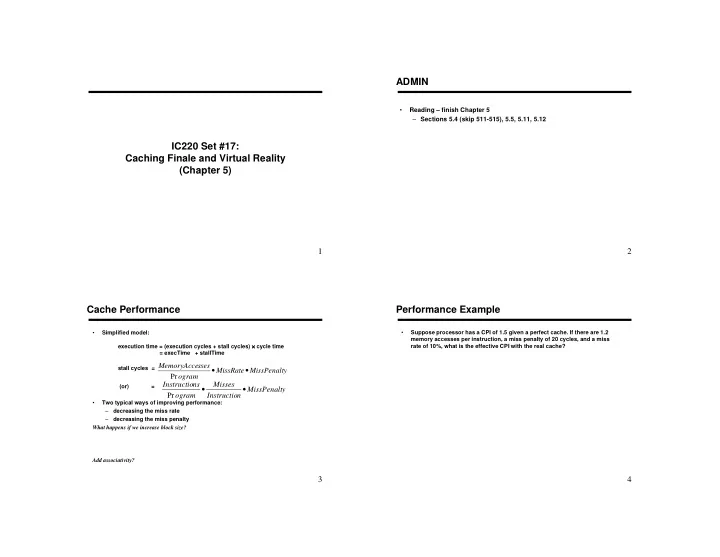
Cache Performance

  • Simplified model:

execution time = (execution cycles + stall cycles) × × × × cycle time = execTime + stallTime stall cycles = (or) =

  • Two typical ways of improving performance:

– decreasing the miss rate – decreasing the miss penalty What happens if we increase block size? Add associativity?

y MissPenalt n Instructio Misses

  • gram

ns Instructio

  • Pr

y MissPenalt MissRate

  • gram

sses MemoryAcce

  • Pr

4

Performance Example

  • Suppose processor has a CPI of 1.5 given a perfect cache. If there are 1.2

memory accesses per instruction, a miss penalty of 20 cycles, and a miss rate of 10%, what is the effective CPI with the real cache?

slide-2
SLIDE 2

5

  • Instructions and data have different properties

– May benefit from different cache organizations (block size, assoc…)

  • Why else might we want to do this?

Split Caches

ICache (L1) DCache (L1) L2 Cache Main memory L1 L2 Cache Main memory

6

Cache Complexities

  • Not always easy to understand implications of caches:

Radix sort Quicksort Size (K items to sort) 4 8 16 32 200 400 600 800 1000 1200 64 128 256 512 1024 2048 4096 Radix sort Quicksort Size (K items to sort) 4 8 16 32 400 800 1200 1600 2000 64 128 256 512 1024 2048 4096

Theoretical behavior of Radix sort vs. Quicksort Observed behavior of Radix sort vs. Quicksort 7

Cache Complexities

  • Here is why:
  • Memory system performance is often critical factor

– multilevel caches, pipelined processors, make it harder to predict outcomes – Compiler optimizations to increase locality sometimes hurt ILP

  • Difficult to predict best algorithm: need experimental data

Radix sort Quicksort Size (K items to sort) 4 8 16 32 1 2 3 4 5 64 128 256 512 1024 2048 4096

8

Program Design for Caches – Example 1

  • Option #1

for (j = 0; j < 20; j++) for (i = 0; i < 200; i++) x[i][j] = x[i][j] + 1;

  • Option #2

for (i = 0; i < 200; i++) for (j = 0; j < 20; j++) x[i][j] = x[i][j] + 1;

slide-3
SLIDE 3

9

Program Design for Caches – Example 2

  • Why might this code be problematic?

int A[1024][1024]; int B[1024][1024]; for (i = 0; i < 1024; i++) for (j = 0; j < 1024; j++) A[i][j] += B[i][j];

  • How to fix it?

10

VIRTUAL MEMORY

11

Virtual memory summary (part 1)

Virtual page number Page offset 31 30 29 28 27 3 2 1 0 15 14 13 12 11 10 9 8 Physical page number Page offset 29 28 27 3 2 1 0 15 14 13 12 11 10 9 8 Virtual address Physical address Translation

Data access without virtual memory: Cache Memory Disk Memory address

12

Virtual memory summary (part 2)

Virtual page number Page offset 31 30 29 28 27 3 2 1 0 15 14 13 12 11 10 9 8 Physical page number Page offset 29 28 27 3 2 1 0 15 14 13 12 11 10 9 8 Virtual address Translation

Cache Memory Disk Data access with virtual memory:

slide-4
SLIDE 4

13

Virtual Memory

  • Main memory can act as a cache for the secondary storage (disk)
  • Advantages:

– Illusion of having more physical memory – Program relocation – Protection

  • Note that main point is caching of disk in main memory but will

affect all our memory references!

Virtual addresses Physical addresses Address translation Disk addresses

14

Address Translation

Virtual page number Page offset 31 30 29 28 27 3 2 1 0 15 14 13 12 11 10 9 8 Physical page number Page offset 29 28 27 3 2 1 0 15 14 13 12 11 10 9 8 Virtual address Physical address Translation

Terminology:

  • Cache block
  • Cache miss
  • Cache tag
  • Byte offset
  • 15

Pages: virtual memory blocks

  • Page faults: the data is not in memory, retrieve it from disk

– huge miss penalty (slow disk), thus

  • pages should be fairly
  • Replacement strategy:

– can handle the faults in software instead of hardware

  • Writeback or write-through?

16

Page Tables

Page table Physical page or disk address Physical memory Virtual page number Disk storage 1 1 1 1 1 1 1 1 1 Valid

slide-5
SLIDE 5

17

Example – Address Translation Part 1

  • Our virtual memory system has:

– 32 bit virtual addresses – 28 bit physical addresses – 4096 byte page sizes

  • How to split a virtual address?
  • What will the physical address look like?
  • How many entries in the page table?

Virtual page # Page offset Physical page # Page offset

18

Example – Address Translation Part 2

Physical Page

  • r Disk Block #

Valid? 1 1 1 1 1 F5C0 C0006 5600 C0005 7290 C0004 8003 C0003 FB00 C0002 A200 C0001 A204 C0000

Page Table Translate the following addresses:

  • 1. C0001560
  • 2. C0006123
  • 3. C0002450

EX 7-31…

19

Making Address Translation Fast

  • A cache for address translations: translation lookaside buffer

1 1 1 1 1 1 1 1 1 1 1 1 1 1 1 1 1 1 1 1 Physical page

  • r disk address

Valid Dirty Ref Page table Physical memory Virtual page number Disk storage 1 1 1 1 1 1 1 1 1 1 1 1 Physical page address Valid Dirty Ref TLB Tag

Typical values: 16-512 entries, miss-rate: .01% - 1% miss-penalty: 10 – 100 cycles

20

Protection and Address Spaces

  • Every program has its own “address space”

– Program A’s address 0xc000 0200 not same as program B’s – OS maps every virtual address to distinct physical addresses

  • How do we make this work?

– Page tables – – TLB –

  • Can program A access data from program B? Yes, if…
  • 1. OS can map different virtual page #’s to same physical page #’s
  • So A’s 0xc000 0200 = B’s 0xb320 0200
  • 2. Program A has read or write access to the page
  • 3. OS uses supervisor/kernel protection to prevent user programs

from modifying page table/TLB

slide-6
SLIDE 6

21 Integrating Virtual Memory, TLBs, and Caches

Yes Write access bit on? No Yes Cache hit? No Write data into cache, update the dirty bit, and put the data and the address into the write buffer Yes TLB hit? Virtual address TLB access Try to read data from cache No Yes Write? No Cache miss stall while read block Deliver data to the CPU Write protection exception Y es Cache hit? No Try to write data to cache Cache miss stall while read block TLB miss exception Physical address

(Figure 5.25)

22

TLBs and Caches

Virtual page number Page offset 31 30 29 28 27 3 2 1 0 15 14 13 12 11 10 9 8 Physical page number Page offset 29 28 27 3 2 1 0 15 14 13 12 11 10 9 8 Virtual address Translation

What happens after translation? Cache

23

Modern Systems

24

Concluding Remarks

  • Fast memories are small, large memories are slow

– We really want fast, large memories – Caching gives this illusion

  • Principle of locality

– Programs use a small part of their memory space frequently

  • Memory hierarchy

– L1 cache ↔ ↔ ↔ ↔ L2 cache ↔ ↔ ↔ ↔ … ↔ ↔ ↔ ↔ DRAM memory ↔ ↔ ↔ ↔ disk

  • Memory system design is critical for multiprocessors