ADVANCED MICROSCOPY TECHNIQUES FOR STUDYING THE DURABILITY OF FUEL - - PowerPoint PPT Presentation

advanced microscopy techniques for studying the
SMART_READER_LITE
LIVE PREVIEW

ADVANCED MICROSCOPY TECHNIQUES FOR STUDYING THE DURABILITY OF FUEL - - PowerPoint PPT Presentation

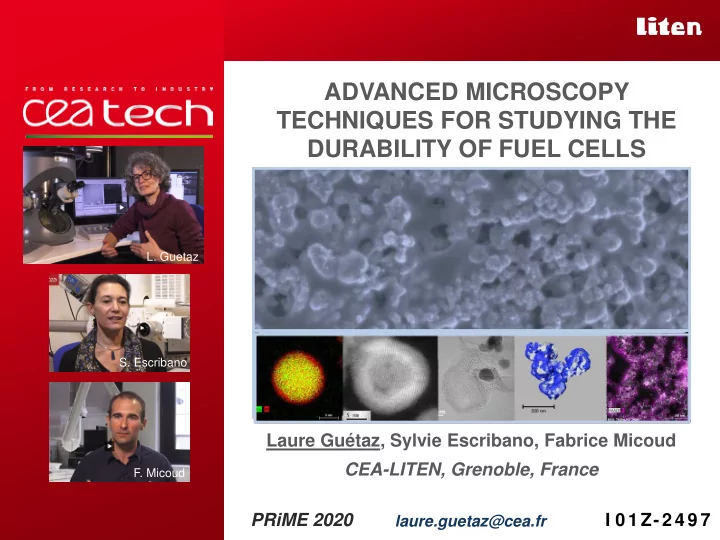
ADVANCED MICROSCOPY TECHNIQUES FOR STUDYING THE DURABILITY OF FUEL CELLS L. Guetaz S. Escribano Laure Gutaz, Sylvie Escribano, Fabrice Micoud CEA-LITEN, Grenoble, France F. Micoud PRiME 2020 I 0 1 Z-2 4 9 7 laure.guetaz@cea.fr


slide-1
SLIDE 1

ADVANCED MICROSCOPY TECHNIQUES FOR STUDYING THE DURABILITY OF FUEL CELLS

Laure Guétaz, Sylvie Escribano, Fabrice Micoud CEA-LITEN, Grenoble, France

laure.guetaz@cea.fr

  • L. Guetaz
  • S. Escribano
  • F. Micoud

PRiME 2020 I 0 1 Z-2 4 9 7

slide-2
SLIDE 2

The durability of PEMFCs remains, with their cost, one of the main barriers to the widespread commercialization of fuel-cell electric vehicles.

Introduction

The first generation fuel cell vehicles (Toyota Mirai) have demonstrated their good performance:

  • by using MEA with quite high Pt loading (0.37 mgPt/cm2)
  • probably through the development of good system mitigation strategies

To reduce the MEA Pt loading and to simplify the system management  it is crucial to still improve the durability of MEA components

Borup et al., Current Opinion in Electrochemistry 2020, 21, 192 I 0 1 Z-2 4 9 7 2 PRiME 2020 laure.guetaz@cea.fr

slide-3
SLIDE 3

Two main strategies

Ageing tests in single cell under accelerating stress test (AST) protocols Ageing tests in stack under near real automotive application conditions

  • Screening and selection of

the MEA materials and components

  • Accurate understanding of

the degradation mechanisms

  • f each component.
  • Which MEA components are

degraded and by which mechanisms?

  • Do the observed degraded

components explain the performance losses?

MEA degradation studies

 

I 0 1 Z-2 4 9 7 3 PRiME 2020 laure.guetaz@cea.fr

slide-4
SLIDE 4

Electron microscopy techniques

SEM

Scanning Electron Microscopy

TEM

Transmission Electron Microscopy

FIB/SEM

Focused Ion Beam / Scanning Electron Microscopy-

Powerful tools to progress in degradation mechanisms understanding

I 0 1 Z-2 4 9 7 4 PRiME 2020 laure.guetaz@cea.fr

slide-5
SLIDE 5

OUTLINE

Introduction

Pt and Pt alloy nanoparticle degradation

  • Pt nanoparticles

Electrochemical Ostwald ripening: Pt nanoparticle growth Pt membrane precipitation band

  • Pt-Co nanoparticles

Electrochemical Ostwald ripening: Pt shell thickness increase Ionomer contamination by Co cations

  • Role of the carbon support

Pt nanoparticles can be localized on or inside the carbon

Carbon corrosion

  • Compaction of the cathode and effect on the Pt band localization
  • Possibility to measure the porosity evolution by FIB-SEM

Membrane and cathode ionomer degradation

  • Different locations of the membrane degradation

Conclusions

I 0 1 Z-2 4 9 7 5 PRiME 2020 laure.guetaz@cea.fr

slide-6
SLIDE 6

TEM or STEM for nanoparticle structure analyses Atomic structure of Pt nanoparticles

I 0 1 Z-2 4 9 7 6 PRiME 2020 laure.guetaz@cea.fr

slide-7
SLIDE 7

HAADF/STEM for nanoparticle structure analyses

Advantages of HAADF/STEM

  • Chemical contrast (Z-contrast): heavier atoms scatter electrons more intensely than

lighter atoms

  • Possibility to analyze the chemical composition of the atomic columns during the

scan by EELS or X-EDS

HAADF / STEM

Cs aberration corrector

HAADF / STEM BF / STEM

I 0 1 Z-2 4 9 7 7 PRiME 2020 laure.guetaz@cea.fr

slide-8
SLIDE 8

Pt Nanoparticles

Nanoparticle size distribution is the main microstructural parameter

Image overlapping of nanoparticles that are not at the same level in the sample thickness is often measured as large nanoparticles  increase of the number of large nanoparticles

Nanoparticle size histogram

Electrochemical Surface Area (ECSA)

TEM or HAADF / STEM images

Diameter size of nanoparticles

Number of nanoparticles

Nanoparticle size can be measured using image analysis software I 0 1 Z-2 4 9 7 8 PRiME 2020 laure.guetaz@cea.fr

slide-9
SLIDE 9

Pt surface area loss can be of 40-50% in few hundred hours of fuel cell operation time.

Pt Nanoparticle Degradation

Electrochemical Ostwald ripening mechanism

700h aged cath.

Nanoparticle size increases during fuel cell operation

Fresh cathode

Nanoparticle size histogram

3 nm 5 nm Electrochemical Ostwald ripening mechanism

Negative shift in the standard electrode potentials of small nanoparticles (Plieth 1982) Ageing tests representative of automotive application

(load cycling mode)

 Migration of Pt ions (and electron transfer) between neighboring nanoparticles.  Enhanced by liquid water content due to higher ionomer ionic conduction.  Slows down when nanoparticles become larger.  Driven by the nanoparticle size dependence of the standard potential. I 0 1 Z-2 4 9 7 9 PRiME 2020 laure.guetaz@cea.fr

slide-10
SLIDE 10

Pt Nanoparticle Degradation

Electrochemical Ostwald ripening mechanism

Nanoparticle size histogram

Electrochemical Ostwald ripening mechanism

Negative shift in the standard electrode potentials of small nanoparticles (Plieth 1982)

Similar results have been highlighted in studies performed by Operando A-SAXS during AST

(Gilbert et al., Electrochimica Acta 173, 2015, 223) 4 nm

Optimization of the electrode microstructure by using larger nanoparticles (4-5 nm)

Particles with diameters ≥ 4.0 nm are stable

Evolution of Pt NP number during AST for different NP diameters Nanoparticle size histogram evolution

4 nm

Evolution of Pt NP number for the different NP diameters

4 nm I 0 1 Z-2 4 9 7 10 PRiME 2020 laure.guetaz@cea.fr

slide-11
SLIDE 11
  • J. Zhang, J. of Electrochem

Soc.,(2007),154 (10) B1006.

  • The position of this

band depends on H2/O2 crossover.

  • It is located where the

crossover molar flux of O2 equals one half of the crossover molar flux of H2 1. Pt ions migrate toward the membrane 2. Pt ions are reduced by H2 crossover

Small precipitates also appear in the whole area between the band and the anode.

Pt dissolution rate

1 V

For potential larger than 1 V, a large amount of Pt is dissolved

Pt Nanoparticle Degradation

Membrane Pt precipitate band Formation of a Pt precipitate band

Myers et al. , J. of Electrochem Soc.,165 (6), 2018,F3178

I 0 1 Z-2 4 9 7 11 PRiME 2020 laure.guetaz@cea.fr

Cathode Membrane Pt precipitate band

slide-12
SLIDE 12

The membrane Pt precipitates have different morphologies

Shape close to the cube Star/dendritic shape

Pt Nanoparticle Degradation

Membrane Pt precipitate band

I 0 1 Z-2 4 9 7 12 PRiME 2020 laure.guetaz@cea.fr

The precipitate shape probably results from the intensity fluxes of the Pt ions and/or H2

(Ferreira et al. Electrochemical and Solid-State Letters, 10 3 2007, B60)

Lower Pt ion flux  shape close to the cube Higher Pt ion flux  star/dendritic shape

Star shaped precipitates are also

  • bserved when Pt-Ru anode is used:

they are Pt-Ru precipitates

Pt Ru

P.A. Henry et al., J. Power Sources 275 (2015) 312

slide-13
SLIDE 13

Middle zone Air Inlet zone

Pt Nanoparticle Degradation

Membrane Pt precipitate band

The morphology of the membrane precipitates can provide some information on the MEA local conditions that could appear during the ageing test.

The precipitate star/dendritic morphology indicates that probably a high-potential phase occurred during start/stop steps

Cathode Cathode Membrane Membrane Precipitate band Precipitate band

I 0 1 Z-2 4 9 7 13 PRiME 2020 laure.guetaz@cea.fr

slide-14
SLIDE 14

Pt Alloy Nanoparticles

Pt alloys (Pt-Ni, Pt-Co): Higher Oxygen Reduction Reaction activity than pure Pt

Protection of the metal dissolution ( ionomer contamination) by a Pt shell (acid leaching, heat treatment)

Electron energy loos spectroscopy EELS

Xin et al., Nano Lett. 2012, 12, 1, 490

EELS Chemical analysis at the atomic scale is needed

I 0 1 Z-2 4 9 7 14 PRiME 2020 laure.guetaz@cea.fr

slide-15
SLIDE 15

Pt Alloy Nanoparticles

Xray energy dispersion spectroscopy X-EDS

0.6 nm

Pt L Co k

One nanoparticle X-EDS or EELS elemental map acquisition time: 5-10 min ► Difficulty to have statistically representative data when the catalysts are not homogeneous

Chemical analysis at the atomic scale is needed

I 0 1 Z-2 4 9 7 15 PRiME 2020 laure.guetaz@cea.fr

slide-16
SLIDE 16

Pt-Co nanoparticle degradation

1.Co and Pt dissolution of the small nanoparticles 2.Co ions migration through the ionomer (ionomer contamination),

Standard electrode potential Co2+/Co = - 0,28 < 0

3. Pt re-deposition on largest nanoparticles  Thicker Pt shells (> 1 nm)

Electrochemical Ostwald ripening mechanism

Ageing tests representative of automotive application

4 nm 7 nm I 0 1 Z-2 4 9 7 16 PRiME 2020 laure.guetaz@cea.fr

The electrochemical Ostwald ripening mechanism leads to thicker Pt shell surrounding the Pt-Co nanoparticles

slide-17
SLIDE 17

Pt-Co nanoparticle degradation

Ageing tests representative of automotive application

4 nm 7 nm

Nanoparticles smaller than 4-5 nm are dissolved (Pt shell is also dissolved) Pt shell protects Co dissolution only for the larger nanoparticles

Aged Cathode Histogram –Fresh Cathode Histogram I 0 1 Z-2 4 9 7 17 PRiME 2020 laure.guetaz@cea.fr

Optimization of the electrode microstructure by using larger PtCo nanoparticles (4-5 nm)

5 nm

Evolution of Pt NP number for the different NP diameters

 

slide-18
SLIDE 18

Pt-Co nanoparticle degradation

Pt re-deposition on neighboring Pt-Co nanoparticles leads to their coalescence

Coalescence of neighboring NP appears to result from Pt re-deposition rather than from nanoparticle migration

PRiME 2020 laure.guetaz@cea.fr I 0 1 Z-2 4 9 7 18

Nanoparticle sintering by Pt re-deposition

I 0 1 Z-2 4 9 7 18 PRiME 2020 laure.guetaz@cea.fr

Nanoparticle migration

slide-19
SLIDE 19

The membrane contamination can be detected on MEA cross-section by X-EDS analysis in a SEM As the standard electrode potential of Co2+/Co < 0 V, the released Co cations remain in the ionomer

Contrary to the Pt ions, Co ions are not reduced within the MEA. Pt and Co X-EDS elemental maps PRiME 2020 laure.guetaz@cea.fr I 0 1 Z-2 4 9 7 19

I 0 1 Z-2 4 9 7 19 PRiME 2020 laure.guetaz@cea.fr

No Co cation are detected in the membrane of the fresh MEA Fresh MEA

In order to avoid the contamination

  • f the membrane during the

sample preparation, the embedded cross-section was cut by microtomy in dry conditions

Lines scan across the MEA

Reinforcement Reinforcement

Membrane contamination by Co cations

slide-20
SLIDE 20

PRiME 2020 laure.guetaz@cea.fr

I 0 1 Z-2 4 9 7 20 PRiME 2020 laure.guetaz@cea.fr

Membrane contamination by Co cations

A high level of Co cation contamination is detected in the membrane Co cations form high concentration band in the membrane

  • The position of the band in the membrane varies in the different zones of the MEA

Results in large performance losses particularly at high current density

 

  • The band is often located in the reinforcement (leading probably to a high Co2+/SO3- ratio)
slide-21
SLIDE 21

Co contamination of the cathode ionomer by Pt3Co catalyst degradation

HAADF/STEM image of the cathode Pore filled with Nafion

Large amount of Co is detected in the pore filled with Nafion

F X-EDX elemental map

EDS spectrum in the pore filled with Nafion Pt Cu (from TEM grid) Co PRiME 2020 laure.guetaz@cea.fr

I 0 1 Z-2 4 9 7 21 PRiME 2020 laure.guetaz@cea.fr

The ionomer in the cathode could be even more contaminated by Co cations than the membrane

To reduce the ionomer contamination, it is important to lower the Co content in the catalysts (∼10 at.% Co instead of 25 at.%)

Borup et al., Current Opinion in Electrochemistry 2020, 21, 192

slide-22
SLIDE 22

Carbon support and nanoparticle dispersion

TEC10V50E (LSAC)

Tilt series of images is recorded 3D structure of the specimen is computed

Digitally sliced images

Electron tomography analyses have shown that for the high surface area carbon (HSAC) support, many nanoparticles are located inside the carbon

TEC10E50E (HSAC) Digitally sliced images Ito et al., Electrochemistry, 79, 2011, 374

PRiME 2020 laure.guetaz@cea.fr

I 0 1 Z-2 4 9 7 22 PRiME 2020 laure.guetaz@cea.fr Padgett et al., J. of The Electrochem. Society, 165 (3), 2018, F173

slide-23
SLIDE 23

Carbon support and nanoparticle dispersion

PRiME 2020 laure.guetaz@cea.fr

I 0 1 Z-2 4 9 7 23 PRiME 2020 laure.guetaz@cea.fr

Padgett et al., J. of The Electrochem. Society, 166, 2019, (4) F198

Park et al., J. Power Sources 315 (2016), 179 Nanoparticles in the interior of the CB are:  active in low current density region  no active in the high current density region due to their too low proton and O2 accessibility

The interior nanoparticles appear to be active, however they could be more sensitive to the local conditions (RH, current…) Are the interior nanoparticles less sensitive to coarsening ?

  • First studies suggest that the

confinement of nanoparticles in C pores reduces the coalescence of neighboring nanoparticles

  • It is yet not known whether

their coarsening by the electrochemical Ostwald ripening is also limited The optimization of carbon supports seems to be a promising path for the development

  • f more efficient and resistant catalysts.

Sneed et al., ACS Appl. Mater. Interfaces, 9, 29839 (2017).
slide-24
SLIDE 24

24

During start/stop procedure, the anode can be partially exposed locally to O2 creating a H2 / O2 front.  reverse current mechanism proposed by Reiser (2005), Electrochemical and

Solid-State Letters, 8 (6) A273.

CATHODE CARBON SUPPORT CORROSION

Fresh cathode Aged cathode The high cathode potential leads to the carbon corrosion

SEM/SE PRiME 2020 laure.guetaz@cea.fr

I 0 1 Z-2 4 9 7 24 PRiME 2020 laure.guetaz@cea.fr

Carbon corrosion is often occurred during the start/stop procedure Compaction of the cathode

slide-25
SLIDE 25

CATHODE CARBON SUPPORT CORROSION

PRiME 2020 laure.guetaz@cea.fr

I 0 1 Z-2 4 9 7 25 PRiME 2020 laure.guetaz@cea.fr

Carbon corrosion can modify the aspect of the cathode catalyst layer

  • Pt precipitates closer to the cathode revealing the presence of H2 nearby the

cathode / membrane interface

  • That indicates that no more O2 could diffuse into the membrane due to cathode

compaction.

Carbon corrosion can change the position of the membrane Pt band

Compaction of the cathode Cathode without compaction

slide-26
SLIDE 26

CATHODE CARBON SUPPORT CORROSION

PRiME 2020 laure.guetaz@cea.fr

I 0 1 Z-2 4 9 7 26 PRiME 2020 laure.guetaz@cea.fr

Cathode compaction can be analyzed quantitatively by measuring the evolution

  • f cathode porosity

FIB/SEM

Focused Ion Beam / Scanning Electron Microscopy

slide-27
SLIDE 27

Courtesy of Thomas David, CEA-Liten

CATHODE CARBON SUPPORT CORROSION

Schulenburg et al., J. Phys. Chem. C 2011, 115, 14236 Stack of SEM images 3D reconstruction of the MPL structure After 1000 cycles start-up/shut-down Fresh Cathode SEM images Porosity analysis PRiME 2020 laure.guetaz@cea.fr

I 0 1 Z-2 4 9 7 27 PRiME 2020 laure.guetaz@cea.fr

slide-28
SLIDE 28

Membrane degradation

Degradation of the membrane, when it is severe, is visible on SEM MEA cross-sections Fresh MEA MEA after OCV test Membrane degradation can occur at different locations

The epoxy resin can fill the voids left by the membrane degradation : light contrast between membrane and epoxy resin

Near the cathode side In the reinforcement Near the anode side PRiME 2020 laure.guetaz@cea.fr

I 0 1 Z-2 4 9 7 28 PRiME 2020 laure.guetaz@cea.fr

slide-29
SLIDE 29

F map in fresh cathode Quantitative analysis (at.%): F/Pt =88/12 Collaboration with Rod Borup (LANL)

Comparison of F content in the fresh and aged cathodes

F map in OCV aged cathode Fluorine EDS elemental maps are acquired using low electron dose at cryogenic temperature Quantitative analysis (at.%): F/Pt =87/13

No degradation of the Nafion is detected in the cathode aged under OCV conditions, even if severe membrane degradation was observed

=

PRiME 2020 laure.guetaz@cea.fr

I 0 1 Z-2 4 9 7 29 PRiME 2020 laure.guetaz@cea.fr

Cathode ionomer degradation

slide-30
SLIDE 30

Conclusions

The different electron microscopy techniques are powerful as they provide accurate analyses of the different MEA components and of their evolution after the ageing tests  Pt and Pt alloys nanoparticles degradation by the electrochemical Ostwald ripening mechanism  Pt dissolution and precipitate band in the membrane  Contamination of the ionomer by the Co cations  Distribution of the nanoparticles on or in the carbon support  Deterioration of the cathode porosity by the carbon corrosion  Severe membrane degradations

  • Which MEA components are degraded and by which mechanisms?

PRiME 2020 laure.guetaz@cea.fr

I 0 1 Z-2 4 9 7 30 PRiME 2020 laure.guetaz@cea.fr

To answer the question:

slide-31
SLIDE 31

Conclusions

PRiME 2020 laure.guetaz@cea.fr

I 0 1 Z-2 4 9 7 31 PRiME 2020 laure.guetaz@cea.fr

  • Do the observed degraded components explain the performance losses?

However, to answer the question:

Electron microscopy analyses must be combined with other local analyses techniques

Measurement of the local current Characterization of the local electrochemistry performances Measurement of the local water content Simulation of the local conditions and performances

slide-32
SLIDE 32

32

Thank you!

ACKNOWLEDGEMENTS

Part of the research leading to these results has received funding from the European Union's Seventh Framework Programme (FP7/2007-2013) for the Fuel Cells and Hydrogen Joint Technology Initiative under grant agreement n°621216 (SECOND ACT) & from the Fuel Cells and Hydrogen 2 Joint Undertaking under the European Union’s Horizon 2020 research and innovation program under grant agreement No. 779565 (ID-FAST).

.