
SLIDE 1
12/12/2016
The Liturgical Seasons of Advent & Christmas
1
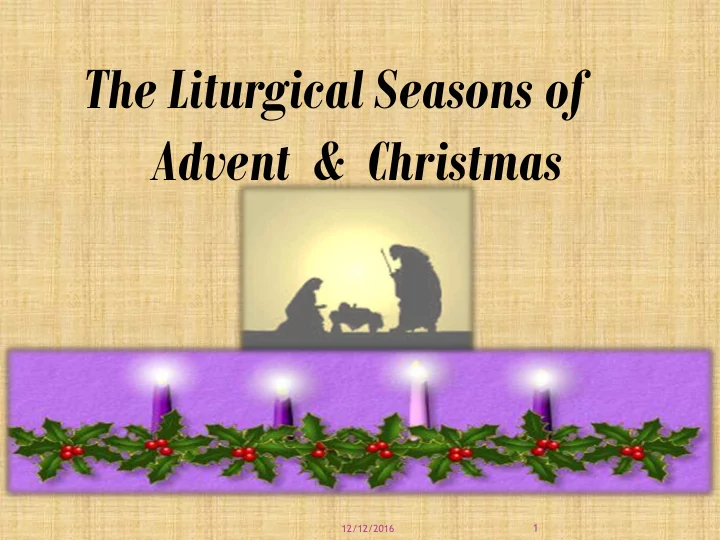
Advent & Christmas 1 12/12/2016 How did the celebration of - - PowerPoint PPT Presentation
The Liturgical Seasons of Advent & Christmas 1 12/12/2016 How did the celebration of Advent come about? The liturgical season of Advent marks the time of spiritual preparation by the faithful before Christmas. Advent begins on the
12/12/2016
1
How did the celebration of Advent come about?
The liturgical season of Advent marks the time of spiritual
preparation by the faithful before Christmas. Advent begins on the Sunday closest to the Feast of St. Andrew the Apostle (Nov. 30). It spans four Sundays and four weeks of preparation, although the last week of Advent is usually truncated because of when Christmas falls.
The celebration of Advent has evolved in the spiritual life
determine with great precision. In its earliest form, beginning in France, Advent was a period of preparation for the Feast of the Epiphany, a day when converts were baptized; so the Advent preparation was very similar to Lent with an emphasis on prayer and fasting which lasted three weeks and later was expanded to 40 days.
12/12/2016
2
In 380, the local Council of Saragossa, Spain, established a three-
week fast before Epiphany. Inspired by the Lenten regulations, the local Council of Macon, France, in 581 designated that from
would be required on Monday, Wednesday, and Friday. Eventually, similar practices spread to England. In Rome, the Advent preparation did not appear until the sixth century, and was viewed as a preparation for Christmas with less of a penitential bent.
The Church gradually formalized the celebration of Advent. The
Gelasian Sacramentary, traditionally attributed to Pope St. Gelasius I (d. 496), was the first to provide Advent liturgies for five Sundays. Later, Pope St. Gregory I (d. 604) enhanced these liturgies composing prayers, antiphons, readings, and responses. Pope St. Gregory VII (d. 1095) later reduced the number of Sundays in Advent to four. Finally, about the ninth century, the Church designated the first Sunday of Advent as the beginning of the Church year.
12/12/2016
3
The Catechism stresses the two-fold meaning of this
“coming” : “When the Church celebrates the liturgy of Advent each year, she makes present this ancient expectancy of the Messiah, for by sharing in the long preparation for the Savior’s first coming, the faithful renew their ardent desire for His second coming” (No. 524).
Music: CBW III—310, 319 Therefore, on one hand, the faithful reflect back and are
encouraged to celebrate the anniversary of the Lord’s first coming into this world. We ponder again the great mystery
us from sin. On the other hand, we recall in the Creed that
and that we must be ready to meet Him.
12/12/2016
4
A good, pious way to help us in our Advent preparation has been the use
borrowed from the German Lutherans in the early 1500s.) The wreath is a circle, which has no beginning or end: So we call to mind how our lives, here and now, participate in the eternity of God’s plan of salvation and how we hope to share eternal life in the Kingdom of Heaven. The wreath is made of fresh plant material, because Christ came to give us new life through His passion, death, and resurrection. Three candles are purple, symbolizing penance, preparation, and sacrifice; the pink candle symbolizes the same but highlights the third Sunday of Advent, Gaudete Sunday, when we rejoice because our salvation is nearer now than when we first became believers, cf. Romans 13:12ff.
The light represents Christ, who entered this world to scatter the
darkness of evil and show us the way of righteousness. The progression of lighting candles shows our increasing readiness to meet our Lord. Each family ought to have an Advent wreath, light it at dinner time, and say the special prayers. This tradition will help each family keep its focus on the true meaning of Christmas. In all, during Advent we strive to fulfill the opening prayer for the Mass of the First Sunday of Advent: “Grant your faithful, we pray, almighty God, the resolve to run forth to meet your Christ with righteous deeds at his coming, so that, gathered at his right hand, they may be worthy to possess the heavenly Kingdom.”
12/12/2016
5
When and how long is Advent?
For most Christians, the Advent Season always begins four Sundays before Christmas; so it is rarely four full weeks long, but only between three and four weeks, depending on what weekday Dec. 25 happens to be in a certain year. The First Sunday of Advent, which also marks the beginning of the new liturgical year for the Church, could be as early as Nov. 27 or as late as Dec. 3. The Third Sunday of Advent is traditionally called "Gaudete Sunday" (from Latin, meaning "Rejoice!), because the "Entrance Antiphon" of this Sunday's Mass is taken from Paul's letter to the Philippians: "Rejoice in the Lord always; again I say, rejoice! The Lord is near." (Phil 4:4,5b) The Fourth Sunday of Advent could be as early as Dec. 18, a full week before Christmas (as in 2005 and 2011), or as late as Dec. 24, making it the same day as "Christmas Eve" (as in 2006 or 2017). Advent technically ends on the afternoon of Dec. 24, since that evening, Christmas Eve, begins the Christmas Season.
12/12/2016
6
What does the word "Advent" mean? When capitalized, "Advent" usually refers to "the coming of Christ into
the world" or to "the liturgical period preceding Christmas"; it may also refer to the "Second Coming" of Christ (the "Advent of our Lord").
In secular English, "advent" (not capitalized) may refer to any "coming"
changed a whole culture (e.g., "The advent of electricity" or "The advent of the computer age").
The word is derived from the Latin adventus ("arrival, approach"),
made up of the preposition ad- ("to, towards"), the verbal root ven- (from venire, "to come"), and the suffix -tus (indicating verbal action).
What are the traditional colors of Advent? In the Roman Catholic Church, the official liturgical color for most of
the Season of Advent is violet. Only on the Third Sunday of Advent is a rose (pink) colored candle lit, as a symbol of joy; the priest may also wear rose vestments on this Sunday.
12/12/2016
7
Each of the four Sundays of Advent has its own special readings and
characteristics:
First Sunday of Advent - The readings look forward to the "End Times" and the coming of the "Day of the Lord" or the "Messianic Age"; the Gospel is an excerpt from the Apocalyptic Discourse of Jesus in one of the Synoptic Gospels. Music: CBW III—315
Second Sunday of Advent - The Gospel readings focus on the preaching and ministry of John the Baptist as the forerunner of Jesus, the one who came to “Prepare the Way of the Lord.” Music: CBW III—317, 351
Third Sunday of Advent - The Gospel readings continue to focus on John the Baptist, while the first and second readings convey the joy that Christians feel with the increasing closeness of the incarnation and the world's salvation. Music: CBW III—303, 318
Fourth Sunday of Advent - The Gospels tell of the events that immediately preceded the birth of Jesus, including the dreams and visions of Joseph and Mary
Lectionary for Mass, "Introduction," chap. 5, par. 93)
12/12/2016
8
There are actually two sets of weekday
readings for the Advent season which are the same every year:
Readings for the weekdays in the first three
weeks, but only up to Dec. 16: the Gospel readings are excerpts from various chapters in Matthew and Luke; the first readings are mostly from the book of the prophet Isaiah.
Readings for the weekdays from Dec. 17 to Dec.
24: the Gospel readings cover all of Matthew 1 and Luke 1, sequentially; the first readings are selected thematically from various prophetic books of the Old Testament.
12/12/2016
9
The weekdays from Dec. 17 to Dec. 24 also make use of
the “O Antiphons," not only during Evening Prayer in the Liturgy of the Hours, but also in the Alleluia verse before the Gospel at Mass. Music:Celebrate in Song/CIS, 6.13
Most familiar today from the Advent hymn, "O Come, O
Come, Emmanuel," the seven traditional "O Antiphons" are actually more than a thousand years old. They have long been used at the very end of Advent (Dec. 17-23) in the liturgical prayer of the Church, as Antiphons for the "Magnificat" sung or recited during Vespers (the Evening Prayer of the Liturgy of the Hours). Since the Second Vatican Council, they have also been adapted (slightly reworded and rearranged) for the "Alleluia Verse" of the Mass (the short scriptural text or paraphrase that immediately precedes the Gospel reading). Each Antiphon invokes the coming of the Messiah, beginning with a biblical title and closing with a specific petition.
12/12/2016
10
· December 17: O Sapientia (O Wisdom) · December 18: O Adonai (O Lord) · December 19: O Radix Jesse (O Root of Jesse) · December 20: O Clavis David (O Key of David) · December 21: O Oriens (O Dayspring) · December 22: O Rex Gentium (O King of the nations) · December 23: O Emmanuel (O With us is God) Benedictine monks arranged these antiphons with a
definite purpose. If one starts with the last title and takes the first letter of each one—Emmanuel, Rex, Oriens, Clavis, Radix, Adonai, Sapientia—the Latin words ero cras are formed, meaning, "Tomorrow, I will come". Therefore Jesus, whose coming Christians have prepared for in Advent and whom they have addressed in these seven Messianic titles, now speaks to them: "Tomorrow, I will come." So the "O Antiphons" not only bring intensity to Advent preparation, but bring it to a joyful conclusion.
12/12/2016
11
Note that the first verse of the popular hymn (O
Come, O Come Emmanuel)is actually the last of the traditional "O Antiphons" (for Dec. 23!), while the
most hymnals) correspond to the Antiphons for Dec. 17 to Dec. 22.
Unfortunately, many churches sing the first verse
maybe also sing verses two and three, but never get around to singing the other beautiful verses.
Ideally, the hymn "O Come, O Come, Emmanuel"
But since it is so popular, and some people might not even realize that it was Advent unless they heard this hymn, it could be sung earlier, possibly even each Sunday (to help unify the season liturgically).
12/12/2016
12
Yet if this is done, there are better ways of distributing the
verses over the four weeks. Since most people know the tune so well, one could easily sing the first verse at the end of the season (4th Sunday), and people could just as easily sing the other verses
First Sunday: Verses 2 (Wisdom) & 3 (Lord) Second Sunday: Verses 4 (Rod of Jesse) & 5 (Key of David) Third Sunday: Verses 6 (Dayspring) & 7 (Desire of Nations) Fourth Sunday: Verse 1 (Emmanuel) & repeat one or two others Or, if your congregation insists on singing the first verse on the
first Sunday, then at least sing all the other verses throughout the
depending on how many verses your congregation normally sings):
First Sunday: Verses 1 (Emmanuel) & 2 (Wisdom) & 3 (Lord) Second Sunday: Verses 3 (Lord) & 4 (Rod of Jesse) & 5 (Key of David) Third Sunday: Verses 5 (Key of David) & 6 (Dayspring) & 7 (Desire of
Nations)
Fourth Sunday: Verse 1 (Emmanuel) & any others you wish to repeat
12/12/2016
13
Advent Music: In addition to the countless
songs, carols, and hymns for Christmas, there is much good, thematically appropriate music for Advent, not just "O Come, O Come, Emmanuel" (which really ought to be saved for the last eight days of Advent). Music: CBW III—608 (Communion)
12/12/2016
14
12/12/2016
15
Christmas, the festival commemorating the birth of Jesus
Christ, is celebrated by a majority of Christians on December 25 on the Gregorian calendar. But early Christians did not celebrate his birth, and no one knows on which date Jesus was actually born (some scholars believe that the actual date was in the early spring, which would place the occurrence of the holiday closer to Easter, the holiday commemorating his resurrection).
The origins of the holiday and its December date lie in
the ancient Greco-Roman world, as commemorations probably began sometime in the 2nd century. There are at least three possible origins for the December date. The Roman Christian historian Sextus Julius Africanus dated Jesus’ conception to March 25 (the same date upon which he held that the world was created), which, after nine months in his mother’s womb, would result in a December 25 birth.
12/12/2016
16
In the 3rd century, the Roman Empire, which at the time
had not adopted Christianity, celebrated the rebirth of the Unconquered Sun (Sol Invictus) on December 21/22—this holiday not only marked the return of longer days after the winter solstice but also followed the popular Roman festival called the Saturnalia (during which people feasted and exchanged gifts). It was also the birthday of the Indo- European deity Mithra, a god of light and loyalty whose cult was at the time growing popular among Roman soldiers.
As the church in Rome only formally celebrated
December 25th in 336 AD during the reign of the emperor Constantine, who made Christianity the effective religion
date had the political motive of weakening the established pagan celebrations. The date was not widely accepted in the Eastern Empire where January 6 had been favored, and Christmas did not become a major Christian festival until the 9th century.
12/12/2016
17
The Nativity of the Lord (Christmas), Dec. 25 St. Stephen, The First Martyr, Dec. 26 St. John, Apostle and Evangelist, Dec. 27 The Holy Innocents, Martyrs, Dec. 28 The Holy Family of Jesus, Mary, and Joseph, Sunday
between Dec. 25 and Jan. 1(Transferred to Dec. 30 if the Sunday is Jan. 1)
Solemnity of Mary, the Holy Mother of God, Jan. 1
(Octave Day of Christmas)
Epiphany of the Lord, Jan. 6 or the Sunday between
Baptism of the Lord, the Sunday after January 6 or, if
in a particular country the Epiphany is celebrated on January 7 or 8, on the following Monday (i.e. January 8
Lord is the following Sunday, i.e. January 13.
12/12/2016
18
In our Roman Catholic tradition, the liturgical celebration of Christmas
includes four distinct celebrations of the Eucharist. The Vigil Mass of Christmas may be celebrated on December 24, either before or after Evening Prayer I. On Christmas itself, following the ancient tradition of Rome, three masses may be celebrated, namely: The Mass During the Night (often referred to as Midnight Mass), the Mass at Dawn, and the Mass During the Day. Each celebration possesses a unique character which is defined by its proper liturgical texts and the time of day when it is to take place.
It is interesting to note that in the official liturgical texts and rubrics, the
first of the three Masses of Christmas itself is not referred to as “Midnight Mass” but rather as “Mass During the Night”(Missa in Nocte). Traditionally this has translated into Midnight Mass which is a custom dear to many hearts and a laudable practise where pastorally and practically feasible. However, the fact is the rubric refers to Mass during the night and the current Lectionary and the revised Roman Missal no longer refer to “midnight” as such. None of this means to say or imply that Mass at Midnight is abrogated.
12/12/2016
19
A formal "Proclamation of the Birth of Christ" is
traditionally chanted or recited near the beginning of the Christmas Mass During the Night and/or during the Liturgy
Solemnity of the Nativity of the Lord from the Roman Martyrology draws upon Sacred Scripture to declare in a formal way the birth of Christ. It begins with creation and relates the birth of the Lord to the major events and personages of sacred and secular history. The particular events contained in the announcement help pastorally to situate the birth of Jesus in the context of salvation history.
This text, The Nativity of our Lord Jesus Christ, may be
chanted or recited before the beginning of Christmas Mass during the Night. It may not replace any part of the Mass. (The Proclamation is found in Appendix I, Page 1442, of the Roman Missal, Third Edition.)
12/12/2016
20
The Nativity of our Lord Jesus Christ
The Twenty-fifth Day of December, when ages beyond number had run their course from the creation of the world, when God in the beginning created heaven and earth, and formed man in his own likeness; when century upon century had passed since the Almighty set his bow in the clouds after the Great Flood, as a sign of covenant and peace; in the twenty-first century since Abraham, our father in faith, came out of Ur of the Chaldees; in the thirteenth century since the People of Israel were led by Moses in the Exodus from Egypt; around the thousandth year since David was anointed King; in the sixty-fifth week of the prophecy of Daniel; in the one hundred and ninety-fourth Olympiad; in the year seven hundred and fifty-two since the foundation of the City of Rome; in the forty-second year of the reign of Caesar Octavian Augustus, the whole world being at peace, JESUS CHRIST, eternal God and Son of the eternal Father, desiring to consecrate the world by his most loving presence, was conceived by the Holy Spirit, and when nine months had passed since his conception, was born of the Virgin Mary in Bethlehem of Judah, and was made man:
The Nativity of Our Lord Jesus Christ according to the flesh.
12/12/2016 21
Regarding the readings for the feast, a rubric in the
Lectionary for Christmas indicates that it is permitted to choose among the readings for the three Masses of Christmas, depending on pastoral needs. However, this choice must respect the proper liturgical order of Old Testament, Psalm, Epistle, and Gospel. Notably, the rubric appears in the Lectionary only after the readings of the Vigil Mass on December 24 and refers
itself (During the Night, Dawn, During the Day). It would appear, therefore, that the readings for the Vigil of Christmas Mass fall outside the possibility for
readings does not necessarily extend to the other liturgical formulas (Collects, etc.) and so these must be respected in accordance with the time of celebration.
12/12/2016
22
Christmas itself is the only day on the liturgical calendar which has
four different sets of biblical readings for the four different Masses that can be celebrated at various times: Vigil Mass (Christmas Eve), Mass at Midnight, Mass at Dawn, and Mass during the Day.
The Gospel readings for the first three Masses contain excerpts from the
biblical accounts of the birth of Jesus (from Matthew and Luke), while the Gospel reading for the Mass of Christmas Day is the Prologue of John's Gospel (John 1:1-18).
The first readings are various selections from the book of the prophet Isaiah,
while the Responsorial Psalms, the Second Readings, and the Gospel Acclamations are chosen thematically.
The readings for the other major feasts of the Christmas Season
include the biblical accounts of the various events being commemorated.
For example, the Gospel reading for the Solemnity of the Epiphany of the Lord
is always Matthew 2:1-12, the biblical account of the visit of the Magi from the East. Similarly, the Gospel readings for the Feast of the Baptism of the Lord, which concludes the Christmas season, are the accounts of the Baptism
respectively.
The first and second readings for all feast days are chosen thematically from a
variety of Old Testament books and New Testament letters.
For most weekdays during the Christmas season, the first reading is taken
from the First Letter of John.
12/12/2016
23
The earliest evidence of this feast is found in Alexandria (Egypt) c. 215
A.D. according to St. Clement. The various narratives for the feast in the 4th and early 5th Centuries were the birth of Jesus, the visit of the Magi, the baptism of Jesus, the wedding feast of Cana, the multiplication of the loaves and fish, and the Transfiguration. All had the element of change and surprise, and the theology of the feast was a manifestation of God in the world.
The theology of Epiphany is revealed in the Collects (Presidential Prayers)
for the day. Each prayer emphasizes God’s ongoing presence and manifestation in the Church. Common to each prayer is the imagery of light which has a metaphorical link to Easter.
Unfortunately, this link is not fully played out in the common RCIA
practise of Enrolment of Catechumens on 1st Sunday of Advent/Election
enrolment of candidates for Easter baptism.
The NT embraces a variety of theologies of baptism and the loss of the
infancy and birth images for baptism in the feast of the Epiphany as the Eastern traditions surrendered to the Western dating of Christ’s nativity (December 25) has contributed over time to the feast being eclipsed in
been juggled around in its date, transferred from a fixed liturgical date to the nearest Sunday between January 2-8.
12/12/2016
24
On the Epiphany of the Lord, after the
proclamation of the Gospel, a Deacon, lector, or cantor, in keeping with an ancient practise of the Church, may announce from the ambo the moveable feasts of the current year according to the formula found in Appendix I, Page 1440, of the Roman Missal, Third Edition.
Ash Wednesday Easter Day Ascension Pentecost Corpus Christi The First Sunday of Advent
12/12/2016
25
Solemnity of Christmas (CBW III—330, 394) Feast of the Holy Family Mary, Mother of God (CIS, 6.24) Epiphany (CBW III—338) Baptism of the Lord (CBW III—350)
12/12/2016
26
The following questions will be helpful to pastors and liturgical committees when determining a schedule of additional Christmas Masses During the Night and/or Masses on Christmas Day:
1. Is there a genuine pastoral need for additional Masses in this
parish, or are additional Masses being considered simply for convenience?
2. Will the multiplication of Christmas Masses During the Night
diminish or obscure the importance of December 25 as the day on which the universal Church celebrates the Nativity of the Lord?
3. Can the needs of special groups be met more properly within a
regularly scheduled Mass of Christmas Day (e.g. families with young children)?
4. Are there sufficient liturgical ministers available for additional
Masses so that worthy celebrations can take place without undermining their quality?
5. Will the scheduling of additional Masses place an undue burden
three Masses on the feast of Christmas?
12/12/2016
27
Particular Guidelines for the Archdiocese of Regina
Given the pastoral situation in the Archdiocese of Regina of most
priests serving more than one parish community and having to generally celebrate more than one Mass on any given Sunday or Holy Day of Obligation, the following guidelines for the celebration of Christmas Masses are established:
1. Parishes should work towards avoiding several Christmas
Masses During the Night when possible, especially if they begin in the early evening, and when necessary, their number should be kept to a minimum.
2. Christmas Masses During the Night should be scheduled no
earlier than 7:00 p.m.
3. When Christmas is celebrated on Saturday the regularly
scheduled Saturday evening Mass in anticipation of Sunday should be omitted altogether.
4. When Christmas is celebrated on Monday, in order to keep
Sunday distinct from Christmas there should be no Sunday Masses celebrated on Sunday evenings, and no Christmas Masses During the Night should be celebrated before 7:00 p.m.
12/12/2016
28