African Freedom of Expression Exchange (AFEX) Panelists Ms - - PowerPoint PPT Presentation

african freedom of expression exchange afex panelists
SMART_READER_LITE
LIVE PREVIEW

African Freedom of Expression Exchange (AFEX) Panelists Ms - - PowerPoint PPT Presentation

African Freedom of Expression Exchange (AFEX) Panelists Ms Felicia Anthonio, Coordinator, African Freedom of Expression Exchange (AFEX) Ms Koliwe Majama, ICTs and Broadcasting Officer, Media Institute of Southern Africa, Zimbabwe


slide-1
SLIDE 1

African Freedom of Expression Exchange (AFEX)
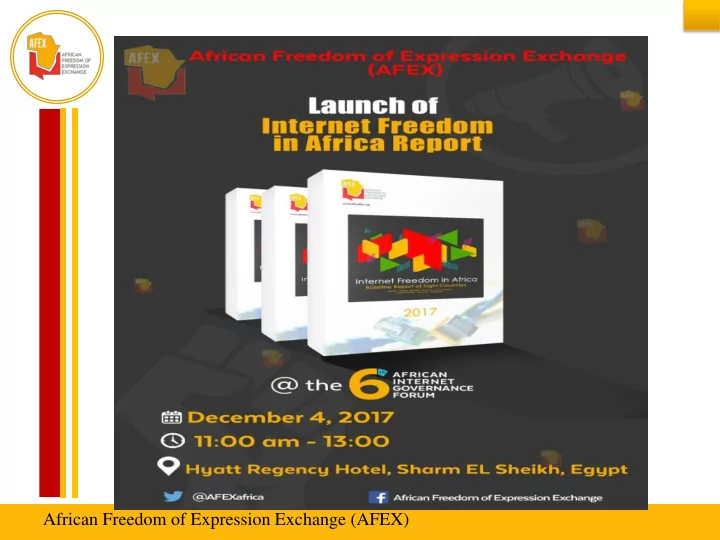
slide-2
SLIDE 2

African Freedom of Expression Exchange (AFEX)

Panelists

  • Ms Felicia Anthonio, Coordinator,

African Freedom of Expression Exchange (AFEX)

  • Ms Koliwe Majama, ICTs and

Broadcasting Officer, Media Institute of Southern Africa, Zimbabwe

  • Dr Mawaki Chango, Founder of

DigiLexis

  • Ms Tusi Fokane, Executive Director of

Freedom of Expression Institute (FXI)

slide-3
SLIDE 3

African Freedom of Expression Exchange (AFEX)

Rationale for Producing Internet Freedom in Africa Report

  • Indispensable role of the Internet in

Sustainable Development

  • Internet as an enabler of other human

rights

  • Increasing Reports of Network

shutdowns

  • Report will serve as an advocacy

material for press freedom groups in Africa

slide-4
SLIDE 4

African Freedom of Expression Exchange (AFEX)

Methodology

  • Monitoring and reporting of Internet

related policies and practices in selected countries

  • Received country reports from AFEX

members in eight countries

  • Consolidated report
slide-5
SLIDE 5

African Freedom of Expression Exchange (AFEX)

Country Reports

  • Findings of the Internet Freedom in

Africa report are presented on a country-by-country basis

  • Recommendations are made at the

end of each country reports with general recommendations at the end

  • f the report aimed at improving the

Internet landscape in Africa

slide-6
SLIDE 6

African Freedom of Expression Exchange (AFEX)

Findings: Ghana

  • Ghana’s Internet landscape since 1994
  • Freedom of expression rights extended online –

Data Protection Act 2012, Electronic Communications Act, 2008 and most recently the National Cyber Security Policy and Strategy.

  • Currently has six mobile service network
  • perators
slide-7
SLIDE 7

African Freedom of Expression Exchange (AFEX)

Findings: Ghana

  • Penetration rate of 76.22% as at April 2017.
  • 40.6% of Ghanaians depend on the internet to

gather information on products and services

  • Ghana has not experienced network shutdown
  • No reported incidents of government interference

in citizens rights online, however citizens tend to abuse the rights of others online – revenge porn

slide-8
SLIDE 8

African Freedom of Expression Exchange (AFEX)

Findings: Ghana

Challenges Rural-urban digital gap Gender digital divide – 20% women have access to internet Cyber-attacks Cybercrime .

slide-9
SLIDE 9

African Freedom of Expression Exchange (AFEX)

Findings: Liberia

  • Connected to the Internet in mid-1990s – Data

Technology solutions, a Liberian-owned company

  • Adoption of National ICT/Telecommunications

Policy in 2010

  • 395,063 internet users 83.5% of whom are on

Facebook

slide-10
SLIDE 10

African Freedom of Expression Exchange (AFEX)

Findings: Liberia

  • Liberia has seven web hosting

companies (2012)

  • Although

Liberia’s Constitution guarantees freedom of expression rights, right to privacy, Sections still criminalises speech

  • Has

not experienced internet shutdown

  • No reported cases of surveillance

and lawful interception

slide-11
SLIDE 11

African Freedom of Expression Exchange (AFEX)

Findings: Liberia

Challenges

  • High data cost
  • Low broadband speeds
  • Existence of laws that criminalise

speech offline/online

  • Few policies in place to guide access,

use and online behaviour

slide-12
SLIDE 12

African Freedom of Expression Exchange (AFEX)

Findings: Nigeria

  • Obtained internet in 1995
  • National Constitution guarantees freedom of

expression and access to information offline but silent on online expression

  • No Data Protection law however, the Digital rights

and Freedoms Bill currently before National Parliament contains significant data protection provisions.

  • Cybercrimes Act Section 24 A & B imposes harsh

penalties that violate the right to free expression under the guise of ensuring national security – arrest of bloggers and online journalists.

slide-13
SLIDE 13

African Freedom of Expression Exchange (AFEX)

Findings: Nigeria

  • Cyber-attacks are not common in

Nigeria – one case recorded since 2015

  • Internet shutdown not common
slide-14
SLIDE 14

African Freedom of Expression Exchange (AFEX)

Findings: Nigeria

Challenges

  • Existence of harsh laws that seeks to

stifle online expression

  • Use of defamation laws to harass

journalists and

  • rdinary

citizens

  • nline
  • Lack of laws to protect citizens’

privacy and rights online

slide-15
SLIDE 15

African Freedom of Expression Exchange (AFEX)

Findings: Uganda

  • Connected to the Internet in 1994.
  • One of the fastest growing internet space

in Africa

  • 22 ISPs – MTN, Airtel, Africell, Uganda

Telecom and Vodafone

  • Has a national fibre-optic backbone
  • Communication sector expanded rapidly

due to Uganda’s young population (78% of population are below 30 years)

slide-16
SLIDE 16

African Freedom of Expression Exchange (AFEX)

Findings: Uganda

  • Several laws: Uganda’s

Communications Act (UCA 2013), Computer Misuse Act 2011, Anti- terrorism Act, Anti-Pornographic Act of 2014, some of which are used to harass, arrest and prosecute individuals.

  • Internet shutdowns – one in April 2011

and two cases recorded in 2016

slide-17
SLIDE 17

African Freedom of Expression Exchange (AFEX)

Findings: Uganda

Challenges

  • Restrictive regulations
  • Poor infrastructure
  • Prohibitive cost of data and mobile

devices

  • Poor quality of service
slide-18
SLIDE 18

African Freedom of Expression Exchange (AFEX)

Findings: Somalia

  • Internet penetration – 1.9%
  • 6.8 mobile subscribers – not all

phones are connected to internet

  • Absence of a central regulatory

authority posing serious challenges

  • f interconnectivity among networks
  • Somalia does not have any officially

recognized national regulation against cybercrime

slide-19
SLIDE 19

African Freedom of Expression Exchange (AFEX)

Findings: Somalia

Internet shutdown/website blockage

  • In February 2016, ISPs in Somalia

blocked 29 websites critical of government

  • Most recent: In January 2017, Telesom

blocked access to news website called Aftahan.com. for publishing a poetic work by a local artist who criticised the company’s mobile banking system.

slide-20
SLIDE 20

African Freedom of Expression Exchange (AFEX)

Findings: Somalia

  • Challenges
  • Weak authority
  • Fragmented society
  • Lack of regulation in the country’s

cyberspace

slide-21
SLIDE 21

African Freedom of Expression Exchange (AFEX)

Findings: South Sudan

  • 20.5% Internet Penetration
  • Constitution guarantees FOE but restrictive clause in

ARTICLE 24 is worded vaguely which usually allows authorities to interpret them subjectively.

  • Adopted an ICT Policy in 2012
  • Internet landscape is relative – mobile networks

remain the source of Internet connection, the country does not have any internet specific laws.

  • No internet regulatory body – free environment but

threats

  • Relatively free environment
  • No reported cases of arrests for online expression
slide-22
SLIDE 22

African Freedom of Expression Exchange (AFEX)

Findings: South Sudan

Internet Shutdowns

  • President Salva Kiir threatened

to shut down the net in 2016 following circulation

  • f

rumours that he had died.

  • Has

experienced two shutdowns 2013/2014

  • Reports of website blockage-

2017

slide-23
SLIDE 23

African Freedom of Expression Exchange (AFEX)

Findings: South Sudan

Challenges:

  • Urban-rural digital divide
  • High cost of data and devices
  • Cybercrime and fake news -

publication of false information

  • Low civil society engagements in

advocating for online rights due to limited funding

slide-24
SLIDE 24

African Freedom of Expression Exchange (AFEX)

Findings: South Africa

  • 59.3 % of South Africans households

access or use the Internet

  • Like most countries, Internet access

is highest in urban and larger cities in South Africa

  • Free and open digital environment
slide-25
SLIDE 25

African Freedom of Expression Exchange (AFEX)

Findings: South Africa

  • Electronic Communications and

Transactions Act

  • Cybercrimes and Cyber Security Bill

(2017) remains problematic

  • Surveillance and lawful interception
  • Hate Speech Bill
  • No known internet shutdown in South

Africa but reports of arbitrary filtering, blocking and content control, including parental control of what information children can access

slide-26
SLIDE 26

African Freedom of Expression Exchange (AFEX)

Findings: South Africa

Challenges:

  • Access
  • Repressive laws
slide-27
SLIDE 27

African Freedom of Expression Exchange (AFEX)

Findings: Zimbabwe

  • Experienced the internet in 1991
  • Now Zimbabwe has 15 ISPs
  • No cyber laws in place
  • Government continues to use alternative laws to limit the

use of the Internet – Criminal Law (codification and reform) Act and the Postal and Telecommunications Act

  • Existing laws targeting traditional media are being

extended online

  • Active CSOs engagement in Zimbabwe’s internet

landscape

slide-28
SLIDE 28

African Freedom of Expression Exchange (AFEX)

Findings: Zimbabwe

Incidents of online violations recorded- Two hour disruption of WhatsApp during nationwide “shutdown’ in july 2016 Arbitrary blocking and filtering

slide-29
SLIDE 29

African Freedom of Expression Exchange (AFEX)

Findings: Zimbabwe

Challenges:

  • Poor or no internet access in rural
  • High cost of internet services
  • Widespread poverty making it difficult

for ordinary citizens to purchase mobile devices and services – urban-rural digital divide

  • Lack of relevant content
  • Regulatory challenges
  • Lack of digital literacy
slide-30
SLIDE 30

African Freedom of Expression Exchange (AFEX)

Recommendations

African Governments should:

  • Amend and repeal laws that are inimical to freedom of

expression

  • Adopt Internet laws/legislations that are progressive

and rights-respecting to ensure/guarantee online freedom, safety and security of all citizens.

  • Collaborate with Internet Service Providers (ISPs),

Telecommunications, electricity power suppliers and

  • ther stakeholders to explore ways of driving down

the cost of data and expand internet connectivity

  • Invest more in the ICTs sector to help make internet

connectivity more accessible and affordable throughout their respective countries to ensure an all inclusive cyberspace.

slide-31
SLIDE 31

African Freedom of Expression Exchange (AFEX)

Recommendations

African Governments should:

  • Refrain from coercing service providers

to monitor, filter, block and shut down the internet and other communications networks.

  • Recognise that Internet shutdowns are

inimical to freedom of expression, access to information and enjoyment

  • Governments across the region should

collaborate to tackle the threats of cybercrime

slide-32
SLIDE 32

African Freedom of Expression Exchange (AFEX)

Recommendations

Service Providers should:

  • Resist/defy unjustified orders from governments to

shut down the Internet.

  • Endeavour to invest more in the ICTs sector and

expand services across the respective countries they

  • perate in to help bridge the rural-urban digital gap
  • Provide fast, reliable and affordable internet services

at all times

  • Insist and demand court orders or warrants before

disclosing user information or communications or taking down content.

  • Proactively engage CSOs and join in advocacy against

governments’ abuse of users rights such as network shutdowns.

slide-33
SLIDE 33

African Freedom of Expression Exchange (AFEX)

Recommendations

Civil Society (including academia and media) should:

  • Conduct regular monitoring and evaluation
  • f the ICTs sectors in their respective

countries to highlight developments (positive and negative) for proactive and timely interventions to be rolled out.

  • Proactively engage governments, service

providers and other stakeholders to ensure that rights-respecting issues are factored into formulation of policy and other interventions

slide-34
SLIDE 34

African Freedom of Expression Exchange (AFEX)

Recommendations

Civil Society (including academia and media) should:

  • Vigorously advocate for the repeal of penal

codes and sections of legislation that criminalise speech as well as advocate for the withdrawal and/or review of Bills which have repressive provisions

  • Vigorously advocate against all forms of

network shutdowns.

  • Educate, sensitise and build capacity of peple
  • n their rights, responsible use of the internet,
  • nline safety and other internet-related issues.
slide-35
SLIDE 35

African Freedom of Expression Exchange (AFEX)

Recommendations

The Judiciary should:

  • Consider the supreme interest and of

the public in countries where court

  • rders are required for government to

shut down the internet.

  • Protect the rights of citizens at all

times

slide-36
SLIDE 36

African Freedom of Expression Exchange (AFEX)

Recommendations

Internet Users should:

  • Use the internet responsibly and

respect the rights of other internet users at all times

  • Actively participate in rights-based

campaigns and speak out against threats to internet freedoms

slide-37
SLIDE 37

African Freedom of Expression Exchange (AFEX)

Want to Know more about AFEX?

Follow our activities on: Website: www.africafex.org Twitter: @AFEXafrica Facebook: African Freedom of Expression Exchange (AFEX) Send a mail to: info@africafex.org for Inquiries.