Aged Care Accreditation Standards 1. Management systems, staffing - - PowerPoint PPT Presentation

aged care accreditation standards
SMART_READER_LITE
LIVE PREVIEW

Aged Care Accreditation Standards 1. Management systems, staffing - - PowerPoint PPT Presentation

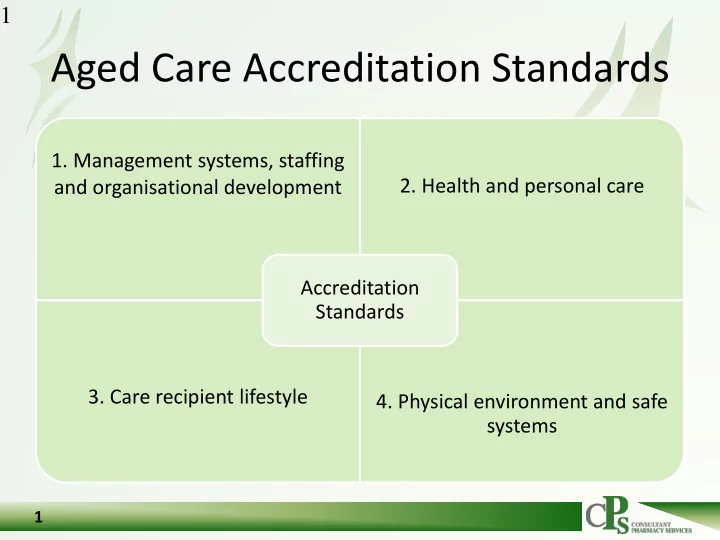
1 Aged Care Accreditation Standards 1. Management systems, staffing 2. Health and personal care and organisational development Accreditation Standards 3. Care recipient lifestyle 4. Physical environment and safe systems 1 Resources 3 4


slide-1
SLIDE 1

1

  • 1. Management systems, staffing

and organisational development

  • 2. Health and personal care
  • 3. Care recipient lifestyle
  • 4. Physical environment and safe

systems Accreditation Standards

Aged Care Accreditation Standards

1

slide-2
SLIDE 2
slide-3
SLIDE 3

3

Resources

slide-4
SLIDE 4

4

slide-5
SLIDE 5

5

slide-6
SLIDE 6

6

  • 2.3 Education and staff development

Management and staff have appropriate knowledge and skills to perform their roles effectively.

  • 2. Health and personal care

6

slide-7
SLIDE 7

Educational modules

7

slide-8
SLIDE 8

8

Medication competency modules

8

slide-9
SLIDE 9

9

User reports

slide-10
SLIDE 10

10 10

slide-11
SLIDE 11
  • Results

– Management demonstrates residents’ medication is managed safely and correctly. – Management can demonstrate staff compliance with the medication management system. – Management can demonstrate the medication management system is safe, according to relevant legislation, regulatory requirements, professional standards and guidelines. – Residents/representatives confirm they are satisfied that medication is managed safely and correctly.

  • Right resident, right

medication, right dose, right route at the right time.

– Looking at home processes

  • Residents individual needs
  • Staff skill levels
  • Ordering procedure
  • Storage
  • Administration
  • Incident reports

2.7 Medication management

11

slide-12
SLIDE 12

12

2.7 Medication management

  • Processes

– Are policies and procedures documented and made available to staff? – How are staff practices developed and monitored to ensure understanding and compliance with processes and procedures? For example, are quality assurance audits conducted and reviewed, and does supervision of staff occur including in relation to the use of assessment tools, equipment, and methods

  • f managing medication?

12

slide-13
SLIDE 13

Specifics

13

slide-14
SLIDE 14
  • How does the home

ensure regular evaluation and review

  • f residents’ medication

needs and preferences as undertaken by a pharmacist or medical

  • fficer? For example,

does this include consideration of:

  • allergies
  • each resident’s cognitive ability
  • each resident’s pain management

needs

  • each resident’s swallowing and
  • ther physical abilities
  • medication side effects including

polypharmacy effects

  • monitoring of doses which may

need to be regularly adjusted (for example, psychotropic medications, warfarin and insulin)?

2.7 Medication management

14

slide-15
SLIDE 15
  • Are medication side

effects reported to the resident’s medical

  • fficer? For example,

are staff aware of follow-up actions and protocols as a result of adverse drug reactions and adverse pathology results?

  • Is there proper recording and
  • rdering of medication orders?

For example, are:

  • rders reviewed for

appropriateness

  • rders current, legible, signed

and dated, with the dose and time prescribed

  • medications ordered using a

secure communication system

  • urgent and out-of-hours orders

catered for?

2.7 Medication management

15

slide-16
SLIDE 16
  • Does the storage of

medication include:

– a level of security of medications appropriate for the medication and circumstances – refrigeration of medications as appropriate – dating of opened medications as appropriate (creams, ointments, etc) – correct and safe storage of medications for residents who self-administer?

  • Does administration of medications

to residents by staff include:

– the correct identification of residents – administration record entries which do not contain alterations or erasure of drugs –

  • f dependence (as prohibited by law)

– documented methods of alteration and administration and any equipment used to alter medication (for example, for the crushing of the medication) – ensuring residents receive the correct medication, in the correct dose via the correct route and at the correct time – assessment of the skills and knowledge of all staff administering medications – administering of medication in a manner which promotes residents’ rights?

2.7 Medication management

16

slide-17
SLIDE 17
  • Does self-administration of

medications by residents include:

– assessment of the resident’s ability to self-administer – education for the resident to self-administer in a safe and correct manner – regular monitoring of the resident self-administering – consultation with residents/representatives and

  • thers (medical officers and

health professionals) about the self-administration?

  • Do nurse-initiated

medications and PRN5 medications include indications of:

– reason for administration – maximum dosages – route of administration and any other administration instructions – authorisations by each resident’s doctor?

2.7 Medication management

17

slide-18
SLIDE 18

18

  • A patient may choose to administer their own medication

following an assessment by a medical practitioner that medication administration can be safely carried out by that

  • individual. Documentation by the medical practitioner that

the patient is to self-administer medications should be made

  • n the patient’s medication chart, care notes or health record.
  • Policy

– form of competency assessment for self medication; – monitoring and documentation; – frequency of re-assessment of competency; – possible forms of assistance which will be made available; – communication with prescriber and resident; and storage guidelines

Self-administration

18

slide-19
SLIDE 19
  • How does the home ensure regular

evaluation and review of the medication management system including:

– processes for reviewing residents’ medications (including the use of PRN, psychotropic medications, drug interactions, and the use of nurse-initiated medications as appropriate) – regular review/use of multidisciplinary teams where possible – medication ordering processes, including emergency supplies – correctness of medications against medication records and orders – medication administration processes including for residents who self-administer – monitoring of the effectiveness and appropriateness of assessment tools?

  • Does the home respond to actual
  • r potential adverse drug events,

significant adverse drugs reactions, and medication errors? For example, how does the home ensure medication incidents are documented, reported and appropriately addressed?

  • How does the home ensure

appropriate disposal of medications including that of ceased, contaminated, damaged and out-of-date medications?

2.7 Medication management

19
slide-20
SLIDE 20

20

  • Expected outcome 1.7 Inventory and equipment

Problems with the ordering, storage and disposal of medications may indicate gaps in expected outcome 1.7 Inventory and equipment.

  • Expected outcome 2.1 Continuous improvement

Medication management data (which may include prevalence of medication errors or use of psychotropic medications) may be used by the home to identify opportunities for improvement within the home in relation to medication management and linked expected outcomes.

Links to other standards

20

slide-21
SLIDE 21

21

  • Expected outcome 2.2 Regulatory compliance There are various

state and territory laws and guidelines which govern medication management practices. While assessors do not assess compliance with such requirements, the home should be able to demonstrate how its processes are in accordance with relevant protocols and are hence ‘correct’.

  • Other expected outcomes of Standard Two Various expected
  • utcomes relating to health and personal care may involve the

administration of medication. Therefore, identification of gaps within these expected outcomes (for example, relating to pain management, continence management, behavioural management

  • r sleep) may indicate subsequent gaps in the home’s systems

relating to medication management and vice versa.

Links to other standards

21

slide-22
SLIDE 22

22

slide-23
SLIDE 23

23

slide-24
SLIDE 24

24

24

slide-25
SLIDE 25

25

25

slide-26
SLIDE 26

26

26

slide-27
SLIDE 27

27

27

slide-28
SLIDE 28

Routine QUM indicators

QUM indicators

Polypharmacy

Benzodiazepines

RMMR recommendations

Antipsychotics

  • Quarterly reports from

CPS

slide-29
SLIDE 29

29

Polypharmacy

Facility Date of Visit QUM Indicators Polypharmacy Number Percent Names A Feb-17 12 42.9 A May-17 12 18.2 A subtotal 24 25.5 B Feb-17 8 25.8 B May-17 3 14.3 B subtotal 11 21.2 C Feb-17 6 60.0 C May-17 5 50.0 C subtotal 11 55.0 D Feb-17 9 69.2 D Apr-17 17 50.0 D subtotal 26 55.3 E Jan-17 5 38.5 E Mar-17 5 41.7 E Apr-17 1 50.0 E subtotal 11 40.7 F Feb-17 7 38.9 F May-17 3 42.9 F subtotal 10 40.0 G Apr-17 10 28.6 G Feb-17 1 14.3 G May-17 13 41.9 G subtotal 14 36.8 Total 93 38.1

CPS benchmark for polypharmacy is ~33%

slide-30
SLIDE 30

30

Antipsychotics

Facility Date of Visit QUM Indicators Antipsychotics Number Percent Names A Feb-17 6 21.4 A May-17 7 10.6 A subtotal 13 13.8 B Feb-17 7 22.6 B May-17 6 28.6 B subtotal 13 25.0 C Feb-17 2 20.0 C May-17 1 10.0 C subtotal 3 15.0 D Feb-17 4 30.8 D Apr-17 6 17.6 D subtotal 10 21.3 E Jan-17 1 7.7 E Mar-17 0.0 E Apr-17 2 100.0 E subtotal 3 11.1 F Feb-17 9 50.0 F May-17 2 28.6 F subtotal 11 44.0 G Apr-17 1 2.9 G Feb-17 0.0 G May-17 12 38.7 G subtotal 12 31.6 Total 53 21.7

CPS benchmark for antipsychotics is ~20%

slide-31
SLIDE 31

Psychotropic Audits

slide-32
SLIDE 32

32

Benzodiazepines

Facility Date of Visit QUM Indicators Benzodiazepines Numbe r Percent Names A Feb-17 9 32.1 A May-17 4 6.1 A subtotal 13 13.8 B Feb-17 4 12.9 B May-17 5 23.8 B subtotal 9 17.3 C Feb-17 3 30.0 C May-17 1 10.0 C subtotal 4 20.0 D Feb-17 4 30.8 D Apr-17 11 32.4 D subtotal 15 31.9 E Jan-17 3 23.1 E Mar-17 2 16.7 E Apr-17 1 50.0 E subtotal 6 22.2 F Feb-17 7 38.9 F May-17 2 28.6 F subtotal 9 36.0 G Apr-17 7 20.0 G Feb-17 1 14.3 G May-17 9 29.0 G subtotal 10 26.3 Total 60 24.6

CPS benchmark for benzodiazepines is ~25%

slide-33
SLIDE 33

33

Recommendations

Facility Date of Visit Recommendations Made Per Review Cessation Changes Addition Total Done Number Per Review Number Per Review Number Per Review Number Per Review A Feb-17 28 24 0.86 23 0.82 6 0.21 53 1.89 A May-17 66 30 0.45 28 0.42 3 0.05 61 0.92 A subtotal 94 54 0.57 51 0.54 9 0.10 328 3.49 B Feb-17 31 18 0.58 35 1.13 8 0.26 61 1.97 B May-17 21 18 0.86 6 0.29 2 0.10 26 1.24 B subtotal 52 36 0.69 41 0.79 10 0.19 529 10.17 C Feb-17 10 10 1.00 12 1.20 5 0.50 27 2.70 C May-17 10 3 0.30 9 0.90 1 0.10 13 1.30 C subtotal 20 13 0.65 21 1.05 6 0.30 656 32.80 D Feb-17 13 18 1.38 9 0.69 10 0.77 37 2.85 D Apr-17 34 47 1.38 38 1.12 5 0.15 90 2.65 D subtotal 47 65 1.38 47 1.00 15 0.32 823 17.51 E Jan-17 13 13 1.00 17 1.31 10 0.77 40 3.08 E Mar-17 12 16 1.33 16 1.33 2 0.17 34 2.83 E Apr-17 2 4 2.00 2 1.00 1 0.50 7 3.50 E subtotal 27 33 1.22 35 1.30 13 0.48 74 2.74 F Feb-17 18 20 1.11 24 1.33 8 0.44 52 2.89 F May-17 7 6 0.86 11 1.57 1 0.14 18 2.57 F subtotal 25 26 1.04 35 1.40 9 0.36 185 7.40 G Apr-17 35 25 0.71 17 0.49 5 0.14 47 1.34 G Feb-17 7 3 0.43 6 0.86 3 0.43 12 1.71 G May-17 31 33 1.06 31 1.00 4 0.13 68 2.19 G subtotal 38 36 0.95 37 0.97 7 0.18 330 8.68 Total 244 234 0.96 233 0.95 65 0.27 532 2.18

slide-34
SLIDE 34

34

Chart Audit

Facility Name: Auditor's Name: Signature: Date: 6/08/2017 Yes=1 No=2 N/A=0 Unknown=99 Resident Number: % % compliance Demographics: Has the resident's name been written clearly and correctly in the medication chart? 0.0% Has the Resident's Date of Birth been written in the medication chart? 0.0% Has the status of 'Allergy' been clearly marked on the medication chart? 0.0% Is the resident's currnet photo attached to the medication chart? 0.0% Medication Orders: Are the required signatures/initials present on all medication charts? 0.0% Is the doctor's signature present on all medication orders? 0.0% Is the 'Date of Order' written on all medication orders by the doctor? 0.0% Are the medication orders clear and legible? 0.0% Are the medication orders clear with dose to be given? 0.0% Are the medication orders clear with the route to be given? 0.0% Are the medication orders clear with time to be given? 0.0% For PRN medications, has a maximum dose been included in the order? 0.0% For PRN medications, has an indication been written with the order? 0.0% Refused/Ceased Medications: Are there any medicines that have been ceased for this resident in the last 7 days? If 'yes', has the chart been signed and dated to indicate the cessation date? 100.0% Has the DAA been returned to the pharmacy for repacking and/or bottle

  • r packs of ceased medicines been removed from the drug trolley?

100.0% If medication has been refused or withheld has this been recorded appropriately? 100.0% Have all refused medicines (more than 7 consecutive doses) been referred to the doctor for review? 100.0% Drug Storage: Has the pharmacy dispensed adequate stock of medicines to ensure that missed doses do not occur? Have all open eye drops, Anginine, etc. been marked with an opening date? Has the drug refrigerator temperature been monitored? Corrective Action Plan: By By whom? By By when?