Agenda 9.30-09.40 Welcome and introductory remarks, Christian - - PowerPoint PPT Presentation

agenda 9 30 09 40 welcome and introductory remarks
SMART_READER_LITE
LIVE PREVIEW

Agenda 9.30-09.40 Welcome and introductory remarks, Christian - - PowerPoint PPT Presentation

Assessing Human Rights Impacts in Nestls Business Activities Stakeholder consultation, London April 29, 2014 Agenda 9.30-09.40 Welcome and introductory remarks, Christian Frutiger, Nestl 9.40-10.00 Nestls Human Rights Due Diligence


slide-1
SLIDE 1

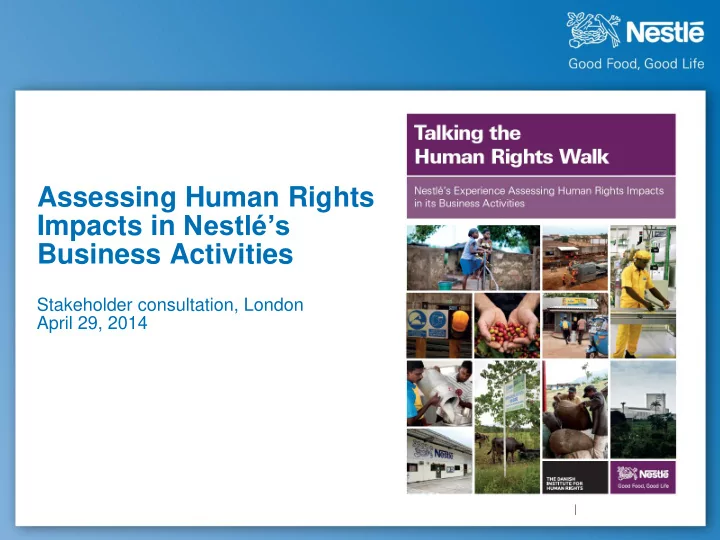
Assessing Human Rights Impacts in Nestlé’s Business Activities

Stakeholder consultation, London April 29, 2014

slide-2
SLIDE 2

1 September, 2014

Agenda

9.30-09.40 Welcome and introductory remarks, Christian Frutiger, Nestlé 9.40-10.00 Nestlé’s Human Rights Due Diligence Programme: Overview, Yann Wyss, Nestlé 10.00-11.00 Nestlé’s HRIAs: Introduction, Allan Jorgensen, DIHR Panel discussion:

  • Peter Frankental, Amnesty International UK
  • Adam Greene, Bureau for Employers' Activities, ILO
  • Farid Baddache, Business for Social Responsibility

Coffee break – Transition to break-out rooms 11.00 -12.30 Break-Out Session and Group Discussion:

  • HRIA scope
  • Stakeholder and rights-holder engagement
  • Integrated vs. stand-alone HRIAs
  • HRIA reporting

12.30-13.15 Lunch

slide-3
SLIDE 3

1 September, 2014

Basic rules for constructive engagement

 Objective: To improve the way human rights impacts of Nestlé’s business activities are assessed and addressed  Focus = HRIA methodology and process

  • References to specific countries are welcome but should be used to illustratre

strengths/weaknesses of HRIAs

  • Country-specific HRIA findings will not be shared/discussed during this session

 Public report:

  • Chatham House Rule
  • To be shared with all participants before making it public
  • Organisations who don’t want to be named as participants, please let us know

 Next steps:

  • Additional stakeholder consultations to be held in 2014 and 2015
  • Recommendations from consultations integrated into HRIA process
  • By 2015:
  • Cover all FTSE4Good «countries of concern»
  • «Talking the Human Rights Walk»: Volume II
slide-4
SLIDE 4

Nestlé’s Human Rights Due Diligence Programme: Overview

1 September, 2014

slide-5
SLIDE 5

A Material Issue Now… and for the Future

Our Key Opinion Leaders (KOLs) think that Human Rights:  Are critical to Nestlé’s business  Will become even more important in the next few years

Source: Nestlé Stakeholder Community Survey, GlobeScan, 2013

1 September, 2014

slide-6
SLIDE 6

Nestlé Materiality Analysis 2013

1 September, 2014

slide-7
SLIDE 7

Right to just and favourable conditions at work Right to health (consumers’ health) Right to water Right to freedom from child labour Right to freedom

  • f association

Right to health (safety and health at work) Right to education

Human Rights in our Business Activities: Examples

slide-8
SLIDE 8

The Nestlé Strategic & Performance Framework 4x4

1 September, 2014

slide-9
SLIDE 9

1 September, 2014

Nestlé’s Human Rights Due Diligence Programme

slide-10
SLIDE 10
  • 1. Policy Commitments

Maintreaming human rights into new or exisiting policies and procedures

1 September, 2014

slide-11
SLIDE 11
  • 2. Stakeholders Engagement

IUF Uniting food, farm and hotel workers world-wide

1 September, 2014

Engaging with key stakeholders on human rights issues

slide-12
SLIDE 12
  • 3. Training

Achievements since 2011:  Translated into 6 languages  42,000 employees trained  64 countries covered; 25 high- risk (FTSE4Good) countries  3 face-to-face sessions for Corporate Human Resources (166 employees trained) Increasing the awareness and building the capacity of our employees worldwide

1 September, 2014

slide-13
SLIDE 13
  • 4. Risks Evaluation

Integrating human rights into our overall Enterprise Risk Management System

1 September, 2014

43 material human rights risks evaluated each year 5 levels of analysis:

  • Nestlé facilities
  • Tier-1 suppliers
  • Upstream suppliers
  • Local communities
  • Markets

Brand, reputation, legal,

  • perational, etc.

How can human rights risks impact our business?

slide-14
SLIDE 14
  • 5. Impacts Assessments (1)

HUMAN RESOURCES HEALTH & SAFETY SECURITY BUSINESS INTERGITY

  • Working conditions
  • Discrimination
  • Association &

bargaining

  • Medical services
  • Repetitive stress

injuries

  • Night work
  • Security risk

management

  • Private guards
  • Public authorities
  • Corruption
  • Privacy (employees)
  • Lobbying
  • Complicity

COMMUNITY IMPACTS PROCUREMENT RAW MATERIALS MARKETING

  • Land acquisition
  • Access to water
  • Health impacts
  • Working conditions
  • Selection and

monitoring

  • Child labour
  • Forced labour
  • Health & safety
  • Product quality &

safety

  • Product advertising
  • Privacy (consumers)

1 September, 2014

Assessing human rights impacts of our business activities

slide-15
SLIDE 15
  • 5. Impacts Assessments (2)

Engaging with rightholders : employees, contractors suppliers, farmers, local communities

1 September, 2014

slide-16
SLIDE 16
  • 5. Impacts Assessments (3)

1 September, 2014

Reporting on HRIAs process, findings and remediation actions

slide-17
SLIDE 17

+ Zones Management SHE Procurement HRIAs briefings and follow-up on action plans: Risk Management Security Legal Compliance

  • 6. Human Rights Working Group (1)

Creating the enabling structure and environment: Nestlé HRWG  Supervise and coordinate implementation progress  Provide strategic oritentation  Contribute technical expertise Nestlé Human Rights Working Group Public Affairs Human Resources CEO

1 September, 2014

slide-18
SLIDE 18
  • 6. Human Rights Working Group (2)

Nestlé’s HRWG is fully integrated into Nestlé overall governance structure

1 September, 2014

slide-19
SLIDE 19
  • 7. Partnerships & Dialogue

Partnering with exepert organisations to further improve our human rights performance Global partnerhsip: Nestlé human rights due diligence approach Focused partnership: Labour standards in Nestlé agricultural supply chains Action-oriented dialogue: Nestlé and trade unions in Colombia

1 September, 2014

slide-20
SLIDE 20
  • 8. Monitoring & Reporting

Maintreaming human rights into monitoring systems and procedures Nestlé facilities Tier-1 suppliers Upstream suppliers

1 September, 2014

Sedex/SMETA audits Traceability Assssments Human Rights Impacts Assessments Certification/Verification Human Rights Risks Assessments CARE audits Rural Development Framework Integrity Reporting System Tells Us

slide-21
SLIDE 21
  • 8. Monitoring & Reporting

Reporting on our human rights performance and challenges

1 September, 2014

2013 main features: Revised version of our Supplier Code: New human section New external grievance mechanism: Tell Us 9 HRIAs completed since 2010 42,000 employees trained on human rights in 64 countries since 2011 43 human rights risks evaluated every year as part of our Enterprise Risk Management System Action plan on child labour in Côte d’Ivoire

  • 25,000 farmers received illustrated Supplier Code
  • 90 supplier and personnel trained on child labour
  • Monitoring & remediation system in 8 cooperatives

http://www.nestle.com/csv/human-rights-compliance

slide-22
SLIDE 22

1 September, 2014

HRIAs and Nestlé’s HRDD Programme

slide-23
SLIDE 23

Our commitments to our people, human rights and compliance 29o

Assess and address human rights impacts in our

  • perations and supply chain

12

By 2015 – All FTSE4Good countries of concern where we have significant involvement are covered and employees trained Objective

23 01 September 2014 Nestlé in Society: Creating Shared Value and meeting our commitments

slide-24
SLIDE 24
  • 1. Methodology
  • 2. Results
  • 3. Lessons learnt
  • Reactions and feedback
slide-25
SLIDE 25
  • Reactions from NGOs, trade unions, business

groups, experts and practitioners

  • Praise: Welcomed as important step towards

greater transparency on human rights for Nestlé and for business more generally

  • Criticism: HRIAs are not sufficiently independent
  • f Nestlé, public relations stunt
  • Criticism and improvement suggestions:

1. General 2. Scope of the assessments 3. Human rights issues considered 4. Methodology and process 5. Stakeholder participation

REACTIONS TO HRIA WHITE PAPER

slide-26
SLIDE 26

REACTIONS: GENERAL

  • Welcomed as important step towards greater transparency on human rights

for Nestlé and for business more generally

  • Parameters for the assessments were set by Nestlé, public relations stunt
  • The assessments review corporate policy rather than practice
slide-27
SLIDE 27

REACTIONS: SCOPE OF THE ASSESSMENTS

1. Geographical scope: need to focus on high risk countries but also cover

  • ther countries

2. Need to consider impacts from more functions such as Production. 3. What about full value chain such as supermarkets who sell Nestlé products? Need to consider upstream impacts. 4. Differentiating between potential and actual impacts

slide-28
SLIDE 28

REACTIONS: HUMAN RIGHTS ISSUES CONSIDERED

1. Does not include a discussion around the human rights to water 2. What about environmental impacts to communities? 3. Risk of missing impacts: limiting the scope of rights during the pre- assessment stage vs remaining open 4. Lense of assessment: 8 functions or 48 rights? 5. Can we assume from this that you are only concerned with your Raw Material Suppliers' impacts on a few human rights and of employees only? 6. Lacks focus on how Nestlé addresses threats against staff and union leaders from paramilitaries, with particular reference to Colombia.

slide-29
SLIDE 29

REACTIONS: METHODOLOGY AND PROCESS

1. The presence of Nestlé management in worker interviews is highly questionable for gaining valid and accurate perceptions. 2. Should try to build capacity of local consultants. 3. Final assessment data is vetted by Nestlé headquarters and executives in the countries where operations were evaluated 4. Work with local management to develop the responses to the findings - to ensure they have the necessary ownership of the outcomes to implement them. 5. More emphasis on tracking the progress and efficiency of mitigation actions

slide-30
SLIDE 30

REACTIONS: STAKEHOLDER PARTICIPATION

1. Should establish multi-stakeholder oversight of impact assessment processes. 2. Should involve participation of rights holders at “integrating and acting upon the findings” stage. 3. Need to be established how follow-up will happen, in particular how results will be communicated to the stakeholders involved.

slide-31
SLIDE 31
  • 1. HRIA scope
  • 2. Stakeholder and rights holder

engagement

  • 3. Integrated vs stand-alone HRIAs
  • 4. HRIA reporting

BREAK-OUT GROUPS

slide-32
SLIDE 32

7 HUMAN RIGHTS IMPACT ASSESSMENTS: SOME LESSONS AND REFLECTIONS

1. Country selection: when and where to do HRIA 2. Tools: need to be simple yet comprehensive and grounded in int’l norms 3. Time and money: combining cost-effectiveness and sustainability with scope and depth 4. HRIAs as capacity building: balancing company involvement with third party independence 5. Stakeholder engagement: requires local expertise to be meaningful 6. Government authorities: risks vs value added of engaging 7. Public reporting: pros and cons 8. Integrating findings: feeding local lessons into global systems 9. Making it normal: embedding HRIA into the normal business process