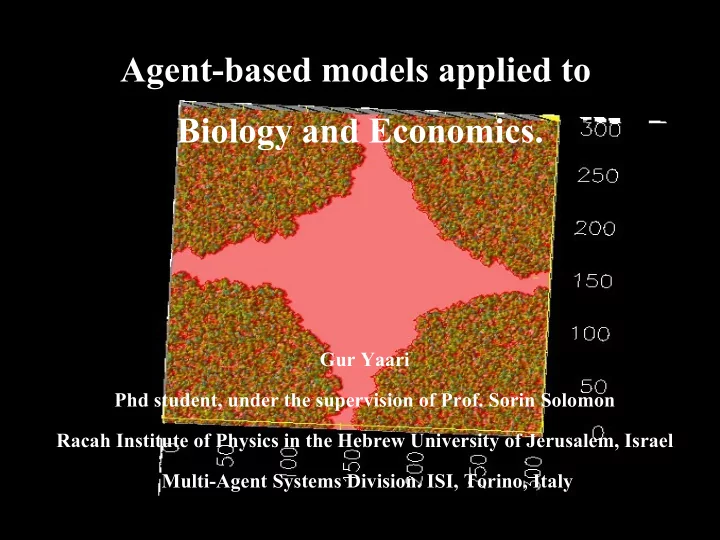
SLIDE 1 Agent-based models applied to Biology and Economics.
Gur Yaari Phd student, under the supervision of Prof. Sorin Solomon Racah Institute of Physics in the Hebrew University of Jerusalem, Israel Multi-Agent Systems Division. ISI, Torino, Italy
SLIDE 2 “G.L.V” Generalized Lotka Volterra
Stochastic Lotka-Volterra Systems of Competing Auto-catalytic Agents lead Generically to Truncated Pareto Power Wealth Distribution, Truncated Levy Distribution of Market Returns, Clustered Volatility, Booms and Crashes.
in Decision Technologies for Computational Finance, edited by A.-P. Refenes, A. N. Burgess, and J. E. Moody (Kluwer Academic Publishers, 1998). http://xxx.lanl.gov/abs/cond-mat/9803367 Generalized Lotka Volterra (GLV) Models of Stock Markets
in "Applications of Simulation to Social Sciences" , Eds: G Ballot and G Weisbuch; Hermes Science Publications 2000 http://xxx.lanl.gov/abs/cond-mat/9901250 Power laws in cities population, financimarkets and internet sites (scaling in systems with a variable number of components) Aharon Blank and Sorin Solomon Physica A 287 (1-2) (2000) pp.279-288 http://xxx.lanl.gov/abs/cond-mat/0003240 Power-law distributions and L'evy-stable intermittent fluctuations in stochastic systems of many autocatalytic elements.
- O. Malcai O. Biham and S. Solomon,
- Phys. Rev. E, 60, 1299 (1999). http://xxx.lanl.gov/abs/cond-mat/9907320
Theoretical analysis and simulations of the generalized Lotka-Volterra model Ofer Malcai,1 Ofer Biham,1 Peter Richmond,2 and Sorin Solomon Phys. Rev. E 66, 031102 (2002) URL: http://link.aps.org/abstract/PRE/v66/e031102 doi:10.1103/PhysRevE.66.031102 http://xxx.lanl.gov/PS_cache/cond-mat/pdf/0208/0208514.pdf
SLIDE 3 “AB Model”
The importance of being discrete: Life always wins on the surface Nadav M. Shnerb, Yoram Louzoun, Eldad Bettelheim, and Sorin Solomon
- Proc. Natl. Acad. Sci. USA, Vol. 97, Issue 19, 10322-10324, September 12, 2000
http://xxx.lanl.gov/abs/adap-org/9912005 Adaptation of Autocatalytic Fluctuations to Diffusive Noise
- N. M. Shnerb, E. Bettelheim, Y. Louzoun, O. Agam, S. Solomon
Phys Rev E Vol 63, No 2, 2001; http://xxx.lanl.gov/abs/cond-mat/0007097 HIV time hierarchy: winning the war while, loosing all the battles Uri Hershberg, Yoram Louzoun, Henri Atlan and Sorin Solomon Physica A: 289 (1-2) (2001) pp.178-190 ; http://xxx.lanl.gov/abs/nlin.AO/0006023 [pdf] The Emergence of Spatial Complexity in the immune System. Louzoun, Y, Solomon. S., Atlan. H., Cohen.I.R. (2001) Physica A, 297 (1-2) pp. 242-252. http://xxx.lanl.gov/html/cond-mat/0008133 Proliferation and Competition in Discrete Biological Systems Y Louzoun S Solomon, H Atlan and I R. Cohend Bulletin of Mathematical Biology Volume 65, Issue 3 , May 2003, P 375-396
SLIDE 4 Issues that had been explained (at least qualitatively) by these two models and their extensions:
- The distribution of individuals in colonies (cities population)
- The distribution of individuals/companies wealth
- Genetic evolution – The origin of life (??)
The H.I.V war against our Immune system
- The distribution of number of individuals for various species
- Patches of green vegetation in the desert
- Waiting for new Ideas...
- The distribution of word's frequency in a language
SLIDE 5 “G.L.V” Generalized Lotka Volterra
Thomas Robert Malthus (1766–1834)
contemporary estimations= doubling of the population every 30yrs exponential solution: X(t) = X(0)ea t dx dt =a⋅x autocatalitic proliferation: with a =birth rate - death rate
1798
SLIDE 6 dX/dt = a X – c X2
Solution: exponential ==========saturation at X= a / c
Pierre François Verhulst (1804-1849) way out exponential explosion:
1838
SLIDE 7 For humans data at the time could not discriminate between:
- 1. exponential growth of Malthus
- 2. logistic growth of Verhulst
But data fit on animal population: sheep in Tasmania
- exponential in the first 20 years after their introduction and
completely saturated after about half a century. ==> Verhulst
SLIDE 8 “G.L.V” Generalized Lotka Volterra
proposed independently (Lotka-1925 , Volterra-1926)
The Lotka Volterra Equations.
Describes Predator-Prey Relations:
Alfred James Lotka (March 2, 1880 - December 5, 1949) Vito Volterra (May 3, 1860 - October 11, 1940)
dx dt = x⋅− ⋅y dy dt =− y⋅− ⋅x
SLIDE 9 Taking into account self competition (limited
resources) we have:
dx dt = x⋅−1⋅x−12⋅y dy dt = y⋅−− 1⋅y21⋅x
Results: Cycles in time in the number of Predator's-Prey's Number of individuals
SLIDE 10 “G.L.V” Generalized Lotka Volterra
General Frame-work for various processes in Economics and Biology. N agents (fix number) : N individuals (Economics) N spieces (Biology)
The Model
SLIDE 11 wit1=wit⋅ 1t∑
j=1 N
ai , j⋅w jt−∑
j=1 N
ci , j⋅w jt⋅wit
w jt1=w jt i=1.. N ;i≠ j
Update:
each time step
Choose individual i randomly from 1..N Is a stochastic variable drawn from a distribution with : D≡〈t
2〉−〈t〉 2
t
Stochastic Term!
SLIDE 12 wit1=wit⋅1ta⋅ wt−c⋅wit⋅ wt
In order To Kis (keep it simple) it:
- ne can choose uniform interaction:
ai , j= a N ci , j= a N
And then the process can be described by:
wt = 1 N ⋅∑
j=1 N
wit
where:
SLIDE 13
Another possibility is:
wit1=wit⋅1t
With the restriction:
wit≥c⋅ wt
SLIDE 14
Xi (t+τ) – Xi (t) = λi (t) Xi (t) + a X (t) – c(X.,t) Xi (t) admits a few practical interpretations Xi (t) = the individual wealth of the agent i then
λi (t) = the random part of the returns that its capital Xi (t) produces
during the time between t and t+τ
a = the autocatalytic property of wealth at the social level
= the wealth that individuals receive as members of the society in subsidies, services and social benefits. This is the reason it is proportional to the average wealth This term prevents the individual wealth falling below a certain minimum fraction of the average.
c(X.,t) parametrizes the general state of the economy:
large and positive correspond = boom periods negative =recessions
SLIDE 15
A different interpretation: a set of companies i = 1, … , N Xi (t)= shares prices
~ capitalization of the company i
~ total wealth of all the market shares of the company
λi (t) = fluctuations in the market worth of the company
~ relative changes in individual share prices (typically fractions of the nominal share price)
aX = correlation between Xi and the market index w c(X.,t) usually of the form c X → represents competition
Time variations in global resources may lead to lower or higher values of
c →increases or decreases in the total X
SLIDE 16 Yet another interpretation: investors herding behavior (also cities) Xi (t)= number of traders adopting a similar investment policy or
- position. they comprise herd i
- ne assumes that the sizes of these sets vary autocatalytically according
to the random factor λi (t) This can be justied by the fact that the visibility and social connections
- f a herd are proportional to its size
aX represents the diffusion of traders between the herds c(X.,t) = popularity of the stock market as a whole
competition between various herds in attracting individuals
SLIDE 17 Important Results: When N is very large and t → ∞ , The “wealth” (w's) distribution approaches a stationary distribution with the well common empirical feature of a power-law “tail”. For the first case one gets: For the second case one gets:
Px=x
−1−⋅exp
1− x
xit=wi t w t i=1,...n
Px~x
−1−
=1 2⋅a D
= 1 1−c
SLIDE 18
Computer's Simulations
SLIDE 19
Fits the well known empirical Pareto's law Or the Zipf's law
Vilfredo Pareto (1848-1923) P(x) ~ x –1-α d x
Income distribution
George Kingsley Zipf , (1902-1950)
Economics Statistics Word's distribution Cities size's distribution
P(n) ~ n-α d n n- rank
SLIDE 20 red circles: Pareto for 400 richest people is USA the average wealth history 88-2003 and model fit blue squares: simulation results − α
Zipf plot of the wealths of the investors in the Forbes 400 of 2003 vs. their ranks. The corresponding simulation results are shown in the inset.
SLIDE 21 In addition, the average of the wealth is basically a result of a random walk with steps taken from a power-law distribution → truncated Levy distribution:
Lr=0 ≡ P wt= wt ~
−1
r= wt− wt wt A strong prediction of this model is that the exponents of the wealth distribution and the returns of the stock market (the fluctuations of the average wealth ) are connected through a simple connection:
1 ⇒ 1
SLIDE 22 The relative probability of the price being the same as a function of the time interval
β α
Prediction of The Lotka- Volterra- model:
−1/β
And indeed it was found empirically:
SLIDE 23 The AB Model Two types of agents: A B Three types of processes:
- 1. Diffusion – Locate ourselves in concrete space – until now d-dimensional square
lattice
B(r) + A(r) B(r) + B(r) + A(r)
B(r) Ø
- 4. Competition -with rate σ :
B(r) + B(r) B(r)
- with rate σ·<B>r : B(r) + B(r) B(r)
- with rate σ : B(r) + B(r) B(r)+B(r+i)
SLIDE 24 Differential Equation:
dAx ,t dt =Da⋅∇
2⋅Ax ,t
dBx ,t dt =Db⋅∇
2⋅Bx ,t⋅Ax ,t−⋅B x ,t
SLIDE 25 Differential Equation:
−⋅B
2
r− ⋅B r⋅〈B r
Competition dAx ,t dt =Da⋅∇
2⋅Ax ,t
dBx ,t dt =Db⋅∇
2⋅Bx ,t⋅Ax ,t−⋅B x ,t
SLIDE 26 Naïve approach: when t is very large:
Differential Equation:
A r⇒ nA
⋅nA−0
⋅nA−0
Exponential Growth Exponential Decay Malthus Naïve prediction dBx ,t dt =Db⋅∇
2⋅Bx ,t⋅Ax ,t−⋅B x ,t
⇒ dBx ,t dt =⋅Ax ,t− ⋅Bx ,t
SLIDE 27
Important Results: If d ≤ 2 Life always win ! For all parameter's values
Computer's Simulations + R.G (Renormalization Group) calculation:
In higher dimensions, λ/Da > 1-Pd
SLIDE 28
Surprize! Simulations + R.G calculation: outcome of the discreteness nature of the agents,
SLIDE 29
Only Practical Effect: Islands are of limited height
SLIDE 30
Island's formation Movie 1
SLIDE 31
B-islands search, follow, adapt to, and exploit fortuitous fluctuations in A density. This is in apparent contradiction to the “fundamental laws” where individual B don’t follow anybody In Complexity it is very popular to talk about : Emergent Collective Dynamics:
SLIDE 32
B's Island's search for food.. Movie2
SLIDE 33 Desert / Vegetation:
- B = plants,
- A= water / light / nutrients
- patches- patterns= stripes, oases
Desert <-> Patchy <-> Full cover
(contact to Judean Desert-Jerusalem mountains studies) ; Reclaim; PRL 90, 38101 (2003)
Interpretations in Various Fields
Finance:
sites= individuals, companies, B = capital A= wealth generating conditions jobs, good location, good managers, customers, education
SLIDE 34 Genetic Evolution:
- Sites: various genomic configurations.
- B= individuals; Jumps of B= mutations.
- A= advantaged niches
- emergent adaptive patches= species
why are there not a continuum of creatures between snails and salamanders (both are partenogenetic).
SLIDE 35
SLIDE 36
Polish spatial economic map since 89 (Andrzej Nowak ).
SLIDE 37 The analogy between these two models
wit1=wit⋅1ta⋅ wt−c⋅wit⋅ wt
⇒ dwit dt =wit⋅ta⋅ wt−c⋅wit⋅ wt
Stochastic noise Discrete A's
dBx ,t dt =Db⋅∇
2⋅Bx ,t⋅Ax ,t−⋅B x ,t−⋅Bx ,t
⋅〈 Bx ,t〉 dAx ,t dt =Da⋅∇
2⋅Ax ,t
SLIDE 38 Major differences
⇒ dwit dt =wit⋅ta⋅ wt−c⋅wit⋅ wt
dBx ,t dt =Db⋅∇
2⋅Bx ,t⋅Ax ,t−⋅B x ,t−⋅Bx ,t
⋅〈 Bx ,t〉
SLIDE 39 Major differences
⇒ dwit dt =wit⋅ta⋅ wt−c⋅wit⋅ wt
But... If
a⋅ wt⇒a⋅ wit
We get similar results for the GLV And
a⋅ wit⇔ ∇
2⋅B
r= 1 N.O.N ⋅∑
j=1 N.O.N
B r e j
dBx ,t dt =Db⋅∇
2⋅Bx ,t⋅Ax ,t−⋅B x ,t−⋅Bx ,t
⋅〈 Bx ,t〉
SLIDE 40
Major differences
And
〈i ,t⋅ j ,t'〉=i , j⋅t ,t '≠〈A r ,t⋅A r ' ,t '〉
And But it turns out that the results of the AB Model are still valid even for uncorrelated noise
SLIDE 41
Future research
Combine these two models in a more quantitative manner Find more empirical evidences for these type of processes Find more empirical evidences for these type of processes Adjust the model to the specific case studied
SLIDE 42
Thank You very much Grazie mille
הבר הדות
NAGYON KÖSZÖNÖM
dunke schoen
Merci beaucoup