
SLIDE 1
Agent-Based Systems
Agent-Based Systems
Michael Rovatsos
mrovatso@inf.ed.ac.uk
Lecture 12 – Bargaining
1 / 19
Agent-Based Systems Where are we?
- Different auction types and properties
- Combinatorial Auctions
- Bidding Languages
- The VCG mechanism
Today . . .
- Bargaining
2 / 19
Agent-Based Systems Bargaining
- Reaching agreement in the presence of conflicting goals and
preferences (a bit like a multi-step game with specific protocol)
- Negotiation setting:
- The negotiation set is the space of possible proposals
- The protocol defines the proposals the agents can make, as a
function of prior negotiation history
- Strategies determine the proposals the agents will make (private)
- Number of issues:
- Single-issue, e.g. price of a good
- multiple-issues, e.g. buying a car: price, extras, service
· Concessions may be hard to identify in multiple-issue negotiations · Number of possible deals: mn for n attributes with m possible values
- Number of agents:
- one-to-one, simplified when preferences are symmetric
- many-to-one, e.g. auctions
- many-to-many, n(n − 1)/2 negotiation threads for n agents
3 / 19
Agent-Based Systems Alternating Offers
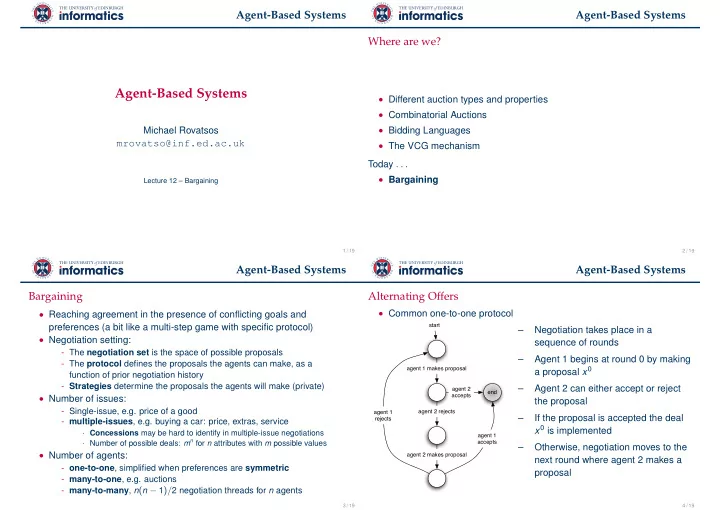
- Common one-to-one protocol
start agent 1 makes proposal agent 2 rejects agent 2 makes proposal end agent 2 accepts agent 1 accepts agent 1 rejects
– Negotiation takes place in a sequence of rounds – Agent 1 begins at round 0 by making a proposal x0 – Agent 2 can either accept or reject the proposal – If the proposal is accepted the deal x0 is implemented – Otherwise, negotiation moves to the next round where agent 2 makes a proposal
4 / 19