
SLIDE 1
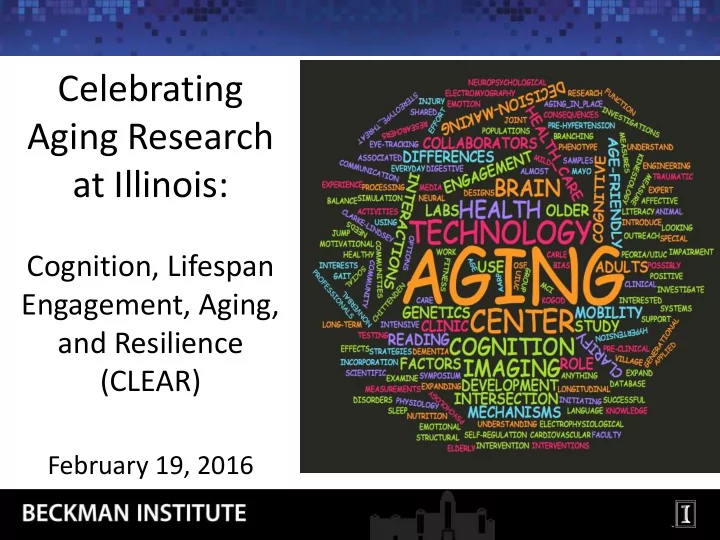
Celebrating Aging Research at Illinois:
Cognition, Lifespan Engagement, Aging, and Resilience (CLEAR)
February 19, 2016
Aging Research at Illinois: Cognition, Lifespan Engagement, Aging, - - PowerPoint PPT Presentation
Celebrating Aging Research at Illinois: Cognition, Lifespan Engagement, Aging, and Resilience (CLEAR) February 19, 2016 World Report on Aging and Health (2015) http://beckman.illinois.edu/research/initiatives/clear clear@lists.illinois.edu
Celebrating Aging Research at Illinois:
Cognition, Lifespan Engagement, Aging, and Resilience (CLEAR)
February 19, 2016
World Report on Aging and Health (2015)
http://beckman.illinois.edu/research/initiatives/clear
clear@lists.illinois.edu
Director, Center for Health Aging & Disability
Healthy Aging at Illinois
A collaboration between the
for the benefit of all who do aging research on campus
Our goal is to bring campus faculty and students who do aging research together for the common good:
We have been provided campus-level support from the Provost’s Office
Healthyaging.illinois.edu
Center on Health, Aging and Disability (CHAD)
around campus. All AHS faculty are automatically CHAD members.
– Foster interdisciplinary research, education and outreach that promotes health and wellness, healthy aging across the lifespan, healthy communities and optimal participation of individuals with disabilities. WE ARE THE RESEARCH SUPPORT ARM OF THE COLLEGE OF AHS FOR ALL AHS FACULTY.
– Jeff Woods, Director, 244-8815 (woods1@Illinois.edu) – Sa Shen, Biostatistician, 300-9211 (sashen2@Illinois.edu) – Wendy Bartlo, Proposal Development & Community Outreach – Penny Nigh, Office Administrator, 333-4954 (nigh@Illinois.edu) – Undergrad interns – Work in conjunction with the Business Office for competitive grant proposal submission
URL: http:/chad.illinois.edu (217) 333-4965 New Web page coming early 2016!
Health Care Engineering Systems Center (HCESC)
– The Health Care Engineering Systems Center (HCESC) provides clinical immersion to engineers and fosters collaborations between engineers and physicians. The aim is to develop new technologies and cyber-physical systems, enhance medical training and practice, and in collaboration with key partners, drive the training of medical practitioners of the future.
– Kesh Kesavadas, Director, 244-9341 (kesh@Illinois.edu) – Tony Michalos, Assoc. Director, 300-9211 (michalos@Illinois.edu) – Michelle Osborne, Office Administrator, (mosb@Illinois.edu) – Two Research Scientists – Work in conjunction with the Business Office at CSL for competitive grant proposal submission
URL: http://healtheng.illinois.edu HCESC Jump Sim
The timing is right for interactions between CoEng and AHS!
UIUC Applied Health Sciences UIUC Engineering New UIUC Engineering-Inspired College of Medicine Mayo Clinic OSF Healthcare
HEALTH TECHNOLOGY MEDICINE
A similar position is being offered in Engineering
Center on Health, Aging and Disability
College of Engineering
Health Care Engineering Systems Center
Recreation Sport Tourism Disability Resources Speech Hearing Science Center Wounded Veterans Computer Science Electrical & Computer Industrial & Systems Kinesiology
Health Technology and Aging
College of Applied Health Sciences
Mechanical
Singapore Aging Nation OSF HealthCare JUMP/ARCHES Carle-Illinois College of Medicine Cluster Hires Health Technology and Aging Chittenden Family Foundation
Bioengineering
Pieces of the Puzzle: Health Technology and Aging at UIUC
Civil Mayo-UIUC Alliance (Kogod Center) (Geriatrics)
Woese Institute for Genomic BiologyWHO Age-Friendly Cities
Presence Health AARP UIUC Extension UIUC Art & DesignPublic & Community Health
Clarke-Lindsey VillageBeckman Institute for Advance Science and Technology
Center on Health, Aging and Disability
College of Engineering
Health Care Engineering Systems Center
Recreation Sport Tourism Disability Resources Speech Hearing Science Center Wounded Veterans Computer Science Electrical & Computer Industrial & Systems Kinesiology
Health Technology and Aging
College of Applied Health Sciences
Mechanical
Singapore Aging Nation OSF HealthCare JUMP/ARCHES Carle-Illinois College of Medicine Cluster Hires Health Technology and Aging Chittenden Family Foundation
Bioengineering
Pieces of the Puzzle: Health Technology and Aging at UIUC
Civil Mayo-UIUC Alliance (Kogod Center) (Geriatrics)
Woese Institute for Genomic BiologyWHO Age-Friendly Cities
Presence Health AARP UIUC Extension UIUC Art & DesignPublic & Community Health
Clarke-Lindsey VillageBeckman Institute for Advance Science and Technology
3 excellent candidates: Wendy Rogers Maureen Schmitter-Edgecombe Michelle Carlson
Center on Health, Aging and Disability
College of Engineering
Health Care Engineering Systems Center
Recreation Sport Tourism Disability Resources Speech Hearing Science Center Wounded Veterans Computer Science Electrical & Computer Industrial & Systems Kinesiology
Health Technology and Aging
College of Applied Health Sciences
Mechanical
Singapore Aging Nation OSF HealthCare JUMP/ARCHES Carle-Illinois College of Medicine Cluster Hires Health Technology and Aging Chittenden Family Foundation
Bioengineering
Pieces of the Puzzle: Health Technology and Aging at UIUC
Civil Mayo-UIUC Alliance (Kogod Center) (Geriatrics)
Woese Institute for Genomic BiologyWHO Age-Friendly Cities
Presence Health AARP UIUC Extension UIUC Art & DesignPublic & Community Health
Clarke-Lindsey VillageBeckman Institute for Advance Science and Technology
Community Outreach for an Age-Friendly Champaign-Urbana
community
World Health Organization (WHO) and AARP
community, but why is the University of Illinois and specifically the Center on Health, Aging and Disability interested in this and why should you be?…….
What are our goals?
World Health Organization (WHO) – Age-Friendly Cities Program: Steps
World Health Organization (WHO) – Age-Friendly Cities Program: Topic Areas
These topics are flexible and can be combined, separated, or added to, dependent on the community
Why is UIUC’s, Center on Health, Aging and Disability Wanting to Lead Such an Effort?
after retirement
CHAD has the capacity to coordinate and communicate to all stakeholders. We have experience accessing resources (e.g. grants). We have topical expertise in the domains. Every effort needs a ‘leader’! I want to leverage this for the benefit of our faculty and students:
and the new College of Medicine – a living laboratory?)
Presence, local governments, park districts, YMCA, OLLI, health support groups, Health Alliance, area agencies on aging, Faith-in-Action)
and services
Center on Health, Aging and Disability
College of Engineering
Health Care Engineering Systems Center
Recreation Sport Tourism Disability Resources Speech Hearing Science Center Wounded Veterans Computer Science Electrical & Computer Industrial & Systems Kinesiology
Health Technology and Aging
College of Applied Health Sciences
Mechanical
Singapore Aging Nation OSF HealthCare JUMP/ARCHES Carle-Illinois College of Medicine Cluster Hires Health Technology and Aging Chittenden Family Foundation
Bioengineering
Pieces of the Puzzle: Health Technology and Aging at UIUC
Civil Mayo-UIUC Alliance (Kogod Center) (Geriatrics)
Woese Institute for Genomic BiologyWHO Age-Friendly Cities
Presence Health AARP UIUC Extension UIUC Art & DesignPublic & Community Health
Clarke-Lindsey VillageBeckman Institute for Advance Science and Technology
3 excellent candidates: Wendy Rogers Maureen Schmitter-Edgecombe Michelle Carlson
The Chittenden Symposium
April 26, 2016 8:30 AM - 5:30 PM iHotel and Conference Center
Registration: 8:30 AM § Research Program: 9:00 AM - 12 NOON
“Health, Technology & Aging”
§ Community Outreach Program: 1:15 PM - 4:30 PM
“Age-Frie iendly Cha hampa paig ign-Urbana”
Reception/Poster Presentation Following Sponsored by The Departments of Kinesiology and Community Health and Industrial and Enterprise Systems Engineering
SAVE-THE-DATE
Center on Health, Aging and Disability
College of Engineering
Health Care Engineering Systems Center
Recreation Sport Tourism Disability Resources Speech Hearing Science Center Wounded Veterans Computer Science Electrical & Computer Industrial & Systems Kinesiology
Health Technology and Aging
College of Applied Health Sciences
Mechanical
Singapore Aging Nation OSF HealthCare JUMP/ARCHES Carle-Illinois College of Medicine Cluster Hires Health Technology and Aging Chittenden Family Foundation
Bioengineering
Pieces of the Puzzle: Health Technology and Aging at UIUC
Civil Mayo-UIUC Alliance (Kogod Center) (Geriatrics)
Woese Institute for Genomic BiologyWHO Age-Friendly Cities
Presence Health AARP UIUC Extension UIUC Art & DesignPublic & Community Health
Clarke-Lindsey VillageBeckman Institute for Advance Science and Technology
3 excellent candidates: Wendy Rogers Maureen Schmitter-Edgecombe Michelle Carlson
http://www.jumpsimulation.org/research/applied/arches/index.html
JUMP ARCHES
information technologies, simulation, human factors/ergonomics and design
Singapore Interactions
business with friends
research thrust in ‘healthy and active aging’
communication and cognition (which fits our college focus)
Questions?/Discussion?
In our opinion, it makes sense to partner with CLEAR to promote age-related research on campus:
Mayo-Illinois Alliance (for technology-based healthcare)
to personalize treatments
visualization,epigenomics/genomics, pharmacogenomics, and point of care diagnostics
Geriatrics unit in the country, Kogod Center on Aging) and perhaps
Christine Catanzarite, Director catanzar@Illinois.edu
OLLI at ILLINOIS is
credit courses, participatory study groups, lectures, educational travel, and other engagement opportunities
Provost
OLLI launched in 2007 with the support of the University of Illinois and the Bernard Osher Foundation
OLLI is also supported by membership and enrollment fees and gifts from individual donors.
M2 Building – Downtown Champaign
OLLI Member Snapshot
1,300+ members Youngest: 50 Oldest: 104 Typical: 67-77 – 60% women, 40% men Evenly split between campus and community affiliations
OLLI has experienced dramatic growth:
Year 1 (2007-2008)
Year 9 (2015-2016)
counting)
OLLI is a laboratory for the potentials of remaining intellectually and physically active across the lifespan.
Citizen Scientist Program Beckman – IGB - OLLI
Building Bridges
Jeffrey (Jeff) A. Woods, PhD
Department of Kinesiology and Community Health
Director, Center on Health, Aging and Disability
Associate Dean for Research, College of Applied Health Sciences
Division of Nutritional Sciences
Center for Nutrition, Learning and Memory
Department of Pathology, College of Medicine
If and how exercise and diet affect the aging immune system
Effects and mechanisms behind anti-inflammatory effects of exercise
Effects of exercise on the gut microbiome and gut-brain axis
Diet and exercise synergy on age-related cognitive loss
Molecular transducers of the effects of physical activity/exercise
In vitro, ex vivo and in vivo immune function assays
Flow cytometry
Gene expression
Protein expression
16S rRNA analysis of microbiome
Clinical interventions in older adults
Pre-clinical animal experiments (including in aged mice)
University of Illinois Urbana-Champaign
Jeffrey (Jeff) A. Woods, PhD
Ed McAuley (KCH)
Art Kramer (Beckman)
Bryan White (IGB)
Hannah Holscher (FSHN)
Rod Johnson (AnSci/DNS)
Justin Rhodes (Beckman/Psych)
Kelly Swanson (AnSci)
George Fahey (AnSci)
Marni Boppart (KCH/Beckman)
Nick Burd (KCH)
Mike DeLisio (KCH)
Rex Gaskins (IGB)
Greg Freund (AnSci/CoM)
Drew Steelman (AnSci)
Abbott Nutrition
Mayo Clinic (Vandana Nehra, John Fryer)
UIC (Brown, Haus, Phillips, Arena)
Jeffrey (Jeff) A. Woods, PhD
Interests in Aging
AARP
Mayo Clinic Kogod Center on Aging (Nathan LaBrasseur)
Clarke-Lindsey Village (Deb Reardanz)
Communities of Champaign and Urbana (my Center initiating an ‘age-friendly’ community
Champaign-Urbana”)
Anything health, technology and aging
Carle Clinic Digestive Health Group (emerging)
Burning Questions
mediated through the gut-brain axis?
effects of exercise?
improving cognition in the aged?
J.A.Woods, Integrative Immunology & Behavior
Excessive or Chronic Local and/or Systemic Inflammation Obesity Infection Aging Cancer and Treatment Gut Damage Brain Injury Metabolic Dysregulation Morbidity and Mortality Impaired Wound Healing Tumor Growth Altered Behavior (fatigue) Learning and Memory Poor Immune Responses Poor Nutritional Status Inflammatory Bowel Disease
Inappropriate Inflammation: A common thread to pathology
Can Regular Exercise Alter Inappropriate Inflammation and Improve Its Consequences?
Titles of Some of Our Published Work
Recent Published Papers on Exercise and the Gut
Some Current Projects
program for obesity: The fecal microbiome” (in conjunction with Mayo Clinic)
changes attenuate the effects of ulcerative colitis” (experiment in gnotobiotic mice)
(preclinical study)
and pathophysiology of diseases within NIDDK’s mission”
From An Exercise Physiology Standpoint: Where are the ‘Next Frontiers’?
Advertising
Interactive Media Use…
16 March 2016 50
Increasingly physical Increasingly mobile
Increasingly Embodied
Embodied Media Psychology
1.
What physical cue is experienced during media use?
1.
What related mental concept might be activated by this physical cue?
1.
How might the activation of this mental concept affect the psychological outcomes of media use?
16 March 2016 51
16 March 2016 52
Question: What role do interactive/embodied media experiences play in CLEAR-related phenomena? Kevin Wise krwise@illinois.edu
Educational Psychology
The Adult Learning Lab (TALL)
Adult development of learning and language processing
– Sentences Discourse – Age-related change in mechanisms – Self-regulation of attention – Effects of literacy experience
Resilience
– Strategy Instruction – Activity Engagement – Cognitive Training
Liz Stine-Morrow, Dept of Educational Psychology
N=458 (59-93 yrs old)
40 45 50 55 60
<65 65-69 70-74 75-79 80-84 85+ Speed Reasoning Divergent Thinking Visual Spatial Memory VocabularyT Scores Age (yrs)
Data from Stine-Morrow et al. (2014, Psych and Aging)
30 35 40 45 50 55 60 65 70 <65 65-69 70-74 75-79 80-84 85+ Speed T Scores 30 35 40 45 50 55 60 65 70 <65 65-69 70-74 75-79 80-84 85+ Reasoning T Scores 30 35 40 45 50 55 60 65 70 <65 65-69 70-74 75-79 80-84 85+ Divergent Thinking T Scores 30 35 40 45 50 55 60 65 70 <65 65-69 70-74 75-79 80-84 85+ Visual Spatial T Scores 30 35 40 45 50 55 60 65 70 <65 65-69 70-74 75-79 80-84 85+ Memory T Scores 30 35 40 45 50 55 60 65 70 <65 65-69 70-74 75-79 80-84 85+ Memory T Scores10th and 90th percentiles
Vocabulary Speed Reasoning Divergent Thinking Visual Spatial Memory Conceptual Integration Training
the syntactic cues to bind information together.
– e.g., The alderman the mayor opposed did not support the veto of the bill that banned smoking in restaurants.
(Stine-Morrow et al., PandA, 2001; QJEP, 2010)
Young Older All Immediacy 0.39* 0.70 ** 0.54** Sentences 0.37 0.64 ** 0.50** *p<.05, **p<.01
r(DCI, DRecall)
Home-Based Working Memory Training
impact
(Payne & Stine-Morrow, in preparation)
0.2 0.4 0.6 0.8 1 Speed Reasg DivTh Memory
Waitlist Reasoning Training EngagementStandardized Estimates of Change
* * * * * * * * *
VisSpat
Lifestyle Intervention
(Stine-Morrow, Payne, Gao, Roberts, Kramer, Morrow, Payne, Hill, Noh, Janke, & Parisi, PandA, 2014)
Help Wanted
cognitive development?
– Cognitive? Neural? Dispositional?
engagement?
– Electromyography? – Imaging?
embedding? Cognitive benefits?
Kinesiology & Community Health
Tele-rehabilitation system for fall risk assessment
Kathleen L Roeing1, Yaejin Moon1, Rama Ratnam2, Jacob J. Sosnoff1
1 Kinesiology and Community Health 2 Coordinated Science Lab
Falls: Aging and Disability
result in injury, hospitalization, and/or death (Rubenstein, 2006)
with an incidence rate of over 50% (Finlayson, Peterson, & Cho, 2006)
health care costs and improve quality of life.
Bertec Force Plate Kinect system
Challenging balance conditions
Salus Force Plate
0.006 0.008 0.01 0.012 0.014 0.035 0.045 0.055 0.065
Body sway as a fall risk factor
Results and Capabilities
(18-30), 15 older adults (65+), 6 individuals with MS
correlations for postural sway between Kinetic camera and force plate in all conditions
Determine fall risk
Design exercises targeting impairment
Psychology
that predict human capital for OECD and World Bank
important than traits and abilities in shaping the life course
Future possibilities in the area of aging
with Bennett and Briley
personality change
Kinesiology & Community Health
Exercise, Technology, & Cognition Lab
Sean Mullen, PhD
exercisetechlab.com
1.What are the best ways to increase exercise self-regulation? (outside the lab) 2.What technologies are most effective at increasing exercise? 3.What types of adjuvant therapies combined with exercise will increase brain function and heart health?
Sean Mullen, PhD
71
Research Focus
STEAM CORTEX WEST CALF mHABITS HEAT SAUNAS OCULUS
Sean Mullen, PhD exercisetechlab.com
72
Research Compass
NHLBI-fund funded ed RCT T to test t the efficacy cacy
ti-mod modal al cogn gnit itiv ive e training ing to enhance nce 4-mon
th exercise ise self- regulat ation ion among ng health thy y middle- aged d adults. ts. CHA HAD-fu funded nded pilot
RCT T to test t the effects ects of a 10- month th iPa Pad- enhanced nced exergam amin ing interven enti tion
spati tial memor
wayfindi nding ng self- efficacy cacy among ng adults ts with probab able e MCI. UIUC UC RB-fu funde nded d pilot
rial to test t the additi tive e effects ects of exercise cise & steam am- room on BP among g middle-aged aged adults ts with pre-hyper pertension nsion.
73
ETC Lab Toys
Educational Psychology
Dan Morrow Lab
who are more likely to have chronic illness but less likely to have the cognitive resources needed for self-care
among older adults with chronic illness.
– Leverage age-related cognitive strengths (e.g., knowledge) and minimize demands on age-vulnerable cognitive resources (e.g., processing capacity) to support comprehension and decision making
Health Literacy Resources for Self-Care
With Elizabeth Stine-Morrow (Beckman) Mick Murray (Purdue), Jim Graumlich (UIC-Peoria)
explains health literacy in terms of the interplay between declining processing capacity and sustained general and health knowledge.
association of health literacy and recall of self-care information is mediated by health knowledge and processing capacity.
redesigned information about self- care from credible websites and improved memory for this information among older adults with varying levels of knowledge about hypertension.
Health Literacy Health Literacy Recall Recall
Processing capacity General knowledge
B=0.41, t=8.34* B=0.48, t=6.03* B=0.19 , t=1.99 * B=0.30, t=5.74* B=0.24
t=3.72*
B=0.31, t=4.55*
Health knowledge
B=0.21, t=2.44* B=0.28, t=4.68* 50 100 150 200 250 300 350 Low health knowledge High health knowledge Time per unit of information gain (secs) Health Knowledge typical revised
Collaborative Patient Portals
With Mark Hasegawa-Johnson & Tom Huang (Beckman), William Schuh (Carle), Rocio Garcia-Retamero (Univ Granada)
through patient portals to Electronic Health Records. Older adults are less likely to use portals and may not understand portal-based numeric information (e.g., test results).
test results among older adults varying in health literacy by providing context in form of graphics and video recorded physician.
formats improve gist comprehension compared to standard format.
based on the video to evaluate whether the portal-based CA improves patient comprehension and collaboration with providers.
Component Your Value Standard Range Units Total Cholesterol 184 < 200 - mg/dl Triglycerides 42 < 150 - mg/dl HDL Cholesterol 47 40 - 60 mg/dl LDL Cholesterol 130 < 100 - mg/dl
Standard Portal Format Video Portal Format
0% 10% 20% 30% 40% 50% 60% 70% 80% 90% 100% Low Borderline High StText Video
Accuracy
Speech and Hearing Research
Aging Research in the Auditory Cognitive Neuroscience Lab
Fatima Husain, PhD
Associate Professor, Speech and Hearing Science, Beckman Institute for Advanced Science and Technology & the Neuroscience Program Affiliate, Center on Health Aging and Disability University of Illinois at Urbana-Champaign
Broad Outline of my Research
Behavior Brain Imaging Computational Modeling Audition Speech Aging Disorders
TOOLS QUESTIONS
Aging, Hearing & Tinnitus
Both hearing limitations (hearing acuity, tinnitus, listening environment) and aging limitations may have an effect on perceptual, working memory and higher-order processing
Perceptual Processing Working Memory Higher-order Cognitive Processing, Memory Acoustic Input Hearing Limitations Aging Limitations
HL<NH
ACC
x= 2
group with normal hearing
microstructure integrity)
Example result: Gray matter & white matter declines due to hearing loss
Husain, et al., Brain Research, 2011
z= 15
HL<NH
sFG dmFG
Mechanical Science & Engineering
Computer Science
ASPIRE: Automation Supporting Prolonged Independent Residence for the Elderly
Naira Hovakimyan
in collaboration with
provide independence to the elderly population.
Vision & Objective
will grow substantially.
same pace.
critical systems.
sciences & computer science to create meaningful solutions to this problem. Help is required to perform:
activities:
Living
Problem Statement
appearance models of ground and flying robots affect senior citizens comfort and perceived safety.
into account cognitive demand.
algorithms for the care giving robots to minimize human discomfort and increase acceptability.
Perceived & Actual Safety Navigation and control Care giving
Develop a framework for the operation of autonomous vehicles to perform care giving tasks while also acknowledging the perceived safety and comfort of the operator.
Designing robots for autonomous assistive tasks
Source: Wired Magazine
INTERFACE HIGH-LEVEL CTRL (HLC) ROBOTS
N E T W O R K
cmd alarm, … tasks, messages, … LLC 1 LLC n map, obstacles, … pos, vel, acc perceived safety, comfort activities, time, … video, position, … activities, time, … task, perception, … reminders, alarms, … User specific needs
Virtual reality Interface design Acceptability Control
Proposed Architecture
Research Progress
virtual reality for purposes of psychological experiments to study human comfort in the presence of a robot.
simulated in VR, real-time from Simulink.
tracking to predefined destinations.
Our graduate student interacting with a UAV in VR Multi-rotor in the virtual world
What’s next?
the perceived safety of humans in the vicinity of robots.
robotic behaviors in the presence of humans (e.g.: collision avoidance, cooperative control)
in controlled experiments using a mixed factorial design: – Approach angle – Speed, Acceleration – Size
considered to be constant. Future research will explore the case of time-varying acceleration and jerk profiles, as well as audio/noise variations.
Psychological Experiments
Perceived Safety
Major visual field Peripheral visual field Absence of visual field, audio only
in terms of judgments of relative proximity.
to assess variation in head movement: head tilt cheaply measures discomfort.
simulator sickness will be assessed with self- report questionnaires.
Naira Hovakimyan
Conclusion
for the coordinated use of small aerial and ground robots in domestic environments
framework with provable guarantees for robustness and safety, and it takes into account the human’s perception and comfort level
system to aid elder populations and people with disabilities aging in place
periods of independent living will mitigate some of the large and rapidly growing costs associated with the graying of the U.S. population
Kinesiology & Community Health
(c) Zimmer, Inc.
Research Questions
additional attentional resources to maintain balance when navigating novel and complex environments?
altered as we age? Or due to a neurological condition?
Psychology
Kara Federmeier Cognition and Brain (CAB) Lab:
Study cognitive processes using measures of electrical brain activity (ERPs: Event-Related Potentials) and eye-tracking
Language Comprehension and Aging
loss in language comprehension abilities.
striking changes in language comprehension with age.
understanding how brain networks are flexibly and dynamically established to accomplish processing goals.
‘‘With sixty staring me in the face, I have developed inflammation of the sentence structure and definite hardening of the paragraphs.’’ – James Thurber
(New York Post, June 30, 1955)
They are less likely (as a group) to …
– predict – immediately resolve ambiguity (duck) – form mental images from words
whole brain
– different use of the two hemispheres – different tendency to activate control structures – different sensitivity to errors
Individual differences
verbal fluency) are highly robust:
– observed consistently, across different paradigms and measures
malleability of the system, and provide insights into avenues for intervention.
Psychology
Cognitive Neuroimaging Lab
(CNL, Gratton & Fabiani, co-directors)
research over the life span, from preterm infants to
– Working memory and attention – Physiological and anatomical contributions
advances
– Development of fast optical imaging – Combination/fusion of multiple imaging methods – Envisioning methods for the future of imaging
John Rogers’ lab
– Jiang et al., Nature Com, 2014
Intrinsic Optical Signals: Pulse (absorption)
10 20 30 128 256 384 512 640 768 896 1024 1152 1280 1408 1536
% change
+0.5 333 589 ms Arterial pulsation leads to increased light absorption This is most evident over large arteries, which may be visualized The progression of the pulse in these arteries can then be studied In collaboration with Dr. Sutton (U. of Illinois). Funded by NIA (Fabiani/Gratton). Fabiani et al. (2014, Psychophysiology) MR-based arteriogram
Pulse and arterial elasticity
Age 80 CRF 8.02 Age 56 CRF 7.88 Blue = more elastic Red = less elastic Age 65 CRF 9.57 Age 77 CRF 5.99 40 10 -20
Compliance (arterial elasticity) maps for individual subjects Arterial elasticity (stiffness) varies with age. It is a major factor in dementia and strokes. Cerebral arterial elasticity can be measured by studying parameters of the optical pulse (Fabiani et al., 2014) Optical pulse parameters correlate with age, fitness (CRF), and brain volumes Compliance and white matter
D wave amplitude (% peak)
Neurovascular coupling in young and older adults
Z score
EROS Δ[HbR] Δ[HbO]
Fabiani et al. (2014, NeuroImage)
Psychology
Neural Mechanisms Underlying Emotion-Cognition Interactions in Healthy and Clinical Groups
Florin Sanda
Age-Related Differences in Emotion-Cognition Interactions
Evidence for Preserved Emotional Evaluation & Memory, and Enhanced Emotion Control in Aging
St Jacques et al. (2010), Neurobiology of Aging St Jacques et al. (2009), Psychological Science
Derived Ongoing Research & Future Directions:
Cognitive and Emotional Aging
Factors Influencing Successful Cognitive and Emotional Aging
Dolcos S. et al. (2012), Neuropsychology Dolcos S. et al. (2014), Frontiers in Psychology
Evidence for Spontaneous Emotion Regulation in Older Adults: Increased activity in the ventral anterior cingulate cortex (vACC) correlated negatively with the behavioral ratings for low- arousing negative pictures, in older Neural Mechanisms Underlying Emotion-Cognition Interactions in Healthy and Clinical Groups
Florin Sanda
Age-Related Differences in Emotion-Cognition Interactions
Evidence for Preserved Emotional Evaluation & Memory, and Enhanced Emotion Control in Aging
St Jacques et al. (2010), Neurobiology of Aging St Jacques et al. (2009), Psychological Science
Derived Ongoing Research & Future Directions:
Cognitive and Emotional Aging
Factors Influencing Successful Cognitive and Emotional Aging
Dolcos S. et al. (2012), Neuropsychology Dolcos S. et al. (2014), Frontiers in Psychology
Evidence for Spontaneous Emotion Regulation in Older Adults: Increased activity in the ventral anterior cingulate cortex (vACC) correlated negatively with the behavioral ratings for low- arousing negative pictures, in older DISCUSSION?
Happy Hour 5:30-