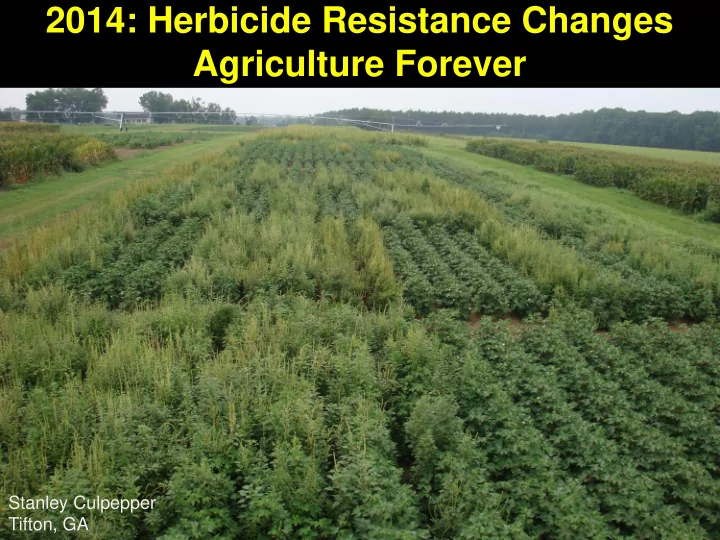
SLIDE 1 2014: Herbicide Resistance Changes Agriculture Forever
Stanley Culpepper Tifton, GA
SLIDE 2
Herbicide-resistance is not a new phenomenon! Its been happening since 1968!
SLIDE 3 The U.S. Wins the Gold Medal in Herbicide Resistance!!!!
Source: International Survey of Herbicide Resistant Weeds (10/4/12)
SLIDE 4 Confirmed Cases of Herbicide-Resistant Weeds in the United States
5 5 11 19 11 6 5 6 9 2
Source: International Survey of Herbicide Resistant Weeds (10/4/12)
24 20 8 26 4 CT-2 DE-7 HI- 4 MD-11 MA-2 NH-2 NJ-4 RI-1 VT-2 13 22 16 22 22 4 2 27 17 13 10 8 5 13 21 18 7 10 1 11 12 2
SLIDE 5
SLIDE 6
Resistance Development
Economics, Effectiveness, and Ease of the herbicide(s)
AND Biology of the weed
SLIDE 7
Roundup Ready Technology Very Economical Very Effective Extremely Easy
SLIDE 8 Resistance Development
Economics, Effectiveness, and Ease are almost always the main factors
- 1. Single mode of action applied to large acreage
- 2. Few or no alternative classes of chemistry used
- 3. Little to no tillage
- 4. Little to no rotation in crops
- 5. Often in stressful environments when herbicide activity
is minimized
- 6. Reduced herbicide rates, poor coverage, etc.. that
minimize activity
SLIDE 9
Tremendous Selection Pressure
SLIDE 10 Selection Pressure
Overuse of herbicide chemistry
Resistance Herbicide Resistance: The acquired (inherited) ability of a weed population to survive a herbicide application that previously was known to control the population.
SLIDE 11 Palmer amaranth Changes Agriculture
Biological Attributes Herbicide Resistance
2005-2011
SLIDE 12 What makes Palmer special?
SLIDE 13
Oh my, how great it was!!!!!!
SLIDE 14 WeatherMax 176 oz; POST 2”, 5”, and 8” (at least 24 times more lb active than normally needed)
cotton
SLIDE 15 Weathermax 88 oz Staple LX 10 oz
SLIDE 16 What makes Palmer special?
- 1. Herbicide resistance?
- 2. Growth rate?
SLIDE 17 Picture taken 7 am on 7-9-07
4 inches 52 hr
SLIDE 18 Picture taken 7 am on 7-9-07
1/2 inch 12 hr (overnight)
SLIDE 19 What makes Palmer special?
- 1. Herbicide resistance?
- 2. Growth rate?
- 3. Large stature?
SLIDE 20
Rapid Growth Becoming Extremely Large
SLIDE 21 What makes Palmer special?
- 1. Herbicide resistance?
- 2. Growth rate?
- 3. Large stature?
- 4. Competitive ability?
SLIDE 22 Crop Rotation
Yield Loss (%) from 1 AMAPA/row meter
SLIDE 23 What makes Palmer special?
- 1. Herbicide resistance?
- 2. Growth rate?
- 3. Large stature?
- 4. Competitive ability?
- 5. Reducing harvest efficacy?
SLIDE 24
Impact on Harvest
SLIDE 25 What makes Palmer a special?
- 1. Herbicide resistance?
- 2. Growth rate?
- 3. Large stature?
- 4. Competitive ability?
- 5. Reducing harvest efficacy?
- 6. Seed production?
SLIDE 26 50,000 100,000 150,000 200,000 250,000 300,000 350,000 400,000 450,000 500,000 230 K 250 28 K 309 K
Giant ragweed
450 K
Number of Seed Produced per Plant Glyphosate-Resistant Weeds in US
Ragweed = Harrison et al. 2001; johnsongrass = Warwick and Black (1983); horseweed = Regehr and Bazzaz (1979); waterhemp = Nordby and Hartzler (2004); Palmer amaranth = Macrae et al (2009).
Johnson
Horseweed Waterhemp Palmer amaranth
SLIDE 27
Palmer amaranth seed production allows for rapid field domination
Year 1 Year 3 to 4
SLIDE 28 What makes Palmer special?
- 1. Herbicide resistance?
- 2. Growth rate?
- 3. Large stature?
- 4. Competitive ability?
- 5. Reducing harvest efficacy?
- 6. Seed production?
- 7. Rapid spread?
SLIDE 29
Role of pollen movement and gene-flow in the spread of herbicide resistance
SLIDE 30
Pollen-flow can move genes across the landscape
SLIDE 31
And a trait becomes established in a new population
SLIDE 32 Traditional Grower Response To Resistance
- 1. It want happen to me!
- 2. Ok, its starting to happen to me so when
will the next new herbicide be here? (1992 was last new mode of action)
- 3. O *$&#, I got a mess. It’s on!
SLIDE 33 Traditional Grower Response To Resistance
- 1. It want happen to me!
- 2. Ok, its starting to happen to me so when
will the next new herbicide be here? (1992 was last new mode of action)
- 3. O *$&#, I got a mess. It’s on!
The challenge for Extension and Industry is figuring out how to skip steps 1 and 2 moving straight into step 3.
SLIDE 34 Helping Growers Respond More Quickly
- 1. Unified communication
- 2. Unbiased research defining potential
impact from resistant weed.
- 3. Provide management programs that are
as simple and economical as possible.
SLIDE 35
Herbicide input increased from 4.25 to 10.625 lb ai/A
2000-2005: Herbicide costs = $27.80/A 2006-2010: Herbicide costs = $68.00/A
SLIDE 36 Changes in Herbicide Management
2002: $24/A 2010: $63/A
Roundup Burndown Roundup POST 1 Roundup POST 2 Roundup + diuron PD Roundup + Valor Burndown1 Gramoxone + Reflex + Direx PRE Roundup + Staple POST 1 Roundup + Dual POST 2 Direx + MSMA PD
SLIDE 37 Photo by A.C. York 2010
2004: 17% of growers hand-weeded 5% cotton acres at $2.40/A 2010: 92% of growers hand-weeded 52% cotton acres at $23.70/A
SLIDE 38 Tillage is now a common scene
2004: 13.1% of cotton acres cultivated 2010: 32.1% of cotton acres cultivated Herbicide incorporation: 264,266 A (26.7%) Deep turn: 256,075 A last 3 yr
SLIDE 39 Current Cotton Situation
Cost to Manage Palmer in GA Cotton
$68.00 per A $88 million
$11.40 per A $15 million
$5.84 per A $7.6 million
??? ???? $110 million
SLIDE 40 RR Herbicide Program Getting Better*
2010 2012
*Conditions first six wk after planting drier during 2012 than 2010.
SLIDE 41 Growers Making Good Decisions IS KEY!!!!!
- 1. Diversified (more than just spray, spray, spray)
- 2. Timely herbicide applications (residuals key!)
- 3. Understand Palmer amaranth biology
- 4. More effective weed management programs
SLIDE 42 Growers Making Good Decisions IS KEY!!!!!
- 4. More effective weed management programs
- A. Herbicides (residuals, tank mixes, etc.)
- B. Hand weeding
- C. Selective applicators
- D. Control before, during, and after crop
- E. Timeliness is still key
- F. Overall objective is to eliminate seed production
SLIDE 43 Relying Too Heavily on Herbicides??
How long will Liberty last? How long will residual of Reflex and Valor last?
SLIDE 44
2013-2015: Develop better programs reducing selection pressure on ALL herbicides
SLIDE 45
SLIDE 46
Using Heavy Rye Covers For Sustainability
Rye Cover Weedy Cover
SLIDE 47 Herbicide Resistance: Will You Survive?
If resistance is one in a billion then you
- nly need 918 acres to find that plant.
(historically resistance is 1 plant in population of 1-10 million…9.18 acres)
25 plants per square foot emerge
=
1,089,000 plants per acre
SLIDE 48 Questions/Comments
Heavy Rye Production System: www.farmprogress.com/heavycover