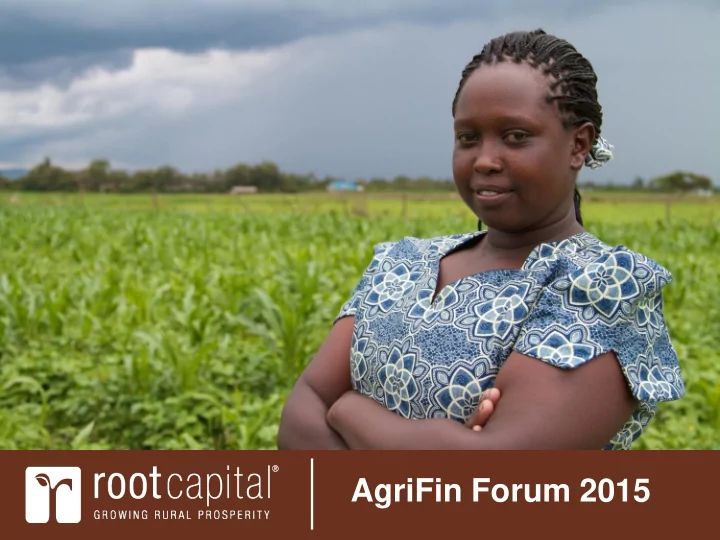
AgriFin Forum 2015 Our Mission Grow rural prosperity by investing - - PowerPoint PPT Presentation
AgriFin Forum 2015 Our Mission Grow rural prosperity by investing in small and growing agricultural businesses that build sustainable livelihoods in Africa and Latin America. Financing the Rural Missing Middle Capital Constraints Facing
Our Mission
Grow rural prosperity by investing in small and growing agricultural businesses that build sustainable livelihoods in Africa and Latin America.
Financing the Rural “Missing Middle”
10 20 30 40 50 60 70 Congo Kenya Nigeria Niger Senegal Benin Burkina Faso Cote d'Ivoire Guinea Bissau Mali
% loans to agriculture Contribution of agriculture to total GDP, %
%
Source: SCOPEinsight, “Mainstream Agrifinance: Enable producer organizations to invest their way out of poverty.” Compliments of AGRA: CIA World Fact Book, Central Bank of Congo, Central Bank of Nigeria, Central Bank of Kenya, Central Bank of South Africa; BCEAO – Annual Report 2008
Capital Constraints Facing African Agriculture
Our Three-Pronged Model
Finance Advise Impact
$120M
Capital Under Management
97%
Repayment Rate from Borrowers
Corporate 14% Foundation 34% Government and Multilateral 31% Individual 13% Institution 8%
Investors
Amount Outstanding as % of Total Notes Payable
$835M
Cumulative Disbursements Since 1999
80%
Operational Self-Sufficiency
Organizational Overview
$178M
Loan Disbursements Enterprises
$1.1B
Enterprise Revenue
655K
Farmers
$842M
Enterprise Payments to Farmers
672K
Hectares
279
2014 Lending
$178M $122M $122M $113M $80M $57M $41M 2014 2013 2012 2011 2010 2009 2008 2007 2006 $28M $20M 2005 $15M
Annual Loan Disbursements
Financing Agricultural Value Chains
Buyer Agricultural Enterprise Smallholder Farmers
Commercial Banks Specialized Ag Lenders Microfinance Institutions Savings & Credit Cooperatives Local NGOs
Technical Assistance
Loans for Working Capital Loans for Pre-Harvest Credit Loans for Capital Expenditure Loans for Farm Renovation Post-harvest handling and processing Financial planning Cost accounting Internal credit system development Agronomic practices Post-harvest handling
Triangulating with Buyers
Agricultural Enterprise (Borrower) Buyer Root Capital
Case: Financing Cashew Exports in West Africa
200
EMPLOYEES (75% women)
$200K
WORKING CAPITAL LOAN
2011 2012 2013 2014 $1.8M $3.0M $4.1M $8.7M
Annual Disbursements – West African Cashew
$196K
IN PAYMENTS TO FARMERS
$2M
WORKING CAPITAL LOAN
660
EMPLOYEES (90% women)
$1.7M
IN PAYMENTS TO FARMERS
An Example of Enterprise Growth
- 1. Informality of many value chains
- 2. Disaggregation of farmers
- 3. Absorptive capacity of enterprises
- 4. Availability of collateral and registration process
- 5. Currency risk
- 6. Market volatility
- 7. Crop failures
Challenges
- 1. Structuring the Transactions
- 2. Impact
- 3. Collaboration
- 4. Lessons Learned
- 5. Future Opportunities
Case: Financing the Sorghum Value Chain in Ghana
Connecting smallholder farmers with a high-value market
- 1. Structuring the Transactions
- Fit and alignment with Root Capital's mission and selection criteria
- Understanding the financing need – nature of business, production cycle, use
- f funds, amount required and timing
- Stages of the value chain at which financing is required: pre- and post-harvest
- Pricing and currency issues
- Risk assessment and mitigation – collateral and insurance
- Access to Forex by aggregators for transfer to Root Capital
- Scheduling of repayments
- 1st year structured as fixed monthly payment beginning from harvest period
- 2nd year changed to a flexible repayment based on aggregator's cash flows
Case: Financing the Sorghum Value Chain in Ghana
Connecting smallholder farmers with a high-value market
- 2. Impact
- In 2013, increased access to credit for aggregators; previously these businesses
struggled with inadequate finance offerings from a local MFI
- Continued financing in 2014 with increased loan amounts and financed a third
aggregator
- Improved access to production inputs for sorghum farmers
- Increased income for farmers consequently increased food security
- Of 205 farmer surveyed, 85% reported increased incomes of 50%+
- Average reported productivity increases of 130%
- Income gains reduced household pressure to sell food crops when cash
was scarce and improved food security
- Increased output and supply to GGBL
Case: Financing the Sorghum Value Chain in Ghana
Connecting smallholder farmers with a high-value market
- 3. Collaboration
- Barclays Bank serves as co-financier and supported funds transfer to Root
Capital
- Guinness Ghana Limited acts as buyer of farmers’ produce, reducing the risk
- f the transaction by serving as a stable off-taker
- AGRA/Concern Universal is providing valuable technical assistance to
aggregators and producers
- Currently in discussion with IFDC to link aggregators to fertilizer suppliers
Case: Financing the Sorghum Value Chain in Ghana
Connecting smallholder farmers with a high-value market
Case: Financing the Sorghum Value Chain in Ghana
Connecting smallholder farmers with a high-value market
- 4. Lessons Learned
- Increased understanding of the dynamics of domestic value chains
- Managing FX risk associated with the transaction
- 5. Future Opportunities
- Finance more aggregators to increase sorghum supply
- Replicate in other countries in which GGBL operates (e.g., Cameroon, Nigeria)
- Replicate in other crops that are part of GGBL supply chain (e.g., maize, cassava)
- Link other multinationals to local sources of sustainable agricultural commodities