
SLIDE 1
Agroecology & Institutions
Challenges, opportunities and recent examples from Argentina Pablo A. Tittonell
National Program on Natural Resources and the Environment, INTA, Argentina
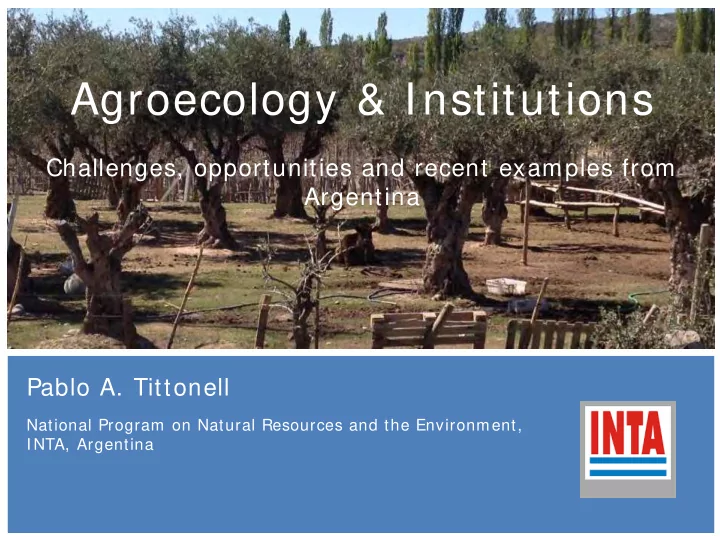
Agroecology & Institutions Challenges, opportunities and recent - - PowerPoint PPT Presentation
Agroecology & Institutions Challenges, opportunities and recent examples from Argentina Pablo A. Tittonell National Program on Natural Resources and the Environment, INTA, Argentina Agroecology & institutions a mismatch 1.
National Program on Natural Resources and the Environment, INTA, Argentina
ETC group
Diversity Resource efficiency Recycling Natural regulation Synergies
3
Agroecology as a scientific discipline
2000s 1960/70s 1980s 1990s 1940/50s 1920/30s
Scale: field/plot Scope: biology/physics Descriptive nature Scale: agro-ecosystem Scope: ecology/agronomy Analytical nature From descriptive to analytical, increases scope and scale From analytical to prescriptive, further increases scope and scale Conceptual framework to design and manage agro- ecosystems
Agroecology as a set of practices
2000s 1970s 1980s 1990s
Further increases scope and scale: Agroecology as the interdisciplinary study of food systems Agro-ecological principles inspire farming practices Indigenous agricultural knowledge for natural resources management
Agroecology as a social movement
2000s 1980s 1990s
Spread of practices is intertwined with movements Indigenous knowledge and family farms Agro-biodiversity, food sovereignty Sustainable agricultural intensification and food systems Agroecological practices are introduced or further developed (conservation agriculture, permaculture, system of rice intensification, organic farming) Agroecological practices as alternative paradigm to conventional agric.
http://pubs.iied.org/14629IIED.html?c=foodag
Khumairoh et al., 2012
Rice yield (t ha-1) at increasing levels of complexity
2 4 6 8 10 12 Rice Rice + ducks Rice + compost Rice + ducks + fis h
+ compost + azolla Rice + ducks + compost Rice + ducks + fish + compost Rice + ducks + compost + azolla Rice + ducks + fish + compost + azolla
Assessing greenhouse gas emissions (T. del Rio, 2014)
(G. Garnacho Alemany, 2014)
Desakota Project, Indonesia, Studio FELIXX (2014)
Nutrient cycling Processing Trading and distribution
Minas Gerais, Brazil
FAO, 2010
“People in China, who with brain and brawn, have successfully and continuously sustained large families on small areas without impoverishing their soil. ”
580 600 620 640 214 305 407 505 431 531 200 400 600 800 1000 1200 1400 1600 100 200 300 400 500 600 700 1961 1969 1977 1985 1993 2001 2009 2017 2025 Grain (million ton) Year Grain demand Grain production Population
The challenge of feeding an increasingly urban population
张强
黑龙江农科院 中国农大 吉林农科院 吉林农大 中国农大 中国农大 中国农大 河北农科院 河北农大 山东农大 青岛农大 南京农大 安徽科技学院 安徽农科院 浙大 华中农大 南亚所 中国农大 海南大学 四川农科院 西南大学 山西农科院 内蒙古农大 西北农林大学 甘肃农科院 石河子大学 河南农大 云南农大 已建小院 23 在建小院 13 四川农大 广西大学
Stepwise approach: productivity, efficiency, incomes, diversification Fu-Suo Zhang Images were taken in March 27, 2004
Practice Planting density Weight 1000 seeds Plants/m2 at tillering Ears/m2 Grain yield (t/ha) Current 200 52 111 277 6.7 Adapted 60 60 84 317 7.7
Agronomic assessment of 380 fields from 1992 to 2009
Conventional vs. organic farming in La Camargue, France
Yield Tillering rate N in fertiliser Clay content Stand density Sowing date Conventional Organic
A conventional farmer purchasing pesticides An agroecological farmer inspecting his intercrop
Photo: Steve Sherwood Photo: Clarin Rural Estancia Laguna Blanca, Entre Rios, Argentina Ecological farming on 3000 ha
Large scale cereal production Tres Arroyos, Argentina
Criterion ‘Classical' agronomy Agroecology
Domain Autoecology Synecology Dynamics Predictable outcomes, feedbacks formalized, continuity Complex feedbacks, randomness, hysteresis
(non-linearity, irreversibility, discontinuity)
Diversity A burden (weeds, heterogeneity,
asynchrony, etc.) – theory of control
An attribute (synergies, natural antagonism, risk
spreading, etc.) – theory of regulation
Up-scaling Aggregation: nested systems from field to world Emerging properties and interactions: the whole is more than the sum of its parts
Tittonell, 2014. Current Opinion in Environmental Sustainability 8: 53–61
Diagnosis
‘Classical' agronomy Agroecology
possibility frontiers
ascendency
(scale agnostic)
emerging property (matrix)
time
Slowly evolving socio- technical landscape Dynamically stable socio-technical regime Regular openings for niche innovations
Levels in system innovation Time
Niche innovations Cross-scale feedback
Niche innovations Turbulent socio- technical landscape Adapting socio- technical regime Frequent
feedbacks
Levels in system innovation Time
System innovation programs
Tittonell et al., 2015. Local Innovation to Address Global Problems
(Complex) systems approach Social learning setting Dynamic project monitoring
Family vegetable production system, Canelones, Uruguay
RE-DESIGN RE-DESIGN Implementation support and monitoring DIAGNOSIS IMPLEMENTATION AND EVALUATION IMPLEMENTATION AND EVALUATION
Process monitoring MSC Records and analysis of the interaction process between farmers and scientists Reflection workshop Records and analysis of the interaction process between farmers and scientists MSC Reflection workshop PIPA workshop Reflection workshop
Planned improvements % adoption Drainage and erosion control 83 Green manures 88 Chicken manure 100 Crop Rotation 75 Rotation with pastures 64 Area of Crops 100 Crop manag 93 Strategic weed control 81 Record sheets 44
100 200 300 400 500 600 5 10 15 20 25 30 35
Family Income ($u yr-1) Soil erosion (Mg ha-1 yr-1)
Farm 1 Farm 2 Farm 3 Initial Actual Potential Initial Initial Actual Actual Potential Potential
20 40 60 80 100 Jan Feb Mar Apr May Jun Jul Aug Sep Oct Nov Dec Relative nectar availability 20 40 60 80 100 Jan Feb Mar Apr May Jun Jul Aug Sep Oct Nov Dec Relative aphid availability
grey = field borders green = existing hedgerows red = planned new hedgerows 500 m.
Participatory landscape design
Current landscape
Groot and Rossing, 2010 Exploration of alternative landscape structures
Deriva de vapor Deriva de Gota Escurrimiento superficial Lixiviación Adsorción
Julie Brodeur (INTA)
2 4 6 8 10 12 14 16 1985 1990 1995 2000 2005 2010 2015 Argentina Brazil
L ha-1 yr-1
Pérez, R.A., De Luca, L.C., Giordano, G., Perez, M, 2015. Instituto de Investigación y Desarrollo tecnológico para la Agricultura Familiar (IPAF), de la región pampeana. INTA, Argentina
knowledge, inputs, etc.;
health risks to be minimized for producers and consumers;
increase sustainability;
Elaboracion propa: Ana Falu – INVIHAB 2014.
Fuente: B.Giobellina 2014, en base a Municipalidad Córdoba 2008
julio de 2015
Diciembre 2008
1993 2001 2008
National programs Research institutes Regional centres Experimen
stations Territorial projects Extension agencies Agroecology network Local actor X
Critical transition zone (vulnerability)
Transition or transformation? Continuity or rupture?
Tittonell, 2014. Current Opinion in Environmental Sustainability 8: 53–61
Farmers are getting old!
* Be careful here!
www.pablotittonell.net