AI Autopilot Final Year Project: Automation and intelligent - PowerPoint PPT Presentation
AI Autopilot Final Year Project: Automation and intelligent optimisation in high performance sailing boats The Data Analysis Bureau Project Introduction Machine Learning approaches to the Helmsman problem Controlling the rudder input
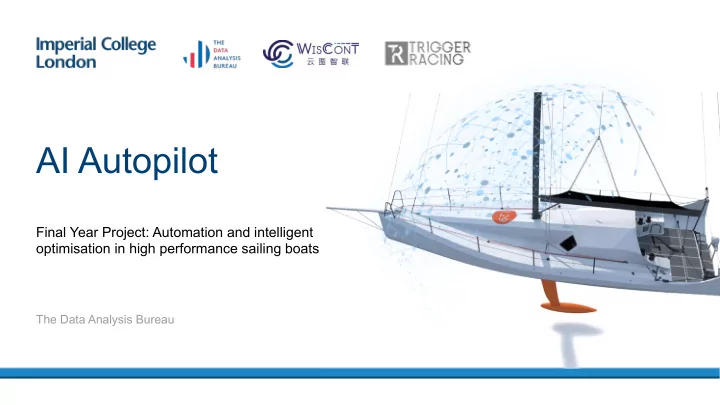
AI Autopilot Final Year Project: Automation and intelligent optimisation in high performance sailing boats The Data Analysis Bureau
Project Introduction • Machine Learning approaches to the Helmsman problem – Controlling the rudder input based on recorded data • Jack Trigger data collected from onboard sensor- and processing system (NKE systems) • Various data formats and additional data sources • A problem split into the domains of: – Control theory – Data science [1] Jack Trigger Racing, www.triggerracing.com – Applied machine learning – Eventually IoT
Background and previous work Background and motivation: • Recent explosion in the development of ML for the purpose of autonomous driving and other applications • A desire to transfer recent developments in methodology and toolboxes to the realm of high performance sailing • Within high performance single-handed sailing: The desire to emulate a human driver and outperform existing, traditional autopilots Skype conversation with Dr. Pieter Adriaans
Data Sources Adrena Export: .csv Sensor Array Topline Bus NKE Proprietary: .NKZ Processor HR NMEA-0183: .LOG (txt) BoxWifi
Data Sources .NKZ => .csv .csv • 32 files • 17 files • 188 (~50) features • 41 features • 16 hours • ~200 hours • 25 Hz • 1 Hz • Rudder data • No rudder data • Pilot data • No pilot data
Aim: Alleviate the workload of a solo sailor and optimise Velocity Made Good (VMG), rather than just keeping course Two different approaches to the same problem: • Reinforcement Learning • Supervised Learning
Reinforcement Learning Rate of convergence to Rudder the desired location action angle Goal Wind Agent Environment Boat Sea state reward Start
• Wind Agent ENVIRONMENT Sea Input • Sea State (Actor) (real) State • Location State Rudder VMG Angle Database Dynamic Model of • Velocity BOAT the Boat • Orientation (model) (Critic)
LSTM – Long-Short-Term Memory Neural Networks LSTM consist of memory blocks called cells. Each cell has three gates: 1. Input gate – which information is useful at this particular level 2. Forget gate – which information is no longer relevant and could be forgotten. Allows for long-term memory, so history of 3. Output gate – what information boat dynamics can be included in the is relevant for the next cell estimation of the next state.
... t-3 t-2 t-1 t t+1 Wind Boat Orientation Current Boat Position LSTM Boat Orientation . Boat Position Boat Speed . . . Boat Speed . . . Control Action . .
• Wind Agent ENVIRONMENT Sea Input • Sea State (Actor) (real) State • Location State Rudder VMG Angle Database Dynamic Model of • Velocity BOAT the Boat • Orientation (model) (Critic)
• Wind ENVIRONMENT Sea Input LSTM • Sea State (real) State • Location Rudder Angle Database
... t-3 t-2 t-1 t Wind Current t+1 Control Action LSTM Boat Orientation Boat Position . Boat Speed . . . Control Action . .
Rudder Angle
Moving to the Cloud
Future: Edge Computing
Recommend
More recommend
Explore More Topics
Stay informed with curated content and fresh updates.