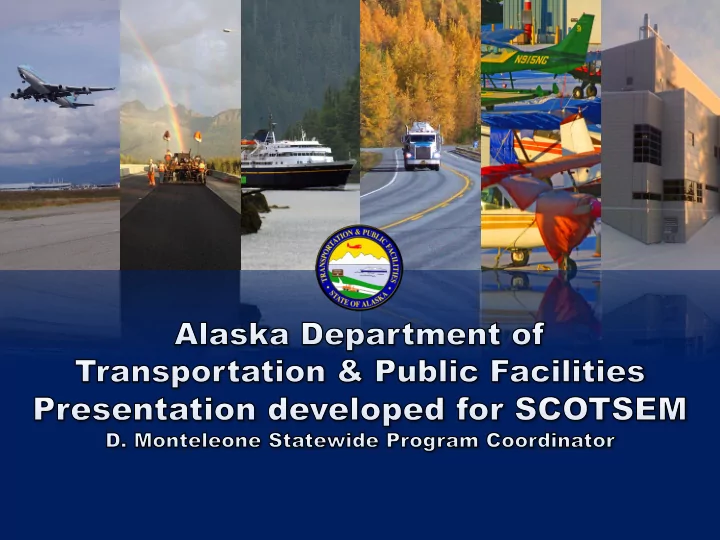
Alaska AK DOT/PF Overview 11/4/2016 Alaska DOT&PF 2 - - PowerPoint PPT Presentation

alaska ak dot pf overview
SMART_READER_LITE
LIVE PREVIEW

Alaska AK DOT/PF Overview 11/4/2016 Alaska DOT&PF 2 - - PowerPoint PPT Presentation

Alaska AK DOT/PF Overview 11/4/2016 Alaska DOT&PF 2 Alaska AKDOT/PF Overview Our mission is to "Keep Alaska Moving through service and infrastructure." 11/4/2016 Alaska DOT&PF 3 Organization REGIONAL STATISTICS


slide-1
SLIDE 1
slide-2
SLIDE 2

11/4/2016 2 Alaska DOT&PF

Alaska AK DOT/PF Overview

slide-3
SLIDE 3

11/4/2016 3 Alaska DOT&PF

Alaska AKDOT/PF Overview

Our mission is to "Keep Alaska Moving through service and infrastructure."

slide-4
SLIDE 4

Organization

slide-5
SLIDE 5

Central Northern South Coast

Geographical Area 181,780 sq. mi. 416,000 sq. mi. 42,000 sq. mi. Public Facilities 235 Buildings 403 Buildings 15 Buildings Roads (centerline miles) 1,990 3,484 541 Bridges 264 378 126 Airports 110 106 45 Certified 11 7 5 Non-Certified 99 99 40 Harbors 6 1 44 Approximately 3,500 employees in 8 labor unions in 85 locations throughout the state.

REGIONAL STATISTICS

slide-6
SLIDE 6
  • 1,500 buildings
  • 10 million square feet of buildings
  • $2.4 billion in replacement value
  • DOA – office buildings, storage
  • 8 Public Building Fund buildings
  • 7 non-PBF buildings
  • Health and Social Services – youth corrections, treatment and health centers,

Pioneers Homes, API

  • Corrections – correctional facilities
  • DM&VA – armories, hangars
  • Fish & Game – bunkhouses, offices
  • DNR – cabins, recreational facilities, offices
  • Education – Mt. Edgecumbe
  • Labor - AVTEC
  • Courts – court and office buildings
  • Public Safety – crime labs, DPS facilities, CAP hangars

State of Alaska Facilities

slide-7
SLIDE 7
  • 700 buildings
  • 4 million sq. feet
  • $302 million original cost
  • $1 billion estimated replacement value
  • 150 buildings are over 60 years old (many built

in the 1940’s and 1950’s)

DOT/ PF Facilities

slide-8
SLIDE 8
  • Airport terminals
  • Ferry terminals
  • Office buildings
  • Maintenance shops
  • Equipment storage buildings
  • Weigh stations
  • Employee housing

TYPES OF FACILITIES

slide-9
SLIDE 9

REGIONAL BOUNDRIES

slide-10
SLIDE 10

HIGHWAY DESIGNATIONS

NHS / AHS

National Highway System Alaska Highway System

slide-11
SLIDE 11
  • #1 cargo airport in the US
  • Busiest floatplane base in the world
  • Nearly one in ten jobs in Anchorage
  • 9,119 airport jobs for $367 million

payroll

  • 5,631 community jobs for $148

million payroll

  • Serves 5 million passengers per year
  • 58 airlines currently operating at

airport

TED STEVENS ANCHORAGE INTERNATIONAL AIRPORT

slide-12
SLIDE 12

FAIRBANKS INTERNATIONAL AIRPORT

#13 cargo airport in the US Large floatplane base – recently expanded Serves 800,000 passengers per year 15 airlines currently operating at airport FIA is the key passenger/cargo/mail hub for interior and northern Alaska serving 33

  • utlying communities.
slide-13
SLIDE 13
  • Largest airport operator in the U.S.

DOT/PF operates 261 airports and seaplane bases statewide. 2 International – TSAIA and FIA.

  • 90% of Alaska landmass is not

connected to the road system.

  • DOT/PF provides comprehensive

services to support all airports in its system, including maintenance and

  • perations, administrative,

planning, airport security under TSA part 1542 and construction personnel.

RURAL AIRPORTS

slide-14
SLIDE 14

ALASKA AIRPORTS

261 State-owned Airports operated by DOT/ PF

slide-15
SLIDE 15

(51) State-owned Harbors (26) M & O Stations

ALASKA DOT/PF HARBORS

slide-16
SLIDE 16

PORTS AND HARBORS

Waterways provide the transportation corridors for the movement of more 95% of all cargoes delivered to Alaska and nearly 100% of all exports. DOT/PF owns 51 of the 76 public harbor facilities in Alaska. 25 are operated through agreements with local governments.

slide-17
SLIDE 17
  • The AMHS is designed to provide basic transportation services to the communities of southeast and

southwest Alaska.

  • AMHS is an integral part of Alaska’s highway system, reaching many communities that would otherwise be

effectively cut off from the rest of the state and nation.

Alaska Marine Highw ay System

slide-18
SLIDE 18
  • 33 ports-of-call
  • 3,500 nautical miles of coastline served from Bellingham, Washington to Unalaska
  • Designated a National Scenic Byway in 2002
  • A new fast vehicle ferry, Chenega, to serve Southeast and Prince William Sound, and travels at speeds up to 36

knots (41 miles/hr.)

AMHS

slide-19
SLIDE 19

ALASKA MARINE VESSELS

slide-20
SLIDE 20
  • Measurement Standards

Division

  • Responsible for

maintaining all Truck Scales and fuel pumps around the state.

Measurement Standards / Commercial Vehicle Enforcement

slide-21
SLIDE 21
  • Commercial Vehicle

Enforcement

  • Responsible for

enforcing all Federal Commercial Vehicle regulations.

MS/CVE

slide-22
SLIDE 22
  • DOT/PF also supports, manages and

maintains the states equipment fleet.

  • At present the fleet consists of over

4,500 vehicles and associated pieces of equipment

State Equipment Fleet

slide-23
SLIDE 23

TARGETS & DRILLS

slide-24
SLIDE 24
  • Bridges
  • Airports
  • Marine Ports
  • Individual Passenger

Terminals

  • Key State Facilities
  • State Equipment Fleet

CRITICAL ELEMENTS

slide-25
SLIDE 25

INTER-DEPENDENCY

Many bridges around the state will also support other critical infrastructure components i.e. Utilities and Communications lines.

slide-26
SLIDE 26
  • Alaska Partnership for Infrastructure Protection (APIP)
  • Federal Protective Security Advisor (RRAP)
  • Federal DOT Critical Nodes
  • TSA
  • FAA
  • USCG Vessels and Bridges

Infrastructure Protection

slide-27
SLIDE 27

DOT/PF RESPONSE

slide-28
SLIDE 28

STATE VULNERABLE TARGETS & DRILLS

State of Alaska Law Enforcement Sensitive

  • 1. Trans Alaska Pipeline System (TAPS)
  • 2. North Pole Williams Express Refinery and Golden Valley Electric Association Power Plant
  • 3. North Slope Oilfields
  • 4. Anchorage Port Fuel Manifold System and Port of Anchorage
  • 5. Cruise ships and Alaska State ferries
  • 6. ACS, ALASCOM and GCI switch complexes (Anchorage and Juneau)
  • 7. State telephone switches
  • 8. Long haul fiber optic cables (Whittier, Valdez and Seward)
  • 9. Tudor Road Tower (single point of failure for radio repeaters north of Anchorage)
  • 10. Alaska National Guard Armory (Fort Richardson)
  • 11. FAA Regional Flight Control
  • 12. Beluga Power Plant and Undersea Cables
  • 13. Four Dam Power Plant (Southeast Alaska)
  • 14. Nikiski Refinery Complex
  • 15. Alaska Railroad (to include the Hurricane Gulch Bridge)
slide-29
SLIDE 29

DOT/PF VULNERABLE TARGETS & DRILLS

  • NOTE: Alaska has a unique relationship with DOD as a result of a

shared history. Much of the population is ex-military

  • There are two regularly scheduled and funded drill activities that

rotate each few years in state. They are called Alaska Shield and Northern Edge.

  • The Alaska Shield exercises- State oversight / funded.
  • The Northern Edge- Federal oversight / funded.
  • 2016 Alaska Shield was held in April and was an Active Shooter drill

that involved (8) communities across the state. Alaska DOT/PF participated in the exercise held at Anchorage Int. Airport. (Simulated Terrorist attack on an arriving overseas flight)

slide-30
SLIDE 30

DOT/PF VULNERABLE TARGETS & DRILLS

  • Vertical insertion Northern Edge.MPG
slide-31
SLIDE 31

DOT/PF VULNERABLE TARGETS & DRILLS

QUESTIONS?