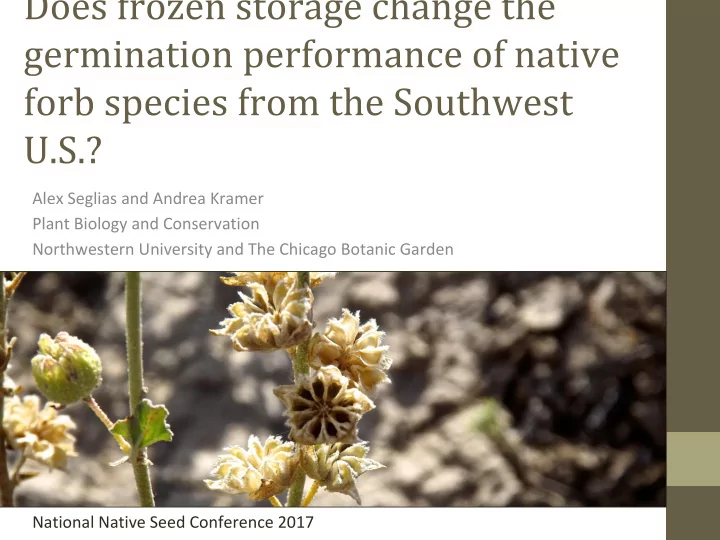
SLIDE 1
Alex Seglias and Andrea Kramer Plant Biology and Conservation Northwestern University and The Chicago Botanic Garden National Native Seed Conference 2017
SLIDE 3 Agriculture Conservation
SLIDE 4 Agriculture Conservation Restoration
SLIDE 5
National Center for Genetic Resources Preservation
SLIDE 6
- Southwest U.S. – Arizona, Colorado, New Mexico, Utah
- Large-scale restorations
- Limited availability of regional native plant material
SLIDE 7
- 7 common forb species*
- Widespread throughout the Southwest
- High priority species for use in large-scale restorations
- Little information about dormancy and germination
- Physiological and combinational dormancy
- Orthodox
*Selected from a list of species created by the Colorado Plateau Native Plant Program and collaborators
SLIDE 8
- Low moisture and temperature (-20°C or below)
- Preservation of seeds for hundreds of years
- Ex situ collections in case of extinction or population
destruction
SLIDE 9
1. Southwestern native forb species will be amenable to seed banking conditions (i.e., drying and storing at sub-zero temperatures) 2. Germination response (proportion and rate) will not differ between non-frozen and frozen seeds 3. Seed bank storage effects will not differ within species
SLIDE 10 www.fs.fed.u s www.fs.fed.u s
Heliomeris multiflora showy goldeneye Dieteria canescens hoary tansyaster Packera multilobata lobeleaf groundsel
www.fs.fed.us greatbasinnativeplants.co m
Penstemon comarrhenus dusty beardtongue Plantago patagonica woolly plantain Sphaeralcea parvifolia small-leaf globemallow Cleome serrulata Rocky Mountain beeplant
www.fs.fed.us
SLIDE 11
- Summer and fall 2015
- 9 populations
- Seeds of Success
protocols
UT CO AZ NM
Utah Colorado Arizona New Mexico
SLIDE 12
Collect seeds Clean seeds Plate seeds Score germination Stratification Incubation Cut tests Seed dryer Seed bank 1/2
SLIDE 13 Collect seeds Clean seeds Plate seeds Score germination 10 weeks (3°C) 8 weeks (3°C) 6 weeks (3, 9°C) No stratification 4 weeks (3, 6, 9°C) 2 weeks (3, 6, 9°C) 20/10°C 25/15°C
- - - - - - - - - - - - - - - - - - - - - - - - - - - - - - - - - - - - - - - - - - - - - - - - - - - - - - - - - - - - - - - - - - - - - - - - - - -
Incubation
- - - - - - - - - - - - - - - - - - - - - - - - - - - - - - - - - - - - - - - - - - - - - - - - - - - - - - - - - - - - - - - - - - - - - - - - - - -
Stratification Incubation Cut tests Seed dryer Seed bank 1/2
SLIDE 14
Cox p-value = 0.001 All treatments shown
SLIDE 15
Cox p-value = 0.18 All treatments shown
SLIDE 16
Cox p-value = 0.05
SLIDE 17
Cox p-value = 0.58 All treatments shown
SLIDE 18
Cox p-value = 0.03 All treatments shown
SLIDE 19
Cox p-value = 0.49 All treatments shown
SLIDE 20
Cox p-value = 0.03 All treatments shown
SLIDE 21 Germination Percentage
SLIDE 22 TRUE
to seed banking
differ after freezing FOR MOST SPECIES
within species DIETERIA CANESCENS SHOWS DIFFERENCE IN RATE
SLIDE 23
- All species have orthodox seeds and are amenable to seed banking
- Dormancy and germination largely unchanged following seed bank
storage
- Effects were most pronounced during stratification for most
species
- Understanding early life stages is critical for restorations now and
in the future
SLIDE 24
Andrea Kramer, Kay Havens, Evelyn Williams Kramer-Havens Lab Jessa Finch, Jacob Zeldin, Becky Barak, Olga K. Nora Talkington, Alicia Foxx, Lila Leatherman Rachel Hosna Patrick Alexander, Kathy See, Dustin Rooks Hau Truong and the Rio Mesa Center Funding: Northwestern Plant Biology and Conservation Robert D. Hevey and Constance M. Filling Native Plant Society of New Mexico BLM & Natural Areas Association
SLIDE 25
alexandraseglias2016@u.northwestern.edu
SLIDE 26
The preceding presentation was delivered at the This and additional presentations available at http://nativeseed.info
2017 National Native Seed Conference
Washington, D.C. February 13-16, 2017