Algorithms and lower bounds for de-Morgan formulas of low- - - PowerPoint PPT Presentation

algorithms and lower bounds for de morgan formulas of low
SMART_READER_LITE
LIVE PREVIEW

Algorithms and lower bounds for de-Morgan formulas of low- - - PowerPoint PPT Presentation

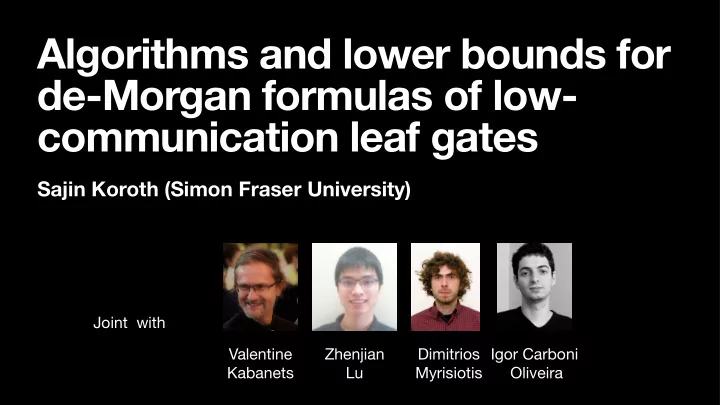
Algorithms and lower bounds for de-Morgan formulas of low- communication leaf gates Sajin Koroth (Simon Fraser University) Joint with Valentine Zhenjian Dimitrios Igor Carboni Kabanets Lu Myrisiotis Oliveira Outline Background


slide-1
SLIDE 1

Algorithms and lower bounds for de-Morgan formulas of low- communication leaf gates

Sajin Koroth (Simon Fraser University)

Valentine Kabanets Joint with Zhenjian Lu Dimitrios Myrisiotis Igor Carboni Oliveira
slide-2
SLIDE 2

Outline

  • Background
  • Circuit model :
  • Prior work
  • Results
  • Lower bounds
  • PRG’s
  • SAT algorithm’s
  • Learning algorithms
  • Overview of the lower bound technique

Formula[s] ∘ 𝒣

slide-3
SLIDE 3

Parallel vs Sequential computation

  • Most of linear algebra can be done in parallel
  • Gaussian elimination is an outlier
  • Intuitively its an inherently sequential procedure
  • There are theoretical reasons to believe so
  • There is an efficient sequential algorithm
slide-4
SLIDE 4

P vs NC1

Are there problems with efficient sequential algorithms which do not have efficient parallel algorithms ?

Class P of poly-time solvable problems Modeled as circuits

slide-5
SLIDE 5

Circuit complexity

  • Complexity parameters :
  • Size : # of gates
  • Depth : length of the longest path

from root to leaf

  • Fan in : 2, Fan out
  • Formulas :
  • Underlying DAG is a tree
  • No reuse of computation
  • Depth = log ( Size )

Internal gates Leaf gates

slide-6
SLIDE 6

Circuit complexity

Class = Poly-Size Formulas

NC1

  • Efficient parallel computation (formally

CREW PRAM):

  • Polynomially many processors
  • Logarithmic computation time

size(F) = nO(1)

x1 x2 xn x5

F

depth(F) = O(log n)

In formula, depth(F) = O(log size(F))

slide-7
SLIDE 7

Circuit complexity

P vs rephrased

NC1

  • A Boolean function (candidates: Perfect matching, Gaussian elimination etc)
  • That can be computed in poly-time (

)

  • Any de-Morgan formula computing it has super-poly size (

)

f f ∈ P f ∉ NC1

slide-8
SLIDE 8

P vs NC1

State of the art

  • Andreev’87 :

for a function in called the Andreev function

  • Also, Andreev’87 :

, where is the shrinkage exponent

  • Paterson and Zwick’93 :
  • Hastad’98 (breakthrough) :
  • Tal’14 :
  • Best l.b. for Andreev’s function (Tal’14) :
  • Best l.b. for a function in (Tal’16) :

Ω(n2.5−o(1)) P Ω(n1+Γ−o(1)) Γ Γ ≥ 1.63 Γ ≥ 2 − o(1) Γ = 2 Ω ( n3 log2 n log log n ) P Ω ( n3 log n(log log n)2)

slide-9
SLIDE 9

Cubic formula lower bounds

Andreev’s function f (

)

x1 x2x3 xn ⋯⋯

,

Truth Table of a bit function ( )

log n h 2log n = n

y1 y2y3 yn ⋯⋯

=

y1 y2y3 y

n log n

⋯⋯

z1

y

n log n

y 2n

log n

⋯⋯

z2

yn−

n log n

yn ⋯⋯

zlog n

h

n log n

slide-10
SLIDE 10

Cubic formula lower bounds

Hastad’s result

  • (Tal’14) :
  • Doesn’t work if there are parity gates at bottom

Ω ( n3 log2 n log log n )

slide-11
SLIDE 11

Our Model

Augmenting de-Morgan formulas

  • de-Morgan formulas : leaf

gates, input literals

  • Our model : leaf gates, low

communication functions

Leaf gates Leaf gates of low cc

slide-12
SLIDE 12

Our model

Reformulation

  • Size s de-Morgan formula
  • : A family of Boolean functions
  • Leaf gates are functions
  • Our model :
  • low communication complexity Boolean functions
  • Formula[s] ∘ 𝒣

𝒣 g ∈ 𝒣 𝒣 s = ˜ O(n2)

slide-13
SLIDE 13

Communication complexity

  • Yao’s 2-party model
  • Input divided into 2 parts
  • Goal : compute

with minimal communication

x, y f(x, y)

x

y

f(x, y)

m1 m2 mk

slide-14
SLIDE 14

Our model

Complexity of Andreev’s function

f (

)

x1 x2x3 xn ⋯⋯

,

Truth Table of a bit function ( )

log n h 2log n = n

y1 y2y3 yn ⋯⋯

=

y1 y2y3 y

n log n

⋯⋯

z1

y

n log n

y 2n

log n

⋯⋯

z2

yn−

n log n

yn ⋯⋯

zlog n

h

n log n

de-Morgan formula of size

n log n

Leaf gates Communication complexity Of Parity = 2 bits

slide-15
SLIDE 15

Our model

Prior work - Bipartite Formulas

  • Input is divided into two parts,
  • Every leaf can gate can access any

Boolean function of either or but not both

  • Models a well known measure - graph

complexity

  • Tal’16: Bipartite formula complexity of

is

  • Earlier methods could not do super

linear

x, y x y IPn ˜ Ω(n2) g1 g2 g3 gs

F x1 x2x3 xn ⋯⋯ y1 y2y3 yn ⋯⋯

Communication complexity Of a bipartite function = 1 bit

slide-16
SLIDE 16

Our model

Connection to Hardness Magnification

  • : Given the truth table of a function on bits (

)

  • Yes : if has a circuit of size at most
  • No : otherwise
  • Meta computational problem with connections to Crypto, learning theory,

circuit complexity etc

  • OPS’19:
  • If there exists an such that

is not in

  • then,

MCSPN[k] f n N = 2n f k ϵ MCSPN[2o(n)] Formula[N1+ϵ] ∘ XOR NP ∉ NC1

slide-17
SLIDE 17

Our model

Connection to PRG for polytopes

  • Polytope : AND of LTF’s
  • LTF :
  • Ex :
  • Nisan’94 : Randomized communication complexity
  • PRG’s for polytopes : Approximate volume computation

sign(w1x1 + … + wnxn − θ) w1, …, wn, θ ∈ ℝ 3x1 + 4x2 + 5x7 ≥ 12 O(log n)

slide-18
SLIDE 18

Our model

Interesting low communication bottom gates

  • Bipartite functions
  • Parities
  • LTF’s (Linear threshold functions)
  • PTF’s (Polynomial threshold functions)
slide-19
SLIDE 19

Our results

Target function - Generalized inner product

  • Generalization of binary inner

product

  • IPn(x, y) = ∑

i∈[n]

xiyi GIPk

n(x1, x2, …, xk) = ∑ i∈[n/k] ∏ j∈[k]

xj

i

x2

1 x2 2 x2 3

x2

n k

⋯⋯ x1

1 x1 2 x1 3

x1

n k

⋯⋯ xk

1 xk 2 xk 3

xk

n k

⋯⋯

∧ ∧ ∧

z1

∧ ∧ ∧

z2

∧ ∧ ∧

zk

0/1

slide-20
SLIDE 20

Our results

Lower bound

  • Let

be computed on average by ,

  • That is,
  • Then,
  • : Randomized communication of

with error in the number on forehead communication complexity model

GIPk

n

F ∈ Formula[s] ∘ 𝒣 Pr

x [F(x) = GIPk n(x)] ≥ 1/2 + ϵ

s = Ω ( n2 k2 ⋅ 16k ⋅ Rk

ϵ/2n2(𝒣) ⋅ log2(1/ϵ) )

Rk

ϵ/2n2(𝒣)

𝒣 ϵ/2n2

slide-21
SLIDE 21

Our results

MCSP lower bounds

  • If

is computed , then

  • Contrast : OPS’19:
  • If there exists an such that

is not in

  • then,
  • Our techniques cannot handle

MCSPN[2cn] Formula[s] ∘ XOR s = ˜ O(n2) ϵ MCSPN[2o(n)] Formula[N1+ϵ] ∘ XOR NP ∉ NC1 MCSPN[2o(n)]

slide-22
SLIDE 22

Our results

PRG

  • A pseudo random generator

is said to fool a function class if

  • is any function from
  • is the seed,
  • Smaller the seed length compared to the better

G ϵ ℱ Pr

z∈{0,1}l(n) [f(G(z)) = 1] −

Pr

x∈{0,1}n [f(x) = 1]

≤ ϵ f ℱ G : {0,1}l(n) → {0,1}n z l(n) ⋘ n n

slide-23
SLIDE 23

Our results

PRG

  • Parities at the bottom can make things harder.
  • best known PRG seed length
  • best known only

AC0 poly(log n) AC0 ∘ XOR (1 − o(1))n

slide-24
SLIDE 24

Our results

PRG

  • There is a PRG that -fools
  • Seed length :
  • Seed length is optimal, unless lower bound can be improved

ϵ Formula[s] ∘ XOR O( s ⋅ log s ⋅ log(1/ϵ) + log n)

slide-25
SLIDE 25

Our results

PRG

  • Natural generalization to
  • There is a PRG that -fools
  • Seed length :
  • Number in hand

Formula[s] ∘ 𝒣 ϵ Formula[s] ∘ 𝒣 n/k + O( s ⋅ (Rk−NIH

ϵ/6s

(𝒣) + log s) ⋅ log(1/ϵ) + log k) ⋅ log k

slide-26
SLIDE 26

Our results

PRG - Corollaries

  • (Ours + Vio15) : There is a PRG
  • Seed length :
  • fools intersection of

halfspaces over

  • Our results beats earlier results when

and

O(n1/2 ⋅ m1/4 ⋅ log n ⋅ log(n/ϵ)) ϵ m {0,1}n m = O(n) ϵ ≤ 1/n

slide-27
SLIDE 27

Our results

PRG - Corollaries

  • There is a PRG
  • Seed length :
  • fools
  • First of its kind
  • Blackbox counting algorithm (Whitebox due to CW19)

O(n1/2 ⋅ s1/4 ⋅ log n ⋅ log(n/ϵ)) ϵ Formula[s] ∘ SYM

slide-28
SLIDE 28

Our results

SAT Algorithm

  • Given circuit class
  • Circuit SAT : Given

, is there an ,

  • #Circuit SAT : Given

, how many ,

𝒟 C ∈ 𝒟 x C(x) = 1 C ∈ 𝒟 x C(x) = 1

slide-29
SLIDE 29

Our results

SAT Algorithm

  • Randomized #SAT algorithm for
  • Running time
  • First of its kind #SAT for unbounded depth Boolean circuits with PTF’s at

the bottom

Formula[s] ∘ 𝒣 2n−t t = Ω n s ⋅ log2 s ⋅ R2

1/3(𝒣) 1/2

for LTFs

log n

slide-30
SLIDE 30

Our results

Learning algorithm

  • There is PAC-learning algorithm
  • Learns
  • Accuracy : , Confidence :
  • Time complexity :
  • can be learned in

[Rei11]

  • Crypto connection:
  • is assumed to compute PRFs (BIP+18)
  • If true,

can’t be learned in time

Formula[n2−γ] ∘ XOR ϵ δ poly(2n/log n,1/ϵ, log(1/δ)) Formula[n2−γ] 2o(n) MOD3 ∘ XOR Formula[n2.8] ∘ XOR 2o(n)

slide-31
SLIDE 31

Lower bound technique

Outline

  • cannot even be weakly approximated by low communication

complexity functions

  • Weakness of

: Size formula can be “approximated” by degree polynomial

  • is weakly approximated by a collection of leaf gates

GIPk

n

Formula[s] ∘ 𝒣 s s GIPk

n

slide-32
SLIDE 32

Lower bound technique

Part I

  • cannot even be weakly approximated by low communication

complexity functions

  • In the number on forehead model
  • Protocol computes

with error (uniform distribution)

  • Then commn.comp >

GIPk

n

GIPk

n

ϵ n/4k − log(1/(1 − 2ϵ))

slide-33
SLIDE 33

Lower bound technique

Part II

  • Weakness of

: Size formula can be “approximated” by degree polynomial

  • Reichardt’11 : Approximation of Boolean formulas by Polynomials
  • be a formula of size
  • There is a real polynomial
  • f degree
  • For every
  • Fact : For any

,

  • Corollary : For any formula of size ,

Formula[s] ∘ 𝒣 s s F(y1, …, ym) s p(y1, …, ym) O( s) y ∈ {0,1}m, |F(a) − p(a)| ≤ 1/10 0 < ϵ < 1 ˜ degϵ(f ) ≤ ˜ deg(f ) ⋅ log(1/ϵ) F s ˜ degϵ(F) ≤ s ⋅ log(1/ϵ)

slide-34
SLIDE 34

Lower bound - proof sketch

g1 g2 g3 gs

F

size(F) = s

d ≤ s

̂ pS

gi1

gid

≤ s

s

p(x)

  • correlates well ( ) with
  • correlates well (

) with a monomial ( )

F ϵ p F 1 s

s

̂ pS ∏

j∈[S],|S|≤ s

gij

  • Since each has low communication complexity, so does
  • correlated well with the target function , thus it

correlates well with the monomial ( a low communication function) !!!!!!!

gi ∏

j∈[S],|S|≤ s

gij F f

Reichardt ‘2011

∀x ∈ {0,1}n, |F(x) − p(x)| ≤ ϵ

deg(p) ≤ s

slide-35
SLIDE 35

Limitations of our approach

  • To get better lower bounds, find a smaller degree approximating polynomial
  • Approximate degree bound of Reichardt (

) cannot be improved

  • function can be computed by a size de-Morgan formula
  • Approximate degree of

is

s ANDn n ANDn θ( n)

slide-36
SLIDE 36

Future directions

  • Extend lower bounds to

when

  • Design a PRG of seed length

and error for intersection of half spaces

  • Learn

in time

Formula[s] ∘ 𝒣 s = ω(n2) no(1) ϵ ≤ 1/n n Formula[s] ∘ XOR 2 ˜

O( s)

slide-37
SLIDE 37

Questions?

Thank you