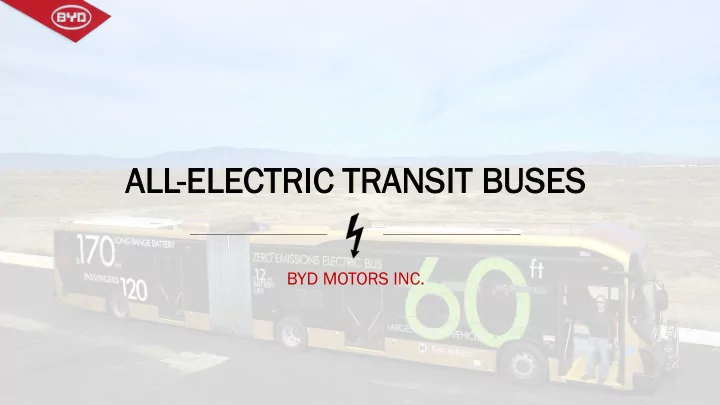
ALL-EL ELECTRIC TRAN ECTRIC TRANSIT SIT BUSES USES BYD MOTORS - - PowerPoint PPT Presentation
ALL-EL ELECTRIC TRAN ECTRIC TRANSIT SIT BUSES USES BYD MOTORS INC. Company Profile & Acknowledgments BYD was founded in 1995 with a $300k family investment and today has grown to $9 Billi llion on in annual revenue. BYD is the
Company Profile & Acknowledgments
- BYD was founded in 1995 with a $300k family investment and today has grown
to $9 Billi llion
- n in annual revenue.
- BYD is the Worlds largest manufacturer of rechargeable batteries.
- BYD entered automotive market in 2003 and today is the Worlds largest
manufacturer of Battery Electric Buses.
- As of October 2015, BYD achieved 6 consecutive months as the World leader
in EV sales.
- As of October 2015, BYD also ranks 1st in total EV sales with 43,069 units sold.
Company Profile & Acknowledgments
- Today 60% of BYD’s public shares are owned by American investors.
- Warren Buffet’s Berkshi
hire Hathaway is BYD’s D’s sing ngle larg rgest publi blic share rehold holder r at 10%.
- In 2015, BYD was ranked #15 in Fortune Magazine’s “51 Companies That are
Changing the World” list.
- In 2010, Bloomberg named BYD a top global technology company.
Company Profile
- 9 Billion in Annual Revenue
- 180,000 Employees Worldwide
BYD Provides Green Sustainable Solutions for the Global Community
Clean Energy Focus
Solar Power Energy Storage LED Lighting
90 mph
Environmentally-Friendly Battery
0 Emissions
Fire Safe
187 Miles
Large Luggage Space Spacious Interior Spacious Interior Low Center of Gravity No Heavy Metals
All-Electric Transit Fleet
Global Popularity
Brazil Amsterdam Milan Israel Hong Kong Beijing Nanjing Hangzhou G-Trans, Gardena Los Angeles Metro Transit Authority Antelope Valley Transit Authority Stanford University Long Beach Transit Denver RTD Link Transit, Washington Columbia, Missouri SolTrans, Vallejo
All-Electric Transit Fleet
- BYD has a current offering of 7 different Transit Bus and Motor Coach models.
- 3,000+ buses in World wide operation today with over 75M miles of data.
- 6,000 buses on order for 2016 World Wide
- Direct replacement for 80% of all bus routes in US today.
- No change in operations, business as normal with better uptime and lower cost.
Why Go All-Electric? Because it is time!
Int ntroducin ing t g the e BYD K D K7 30’ T Tran ansit sit
Why Go All-Electric? Because it is time!
In Intr troducing the the BYD YD K9 K9 35’ & 35’ & 40’ T 40’ Tra ransit
Why Go All-Electric? Because it is time!
Int ntroducin ing t g the e BYD K D K1 60’ T Tran ansit sit
Why Go All-Electric? Because it is time!
Int ntroducin ing t g the e BYD C6 D C6 23’ M Motor Co Coach ach
Why Go All-Electric? Because it is time!
Int ntroducin ing t g the e BYD C9 D C9 40’ M Motor Co Coach ach
Why Go All-Electric? Because it is time!
Int ntroducin ing t g the e BYD C1 D C10 45’ M Motor Co Coach ach
Why Go All-Electric?
- ZERO
RO emissions, Zero CO2, NOx, PM emissions
- Total L
l Lifecy ecycle le cost savings far above traditional technologies
- Redund
ndan ant drive systems
- 12 y
year ar battery warranty significantly reduces lifecycle cost
- No Haz
azar ardous UR UREA EA to store and dispense
- No
No DPF t DPF to c
- clean
an, no soot to dispose of as EPA regulated Hazardous Waste
Why Go All-Electric Reason #1 No Emissions
- What
hat are are some of
- f the
the e envir vironment ntal al bene nefit its? ZER ERO EMI EMISSIONS
- Carb
rbon dio ioxid xide ( (CO2): a 121-ton reduction per year, per electric bus. Over the anticipated 12 year lifetime of the bus, this equates to 1,452 tons per bus.
- Nit
itrogen Ox Oxides ( (NOx Ox): less 0.5938 tons per year, or 7.1256 tons over the lifetime of the bus.
- Particulate ma
matter ( r (PM): reduced by 0.0274 tons per year, or 0.3288 tons over the 12 year lifespan of each electric bus.
- Carb
rbon mo monoxide ( (CO) O): reduced 0.310 tons annually or 3.72 tons over the lifetime of the bus.
- Hyd
ydroca carbons ns (H (HC): C): reduced by 0.0428 tons per year or 0.5136 tons over the 12 year lifespan of each bus.
Why Go All-Electric Reason #1 No Emissions
- Redu
educed ed em emissi ssions lea s lead to red educed o ed occ ccurren ence ces o s of il illne ness. HEA EALTH BENEF BENEFITS
According to the EPA’s ’s Diesel l Emissions
- ns Quant
ntifier Healt lth Be Bene nefits Methodology: The reduction in particulate matter from just one electric bus is equivalent to about $55,000 in health benefits savings annually; and over the anticipated 12 year lifetime of the bus, annual health benefit savings are estimated at about $660,000. A fleet of 18 running on the ART would have a savings of $11,880,000
Why Go All-Electric Reason #1 No Emissions
- CNG
G PM 2 2.5 .5 ref ef: h : http://www3.ep epa.g .gov/pm/h /health.h .html
- The size of particles is directly linked to their potential for causing health problems. Small
particles less than 10 micrometers in diameter pose the greatest problems, because they can get deep into your lungs, and some may even get into your bloodstream.
- He
Health Effect cts
- Particle pollution - especially fine particles - contains microscopic solids or liquid droplets that
are so small that they can get deep into the lungs and cause serious health problems. Numerous scientific studies have linked particle pollution exposure to a variety of problems, including:
- premature death in people with heart or lung disease,
- nonfatal heart attacks,
- irregular heartbeat,
- aggravated asthma,
- decreased lung function, and
- increased respiratory symptoms, such as irritation of the airways, coughing or difficulty
breathing.
Why Go All-Electric Reason #2 Life Cycle Cost
- Cos
- st S
Saving vings thr through re reduced maint maintenan nance
Battery electric buses can save anywhere between 60-80% in operational cost. With a fraction of the moving parts there are fewer things to fail in a battery electric bus. No Hazardous UREA to store and dispense, No DPF to clean, no EPA regulated Hazardous Waste, no oil or filter disposal. Fewer preventative maintenance inspections means less down time.
Why Go All-Electric Reason #2 Energy Cost
Why Go All-Electric Reason #2 Cost Data
Odometer Reading Miles Driven
Vehicle R/M Exp Fuel Gallons 13-14 14-15 7//14-6/30/15 4149 4,688.85 1,293.8 144,830.0 151,697.0 6,867.0 4324 9,145.84 1,214.3 138,070.0 146,127.0 8,057.0 4335 6,123.50 2,042.4 139,602.0 151,880.0 12,278.0 4336 8,234.28 1,905.9 128,819.0 140,030.0 11,211.0 4449 9,622.50 1,989.7 138,833.0 149,833.0 11,000.0 4450 8,547.38 2,933.8 129,221.0 144,371.0 15,150.0 4617 13,603.84 3,464.1 119,525.0 140,693.0 21,168.0 4661 12,302.02 2,698.7 86,693.0 103,315.0 16,622.0 4672 10,820.39 3,218.4 86,677.0 106,183.0 19,506.0 4824 7,103.37 3,101.1 31,034.0 46,451.0 15,417.0 4837 1,422.07 1,605.0 27,317.0 36,396.0 9,079.0 Average R/M Average Miles Average Miles 8,425.09 2,315.2 13,305.0 1.606620466 5.746803732 MCPM MPG
Why Go All-Electric Reason #2 Total LCCA
Why Go All-Electric Reason #2 Operational Cost
20 year fleet total cost
Description Cost QTY Description Cost QTY Diesel Bus Cost $ 140,000.00 2 $ 280,000.00 BYD Bus Cost $ 450,000.00 1 $ 450,000.00 Repair, Maint, Fuel $ 54,072.00 20 $ 1,081,440.00 Interest $ 182,350.94 1 $ 182,350.94 Repair, Maint, Energy $ 7,068.00 20 $ 141,360.00 20 year lifecycle cost per vehicle $ 1,361,440.00 20 year lifecycle cost per vehicle $ 773,710.94 Total Fleet Cost 20 years $ 16,337,280.00 Total Fleet Cost 20 years $ 9,284,531.28 20 year savings on a fleet of 12 BYD buses $ 7,052,748.72
Why Go All-Electric Reason #3 Redundant Drive
Drive-axle diameter Motor diameter Type BYD-3425TZA Max power 90kw Average power 60kw Max torque 1,106 Ft/Lbs Max rotate speed 5000rpm Motor quantity 2 Ratio 10 Brake Knorr Gradeability ≥18%
- High-efficiency, in-wheel traction motors deliver an impressive 1,106 Ft/Lbs. of torque
- 30K Fluid replacement allows for simplified maintenance
- Energy recovery and battery recharging through optimal regenerative braking reduces brake component
wear
- Hundreds of moving parts instead of Thousands
- 30K Fluid replacement allows for simplified maintenance
- Solid State Components
Why Go All-Electric Reason #3 Less is More
The first st battery designed specifically for use in v vehicle les
- BYD batteries have a 40+ year
service life
- 70% capacity even after 10,000
cycles = 28 years
Reliability & Longevity
- No propensity for fire or explosion
even under the most stressful conditions
Safety
- Zero emissions and zero pollution
- 100% Recyclable, no heavy metals
- r caustic materials
Sustainability
Ther ermal B Bal alanc ncing ing A Across C Cel ell
Why Go All-Electric Reason #4 Superior Batteries
BYD Lit D Lithium ium-io ion Ir Iron
- n-Pho
Phosph phate Bat atter ery Modu
- dule
- Long Life Tested 10,000 cycles with
- ver 70% capacity
- 10k/365=27.4 years
- At 83 miles a day, two days of
- peration per cycle.
- High energy output and high
energy density average
- Stable performance in both high and
low temperatures from 140F to -22F
Why Go All-Electric? #7 Bi-Directional Inverters
V2L Emergency Response
- One 40’ BYD bus can power a Red
Cross Medical Tent for a week.
V2V Rolling Generators
- Utilize a bus to charge other fleet
vehicles.
V2L Peak Demand Shaving
- Utilize Vehicles as Energy Storage to
feed back to grid during peak demand.
BYD K7M Body Structure
BYD Battery Layout and Weight Distribution
How to Go All-Electric?
- Sim
imple ins instal tallati ation n – each BYD vehicle includes an easy to install and operate charging interface
Net-Zero Power, Pollution, Impact What does “Off-Grid” Mean?
Collect solar power all day, charge buses from storage at night
10, operating 40-foot Electric Buses: Energy function: 8 hours of sunlight x 405 kW of Solar = 3240 kWh generated 3, 1.1 MWh ESS containers = 3300 kWh “storage capacity” OK 3, 300 kW inverters can discharge = 900 kW rate OK Power interfaces/ ESS charge 10 buses at 80 kW = 800 kW OK 10 buses x 324 kWh energy needed = 3240 kWh - OK