SLIDE 1 All Graduate Students Can Be WACky: Supporting Graduate Student Writers Across the Curriculum
An In-Depth Look at One Research Institution’s Program
Alison Bright, PhD
Lecturer, University Writing Program, asbright@ucdavis.edu
Matthew Zajic
PhD Candidate, School of Education, mczajic@ucdavis.edu
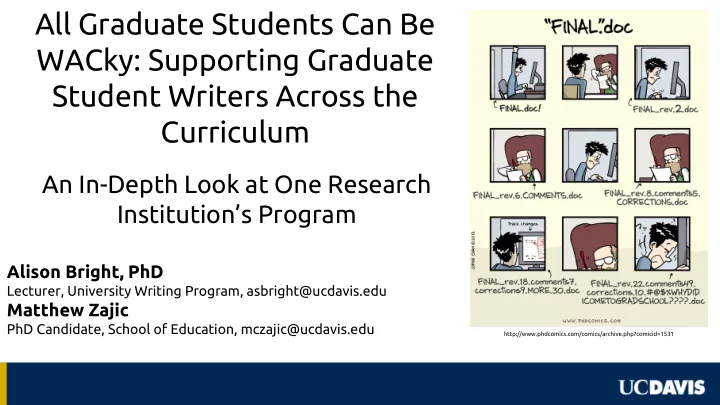
http://www.phdcomics.com/comics/archive.php?comicid=1531
SLIDE 2
- Trace WAC’s history with graduate students
- Outline our WAC program and the ways in which we
work to support graduate students
○ In particular, we’ll highlight changes made over the last two academic years
- One of our Graduate Writing Fellows will share his
experiences and how his role as a fellow intersects with his research interests
Today’s Presentation
SLIDE 3
- Discuss how to implement effective strategies for
supporting graduate student writers across the curriculum at your institution
- Questions, Discussion, and Chaos!
Today’s Presentation, continued
SLIDE 4 What kind(s) of support do graduate students need?
- Take a few moments, meet your neighbor, and chat!
Let’s Start with a Question (WAC & YAK!)
SLIDE 5 What kind(s) of support do graduate students need?
- Need everything - writing, statements, evidence, conclusions, citations
- Need support - writing center as one type
- Hearing from graduate students and “asking about their greatest barriers”
- Time
- Also expected to teach → will need to comment on other writing
○ Support as writing instructor, commentor, and feedback provider
- Broad range of writing support from 1st semester to the final send off
- Non-dissertation writing
○ Job market writing, professional writing
○ Literature reviews
- Support from advanced colleagues and faculty in accessible (online) formats
Let’s Start with a Question (WAC & YAK!)
SLIDE 6
- New traditions and conventions of writing (Gillespie,
2007)
- Higher-stakes writing tasks (Vorhies, 2015)
- Understanding academic style and stance (Phillips,
2013)
- Graduate students rarely exposed to WAC pedagogy
- Graduate students teach undergraduates
Why Offer Graduate Writing Support?
SLIDE 7
○ are “smart” enough to learn on their own (Rose & McClafferty, 2001) ○ will copy other models and learn that way (Silva-Ford, 2013) ○ can receive “remedial” support from undergraduate writing centers (Zawacki et al., 2007)
Misconceptions About Graduate Writing Support
SLIDE 8
- 70% of WAC programs foster writing center
partnerships (Thaiss & Porter, 2013)
- Different epistemologies can strain WAC/writing
center partnerships (Good & Baringer, 2013; Pemberton, 1995)
Partnerships Between WAC and Writing Centers
SLIDE 9
- At large research institutions, like ours, graduate
students play essential roles in both teaching and research.
- However, grads seem to be missing from Condon
and Rutz’s (2007) model of WAC’s complex stakeholder relationships.
- Our WAC program conceptualizes graduate support
as an integral part of the work we do.
Relationship Between WAC and Graduate Students?
SLIDE 10
“The WAC Program helps faculty and teaching assistants (TAs) in all disciplines integrate writing assignments and writing instruction into their undergraduate courses. The program also helps graduate students and postdoctoral scholars with various aspects of their writing, from global concerns such as organization to local concerns such as sentence clarity, and with writing in various genres, such as dissertation chapters, articles, proposals, teaching philosophies, and curriculum vitas.” Longest quote. We promise!
UC Davis’ University Writing Program’s WAC Program
SLIDE 11
- For over 25 years, the UWP’s WAC program has offered
these services from a team of UWP faculty members (who receive a course release for their service).
- For the last 10 years, the WAC team has also included
WAC Graduate Writing Fellows, who offer one-on-one writing consultations with graduate students and postdoctoral scholars.
UC Davis’ University Writing Program’s WAC Program
SLIDE 12
- Historically, the WAC Assistant Director for WAC Programs
selected four to five graduate students (typically from the humanities and social sciences) to serve as Graduate Writing Fellows.
- Fellows earn a stipend for consulting two hours a week,
hosting a graduate writing retreat once a quarter, and later, completing a year-long writing “project” informed by their work as Fellows.
WAC Graduate Writing Fellows
SLIDE 13
○ A new Assistant Director for WAC Programs was appointed.
○ The Assistant Director for WAC Programs appointed a Lead Fellow. ○ Assigned a WAC faculty team member (Alison) to begin supervising the services and professional development of the Fellows.
- In the last two years, we’ve requested funding for additional Fellows
(next year we’ll have 7!), from Grad PathWays, our funding source.
Programmatic Changes to the Fellows Program
SLIDE 14
- In 2014-2015 and 2015-2016, we’ve worked to:
○ Improve access to our services
■ Revised language/access to our website ■ Targeted outreach to graduate departments
○ Improve transparency of services, differentiating services
■ Drafted descriptions/protocols ■ Improved communication (between Fellows, WAC team, campus community, etc.)
Programmatic Changes to the Fellows Program
SLIDE 15
- In 2014-2015, we began to offer (require) monthly
professional development meetings for the Fellows. ○ PD meetings are typically an hour and a half long, and are focused around a central theme and related reading. ○ Meetings are designed to introduce Fellows to the best practices of one-on-one tutoring and guide Fellows in WAC pedagogies
Programmatic Changes to the Fellows Program
SLIDE 16
- PD meetings now afford Fellows a space to share
experiences and build a community
- We ask the Fellows to conceptualize themselves as experts
in writing, in addition to experts in their fields ○ We regularly discuss the ways in which they can negotiate the disciplinary differences in the writing and writers they see in consultations
- We advise fellows to bring in personal expertise but also to
ask questions
Programmatic Changes to the Fellows Program
SLIDE 17
- A focused approach towards professional
development ○ Thematic ○ Discussion of related, required texts ○ Invited speakers ○ Acknowledgment of the limitations of writing center theory; clear focus on WAC theory
Professional Development Meeting Goals
SLIDE 18
- The meetings offer a space for Fellows to check-in
- n their projects
- This year, we also required that each Fellow contact
a WAC faculty member to collaborate, either formally or informally
- Housekeeping items, such as publicity campaigns,
are discussed and distributed
Professional Development Meeting Goals
SLIDE 19 A Brief Look at the Numbers behind the 2015– 16 Graduate Writing Fellow Consultations
http://cloudtweaks.com/wp-content/uploads/2014/03/cloud_191-bigdata.jpg
SLIDE 20
- 59 Departments and Graduate Groups Served (39
STEM, 20 HSS)
- 290 30-minute appointments scheduled
- 124 discrete students served
2015-2016 Graduate Writing Fellow Consultations
SLIDE 21
2015-2016 Graduate Writing Fellow Consultations: Languages Spoken
SLIDE 22
- Increasing number of discrete students served
- Focus on creating and disseminating relevant resources for
- ur writers
- Increasing attendance to retreats
- Continued testing of virtual consultations
- Increase in professionalization of Fellows: publications,
conference presentations, additional writing-related fellowships and work
2015-2016 Graduate Writing Fellow Consultations
SLIDE 23
2015-16 Graduate WAC Fellows
SLIDE 24
- Offer 30-minute consultations (2
hours per fellow per week)
- Can bring in any type of writing
(theses, dissertations, conference proposals, grant proposals, course papers, journal articles, etc.)
- We are not a copyediting service!
Graduate Writing Consultations
https://superbentley.files.wordpress.com/2013/06/minimalist-tutoring-comic.png
SLIDE 25 Our Consultation Sign-Up System
- Online sign-up system through UWP website
○ http://writing.ucdavis.edu/programs-services/graduate-writing-consultations
- Graduate students and postdoctoral scholars able to sign
up for 30-minute time slots with any fellow (depending on time constraints)
- Provides preliminary information about session intent
(goals, type of writing, etc.)
SLIDE 26 Some Quick Numbers: Word Frequencies in Consultation Goals over the Years
Couple quick highlights:
different goals
SLIDE 27 Some Quick Numbers: Word Frequencies in Types of Writing over the Years
Couple quick highlights:
- Graduate student genres
- Heavy emphasis on
different grant applications (notice any peculiar acronyms?)
SLIDE 28
Some Quick Numbers: English as a Second Language (Data from 2015-16)
SLIDE 29
Some Quick Numbers: English as a Second Language (Data from 2015-16)
Main takeaway: Graduate students from a number of different language backgrounds are seeking these services!
SLIDE 30
“Thank you so much for running this program. It was truly helpful for me.” “Thank you for your help! I had a great experience and cannot think of any areas for improvement.” “The essays are done now, and were submitted in a fellowship application. I was very happy with the result at the end after my consultations.” “I really felt like [the consultant] helped me make my essays for my fellowship much better than they were before.”
Feedback and Comments from Graduate Students
SLIDE 31
- Offer 3-hour quiet writing spaces
for graduate students run by WAC fellows
- Open to any and all graduate
students
- Each fellow holds one per quarter
- Offer drop-in writing consultations
during these retreats
Graduate Writing Retreats
http://www.widebaykids.com/images/images/Alison_Marsh/KIDquiettime1.jpg
SLIDE 32 “The writing retreats provide great spaces for graduate students to write
- quietly. There isn't much space on campus to do that so I really appreciate the
effort.” “Helpful to get another perspective, especially from someone in a different subject area.” “It could help to have more writing retreats! Perhaps even on a weekly basis.”
Feedback and Comments from Graduate Students
SLIDE 33
- "Analyzing Consultation Trends and Reflections on Building a
Dissertation Committee Workshop" Jingjing Chen
- "NSF Workshop Series: Preparing for and Writing for the NSF Graduate
Student Fellowship Program" Julia Singleton
- "Postsecondary Writing Instructors' Self-Reported Attitudes and Actions
Regarding Accessibility and Disability: A Small Pilot Study" Matt Zajic
- "Graduate Students' Self-Efficacy with Respect to Academic Writing and
Seeking Help" Lina Yamashita
- "Building a Writing Partner Program for Graduate Students" Lauren Fink
Professional Development Highlight: Fellow Projects
SLIDE 34
- Opportunity for fellows to present on their projects to
interested parties at UCD (including UWP faculty, graduate program staff, and fellow graduate students).
- Opportunities for discussion, questions, and ideas for
this last year and for years going forward. Professional Development Highlight: WAC Showcase
SLIDE 35
Professional Development Highlight: WAC Showcase
SLIDE 36
- Increase in the diversity of Fellows from different
disciplines
- Involve fellows more centrally in the activities of the
WAC program at large
- Empower fellows to help other graduate students
form writing groups and support networks
- Continued professionalization of Fellows within the
WAC discourse community
Future Steps and Looking Ahead to 2016-17
SLIDE 37
Research, Pedagogy, a Pinch of WAC, and Stir: The Life of a WAC Fellow
SLIDE 38
- Each of us with our own research interests,
commitments, and experiences.
- Though I do writing research, I do not specifically do
WAC-related writing research.
- Each writing fellow has varying degrees of writing
studies theory, and knowing about writing studies is not an application requirement.
Graduate Writing Fellows are still Graduate Students
SLIDE 39
- I’m here sharing my experiences as a graduate
writing fellow and not as a WAC-focused researcher conducting graduate writing consultations.
All of that is really to say...
SLIDE 40
consultations
○ 5 formal cancellations ○ ~10 informal, last minute cancellations
Large Picture: My Consultations during this Last Year
SLIDE 41
Consultation Numbers by Individual Graduate Students
On average, most graduate students signed up for 1–4 consultations. However...
SLIDE 42
Writing Pieces & Goals during Consultations - Word Clouds
Writing Pieces Goals
SLIDE 43
- The graduate student with 14 consultations
- A postdoctoral scholar making the jump into
independent writing
Two Quick Stories
SLIDE 44
- First visit in early Winter Quarter (January-February)
- Walks in with a huge stack of paper
- Appears to be a full draft of a dissertation, though
not quite...
Graduate Student with 14 Consultations
SLIDE 45
- First visit in early Winter Quarter (January-February)
- Walks in with a huge stack of paper
- Appears to be a full draft of a dissertation, though
not quite…
- Lots of notes, lots of pictures, and lots of anxiety
- Worked on organizational strategies and working
through the drafting process
Graduate Student with 14 Consultations
SLIDE 46
- Winter ended with a plan for spring and a plan for
systematic consultation signups
- Spring started, and no sign. Until…
Graduate Student with 14 Consultations
SLIDE 47
- Winter ended with a plan for spring and a plan for
systematic consultation signups
- Spring started, and no sign. Until…
- Midway through the quarter: Five immediate signups
for the next three weeks
- Different project this time and had a different
trajectory for his dissertation
Graduate Student with 14 Consultations
SLIDE 48
- Throughout our entire time, both organized in his
ability to pull together sources and layout materials (using Scrivener).
- Though at the same time, student experienced
major anxiety on an ideal structure of the dissertation.
Graduate Student with 14 Consultations
SLIDE 49
- Postdoctoral scholar came in with two concerns:
○ 1) extreme independent writing anxiety ○ 2) concerns with language in a recent journal article.
- I decided to approach the writing anxiety first
○ Discussed resources, books, strategies, etc. for our entire first session. ○ Left with a smile on his face.
Postdoctoral Scholar & Independent Writing
SLIDE 50
- Second session focused on more resources and more
worries about independent writing.
- When we turned to the writing, we focused on
language use (specifically “dictionary hard” words).
- Again, expressed gratitude and left with a long list
- f both resources and strategies to address some of
the language concerns in the paper
Postdoctoral Scholar & Independent Writing
SLIDE 51
- However, when feedback came in, this individual
expressed major concern and worry on not focusing on the paper itself, neglecting to mention the resources
- r the support received in the first session.
- Feedback was highly critical of the focus on resources
to become an independent writer rather than directly addressing (and correcting) all language concerns.
Postdoctoral Scholar & Independent Writing
SLIDE 52
- Graduate students deal with writing situations quite
different from undergraduates, and consulting with graduate students requires a different perspective.
- Writing support is a core component of the graduate school
experience, and each consultation may represent a different, specific need.
- Need to balance both the direct support as well as available
resources in order to help colleagues address issues beyond the consultation.
These Two Stories and Many More
SLIDE 53
- Consultations
- Retreats
- Workshops
○ “Dissertation Day”
- Targeted UWP Graduate Courses
- Writing Partner Program
Review: Ways in Which UCD WAC Program Works to Support Graduate Student Writers
SLIDE 54
- Brenda Rinard, WAC Assistant Director for WAC
Programs
- Melissa Bender, Katie Rodger, and Kelly Crosby,
UWP lecturers and Current WAC Team Members
- Carl Whithaus, UWP Director
- Teresa Dillinger, GradPathways
- Numerous Graduate Writing Fellows!
Huge Acknowledgement to the Full WAC Team
SLIDE 55 Now, let’s WAC & YAK again!
- In which ways does your institution support graduate student
writers?
- In which ways could your institution better support graduate
student writers?
- Or feel free to bring up completely different questions!
Feel free to contact us as well!
Alison Bright, PhD
Lecturer, University Writing Program, asbright@ucdavis.edu
Matthew Zajic
PhD Candidate, School of Education, mczajic@ucdavis.edu
Thank You!