All that glitters is not gold: Zero-point energy in the Johnson noise - - PowerPoint PPT Presentation

all that glitters is not gold zero point energy in the
SMART_READER_LITE
LIVE PREVIEW

All that glitters is not gold: Zero-point energy in the Johnson noise - - PowerPoint PPT Presentation

An error does not become truth by multiplied propagation. Mahatma Gandhi see more at: http://vixra.org/abs/1504.0183 http://vixra.org/abs/1506.0009 (still developing, not final) All that glitters is not gold: Zero-point energy in the Johnson


slide-1
SLIDE 1

All that glitters is not gold: Zero-point energy in the Johnson noise of resistors

L.B. Kish 1, G. Niklasson 2 and C.G. Granqvist 2

1 Department of Electrical Engineering, Texas A&M University, College Station, TX , USA 2 Department of Engineering Sciences, Ångström Laboratory, Uppsala University, Uppsala, Sweden

  • Abstract. The quantum zero-point term in the Fluctuation-Dissipation Theorem (FDT) is incorrect otherwise perpetual motion machines

can be constructed. We show two such perpetual motion machine concepts. We also point out that the Fermic-Dirac statistics of electrons forbids Johnson noise at zero temperature, which is another direct contradiction with the Callen-Welton result. The issue of a conceptual mistake in the Ginzburg-Pitaevski derivation of the FDT yields another proof that the zero-point term is incorrect.

An error does not become truth by multiplied propagation. Mahatma Gandhi

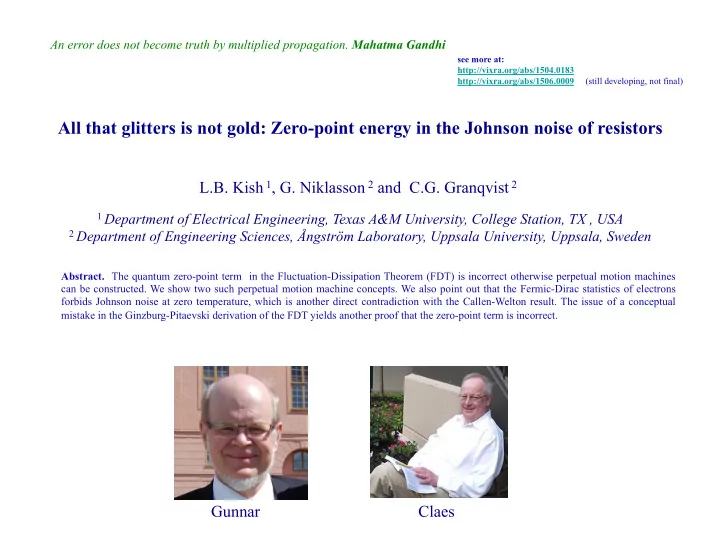
Gunnar Claes

see more at: http://vixra.org/abs/1504.0183 http://vixra.org/abs/1506.0009 (still developing, not final)

slide-2
SLIDE 2

Kyle Sundqvist (TAMU)

Special thanks to:

slide-3
SLIDE 3

Some of the unsolved problems

  • Low-temperature Johnson-noise experiments with wide-band (not-heterodyne) amplifiers.
  • Creating a clean quantum theory of the Fluctuation-Dissipation Theorem, which includes

the measurement setup, too.

  • How to change hard wired beliefs when new aspects show that they cannot be correct?
slide-4
SLIDE 4

Memory: Montreal, ICNF conference, 1987 (debate about the quantum 1/f noise model).

Laszlo Nico van Kampen May 27, 1987

slide-5
SLIDE 5

van Kampen's note about the debated quantum 1/f noise model during his lecture

Theory is good for you

slide-6
SLIDE 6

Theory is good for you Provided the theory is correct

van Kampen's note about the debated quantum 1/f noise model during his lecture

slide-7
SLIDE 7

we add here a relevant item:

Experiment is good for you

slide-8
SLIDE 8

Experiment is good for you Provided its interpretation is correct

we add here a relevant item:

slide-9
SLIDE 9

Su( f ,T ) = R( f )Q( f ,T ) Si( f ,T ) = G( f )Q( f ,T ) P

A→B f ,df

( ) =

TA − TB

( ) Q( f ,T )

RARB RA + RB

( )

2 df

Second Law of Thermodynamics:

When TA = TB , P

A→B f ,Δ f

( ) = 0

Johnson noise of resistors

slide-10
SLIDE 10

Callen-Welton (quantum FDT), 1951:

Nyquist

Planck quantum number For f << kT/h , or hf/k << T , classical Johnson noise formula: For kT/h << f , or T << hf/k , zero-point noise formula: similar for current noise: The meaning of the power-density spectrum of voltage is well-established and most of today's quantum schools believe in the explicit visibility of zero-point term in Johnson noise. (Otherwise the fluctuation- dissipation theorem for resistor noise is not more but just Nyquist.)

Su,q( f ,T ) = 4Rhf N( f ,T )+ 0.5

[ ]

N( f ,T ) = exp(hf / kT )−1

[ ]

−1

Su ≅ 4kTR

Su,ZP = 2hfR Si,ZP = 2hfG

T=0 T>0

slide-11
SLIDE 11

SOME HISTORY. Interesting history-survey by Derek, though a bit incomplete and we disagree about some claims, see below. Also, at UPoN 1996; and in the introduction of a special issue in Chaos (1998). (permission: Derek Abbott)

slide-12
SLIDE 12

The zero-point noise cannot exist because, in that frequency range, kT/h << f , processes are reversible and noise would require irreversibility.

  • D. K. C. Macdonald, Physica 28, 409 (1962)

Incorrect statement, it is not valid in general. For example optical absorption is irreversible while kT/h << f .

slide-13
SLIDE 13

The available (observable) noise power should include only the Nyquist term and any other quantum term associated with the detector or receiver. I.A. Harris, Electron. Lett. 7, 148 (1971) (at National Buro of Standards) (based on J. Weber, "Quantum theory of a damped electrical oscillator and noise", Phys. Rev. 90, 977 (1953) and H. Heffner, "The Fundamental Noise Limit of Linear Amplifiers", Proc. IRE 50, 1604 (1962) ) Looks like these early people had the truth.

Su,q( f ,T ) = 4Rhf N( f ,T )+ 0.5

[ ]

slide-14
SLIDE 14

Why zero-point noise cannot exist: Black-body radiation, Photocell vs antenna

  • G. Grau and W. Kleen, Solid-State Electron. 25, 749 (1982)

Here is a sharpened argumentation (though basically the same) :

Werner Kleen 1967

In 1988, I stayed at his house, in Munich for a few days but he was not interested in the zero-point problem, anymore.

This scheme is a more rigorous derivation of the Nyquist formula than Nyquist's own derivation, which contains some ad-hoc steps not fully justified. Correct claim and it has not been answered by the "zero-point noise people".

Simple proof: darkness in a dark room. At 600 nm (orange), the zero-point term is 30 times greater (!) than the Planck radiation term in the sunshine.

slide-15
SLIDE 15

Fluctuation of the zero-point energy ?

  • W. Kleen, ICNF proc (1985) :

In a stable system, the zero-point energy does not fluctuate thus in cannot emit any energy thus it cannot generate a noise.

  • True. Dirac had the same notion and said "the line-width of the zero-point state is infinitely

narrow, thus its lifetime is infinite". (Peter Rentzepis)

  • D. Abbott, et al, IEEE Trans Education 39, 1 (1996):

He writes zero-point fluctuations as the source of zero-point noise. In any case, Kleen is right; such an effect cannot be he source of the zero-point noise

  • bserved in some experiments.
slide-16
SLIDE 16

FDT derivations are incorrect Recently, L. Reggiani, et al. [Fluct. Noise Lett. 11, 1242002 (2012)] criticized the FDT derivations. Excerpt from their conclusions: "... the FDT holds at the resonant frequencies of the physical system under test only. Outside the resonant frequencies, the formalism of δ-functions does not allow to determine the frequency interrelation between the spectrum of fluctuations, Sxx(ω), and the imaginary part of the susceptibility, Im[α(x)]. As a consequence, the commonly adopted interpretation of the QFDT as a universal spectral relation between Sxx(ω) and Im[α(x)], which is continuous in the whole frequency range [0,∞] and holds for an arbitrary physical system, is invalid/incorrect." So, when the measurement frequency is a "resonance frequency" of the system, the old FDT results are still accepted to be correct. For general cases, they show a new formula, which is not easy to evaluate. Their results support a non-zero zero-point noise, at least at the resonance frequencies of the system.

slide-17
SLIDE 17

Renormalization arguments

L.B. Kish, Solid State Comm. 67, 749 (1988): zero-point noise would cause divergent energy in a shunt capacitor due to the zero-point noise term, so it should be renormalized Abbott, et al, IEEE Trans Education 39, 1 (1996): zero-point energy is infinite thus it should be renormalized but not the "zero-point fluctuations". However, renormalization considerations are not the organic part of quantum theory, so they should be avoided, if possible.

slide-18
SLIDE 18

Perpetual motion machine issues L.B. Kish, Solid State Comm. 67, 749 (1988): If the zero-point noise exists, perpetual motion machines could be constructed by moving capacitor plates. Realization of such was not shown that time. Valid assumption; in this talk, we will show two such machines; which proves that the zero- point noise cannot objectively be present in the resistors.

  • D. Abbott, et al, UPoN'96 proc (1996): Perpetual motion machines with capacitors are no

problems because the Casimir force (and zero-point energy) is a conservative field. This is a correct claim, however it is irrelevant because the conceptual perpetual motion machines do not utilize the Casimir force, see proof below.

slide-19
SLIDE 19

The experiments: Josephson-junction heterodyne detection (spectral analysis by frequency mixing to DC)

Su,q( f ,T ) = 4Rhf N( f ,T )+ 0.5

[ ]

slide-20
SLIDE 20

Uncertainty principle

  • W. Kleen, Solid-State Electron. 30, 1303 (1987). :

The observed zero-point noise in the KVC experiments is not coming from the resistor but it is the amplifier noise due the phase-particle number (energy-time) uncertainty noise of quantum amplifiers (masers, Heffner, 1963) The effect is indeed there and it disqualifies the Josephson junction experiments as proofs of zero-point

  • noise. However, it cannot not prove that the zero-point noise itself does not exist in the resistor.
  • D. Abbott, et al, IEEE Trans Education 39, 1 (1996):

Zero-point noise is there and it is required by the uncertainty principle. However, we will see there are situations when the relevant uncertainty principle is not applicable, see below..

slide-21
SLIDE 21

1981, the same Richard Voss, who went around with the 1/f noise in music show later.

4 orders of magnitude 9 orders of magnitude

Their conclusion was the potential well models of Josephson junctions with Langevin type formulation were

  • inappropriate. The possibility that the

zero-point noise did not exist was not mentioned.

Negative experiments

slide-22
SLIDE 22
  • A. van der Ziel's negative experimental outcome for direct (non-heterodyne) microwave

photonic measurements.

They did not see the zero-point term via direct (non-heterodyne) measurements of Hanbury Brown-Twiss type microwave circuitry at 1 Kelvin temperature and up to 95 GHz frequency, even though this frequency limit at this temperature is about 5 times beyond the kT/h classical/quantum boundary and their accuracy to measure noise- temperature was 0.1 Kelvin. C.M. Van Vliet, Equilibrium and non-equilibrium statistical mechanics, (World Scientific 2008).

  • A. van der Ziel, Proc. ICNF, Washington DC, 1981.

I guess they saw only the black body radiation and then gave it up when the KVC experiments came out in PRL ...

Aldert van der Ziel Laszlo

Montreal, ICNF, May 27, 1987

slide-23
SLIDE 23

THIS TALK: If Callen-Welton (FDT) usual interpretation of objectively present zero-point noise is

correct, we can create at least 2 different types of perpetual motion machines, that is the Second Law is

  • violated. One is with a fixed capacitor, and another one with a moving capacitor plate.

Consider the mean energy due to the zero-point noise term in a capacitor shunting a resistor:

Re Z( f )

[ ] = R 1+ f 2 fL

−2

( )

−1

Su,q( f ,T ) = 4Re Z( f )

[ ]hf N( f ,T )+ 0.5 [ ]

fL = 2π RC

( )

−1

Su,C( f ) = 4RhfN( f ,T ) 1+ f 2 fL

−2

+ 2Rhf 1+ f 2 fL

−2

E C = 0.5C UC

2(t) = 0.5C Su,C( f )df fc

N( f ,T ) = exp(hf / kT )−1

[ ]

−1

slide-24
SLIDE 24

For T 0, the classical term exponentially vanishes because of N(T) thus: and the mean energy at zero Kelvin is: Because it depends on the resistance, perpetual motion machines can be constructed. UC,q

2 (t) =

2hfR 1+ f 2 fL

−2 df fc

= hRfL

2 ln 1+ fc 2

fL

2

⎛ ⎝ ⎜ ⎞ ⎠ ⎟ E C = h 8π 2RC ln 1+ 4π 2R2C 2 fc

2

( )

slide-25
SLIDE 25

Heat generator from zero-point noise (if the zero-point noise in the FDT is correct)

It is an ensemble of M Units, each one containing two different resistors and one capacitor controlled by the same flywheel in asynchronous way. The capacitors in the Units are periodically alternated between the two resistors by centrally controlled switches, in a synchronized fashion, that makes the relative control energy negligible. See, LBK, "Johnson noise engines", Chaos, Solitons & Fractals 44, 114 (2011) The duration of the period is much longer than any of the RC time constants thus the capacitors are "thermalized" by the zero-point noise in each state. Suppose, R1 < R2 . Then at each 1 è 2 transition

energy is dissipated in R2 .

This energy is coming from the zero-point noise of R1. It can be used to drive the flywheel that controls the system. PERIODIC CONTROL

0 < Eh = M h 8π 2C ln 1+ 4π 2R1

2C 2 fc 2

( )

R1 − ln 1+ 4π 2R2

2C 2 fc 2

( )

R2 ⎡ ⎣ ⎢ ⎢ ⎤ ⎦ ⎥ ⎥

M systems

slide-26
SLIDE 26

Two-stroke engine (and heat generator) from zero-point noise (if the FDT is correct)

The engine has M parallel cylinders with identical elements and parameters as in the heat generator. The plate-capacitors have a moving plate, which acts as a piston. The moving plates are coupled to a flywheel, which moves them in a periodic, synchronized fashion. When the plate distance reaches its nearest and farthest distance limits respectively, the switch alternates the driving resistor. During contraction and expansion, we have R1 and R2 , respectively. The mean force in the plate-capacitors is: With R1 < R2 , at any given plate distance x (and corresponding capacitance value), the force is stronger during contraction than during expansion. The heat-generation effect also kicks in, that is, heat is generated in R2, similarly to the first perpetual motion machine.

F(x) = EC x = 1 x h 8π 2RC(x) ln 1+ 4π 2R2C 2(x) fc

2

⎡ ⎣ ⎤ ⎦

slide-27
SLIDE 27

NOTE: Casimir effect in the capacitor is irrelevant!

In the perpetual motion machines introduced above the Casimir effect can always be made negligible by the proper choice of the range of distance x between the capacitor plates during operation. The Casimir-pressure in a plain capacitor decays with x-4, which implies that the Casimir force at fixed capacitance value decays with x-3 see G. Bressi, et al, Phys. Rev. Lett. 88, 041804 (2002). At the same time, the force due to the zero-point noise decays as x-1.

slide-28
SLIDE 28

Already former theories RLC resonators contain of hidden perpetual motion machines: Magnetic versions of the above perpetual motion machines can be constructed if the FDT is correct!!!

Different magnetic noise energy at different resistances! All from zero- point noise!

(1997)

slide-29
SLIDE 29

This is a possible end of the talk because:

When the laws of physics are violated, the game is over...

slide-30
SLIDE 30

But due to Kyle's strong loyalty to Callen-Welton, we were drawn to consider other arguments,

  • too. Research in progress.

NOTE: Due to the perpetual motion issues, it is not a question if the "objective zero-point noise" interpretation of Callen-Welton's theory is wrong. The only question is where. UNSOLVED PROBLEM. In the CW derivation there is no mathematical indication that the 0.5 term should not be objectively observable, to be seen by arbitrary measurements.

slide-31
SLIDE 31

Because the Second Law requires zero mean power flow between two resistors of arbitrary materials, it is enough to show in only a single chosen system that the Callen-Welton derivation is incorrect. For the sake of simplicity, we take a metallic conductor with non-zero residual resistivity.

  • The claim of zero-point current noise contradicts to the Fermi-Dirac statistics in metallic conductors (with

defect scattering) when the temperature is approaching zero. Then all states are occupied up to the Fermi surface and no states can be occupied above. That prohibits any current, including noise current, in this situation.

slide-32
SLIDE 32

They use the same kind of calculations for a serial RLC circuit as we do for the perpetual motion machine

  • calculations. They show that, with the Callen-Welton zero-point noise spectrum result, the energy in the

weakly-damped LC resonator is equal to the energy of the of the quantum linear harmonic oscillator, that is, at zero temperature, and small resistance, this energy converges to the zero-point energy of the oscillator, hf0/2. However, there is a problem. In the large resistance and small inductance limit, they would get our results and a perpetual motion machine with it! Thus the assumption that the zero-point noise is in the resistor in this passive situation must be dropped. Conclusion: it is not possible to derive the zero-point energy of the oscillator with this unphysical assumption that the zero-point voltage noise in the resistor is objectively present there. The agreement in the small resistance limit is only an accident.

slide-33
SLIDE 33

End of presentation. Questions?

When the laws of physics are violated, the game is over...