American Water Resources Association Philadelphia Metropolitan Area - - PowerPoint PPT Presentation

american water resources association philadelphia
SMART_READER_LITE
LIVE PREVIEW

American Water Resources Association Philadelphia Metropolitan Area - - PowerPoint PPT Presentation

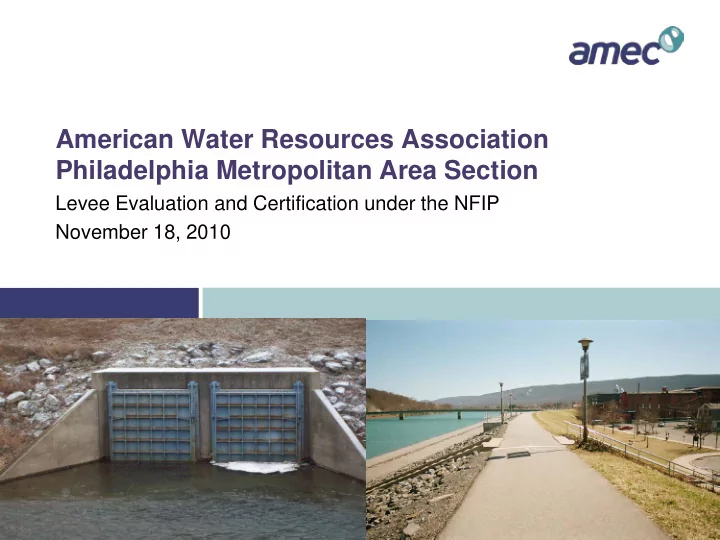
American Water Resources Association Philadelphia Metropolitan Area Section Levee Evaluation and Certification under the NFIP November 18, 2010 Insert picture(s) here Agenda Background and Overview Flood Insurance Rate Maps (FIRMs)


slide-1
SLIDE 1

Insert picture(s) here

American Water Resources Association Philadelphia Metropolitan Area Section

Levee Evaluation and Certification under the NFIP November 18, 2010

slide-2
SLIDE 2

Agenda

  • Background and Overview
  • Flood Insurance Rate Maps (FIRMs) & Levee Accreditation by FEMA
  • Provisionally Accredited Levees (PALs)
  • Consequences of De-Certification
  • Role of FEMA and USACE
  • Technical Requirements for Certification
  • Questions
slide-3
SLIDE 3

Background and Overview

slide-4
SLIDE 4

Background and Overview

slide-5
SLIDE 5

Flood Insurance Rate Maps (FIRMs) & Levee Accreditation by FEMA

slide-6
SLIDE 6

Provisionally Accredited Levees (PALs)

  • If CFR 65.10 certification material submitted and approved → PAL

designation removed

  • If certification not achieved → levee de-accredited
slide-7
SLIDE 7

Consequences of De-Certification

RESIDENTIAL (A ZONES)

Building and Contents Coverage (Building/Contents) Annual Premium $35,000/$10,000 $509 $50,000/$15,000 $686 $75,000/$20,000 $887 $100,000/$30,000 $1,143 $125,000/$40,000 $1,399 $150,000/$50,000 $1,653 $250,000/$100,000 $2,766 Source: www.floodsmart.gov

  • Mandatory Flood Insurance Requirements
  • Floodplain Management Requirements
  • Property Values and Tax Base
  • Public Perception

NON-RESIDENTIAL (A ZONES)

Building and Contents Coverage (Building/Contents) Annual Premium $100,000/$50,000 $1,832 $200,000/$100,000 $3,680 $300,000/$200,000 $6,012 $400,000/$300,000 $8,133 $500,000/$400,000 $10,240 $600,000/$500,000 $11,237 Source: www.floodsmart.gov

slide-8
SLIDE 8

Does Certification Always Make Sense?

  • Sometimes levee certification may not be fiscally reasonable
  • Cost-benefit analysis appropriate to make determination
  • AMEC typically takes a phased approach to certification evaluations
slide-9
SLIDE 9

Role of FEMA and USACE

  • FEMA does not certify levees; it is the responsibility of the levee owner or local

sponsor requesting accreditation to provide technical information demonstrating compliance with 44 CFR 65.10

  • Generally, other than active federal projects, the USACE:

– Is not funded, staffed, or mandated to conduct certification evaluations; and – Does not have jurisdiction to perform certifications (per the Thomas Act),

except:

–On a direct cost reimbursable basis with funding from local sponsors or

communities

–If local sponsor provides documentation that certification services

cannot be procured “reasonably and expeditiously” through ordinary business channels

slide-10
SLIDE 10

44 CFR 65.10 Requirements

slide-11
SLIDE 11

44 CFR 65.10 Requirements

  • Freeboard

– Detailed hydrologic and hydraulic analysis @ 1% annual chance (100-year) standard – Standard Minimum – 3 feet minimum overall; 4 feet within 100’ of structures; + ½ foot at

upstream end of levee based on “expected” flow

– Absolute Minimum – 2 feet minimum for “expected” flow with uncertainty analysis which

considers:

– Discharge-frequency uncertainty (i.e. confidence limits); – Stage-discharge uncertainty (i.e. roughness & geometry); and – Sensitivity to downstream assumptions, sediment transport, and debris/ice jams.

slide-12
SLIDE 12

44 CFR 65.10 Requirements

  • Closures

– All openings must be provided with closure devices that are structural parts of the

system during operation and design according to sound engineering practice

– Structural and mechanical evaluation

slide-13
SLIDE 13

44 CFR 65.10 Requirements

  • Embankment Protection

– No appreciable erosion during 1% flood

from currents, waves, ice loading, impact

  • f debris, flood duration, and bends

– Anticipated erosion will not result in

embankment or foundation failure

slide-14
SLIDE 14

44 CFR 65.10 Requirements

  • Embankment and Foundation

Stability

– Demonstrate that seepage into or

through embankment will not jeopardize stability

– Factors include depth of flooding,

embankment geometry, length of seepage path, materials, compaction, penetrations, drainage layers, woody vegetation, etc.

slide-15
SLIDE 15

44 CFR 65.10 Requirements

slide-16
SLIDE 16

44 CFR 65.10 Requirements

  • Settlement

– Demonstrate that minimum freeboard

will be maintained with potential future settlement

– Analysis must consider embankment

loads, compressibility of soil (embankment and foundation), age of levee, and compaction method during construction

– Analysis per USACE EM 1100-2-1904

must be submitted

slide-17
SLIDE 17

44 CFR 65.10 Requirements

  • Interior Drainage

– An analysis must be submitted that

identifies the sources of such flooding, the extent of the flooded area, and, if the average depth is greater than one foot, the water-surface elevations of the 100- year flood

– Analysis must be based on the joint

probability of interior and exterior flooding and the capacity of facilities (such as drainage lines and pumps) for evacuating interior floodwater

– Mechanical and electrical evaluation – Failure mode analysis

slide-18
SLIDE 18

44 CFR 65.10 Requirements

  • Operations Plans

– Closures – Interior drainage systems (i.e.

pumps, storage areas, backflow prevention, etc.)

– Flood warning systems – Actions and assignments of

responsible personnel

– Training – Periodic testing and operation

(1-year intervals maximum)

  • Maintenance Plans

– Maintain stability, height, and

  • verall integrity of levee and

associated structures

– Replacement of mechanical

and electrical parts per manufacturers specifications

slide-19
SLIDE 19

Questions

  • Joe Bellini, PE, PH, D.WRE, CFM

– Regional Dam & Levee Program Lead – AMEC Earth & Environmental, Inc. – joe.bellini@amec.com