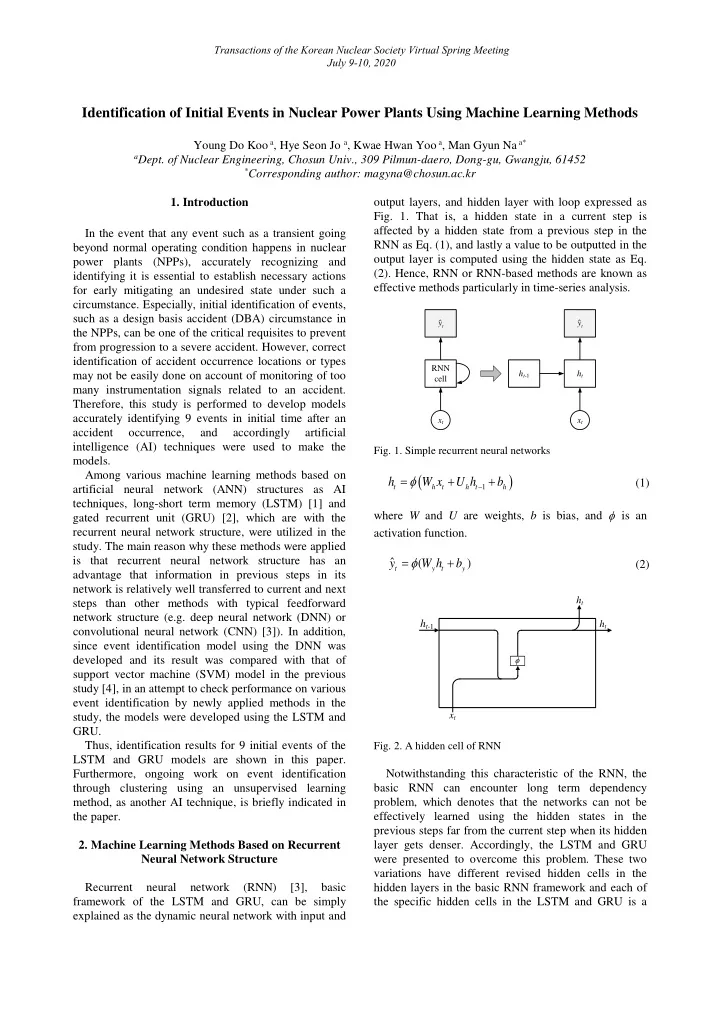

SLIDE 1
Transactions of the Korean Nuclear Society Virtual Spring Meeting July 9-10, 2020
Identification of Initial Events in Nuclear Power Plants Using Machine Learning Methods
Young Do Koo a, Hye Seon Jo a, Kwae Hwan Yoo a, Man Gyun Na a*
- aDept. of Nuclear Engineering, Chosun Univ., 309 Pilmun-daero, Dong-gu, Gwangju, 61452
*Corresponding author: magyna@chosun.ac.kr
- 1. Introduction
In the event that any event such as a transient going beyond normal operating condition happens in nuclear power plants (NPPs), accurately recognizing and identifying it is essential to establish necessary actions for early mitigating an undesired state under such a
- circumstance. Especially, initial identification of events,
such as a design basis accident (DBA) circumstance in the NPPs, can be one of the critical requisites to prevent from progression to a severe accident. However, correct identification of accident occurrence locations or types may not be easily done on account of monitoring of too many instrumentation signals related to an accident. Therefore, this study is performed to develop models accurately identifying 9 events in initial time after an accident
- ccurrence,
and accordingly artificial intelligence (AI) techniques were used to make the models. Among various machine learning methods based on artificial neural network (ANN) structures as AI techniques, long-short term memory (LSTM) [1] and gated recurrent unit (GRU) [2], which are with the recurrent neural network structure, were utilized in the
- study. The main reason why these methods were applied
is that recurrent neural network structure has an advantage that information in previous steps in its network is relatively well transferred to current and next steps than other methods with typical feedforward network structure (e.g. deep neural network (DNN) or convolutional neural network (CNN) [3]). In addition, since event identification model using the DNN was developed and its result was compared with that of support vector machine (SVM) model in the previous study [4], in an attempt to check performance on various event identification by newly applied methods in the study, the models were developed using the LSTM and GRU. Thus, identification results for 9 initial events of the LSTM and GRU models are shown in this paper. Furthermore, ongoing work on event identification through clustering using an unsupervised learning method, as another AI technique, is briefly indicated in the paper.
- 2. Machine Learning Methods Based on Recurrent
Neural Network Structure Recurrent neural network (RNN) [3], basic framework of the LSTM and GRU, can be simply explained as the dynamic neural network with input and
- utput layers, and hidden layer with loop expressed as
- Fig. 1. That is, a hidden state in a current step is
affected by a hidden state from a previous step in the RNN as Eq. (1), and lastly a value to be outputted in the
- utput layer is computed using the hidden state as Eq.
(2). Hence, RNN or RNN-based methods are known as effective methods particularly in time-series analysis.
RNN cell ˆt y ht ˆt y ht-1 xt xt
- Fig. 1. Simple recurrent neural networks
( )
1 t h t h t h
h W x U h b φ
−
= + +
(1) where W and U are weights, b is bias, and φ is an activation function.
ˆ ( )
t y t y
y W h b φ = +
(2)
xt ht
ht-1
φ
ht
- Fig. 2. A hidden cell of RNN