An Abridged Guide to P, NP and Some Things in Between Nicholas - - PowerPoint PPT Presentation

an abridged guide to p np and some things in between
SMART_READER_LITE
LIVE PREVIEW

An Abridged Guide to P, NP and Some Things in Between Nicholas - - PowerPoint PPT Presentation

An Abridged Guide to P, NP and Some Things in Between Nicholas LaRacuente Image by Self, CC BY-SA 3.0, https://commons.wikimedia.org/w/index.php?curid=14535539 A sample of whats out there... Rough PSPACE polynomial writeable


slide-1
SLIDE 1

An Abridged Guide to P, NP and Some Things in Between

Nicholas LaRacuente

Image by “Self”, CC BY-SA 3.0, https://commons.wikimedia.org/w/index.php?curid=14535539
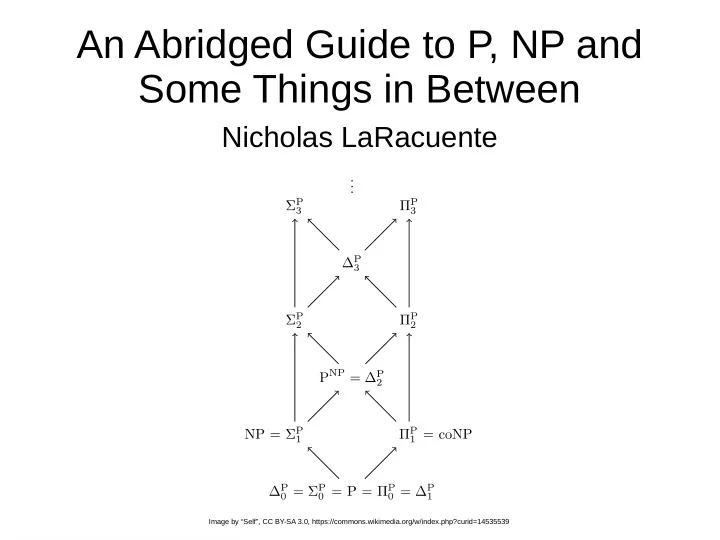
slide-2
SLIDE 2

A sample of what’s out there...

  • PSPACE – polynomial writeable memory
  • #P – counting solutions to polynomial or NP problems
  • Co-NP – confirming that an NP problem has no solution
  • NP Hard – at least as hard as anything in NP
  • NP Complete – NPH & NP
  • FNP – polynomial time to find a particular answer, such as the

minimum time solution for a traveling salesman

  • NP – polynomial time for a non-deterministic Turing machine /

checkable in polynomial time

  • BQP – polynomial time for a quantum computer
  • NP Intermediate – in NP, but not NP Complete
  • P – polynomial time
  • NL – logarithmic writeable memory for a non-deterministic

Turing machine

Rough Order Of Suspected Difficulty

slide-3
SLIDE 3

Church-Turing Thesis: Robust Complexity Classes

  • Asymptotic scaling is invariant to changes in

classical computer architecture.

  • Quantum computers, non-deterministic

machines & oracles may change the rules. See: Boson Sampling, Relativising Proofs

By HorsePunchKid - Own work, CC BY-SA 3.0, https://commons.wikimedia.org/w/index.php? curid=9976340 https://en.wikipedia.org/wiki/Laptop#/media/File:Aluminium_MacBook.png By MaltaGC - Own work, CC BY-SA 3.0, https://commons.wikimedia.org/w/index.php?curid=4629274

slide-4
SLIDE 4

Common Points of Confusion

  • NP Hard vs. NP (!=)
  • BQP vs. NP (probably !=)
  • FNP vs. NP

(apples & oranges)

113 proofs (and counting) that P=NP, P!=NP, and the question is undecidable.

Image by Behnam Esfahbod, CC BY-SA 3.0, https://commons.wikimedia.org/w/index.php?curid=3532181 Image by User Mike1024 - Drawn by User:Mike1024This vector image was created with Inkscape., Public Domain, https://commons.wikimedia.org/w/index.php?curid=1676927

Complexity

P ≠ NP P = NP

NP-Hard NP-Complete P NP NP-Hard P = NP = NP-Complete

https://www.win.tue.nl/~gwoegi/P-versus-NP.htm

slide-5
SLIDE 5

Why/How NP?

  • Non-deterministic Turing Machine – a computer

program that may take all paths for each execution branch, decide after full execution which to keep.

  • May use execution branches to write down all of

the exponentially many possible certificates, or checkable solutions to an NP problem, check in P time, then select them.

  • Equivalently, lucky machine always guesses well.
  • These are EXP time to simulate directly.
slide-6
SLIDE 6

Traveling Salesman: Famously NPC

Animations by Saurabh.harsh - Own work, CC BY-SA 3.0, https://en.wikipedia.org/wiki/Travelling_salesman_problem Quote from Wikipedia.

Ant Colony Heuristic Brute Force Algorithm Branch & Bound Algorithm

How to Solve? Basic: brute force Smart: “branch & bound” or dynamic programming – prune

  • bviously bad pieces of solutions

to reduce search space Heuristic: “Modern methods can find solutions for extremely large problems (millions of cities) within a reasonable time which are with a high probability just 2–3% away from the optimal solution.”

slide-7
SLIDE 7

Integer Factors: Probably Not NPC!

  • Given an n-bit integer x, find the factorization.
  • Agrawal–Kayal–Saxena primality test: deciding

whether x is prime is in P!

  • Shor’s algorithm: factoring is in BQP
  • Note that this problem has a single correct

certificate – most NPC probs are ambiguous, especially w/ a fixed “good enough” criterion.

By Bender2k14 - Own work. Created in LaTeX using Q-circuit. Source code below., CC BY-SA 4.0, https://commons.wikimedia.org/w/index.php?curid=34319883

doi:10.4007/annals.2004.160.781

slide-8
SLIDE 8

Why/How NP Complete? An Case of Reduction

1) Take a given problem in NP. 2) Write down rules for a non-deterministic Turing machine / computer program that solves it. 3) Convert the rules into a bounded tiling problem,

  • ne of the 1st known NP-Complete problems.

4) Anything that converts from bounded tiling is therefore also NPC. (NPC = NP & NPH) General: Any NP problem converts in P time to any NPC problem. NPC != NP unless P = NP.

slide-9
SLIDE 9

What is Bounded Tiling?

  • Given: a set of 4-tuples of symbols, representing kinds of tiles.

A unary-specified number, the size of a square grid to tile.

  • Rules: Each pair of adjacent tiles must have the same symbol
  • n their adjacent edges.
  • Use: Let the X dimension of a grid be memory, and Y be time.

Then we convert the set of transitions defined by a computer program (Turing Machine) into tile types.

a c b b a c b b f a b d

By Wvbailey at the English language Wikipedia, CC BY-SA 3.0, https://commons.wikimedia.org/w/index.php?curid=45094484

slide-10
SLIDE 10

Boolean Satisfiability (SAT)

  • 1st known NPC problem
  • CNF (conjuctive normal

form) is a conjunction of disjunctions of vars and negations

  • Any SAT instance

reduces to an equisatisfiable CNF and/or 3-CNF in P time

By Thore Husfeldt at English Wikipedia, CC BY-SA 3.0, https://commons.wikimedia.org/w/index.php?curid=31943944 Formula from https://en.wikipedia.org/wiki/Conjunctive_normal_form The 3-SAT instance reduced to a clique problem. The green vertices form a 3-clique and correspond to the satisfying assignment x=FALSE, y=TRUE. ~ x ~ y ~ y x y x y ~ x y

(x x y) (¬x ¬y ¬y) (¬x y y) ∨ ∨ ∧ ∨ ∨ ∧ ∨ ∨

slide-11
SLIDE 11

Cook’s Theorem: Tiling to SAT

  • Construct a SAT instance with a variable for each

possible tile for each grid square.

  • Add boolean constraints such that only 1 var is true

for any grid square. We interpret this var as selecting a corresponding tile.

  • Add boolean constraints to enforce adjacent tiles’

same-symbol constraint.

  • Solutions now correspond to tilings!
  • May use auxiliary vars to convert SAT to 3CNF.
slide-12
SLIDE 12

CNF Classification (Boolean Blocks)

  • Assume that we have available some boolean

constructs: conjunction, disjunction, negation, implication, constants, etc.

  • What can we make by applying & substituting

constructs from this set? Some boolean functions may combine to generate others.

  • Answer...

(Now moving beyond the basic part of the presentation)

slide-13
SLIDE 13

Post’s Lattice

By EmilJ - Own work, CC BY-SA 3.0, https://commons.wikimedia.org/w/index.php?curid=3506643

slide-14
SLIDE 14

Post’s Lattice

  • UP0/UP1 – constants
  • VP - disjunction
  • ∧P – conjunction
  • T – all boolean funcs
  • Is the smallest

class that is NPC!

By EmilJ - Own work, CC BY-SA 3.0, https://commons.wikimedia.org/w/index.php?curid=3506643

slide-15
SLIDE 15

Galois Connection

  • Q: if the boolean functions we can create are

restricted, what does that say about the sets of possible solutions?

  • A: We can define var-wise polymorphisms that,

given 0-3 complete solutions, generate another satisfying solution if the lattice class is sufficiently restrictive. The existence of non-unary polymorphisms implies that the boolean formulae in that lattice class are always solvable in P.

slide-16
SLIDE 16

Non-unary Polymorphisms

  • The Constant 0/1 – trivially satisfiable by the

solution that is all 1s or 0s

  • The binary V/ - these are Horn/antiHorn CNF

∧ formulae, in which each clause contains only

  • ne positive/negated literal. It is possible to find

a minimal/maximal solution in P time.

  • The operation majority(x,y,z) – corresponds to

2SAT, which is NL Complete (and in P).

  • The operations minority(x,y,z) – equivalent to

xor, which allows linear algebraic solution.

slide-17
SLIDE 17

Schaefer’s Dichotomy Theorem

  • If a CNF has a non-unary polymorphism, it’s P

If not, it’s NP Complete.

  • Why? Go back to post’s lattice. Take out all the classes

that satisfy any non-unary polymorphism (and anything that’s not a CNF). What we’re left with are the CNF classes that contain .

  • So CNFs are either P or NPH! We also now have a

programmatic way to decide this!

slide-18
SLIDE 18

Consequences

  • Difference between P and NPC for CNF

formulae is an algebraic structure.

  • There are no NP CNF formulae that are not

either also in P or in NPH. Probably no BQP.

  • 2CNF/3CNF distinction is especially poignant –

1 more var in clause goes from P to NPC.

Complexity

P ≠ NP P = NP NP-Hard NP-Complete P NP NP-Hard P = NP = NP-Complete Image by Behnam Esfahbod, CC BY-SA 3.0, https://commons.wikimedia.org/w/index.php?curid=3532181

slide-19
SLIDE 19

Sources & Further Reading

  • “A Rendevouz of Logic, Complexity and

Algebra.” Hubie Chen. 2006

  • “Playing With Boolean Blocks...” Bohler,

Creignou, Reith & Vollmer. 2003. Further topics (not covered today)…

  • Geometric Complexity Theory
  • “Statistical mechanics methods and phase

transitions in optimization problems,” Martin, Monasson & Zecchina