An An Example Python Cl Class superclass class Account(object): - - PDF document

an an example python cl class
SMART_READER_LITE
LIVE PREVIEW

An An Example Python Cl Class superclass class Account(object): - - PDF document

3/25/20 CS 224 Introduction to Python Spring 2020 Class #24: Introduction to Classes An An Example Python Cl Class superclass class Account(object): def __init__(self, name, balance): special method to keyword self.name = name


slide-1
SLIDE 1

3/25/20 1

Class #24: Introduction to Classes

CS 224 Introduction to Python Spring 2020

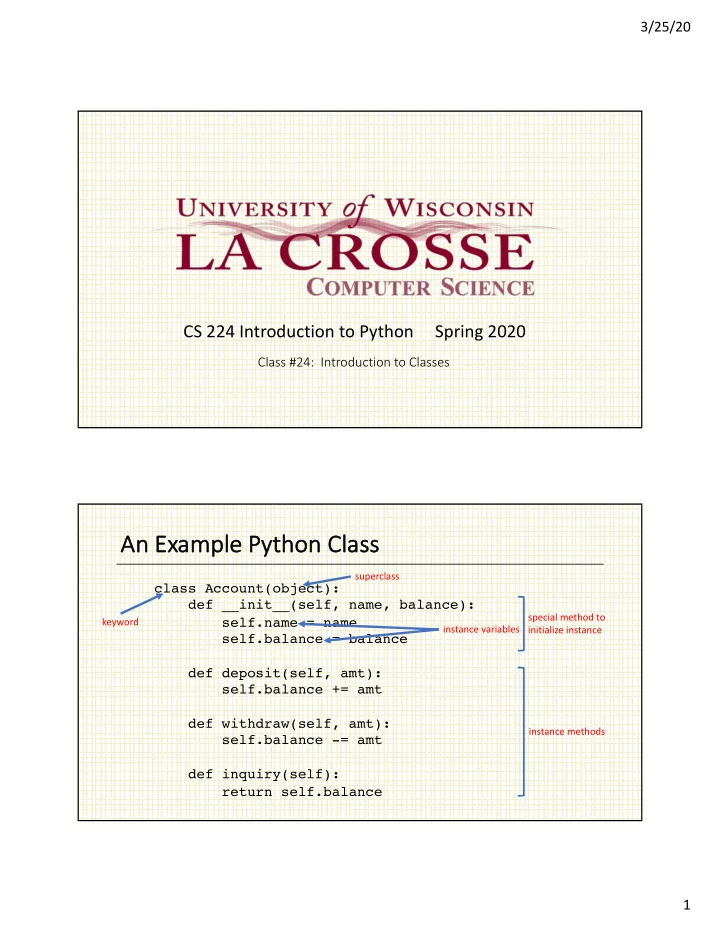
An An Example Python Cl Class

class Account(object): def __init__(self, name, balance): self.name = name self.balance = balance def deposit(self, amt): self.balance += amt def withdraw(self, amt): self.balance -= amt def inquiry(self): return self.balance

keyword superclass special method to initialize instance instance variables instance methods

slide-2
SLIDE 2

3/25/20 2

Th The Details

  • object is the root of the class tree
  • use it as superclass when you are not extending

another class

  • __init__ implicitly defines instance variables
  • self is a parameter to all instance methods
  • but you don’t include it in the parameter list

when you call an instance method

  • technically you can use any identifier in place
  • f self (but don’t do it!)

Au Augmenting the Example:

class Account(object): num_accounts = 0 def __init__(self, name, balance): self.name = name self.balance = balance Account.num_accounts += 1 def __del__(self): Account.num_accounts -= 1 def deposit(self, amt): self.balance += amt def withdraw(self, amt): self.balance -= amt

special method to cleanup, etc. class variable

slide-3
SLIDE 3

3/25/20 3

Mor More D Details

  • class variables are like static variables in Java
  • they belong to the class not to an instance
  • all instances share a single copy of a class

variable

  • __del__ is often absent
  • it is used to do things such as update class

variables (as in our example), close network connections, release locks, etc.

  • calling del on an object does not necessarily

invoke __del__ -- del reduces reference count

Cr Creating Instances:

from account import Account checking = Account(’David’, 50000) savings = Account(‘David’, 1000000) # it’s payday checking.deposit(25000) # can I buy a 488? if savings.inquiry() > 500000: print(“Go shopping. Make sure it’s red.”) print(‘Created: {}‘.format(Account.num_accounts))

Create two Account instances self does not appear here access class variable prints 2

slide-4
SLIDE 4

3/25/20 4

Ex Exercise se

  • Exercise: create a Python class called Car
  • This class should include:
  • Three attributes
  • make
  • model
  • Year
  • Class variable num_cars that tracks the number of cars created
  • An __init__ method
  • Method print_description that prints the attributes for a Car instance
  • Setter methods for each of the attributes
  • Write a main method that creates a couple of Car instances and

applies methods to them

Ex Exercise se so solut ution

class Car(object): num_cars = 0 def __init__(self, make, model, year): self.make = make self.model = model self.year = year num_cars += 1

slide-5
SLIDE 5

3/25/20 5

Ex Exercise se so solut ution

def print_description(self): print(‘Make: {}’.format(self.make)) print(‘Model: {}’.format(self.model)) print(‘Year: {}’.format(self.year)) def set_make(self, new_make): self.make = new_make def set_model(self, new_model): self.model = new_model def set_year(self, new_year): self.year = new_year

Ex Exercise se so solut ution

def main(): f488 = Car(‘Ferrari’, ‘488’, ‘2019’) mc40 = Car(‘MINI’, ‘Cooper S’, ‘2004’) f488.print_description() mc40.set_model(‘Cooper S MC40’) print(‘Number of cars = {}’.format(Car.num_cars)) if __name__ == ‘__main__’: main()