Anartificialneuron Artificialneuralnetworks y = f ( S ) x 0 =+1 - - PDF document

▶
an artificial neuron artificial neural networks
SMART_READER_LITE
LIVE PREVIEW

Anartificialneuron Artificialneuralnetworks y = f ( S ) x 0 =+1 - - PDF document

Anartificialneuron Artificialneuralnetworks y = f ( S ) x 0 =+1 Background n n = = w 0 = S w x w x x 1 i i i i


slide-1
SLIDE 1

1

1

Artificialneuralnetworks

  • Background
  • Artificialneurons,whattheycanandcannotdo
  • Themultilayerperceptron(MLP)
  • Threeformsoflearning
  • Thebackpropagationalgorithm
  • Radialbasisfunctionnetworks
  • Competitivelearning(andrelatives)

2

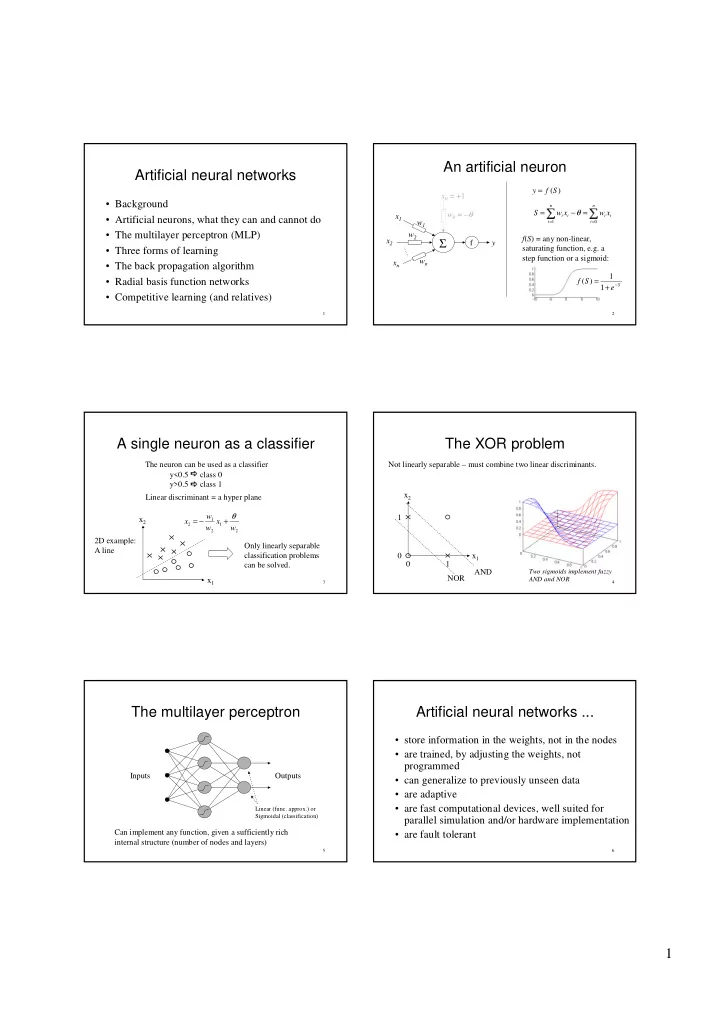
Anartificialneuron

) (S f y =

✁

= =

= − =

n i n i i i i i

x w x w S

1

θ f(S)=any non-linear, saturatingfunction,e.g.a stepfunctionorasigmoid: x0 =+1

Σ

f x1 x2 xn w0 =–θ w1 w2 wn y

S

e S f

−

+ = 1 1 ) (

3

Asingleneuronasaclassifier

2 1 2 1 2

w x w w x θ + − = x1 x2 Theneuroncanbeusedasaclassifier y<0.5

✂

class0 y>0.5

✂

class1 Onlylinearlyseparable classificationproblems canbesolved. Lineardiscriminant=ahyper plane 2Dexample: Aline

4

TheXORproblem

Notlinearlyseparable– mustcombinetwolineardiscriminants. x1 x2 1 1 NOR AND

Twosigmoidsimplementfuzzy ANDandNOR

5

Themultilayerperceptron

Inputs Outputs Canimplementanyfunction,givenasufficientlyrich internalstructure(numberofnodesandlayers)

Linear(func.approx.)or Sigmoidal(classification)

6

Artificialneuralnetworks...

  • storeinformationintheweights,notinthenodes
  • aretrained,byadjustingtheweights,not

programmed

  • cangeneralizetopreviouslyunseendata
  • areadaptive
  • arefastcomputationaldevices,wellsuitedfor

parallelsimulationand/orhardwareimplementation

  • arefaulttolerant
slide-2
SLIDE 2

2

7

Applicationareas

Finance

  • Forecasting
  • Frauddetection

Medicine

  • Imageanalysis

Consumer market

  • Householdequipment
  • Characterrecognition
  • Speechrecognition

Industry

  • Adaptivecontrol
  • Signalanalysis
  • Datamining

8

Whyneuralnetworks?

(statisticalmethodsarealwaysatleastasgood,right?)

  • Neuralnetworksare statisticalmethods
  • Modelindependence
  • Adaptivity/Flexibility
  • Concurrency
  • Economicalreasons(rapidprototyping)

9

Input Target function Learning system

–

Error

Threeformsoflearning

Supervised Unsupervised Reinforcement

Environment Agent State Action Reward Learning system Action selector

Suggested actions 10

Backpropagation

Input Output(y) Errorfunction Desiredoutput(d)

ThecontributiontotheerrorE fromaparticularweightwji is

ji

w E ∂ ∂

Theweightshouldbemovedin proportiontothatcontribution,butinthe

  • therdirection:

Errorfunctionandtransferfunction mustbothbedifferentiable.

ji ji

w E w ∂ ∂ − = ∆ η

11

Backpropagationupdaterule

Assumptions

Errorissquarederror: Transfer(activation) functionissigmoid:

  • =

− − =

n j j j

y d E

1 2

) ( 2 1

j

S j j

e S f y

−

+ = = 1 1 ) ( i j k

i j ji ji

x w E w ηδ η = ∂ ∂ − = ∆

wji

✁✂ ✁ ✄ ☎

− − − =

✆

k k kj j j j j j j j

w y y y d y y δ δ ) 1 ( ) )( 1 (

Ifnodej isanoutputnode Otherwise derivativeofsigmoid sumoverallnodesinthe ’next’layer(closertothe

  • utputs)

derivativeoferror

12

Trainingprocedure(1)

Networkisinitialisedwithsmallrandomweights Splitdataintwo– atrainingset andatestset Thetrainingsetisusedfortraining andispassedthroughmanytimes. Updateweightsaftereach presentation(patternlearning)

  • r

Accumulateweightchanges(∆w) untiltheendofthetrainingsetis reached(epoch orbatchlearning) Thetestsetisusedtotestfor generalization(toseehow wellthenetdoeson previouslyunseendata). Thisistheresultthecounts!

slide-3
SLIDE 3

3

13

Overtraining

Overtraining Typicalerrorcurves Trainingseterror Testorvalidationseterror Time(epochs) E Crossvalidation:Useathirdset,avalidationset,todecidewhentostop(find theminimumforthisset,andretrainforthatnumberofepochs)

14

Networksize

  • Overtrainingismorelikelytooccur…
  • ifwetrainontoolittledata
  • ifthenetworkhastoomanyhiddennodes
  • ifwetrainfortoolong
  • Thenetworkshouldbeslightly largerthanthesize

necessarytorepresentthetargetfunction

  • Unfortunately,thetargetfunctionisunknown...
  • Needmuchmoretrainingdatathanthenumberof

weights!

15

Trainingprocedure(2)

  • 1. Startwithasmallnetwork,train,increasethesize,

trainagain,etc.,untiltheerroronthetrainingset can bereducedtoacceptablelevels.

  • 2. Ifanacceptableerrorlevelwasfound,increasethe

sizebyafewpercentandretrainagain,thistimeusing thecross-validationproceduretodecidewhentostop. Publishtheresultontheindependenttestset.

  • 3. Ifthenetworkfailedtoreducetheerroronthetraining

set,despitealargenumberofnodesandattempts, somethingislikelytobewrongwiththedata.

16

Practicalconsiderations

  • Whathappensifthemappingrepresentedbythedataisnota

function?Forexample,whatifthesameinputdoesnotalways leadtothesameoutput?

  • Inwhatordershoulddatabepresented?Sequentially?At

random?

  • Howshoulddataberepresented?Compact?Distributed?
  • Whatcanbedoneaboutmissingdata?
  • Trickofthetrade:Monotonicfunctionsareeasiertolearnthan

non-monotonicfunctions!(atleastfortheMLP)

17

Radialbasisfunctions(RBF)

  • Layeredstructure,liketheMLP,withonehiddenlayer
  • Outputnodesareconventional
  • Eachhiddennode…
  • measuresthedistancebetweenitsweightvectorandthe

inputvector(insteadofaweightedsum)

  • feedsthatthroughaGaussian(insteadofasigmoid)

Inputs Outputs

18

Geometricinterpretation

  • TheinputspaceiscoveredwithoverlappingGaussians.
  • Inclassification,thediscriminantsbecomehyperspheres

(circlesin2D).

slide-4
SLIDE 4

4

19

RBFtraining

  • Couldusebackprop(transferfunctionstill

differentiable)

  • Better:Trainlayersseparately
Hiddenlayer:FindpositionandsizeofGaussians

byunsupervisedlearning(e.g.competitivelearning, K-means)

Outputlayer:Supervised,e.g.Delta-rule,LMS,

backprop

20

MLPvs.RBF

  • RBF(hidden)nodesworkinalocalregion,MLP

nodesareglobal

  • MLPsdobetterinhigh-dimensionalspaces
  • MLPsrequirefewernodesandgeneralizesbetter
  • RBFscanlearnfaster
  • RBFsarelesssensitivetotheorderinwhichdatais

presented

  • RBFsmakelessfalse-yesclassificationerrors
  • MLPsextrapolatebetter

21

Unsupervisedlearning

Classifyingunlabeleddata Nearestneighbourclassifiers

  • Classifytheunknownsample(vector)x totheclassofitsclosest

previouslyclassifiedneighbour

  • Problem1:Theclosestneighbourmaybeanoutlierfromthe

wrongclass

  • Problem2:Muststorelotsofsamplesandcomputedistanceto

eachone,foreverynewsample

Thenewpattern,x,will beclassifiedasa. x

K-means

K-means,forK=2

  • Makeacodebookoftwovectors,c1 andc2
  • Sample(atrandom)twovectorsfromthedataas

initialvaluesofc1 andc2

  • Splitthedataintwosubsets,D1 andD2 whereD1

isthesetofallpointswithc1 astheirclosest codebookvector,andviceversa

  • Movec1 towardsthemeaninD1 andc2 towards

themeaninD2

  • Repeatfrom3untilconvergence(untilthe

codebookvectorsstopmoving)

23

Voroniregions

  • K-meansformsocalledVoroniregions intheinputspace
  • TheVoroniregionaroundacodebookvectorci istheregionin

whichci istheclosestcodebookvector

Voroniregionsaround10codebookvectors

24

Competitivelearning

M linear,thresholdless,nodes (onlyweightedsums) N inputs 1. Presentapattern(sample),x 2. Thenodewiththelargestoutput (nodek)isdeclaredwinner 3. Theweightsofthewinneris updatedsothatitwillbecomeeven strongerthenexttimethesame patternispresented.Allother weightsareleftunchanged Withnormalisedweights,thisis equivalenttofindingthenodewiththe minimumdistancebetweenitsweight vectorandtheinputvector Networknode=Codebookvector Thestandardcompetitivelearningrule

) (

ki i ki

w x w − = ∆ η

N i ≤ ≤ 1

Competitivelearning+batchlearning=K-means

slide-5
SLIDE 5

5

25

Thewinnertakesitall

  • Poorinitialisation:Theweightvectorshavebeeninitialisedto smallrandom

numbers(inW),butthesearefarfromthedata(A andB)

  • ThefirstnodetowinwillmovefromW towardsA orB andwillalwayswin,

henceforth

  • Solution:Usethedatatoinitialisetheweights(asinK-means),orincludethe

winning-frequencyinthedistancemeasure,ormovemorenodesthanonly thewinner.

Problemwithcompetitivelearning:Anodemaybecomeinvincible W A B

26

Selforganisingmaps

Thecerebralcortexisatwo- dimensionalstructure,yetwe canreasoninmorethantwo dimensions Differentneuronsintheauditory cortexrespondtodifferent frequencies.Theseneuronsare locatedinfrequencyorder! Dimensionalreduction Topologicalpreservation/ topographicmap Kohonen’sself-organisingfeaturemap(SOFM orSOM)

Non-linear,topologicallypreserving,dimensionalreduction(like pressingaflower)

27

SOM

Competitivelearning,extendedintwoways: 1.Thenodesareorganisedinatwo-dimensionalgrid 2.Aneighbourhoodfunctionisintroduced

(incompetitivelearning,thereisnodefinedorderbetweennodes) (notonlythewinnerisupdated,butalsoitsclosestneighboursinthegrid) A3x3grid,makingatwo- dimensionalmapofthefour- dimensionalinput space

28

SOMupdaterule

  • Findthewinner,nodek,andthenupdateall weightsby:
  • f(j,k)isaneighbourhoodfunctionintherange[0,1],witha

maximumforthewinner(j=k)anddecreasingwithdistance fromthewinner,e.g.aGaussian

  • Graduallydecreaseneighbourhoodradius(widthofthe

Gaussians)andlearningrate(η)overtime.

  • Result:Vectorsthatarecloseinthehigh-dimensionalinput

spacewillactivateareasthatarecloseonthegrid.

) )( , (

ki i ki

w x k j f w − = ∆ η N i ≤ ≤ 1

29

  • A10x10SOM,istrainedonachemicalanalysisof178winesfromoneregionin

Italy,wherethegrapeshavegrownonthreedifferenttypesofsoil.Theinputis 13-dimensional.

  • Aftertraining,winesfromdifferentsoiltypesactivatedifferentregionsofthe

SOM.Forexample:

  • Notethatthenetworkisnottoldthatthedifferencebetweenthewinesisthesoil

type,norhowmanysuchtypes(howmanyclasses)thereare.

SOMonlineexample SOMoffline example

http://websom.hut.fi Atwo-dimensional,clickable, mapofUsenetnewsarticles (fromcomp.ai.neural-nets)

slide-6
SLIDE 6

6

31

Growingneuralgas

  • Growingunsupervisednetwork(startingfrom

twonodes)

  • Dynamicneighbourhood
  • Constantparameters
  • Verygoodatfollowingmovingtargets
  • Canalsofollowjumpingtargets
  • Currentwork:UsingGNGtodefineandtrain

thehiddenlayerofGaussiansinaRBFnetwork

32

Nodepositions

  • Startwithtwonodes
  • Eachnodehasasetofneighbours,

indicatedbyedges

  • Theedgesarecreatedand

destroyeddynamicallyduring training

  • Foreachsample,theclosestnode,

k,andallitscurrentneighboursare movedtowardstheinput

33

Nodecreation

  • Anewnode(blue)iscreatedevery

λ’thtimestep,unlessthemaximum numberofnodeshasbeenreached

  • Thenewnodeisplacedhalfway

betweenthenodewiththegreatest errorandthenodeamongits currentneighbourswiththe greatesterror

  • Thenodewiththegreatesterroris

themostunstableone

34

Nodecreation(contd.)

  • Here,afourthnodehasjustbeen

created

  • Ineffect,newnodesarecreated

closetowheretheyaremostlikely needed

  • Theexactpositionofthenewnode

isnotcrucial,sincenodesmove around

35

Afterawhile…

7nodes 50nodes (Voroniregionsinred)

36

Neighbourhood

  • Foreachsample,letk denotethewinner(thenode

closesttothesample)andr therunner-up(thesecond closest)

  • Ifanedgeexistsbetweenk andr,resetitsageto0

– Otherwise,createsuchanedgeandsetitsageto0

  • Incrementtheageofallotheredgesemanatingfrom

nodek

  • Edgesolderthanamax areremoved,asareanynodes

thatinthiswaylosesitslastremainingedge Neighbourhoodedgesarecreatedanddestroyedasfollows:

slide-7
SLIDE 7

7

37

Delaunaytriangulation

Voroniregions(red)andDelaunay triangulation(yellow)

ConnectthecodebookvectorsinalladjacentVoroniregions

ThegraphofGNGedgesisasubsetof theDelaunaytriangulation

38

Deadunits

  • Thereisonlyonewayforanedgetoget’younger’– whenthetwo

nodesitinterconnectsarethetwoclosesttotheinput

  • Ifoneofthetwonodeswins,buttheotheroneisnot therunner-up,

then,andonlythen,theedgeages

  • Ifneither ofthetwonodeswin,theedgedoesnotage!

Theinputdistributionhasjumpedfromthelower lefttotheupperrightcorner

39

Thelab

(inroom1515!)

  • Classificationofbitmaps,bysupervisedlearning(back

propagation),usingtheSNNSsimulator

  • Anillustrationofsomeunsupervisedlearningalgorithms,using

theGNGdemoapplet

– LBG/LBG-U(≈ K-means) – HCL(Hardcompetitivelearning) – Neuralgas – CHL(CompetitiveHebbianlearning) – NeuralgaswithCHL – GNG/GNG-U(Growingneuralgas) – SOM(Selforganisingmap) – Growinggrid