
SLIDE 1
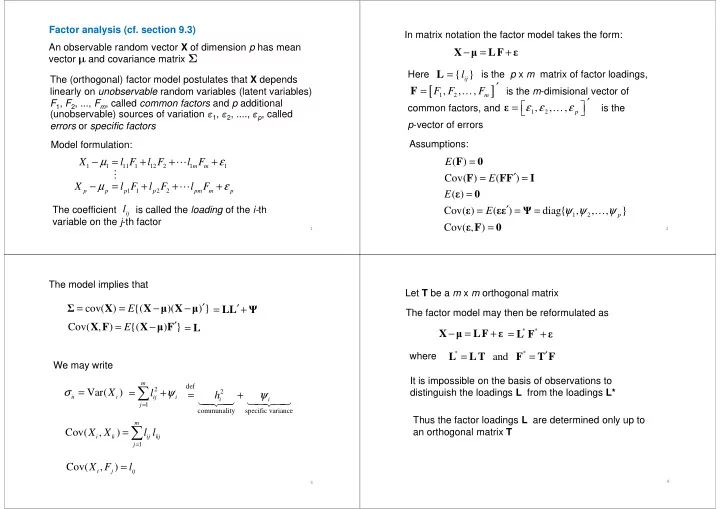
An observable random vector X of dimension p has mean vector and covariance matrix Σ The (orthogonal) factor model postulates that X depends linearly on unobservable random variables (latent variables) F1, F2, ..., Fm, called common factors and p additional (unobservable) sources of variation ε1, ε2, ...., εp, called errors or specific factors Factor analysis (cf. section 9.3)
1
Model formulation:
1 1 11 1 12 2 1 1 m m
X l F l F l F µ ε − = + + + ⋯
errors or specific factors
1 1 2 2 p p p p pm m p
X l F l F l F µ ε − = + + + ⋯
The coefficient is called the loading of the i-th variable on the j-th factor
ij
l ⋮ − = + X
- LF
ε
In matrix notation the factor model takes the form: Here is the p x m matrix of factor loadings, is the m-dimisional vector of common factors, and is the p-vector of errors
{ }
ij
l = L
[ ]
1 2
, , ,
m
F F F ′ = F …
1 2
, , ,
p
ε ε ε ′ = ε …
2
( ) Cov( ) ( ) E E = ′ = = F F FF I
p-vector of errors Assumptions:
1 2
( ) Cov( ) ( ) diag{ , , , }
p
E E ψ ψ ψ = ′ = = = ε ε εε Ψ … Cov( , ) = ε F
The model implies that
cov( ) {( )( ) } E ′ = = − − Σ X X X
- ′
= + LL Ψ
We may write
m
Cov( , ) {( ) } E ′ = − X F X F = L
3
Var( )
ii i
X σ =
2 1 m ij i j
l ψ
=
= +
∑
2
def communality specific variance
i i
h ψ = +
- 1
Cov( , )
m i k ij kj j
X X l l
=
=∑ Cov( , )
i j ij
X F l =
Let T be a m x m orthogonal matrix
− = + X
- LF
ε
The factor model may then be reformulated as
* *
= + L F ε
where
* *
and ′ = = L LT F T F
It is impossible on the basis of observations to
4