An unusual presentation of infmammatory myopathy in a patient on - - PDF document

an unusual presentation of infmammatory myopathy in a
SMART_READER_LITE
LIVE PREVIEW

An unusual presentation of infmammatory myopathy in a patient on - - PDF document

International Journal of Clinical Rheumatology Case Report An unusual presentation of infmammatory myopathy in a patient on natalizumab treatment for multiple sclerosis: A case report and review of myopathological classifjcation of


slide-1
SLIDE 1

ISSN 1758-4272

  • Int. J. Clin. Rheumatol. (2018) 13(3), 197-201

197

International Journal of Clinical Rheumatology

Case Report

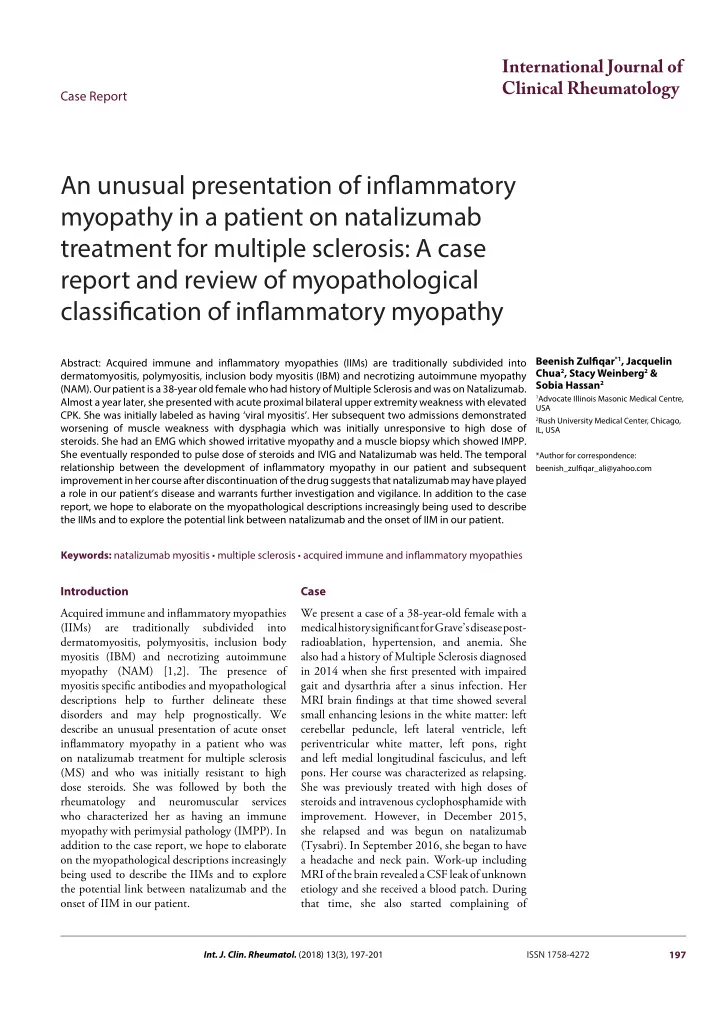
An unusual presentation of infmammatory myopathy in a patient on natalizumab treatment for multiple sclerosis: A case report and review of myopathological classifjcation of infmammatory myopathy

Beenish Zulfjqar*1, Jacquelin Chua2, Stacy Weinberg2 & Sobia Hassan2

1Advocate Illinois Masonic Medical Centre,

USA

2Rush University Medical Center, Chicago,

IL, USA *Author for correspondence: beenish_zulfjqar_ali@yahoo.com

Abstract: Acquired immune and infmammatory myopathies (IIMs) are traditionally subdivided into dermatomyositis, polymyositis, inclusion body myositis (IBM) and necrotizing autoimmune myopathy (NAM). Our patient is a 38-year old female who had history of Multiple Sclerosis and was on Natalizumab. Almost a year later, she presented with acute proximal bilateral upper extremity weakness with elevated

  • CPK. She was initially labeled as having ‘viral myositis’. Her subsequent two admissions demonstrated

worsening of muscle weakness with dysphagia which was initially unresponsive to high dose of

  • steroids. She had an EMG which showed irritative myopathy and a muscle biopsy which showed IMPP.

She eventually responded to pulse dose of steroids and IVIG and Natalizumab was held. The temporal relationship between the development of infmammatory myopathy in our patient and subsequent improvement in her course after discontinuation of the drug suggests that natalizumab may have played a role in our patient’s disease and warrants further investigation and vigilance. In addition to the case report, we hope to elaborate on the myopathological descriptions increasingly being used to describe the IIMs and to explore the potential link between natalizumab and the onset of IIM in our patient. Keywords: natalizumab myositis • multiple sclerosis • acquired immune and infmammatory myopathies

Introduction Acquired immune and infmammatory myopathies (IIMs) are traditionally subdivided into dermatomyositis, polymyositis, inclusion body myositis (IBM) and necrotizing autoimmune myopathy (NAM) [1,2]. Tie presence of myositis specifjc antibodies and myopathological descriptions help to further delineate these disorders and may help prognostically. We describe an unusual presentation of acute onset infmammatory myopathy in a patient who was

  • n natalizumab treatment for multiple sclerosis

(MS) and who was initially resistant to high dose steroids. She was followed by both the rheumatology and neuromuscular services who characterized her as having an immune myopathy with perimysial pathology (IMPP). In addition to the case report, we hope to elaborate

  • n the myopathological descriptions increasingly

being used to describe the IIMs and to explore the potential link between natalizumab and the

  • nset of IIM in our patient.

Case We present a case of a 38-year-old female with a medical history signifjcant for Grave’s disease post- radioablation, hypertension, and anemia. She also had a history of Multiple Sclerosis diagnosed in 2014 when she fjrst presented with impaired gait and dysarthria after a sinus infection. Her MRI brain fjndings at that time showed several small enhancing lesions in the white matter: left cerebellar peduncle, left lateral ventricle, left periventricular white matter, left pons, right and left medial longitudinal fasciculus, and left

  • pons. Her course was characterized as relapsing.

She was previously treated with high doses of steroids and intravenous cyclophosphamide with

  • improvement. However, in December 2015,

she relapsed and was begun on natalizumab (Tysabri). In September 2016, she began to have a headache and neck pain. Work-up including MRI of the brain revealed a CSF leak of unknown etiology and she received a blood patch. During that time, she also started complaining of

slide-2
SLIDE 2

198

Zulfjqar, Chua, Weinberg, et al.

Case Report

  • Int. J. Clin. Rheumatol. (2018) 13(3)

persistent bilateral upper extremity pain and signifjcant arm swelling with proximal muscle

  • weakness. Her exam was notable for 4/5 strength

in neck fmexor and extensors, 5/5 strength in bilateral deltoids, 4/5 in bilateral biceps, 4-/5 in bilateral triceps, 5/5 strength in bilateral hip fmexor and extensor and quadriceps. Distal extremity power was normal. Her laboratory work-up revealed CPK of 3500, 106 mg/dl, AST 126 mg/dl, ALT 53 mg/dl, mildly elevated RF; otherwise, ANA, infmammatory markers, and complements were normal. EMG fjndings were suggestive of an irritative myopathy. She was evaluated by rheumatology at that time and it was felt that her presentation was more likely to represent a viral myositis than infmammatory myositis given the sudden onset of symptoms and also because of the temporal relationship to symptoms suggestive of a viral infection. She was discharged home with close follow-up. Her symptoms persisted and began to include lower extremity weakness, pain and swelling. She was again admitted to the hospital and had a muscle biopsy that showed infmammatory myopathy with myopathic changes, infmammatory infjltrates, increased labeling of endomysial capillaries for C5b-9 membrane attack complex but no perifascicular atrophy. Her CPK at this time was

  • 2500. Given worsening symptoms, persistent

hyperCKemia and biopsy results, she was started

  • n prednisone 60 mg/day. Tiree weeks later she

returned with resolution of swelling; however, her weakness and muscle soreness persisted and she had new symptoms of dyspnea and dysphagia. Her proximal upper and lower extremity strength at this time was 3/5 bilaterally. She was readmitted and started on Methylprednisone 1 g IV × 3 days and IVIG (2 g/kg in divided doses over two days). Cancer screening including

  • varian ultrasound, CT chest and abdomen, and

mammogram were unremarkable. Paraneoplastic markers were negative. A Myomarker panel was sent and was noted to be negative for anti-SRP, anti Jo-1, EJ, OJ, Mi, Ku, MDA5, Anti HMG Co-A. She was evaluated by the neuromuscular service who reviewed her muscle biopsy and felt that her infmammatory changes were subtle and mostly identifjed in the perimysium region. Tiey labeled her as having an infmammatory myopathy with perimysial pathology. Due to her severe and refractory presentation and the potential that Natalizumab might have played a role in the development of her myopathy via its immunomodulatory actions, it was discontinued. After she completed her course of IVIG and IV methylprednisolone, her swallowing and breathing improved. She was sent to rehabilitation for strength training and recovered about 75% of her strength on follow-up. Prednisone was tapered and she was started on mycophenolate mofetil as a steroid sparing agent for her myositis. Discussion Adult acquired immune infmammatory myopathies are traditionally classifjed using the Bohan and Peter criterion which was developed in 1975 [3]. Major advances in knowledge regarding infmammatory myositis have recognized the limitations of such criteria. Developments of more recent classifjcations have emerged; one of which emphasized clinicoserological profjles, extra muscular organ involvement and autoantibodies [4]. Tiese newer classifjcations highlight the heterogeneity

  • f these myositis syndromes and how this has

implications for prognosis and response to

  • therapy. However, it does not take into account

the pathological fjndings which may also have utility for distinguishing between treatable and presently untreatable AIM. For example, a patient with rapidly progressive muscle weakness with mostly necrosis and little infmammation

  • n biopsy may perform poorly despite steroid

therapy as opposed to one with infmammation but little necrosis or fjbrosis. Familiarity of myopathological descriptions, then, can provide insights in to which patients would require more aggressive therapy. Myopathological classifjcation includes description of muscle fjber pathology, immune characteristics, and types

  • f tissues involved [2]. Currently, 6 patterns of

acquired IIMs have been identifjed: immune myopathies with perimysial pathology (IMPP); myovasculopathies; immune polymyopathies; immune myopathies with endomysial pathology (IM-EP); histiocytic infmammatory myopathy; and infmammatory myopathies with vacuoles, aggregates and mitochondrial pathology (IM- VAMP) Table 1. Specifjcally, our patient had myopathy consistent with infmammatory myopathy with perimysial pathology but with negative myositis antibodies. IMPP is commonly associated with positive Anti-Jo1 antibodies. However, autoantibodies can be absent in about 20-40% of patients in patients with infmammatory myositis [5- 7]. Patients with IMPP and positive anti-Jo-1 antibodies can have a constellation of symptoms that may include muscle weakness and pain,

slide-3
SLIDE 3

199

An unusual presentation of infmammatory myopathy in a patient on natalizumab treatment for multiple sclerosis

Case Report

IMPP syndromes are generally responsive to immunomodulatory therapy, including corticosteroids and other drugs [9]. Our patient had symmetric proximal muscle weakness but also had signifjcant bilateral arm swelling. She did not have lung involvement during her

  • course. She was initially resistant to high dose

steroids but on cessation of her natalizumab therapy and with the addition of IVIG and a prolonged course of oral steroids after pulsed treatment with IV methylprednisolone, she eventually started to show improvement. By 9 months follow-up, her motor strength was 5/5 on bilateral proximal upper extremities, 4/5 on both hip fmexors, and 5/5 bilateral hip extensors and thigh adductors and abductors. Our patient had received Natalizumab for treatment of relapsing MS 1 year prior to the onset of her myositis. Although no prior case reports were found in

  • ur literature review, based on its mechanism
  • f action, it was hypothesized that natalizumab

caused immune dysregulation that may have Raynaud's phenomenon, interstitial lung disease, arthritis, and a skin rash, commonly known as antisynthetase syndrome, difgerent from that seen in classic dermatomyositis. In a case series, review of charts, muscle biopsies and laboratory records by Mozafgar T et al. [8], features of myopathology in 11 patients with anti-Jo-1 antibody associated myopathies were compared with other types of infmammatory myopathies. Electromyography in nine patients tested showed an irritable myopathy. Muscle biopsies from all 11 patients with antiJo-1 antibodies contained regions of fragmented, rarefjed perimysial connective tissue. Infmammation was less common in endomysial (two of 11; 18%; p=0.003) and perivascular (one of 11; 9%; p<0.001) regions of muscles. In another report high serum aldolase, normal creatine kinase, and systemic features common to antisynthetase syndromes were associated with IMPP [8]. Among the biopsies that were reviewed in this report, 5 were with negative anti-Jo1 antibodies.

Table 1. Table illustrating the myopathological classifjcation of IIM [12-15]

Type Myopathological features Antibodies/ laboratory fjndings Disease Associations Comment(s) Immune myopathies with perimysial pathology (IMPP) Fragmentation and histiocyte infjltration at the perimysium. Myofjber necrosis and regeneration anti-tRNA synthetase antibodies,(Jo-1, PL-7, PL-12) Dermatomyositis, polymyositis, interstitial lung disease, fasciitis, graft

  • vs. host disease, some toxic

myopathies Common pattern, Aldolase selectively high, Not in hereditary myopathies Myovasculopathies Perifascicular atrophy and vacuolation with little necrosis or focal invasion by mononuclear cells Dermatomyositis in childhood and some adults May be associated with calcinosis Paraneoplastic syndromes Immune polymyopathies Myofjbers may have varying stages

  • f necrosis and regeneration

(early stages) or less necrosis and regeneration (later stages) No mononuclear cell infjltration SRP and HMG-CoA reductase (HMG-CoAR) antibodies Statin use (HMG-CoAR antibodies) Paraneoplastic syndromes CK is very high, Difgers from rhabdomyolysis in which many damaged fjbers have a similar stage of pathology Immune and infmammatory myopathies with endomysial Pathology (IIM-EP) Endomysial molecular pathology that often requires special stains for demonstration. Brachio-cervical infmammatory myopathy (BCIM) Histiocytic infmammatory myopathies Histiocytic foci in the endomysium

  • r perimysium. Myofjbers are

replaced by histiocytic cells and endomysial connective tissue. Granulomatous myopathies, i.e. sarcoidosis Macrophagic myofasciitis (MMF) Infmammatory myopathy with abundant macrophages (IMAMs) Both MMF and IMAMs can be related to immunizations and may be clinically silent Infmammatory myopathies with vacuoles, aggregates and mitochondrial pathology (IM-VAMP) Multifocal mononuclear cell infmammatory foci, mostly CD4+ and CD8+ T cells, in the endomysium in a linear or sinuous pattern. Perivascular foci may also occur. Myofjbers may contain vacuoles, aggregates and mislocalized proteins or mitochondrial pathology. Inclusion body myositis (IBM) Disease progression may be more rapid in IM-VAMP with vacuoles than those with mitochondrial pathology and no vacuoles

slide-4
SLIDE 4

200

Zulfjqar, Chua, Weinberg, et al.

Case Report

  • Int. J. Clin. Rheumatol. (2018) 13(3)

played a role in our patient’s disease and warrants further investigation and vigilance. Tiis report also provides a review of the myopathological classifjcations of infmammatory myopathies which are increasingly being used and can potentially provide additional information about prognostication and response to therapy. References

1. Pestronk A. Acquired immune and infmammatory myopathies: pathologic classifjcation. Curr. Opin.

  • Rheumatol. 23, 595–604 (2011).

2. Nozaki KPA. High aldolase with normal creatine kinase in serum predicts a myopathy with perimysial

  • pathology. J. Neurol. Neurosurg. Psychiatry. 80, 904–

908 (2009). 3. Bohan A, Peter JB. Polymyositis and dermatomyositis (fjrst of two parts). N. Engl. J. Med. 292(7), 344–7 (1975). 4. Senécal JL, Raynauld JP, Troyanov Y. Editorial: A New Classifjcation of Adult Autoimmune Myositis. Arthritis & Rheumatology. 69(5), 878–884 (2017). 5. Dakkalas MC. Infmammatory muscle diseases. N. Engl.

  • J. Med. 372(18), 1734–47 (2015).

6. Koenig M, Fritzler JM, Targofg IN et al. Heterogeneity

  • f autoantibodies in 100 patients with autoimmune

myositis: insights into clinical features and outcomes. Arthritis Research & Tierapy. 9(4), 78 (2007). 7. Aggarwal R, Bandos A, Reed AM et al. Predictors

  • f Clinical Improvement in Rituximab-Treated

Refractory Adult and Juvenile Dermatomyositis and Adult Polymyositis. Arthritis. Rheumatol. 66(3), 740–9 (2014). 8. Mozafgar T, Pestronk A. Myopathy with anti-Jo-1 antibodies: pathology in perimysium and neighbouring muscle fjbres. J. Neurol. Neurosurg. Psychiatry. 68(4), 472–8 (2000). 9. Nozaki K, Pestronk A. High Aldolase with Normal Creatine Kinase in serum predicts a Myopathy with Perimysial Pathology. J. Neurol. Psychiatr. Neurosurg. 80, 829–829 (2009).

  • 10. Kleinschmidt-DeMasters BK, Tyler KL. "Progressive

multifocal leukoencephalopathy complicating treatment with natalizumab and interferon beta-1a for multiple sclerosis". N. Engl. J. Med. 353(4), 369–74 (2005).

  • 11. Zohren F, Toutzaris D, Klarner V et al. "Tie

monoclonal anti-VLA4 antibody natalizumab mobilizes CD34+ hematopoietic progenitor cells in humans". Blood. 111(7), 3893–5 (2008).

  • 12. Gunawardena H, Wedderburn LR. Autoantibodies

to a 140-kd protein in juvenile dermatomyositis are associated with calcinosis. Arthritis. Rheum. 60(6), 1807–14 (2009).

  • 13. Bleecker JLD, Lundberg IE. Pathology diagnosis of

idiopathic infmammatory myopathies 30 November – 2 December 2012, Naarden, Tie Netherlands. Neuromuscular Disorders. 23, 945–951 (2013).

contributed to the development and severity of

  • ur patient’s myopathy. Natalizumab works by

targeting cellular adhesion and T cell migration [10,11]. It acts against the a4b1 integrin, VLA4,

  • n leucocytes, which are fundamental molecules

for adhesion and transmigration of T cells. It has been used in Crohn’s disease and multiple

  • sclerosis. In the myositis group of diseases, it

has actually been studied as a treatment for inclusion body myositis. Tie fjnal results of this study are not available yet but interim analysis

  • f a pilot trial showed signifjcant changes in

muscle biopsies of 2 patients with near complete elimination of infmammation [10]. No changes in the manual muscle testing were noted in these two patients. Treatment of rare diseases or rare disease manifestations in rheumatology are often mirrored on previous experiences of similar more common disease presentations. In a review of natalizumab, it was suggested that it could be a potential therapy for refractory cases or diffjcult cases of polymyositis, dermatomyositis and

  • IBM. Limited literature is available in support
  • f this, however given the temporal relationship

between starting natalizumab and the onset of

  • ur patient’s symptoms, it is postulated that

natalizumab may have played a role in the onset

  • r severity of her myositis. It is speculated that

natalizumab, given its mechanism of action, may afgect the normal traffjcking of lymphocytes and may have perturbed the balance between efgector and regulatory T cells. Discontinuation of the drug and aggressive therapy for her myositis led to a gradual improvement in her symptoms. Even though the link between our patient’s myositis and natalizumab use is only hypothetical, the fact that natalizumab is being considered as a treatment for refractory or resistant cases

  • f infmammatory myositis should raise some

concern and needs further investigation. Conclusion In summary, we report an atypical presentation

  • f adult infmammatory myopathy with perimysial

pathology in the setting of known MS and natalizumab use. We did not fjnd any other case reports implicating natalizumab in the onset

  • f infmammatory myopathy. To the contrary,

it has been suggested as a potential treatment for refractory infmammatory myopathy in a few

  • studies. However, the temporal relationship

between the development of infmammatory myopathy in our patient and subsequent improvement in her course after discontinuation

  • f the drug suggests that natalizumab may have
slide-5
SLIDE 5

201

An unusual presentation of infmammatory myopathy in a patient on natalizumab treatment for multiple sclerosis

Case Report

  • 14. Stenzel W, Goebel HH, E Aronica. Immune-mediated

necrotizing myopathies – a heterogeneous group

  • f diseases with specifjc myopathological features.
  • Neuropathol. Appl. Neurobiol. 38, 632–646 (2012).
  • 15. Lazarou IN, Guerne PA. Classifjcation, Diagnosis, and

Management of Idiopathic Infmammatory Myopathies.

  • J. Rheumatol. 40 (2013).