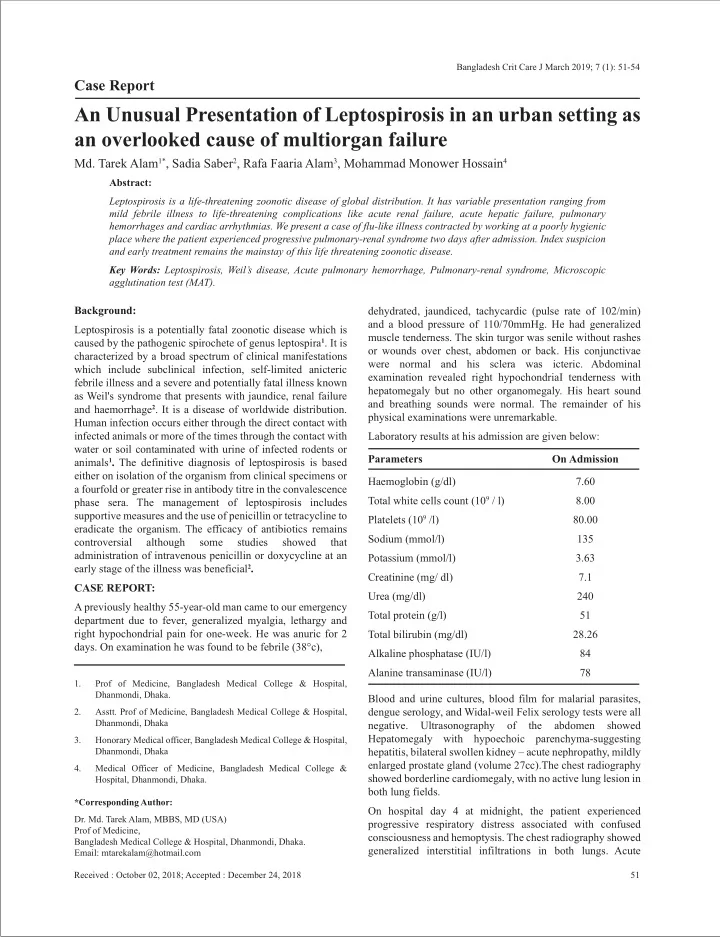

SLIDE 1
Background: Leptospirosis is a potentially fatal zoonotic disease which is caused by the pathogenic spirochete of genus leptospira1. It is characterized by a broad spectrum of clinical manifestations which include subclinical infection, self-limited anicteric febrile illness and a severe and potentially fatal illness known as Weil's syndrome that presents with jaundice, renal failure and haemorrhage2. It is a disease of worldwide distribution. Human infection occurs either through the direct contact with infected animals or more of the times through the contact with water or soil contaminated with urine of infected rodents or
- animals1. The definitive diagnosis of leptospirosis is based
either on isolation of the organism from clinical specimens or a fourfold or greater rise in antibody titre in the convalescence phase sera. The management of leptospirosis includes supportive measures and the use of penicillin or tetracycline to eradicate the organism. The efficacy of antibiotics remains controversial although some studies showed that administration of intravenous penicillin or doxycycline at an early stage of the illness was beneficial2. CASE REPORT: A previously healthy 55-year-old man came to our emergency department due to fever, generalized myalgia, lethargy and right hypochondrial pain for one-week. He was anuric for 2
- days. On examination he was found to be febrile (38°c),
1. Prof of Medicine, Bangladesh Medical College & Hospital, Dhanmondi, Dhaka. 2.
- Asstt. Prof of Medicine, Bangladesh Medical College & Hospital,
Dhanmondi, Dhaka 3. Honorary Medical officer, Bangladesh Medical College & Hospital, Dhanmondi, Dhaka 4. Medical Officer of Medicine, Bangladesh Medical College & Hospital, Dhanmondi, Dhaka. *Corresponding Author:
- Dr. Md. Tarek Alam, MBBS, MD (USA)
Prof of Medicine, Bangladesh Medical College & Hospital, Dhanmondi, Dhaka. Email: mtarekalam@hotmail.com
dehydrated, jaundiced, tachycardic (pulse rate of 102/min) and a blood pressure of 110/70mmHg. He had generalized muscle tenderness. The skin turgor was senile without rashes
- r wounds over chest, abdomen or back. His conjunctivae
were normal and his sclera was icteric. Abdominal examination revealed right hypochondriaI tenderness with hepatomegaly but no other organomegaly. His heart sound and breathing sounds were normal. The remainder of his physical examinations were unremarkable. Laboratory results at his admission are given below: Parameters On Admission Haemoglobin (g/dl) 7.60 Total white cells count (109 / l) 8.00 Platelets (109 /l) 80.00 Sodium (mmol/l) 135 Potassium (mmol/l) 3.63 Creatinine (mg/ dl) 7.1 Urea (mg/dl) 240 Total protein (g/l) 51 Total bilirubin (mg/dl) 28.26 Alkaline phosphatase (IU/l) 84 Alanine transaminase (IU/l) 78 Blood and urine cultures, blood film for malarial parasites, dengue serology, and Widal-weil Felix serology tests were all negative. Ultrasonography
- f
the abdomen showed Hepatomegaly with hypoechoic parenchyma-suggesting hepatitis, bilateral swollen kidney – acute nephropathy, mildly enlarged prostate gland (volume 27cc).The chest radiography showed borderline cardiomegaly, with no active lung lesion in both lung fields. On hospital day 4 at midnight, the patient experienced progressive respiratory distress associated with confused consciousness and hemoptysis. The chest radiography showed generalized interstitial infiltrations in both lungs. Acute
Case Report
An Unusual Presentation of Leptospirosis in an urban setting as an overlooked cause of multiorgan failure
- Md. Tarek Alam1*, Sadia Saber2, Rafa Faaria Alam3, Mohammad Monower Hossain4
Abstract: Leptospirosis is a life-threatening zoonotic disease of global distribution. It has variable presentation ranging from mild febrile illness to life-threatening complications like acute renal failure, acute hepatic failure, pulmonary hemorrhages and cardiac arrhythmias. We present a case of flu-like illness contracted by working at a poorly hygienic place where the patient experienced progressive pulmonary-renal syndrome two days after admission. Index suspicion and early treatment remains the mainstay of this life threatening zoonotic disease. Key Words: Leptospirosis, Weil’s disease, Acute pulmonary hemorrhage, Pulmonary-renal syndrome, Microscopic agglutination test (MAT).
Bangladesh Crit Care J March 2019; 7 (1): 51-54 Received : October 02, 2018; Accepted : December 24, 2018 51