Anaerobes Veillonella Gram positive bacilli Clostridium - - PDF document

anaerobes
SMART_READER_LITE
LIVE PREVIEW

Anaerobes Veillonella Gram positive bacilli Clostridium - - PDF document

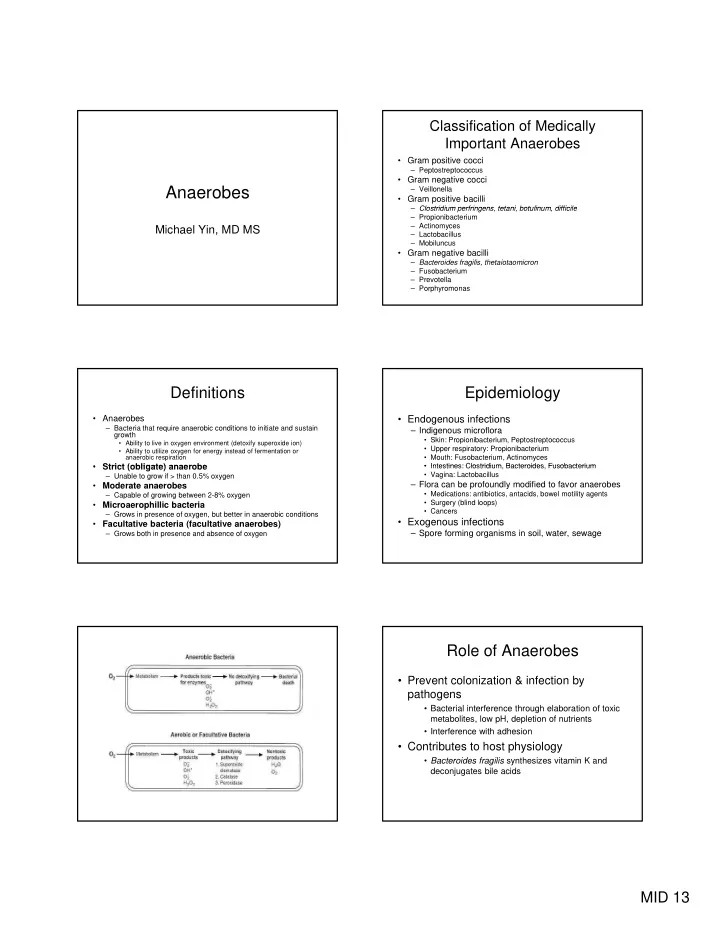
Classification of Medically Important Anaerobes Gram positive cocci Peptostreptococcus Gram negative cocci Anaerobes Veillonella Gram positive bacilli Clostridium perfringens, tetani, botulinum, difficile Clostridium


slide-1
SLIDE 1

MID 13

Anaerobes

Michael Yin, MD MS

Definitions

  • Anaerobes

– Bacteria that require anaerobic conditions to initiate and sustain growth

  • Ability to live in oxygen environment (detoxify superoxide ion)
  • Ability to utilize oxygen for energy instead of fermentation or

anaerobic respiration

  • Strict (obligate) anaerobe
  • Strict (obligate) anaerobe

– Unable to grow if > than 0.5% oxygen

  • Moderate anaerobes

– Capable of growing between 2-8% oxygen

  • Microaerophillic bacteria

– Grows in presence of oxygen, but better in anaerobic conditions

  • Facultative bacteria (facultative anaerobes)

– Grows both in presence and absence of oxygen

Classification of Medically Important Anaerobes

  • Gram positive cocci

– Peptostreptococcus

  • Gram negative cocci

– Veillonella

  • Gram positive bacilli

Clostridium perfringens tetani botulinum difficile – Clostridium perfringens, tetani, botulinum, difficile – Propionibacterium – Actinomyces – Lactobacillus – Mobiluncus

  • Gram negative bacilli

– Bacteroides fragilis, thetaiotaomicron – Fusobacterium – Prevotella – Porphyromonas

Epidemiology

  • Endogenous infections

– Indigenous microflora

  • Skin: Propionibacterium, Peptostreptococcus
  • Upper respiratory: Propionibacterium
  • Mouth: Fusobacterium, Actinomyces
  • Intestines: Clostridium Bacteroides Fusobacterium
  • Intestines: Clostridium, Bacteroides, Fusobacterium
  • Vagina: Lactobacillus

– Flora can be profoundly modified to favor anaerobes

  • Medications: antibiotics, antacids, bowel motility agents
  • Surgery (blind loops)
  • Cancers
  • Exogenous infections

– Spore forming organisms in soil, water, sewage

Role of Anaerobes

  • Prevent colonization & infection by

pathogens

  • Bacterial interference through elaboration of toxic

metabolites, low pH, depletion of nutrients

  • Interference with adhesion
  • Contributes to host physiology
  • Bacteroides fragilis synthesizes vitamin K and

deconjugates bile acids

slide-2
SLIDE 2

MID 13

Clinical features of anaerobic infections

  • The source of infecting micro-organism is

the endogenous flora of host

  • Alterations of host’s tissues provide

suitable conditions for development of p

  • pportunist anaerobic infections
  • Anaerobic infections are generally

polymicrobial

  • Abscess formation
  • Exotoxin formation

Sites of anaerobic infections Virulence factors

  • Attachment and adhesion

– Polysaccharide capsules and pili

  • Invasion

– Aerotolerance

  • Establishment of infection

Establishment of infection

– Polysaccharide capsule (B. fragilis) resists

  • psonization and phagocytosis

– Synergize with aerobes – Spore formation (Clostridium)

  • Tissue damage

– Elaboration of enzymes, toxins

Anaerobic cocci

  • Epidemiology

– Normal flora of skin, mouth, intestinal and genitourinary tracts

  • Pathogenesis

– Virulence factors not as well characterized – Opportunistic pathogens, often involved in polymicrobial infections – Brain abscesses, periodontal disease, pneumonias, skin and soft tissue infections, intra-abdominal infections

  • Peptostreptococcus

– P. magnus: chronic bone and joint infections, especially prosthetic joints – P. prevotti and P. anaerobius: female genital tract and intra- abdominal infections

  • Veillonella

– Normal oral flora; isolated from infected human bites

Anaerobic gram positive bacilli

  • No Spore Formation

– Propionibacterium

  • P. acnes

– Actinomyces

  • Spore Formation

– Clostridium

  • C. perfringens
  • C. difficile

C tetani

  • A. israelii

– Lactobacillus – Mobiluncus

  • C. tetani
  • C. botulinum
slide-3
SLIDE 3

MID 13

Propionibacterium

  • Produces propionic acid as major byproduct of

fermentation

  • Colonize skin, conjunctiva, external ear,
  • ropharynx, female GU tract

p y

  • P. acnes

– Acne

  • Resides in sebaceous follicles, releases LMW peptide,

stimulates an inflammatory response

– Opportunistic infections

  • Prosthetic devices (heart valves, ventricular shunts)

Pilosebaceous follicle Actinomyces

  • Facultative or strict anaerobe
  • Colonize upper respiratory tract, GI, female GU

tract

  • Actinomycosis

– Endogenous disease, no person-person spread – Low virulence; development of disease when normal mucosal barriers are disrupted (dental procedure) – Diagnosis made by examination of infected fluid:

  • Macroscopic colonies of organisms resembling grains of

sand (sulfur granules)

  • Culture

Actinomycosis

  • Cervicofacial

Actinomycosis

– Poor oral hygiene, oral trauma, invasive dental procedure – Chronic granulomatous Chronic granulomatous lesions that become suppurative and form sinus tracts – Slowly evolving, painless process – Treatment: surgical debridement and prolonged penicillin

Lactobacillus

  • Facultative or strict anaerobes
  • Colonize GI and GU tract

– Vagina heavily colonized (105/ml) by Lactobacillus crispatus & jensonii – Certain strains produces H2O2 which is bactericidal to Gardnerella vaginalis

  • Clinical disease

– Transient bacteremia from GU source – Bacteremia in immunocompromized host – Endocarditis

Case 1

  • 12 year old boy with Acute Myelogenous

Leukemia (AML) diagnosed 2 mo. ago

  • Pancytopenia after receiving chemotherapy
  • Presented with painful ecchymotic areas on legs

Presented with painful ecchymotic areas on legs that rapidly progressed with marked swelling and pain over several hours

– Afebrile – Crepitus in both legs – Rapid progression to shock

slide-4
SLIDE 4

MID 13

Case 1

  • Needle aspirate of

ecchymotic area revealed gram- positive bacilli

  • Blood cultures grew

Clostridium perfringens

Clostridium

  • Epidemiology

– Ubiquitous

  • Present in soil, water, sewage
  • Normal flora in GI tracts of animals and humans
  • Pathogenesis

– Spore formation

  • resistant to heat, dessication, and disinfectants
  • can survive for years in adverse environments

– Rapid growth in oxygen deprived, nutritionally enriched environment – Toxin elaboration (histolytic toxins, enterotoxins, neurotoxins)

Clostridium perfringens

  • Epidemiology

– GI tract of humans and animals – Type A responsible for most human infections, is widely distributed in soil and water contaminated with feces – Type B-E do not survive in soil but colonize the intestinal tracts of animals and occasionally humans

  • Pathogenesis

g

– α-toxin: lecithinase (phospholipase C) that lyses erythrocytes, platelets and endothelial cells resulting in increased vascular permeability and hemolysis – ß-toxin: necrotizing activity – Enterotoxin: binds to brush borders and disrupts small intestinal transport resulting in increased membrane permeability

  • Clinical manifestations

– Self-limited gastroenteritis – Soft tissue infections: cellulitis, fascitis or myonecrosis (gas gangrene)

Clostridial soft tissue infections

Crepitant cellulitis Myonecrosis Fascitis

slide-5
SLIDE 5

MID 13

Myonecrosis Clostridial myonecrosis

  • Clinical course

– Symptoms begin 1-4 days after inoculation and progresses rapidly to extensive muscle necrosis and shock – Local area with marked pain, swelling,

  • ca a ea

a ed pa , s e g, serosanguinous discharge, bullae, slight crepitance – May be associated with increased CPK

  • Treatment

– Surgical debridement – Antibiotics – Hyperbaric oxygen

Case 2

  • 80 year old woman who was treated for a

pneumonia with a cephalosporin

– Well upon discharge from hospital 10 days later develops multiple watery loose – 10 days later develops multiple, watery loose stools and abdominal cramps – Fever, bloody stools, worsened abdominal pain

Case 2

  • Leukocytosis with

80% neutrophils

  • Fecal leukocytes
  • Stool culture neg. for

l ll hi ll salmonella, shigella campylobacter, Yersinia spp

  • Colonoscopy

– White plaques of fibrin, mucous and inflammatory cells

Clostridium difficile

  • Epidemiology

– Endogenous infection

  • Colonizes GI tract in 5% healthy individuals
  • Antibiotic exposure associated with overgrowth of C. difficile

– Cephalosporins, clindamycin, ampicllin/amoxicillin

  • Other contributing factors: agents altering GI motility, surgery, age,

underlying illness underlying illness

– Exogenous infection

  • Spores detected in hospital rooms of infected patients
  • Pathogenesis

– Enterotoxin (toxin A)

  • produces chemotaxis, induces cytokine production and

hypersecretion of fluid, development of hemorrhagic necrosis

– Cytotoxin (toxin B)

  • Induces polymerization of actin with loss of cellular cytoskeleton
  • C. difficile colitis
  • Clinical syndromes

– Asymptomatic colonization – Antibiotic-associated diarrhea – Pseudomembranous colitis

  • Diagnosis

– Isolation of toxin Isolation of toxin – Culture

  • Treatment

– Discontinue antibiotics – Metronidazole or oral vancomycin – Pooled human IVIG for severe disease – Probiotics (saccharomyces boulardii) – New drugs (nitazoxanide, tolevamer) – Relapse in 20-30% (spores are resistant)

slide-6
SLIDE 6

MID 13

North American PFGE type 1 (NAP-1)

  • Epidemiology:

– Quebec 2003: 56.3/100,000; 18% severe, 14% died within 30 days

  • Pathogenesis

– Produces greater quantities of toxins A and B in vitro – Deletion in the tcdC gene (a putative negative regulator of toxin production) – Contains a binary toxin – Selected by fluoroquinolone use

Warny et al, Lancet, 2005

Clostridium tetani

  • Epidemiology

– Spores found in most soils, GI tracts of animals – Disease in un-vaccinated or inadequately immunized – Disease does not induce immunity

  • Pathogenesis

– Spore inoculated into wound Spore inoculated into wound – Tetanospasmin

  • Heat-labile neurotoxin
  • Retrograde axonal transport to CNS
  • Blocks release of inhibitory neurotransmitters (eg. GABA) into

synapses, allowing excitatory synapses to be unregulated. This results in muscle spasms

  • Binding is irreversible

– Tetanolysin

  • Oxygen labile hemolysin, unclear clinical significance
  • C. tetani exotoxin

Tetanus

  • Clinical Manifestations

– Generalized

  • Involvement of bulbar and paraspinal muscles

– Trismus (lock jaw), risus sardonicus, opisthotonos

  • Autonomic involvement

– Sweating hyperthermia cardiac arrythmias labile blood Sweating, hyperthermia, cardiac arrythmias, labile blood pressure

– Cephalic

  • Involvement of cranial nerves only

– Localized

  • Involvement of muscles in primary area of injury

– Neonatal

  • Generalized in neonates; infected umbilical stump

Risus sardonicus and Opisthotonos

  • f Tetanus
slide-7
SLIDE 7

MID 13

Tetanus

  • Treatment

– Debridement of wound – Metronidazole Tetanus immunoglobulin – Tetanus immunoglobulin – Vaccination with tetanus toxoid

  • Prevention

– Vaccination with a series of 3 tetanus toxoid – Booster dose every 10 years

Case 3

  • 6 month old infant girl,

full-term, previously healthy

  • Progressive fussiness,

poor oral intake, weak cry for 4 days. y

  • Uninterested in feeding or

playing.

  • Exam:

– Listless – Afebrile, stable vital signs – Sluggish pupils, decreased tone, no reflexes bilaterally

Case 3

  • No ill contacts or recent travel, lives with

parents on Staten Island

– Construction in neighborhood

Diet: Breast milk & some rice cereal only

  • Diet: Breast milk & some rice cereal only
  • No fever, vomiting, diarrhea, rash,

seizures

Case 3

  • Serum, breast milk, stool sent to DOH for

detection of Botulinum toxin

– Stool POSTIVE for toxin type B

Given Baby botulism immunoglobulin

  • Given Baby botulism immunoglobulin

(Baby-BIG)

– Regained movement of arm within a day – Began feeding in 4 days

Clostridium botulinum

  • Epidemiology

– Commonly isolated in soil and water

  • 20% soil samples

– Human disease associated with botulinum toxin A, B, E, F

P th i

  • Pathogenesis

– Blocks neurotransmission at peripheral cholinergic synapses – Prevents release of acetylcholine, resulting in muscle relaxation – Recovery depends upon regeneration of nerve endings

  • C. Botulinum Exotoxin
slide-8
SLIDE 8

MID 13

Botulism

  • Clinical Syndromes

– Foodborne botulism

  • Associated with consumption of preformed toxin

– Home-canned foods (toxin A, B) – Preserved fish (toxin E)

  • Onset of symptoms 1-2 days

– Blurred vision dilated pupils dry mouth constipation – Blurred vision, dilated pupils, dry mouth, constipation – Bilateral descending weakness of peripheral muscles; death related to respiratory failure

– Infant botulism

  • Consumption of foods contaminated with botulinum spores

– 6-10% of syrups or honeys

  • Disease associated with neurotoxin produced in vivo
  • Onset of symptoms in 3-10 days

– Wound botulism (skin popping) – Asymptomatic adult carriage

Cases of Infant botulism 1976-1996

CDC, 1998 CDC, 1998

Botulism: diagnosis

  • Clinical features:

– Symmetric cranial nerve palsies (III, IV, VI, VII) causing 4Ds: diplopia, dysphonia, dysarthria, and dysphagia – Symmetric flaccid paralysis – Mentation remains intact

  • Identification of toxin or organism in stool
  • r serum

– Mouse bioassay most sensitive

  • Electromyography

Botulism: Treatment

  • Treatment

– Supportive care – Elimination of organism from GI tract

  • Gastric lavage
  • Metronidazole or penicillin

Botulinum Immunoglobulin (BIG): pooled plasma from adults – Botulinum Immunoglobulin (BIG): pooled plasma from adults immunized with pentavalent (ABCDE) botulinum toxoid – Trivalent equine Immunoglobulin (ABE)

  • Prevention

– Prevention of spore germination (Storage <4°C, high sugar content, acid PH) – Destruction of preformed toxin (20 min at 80°C)

Anaerobic gram negative bacilli

  • Bacteroides

– B. fragilis – B. thetaiotaomicron

F b t i

  • Fusobacterium
  • Prevotella
  • Porphyromonas

Anaerobic gram negative bacilli

  • Epidemiology

– Bacteroides and Prevotella are most prevalent organisms in human flora – Oral cavity (crypts of tonsils and tongue, dental plaques and gingival crevices)

  • Anaerobes become prominent after eruption of teeth

Anaerobes become prominent after eruption of teeth

  • Porphyromonas gingivalis found in 37% of subjects, colonization

concordance in families

  • Fusobacterium

– GI tract

  • Anaerobes outnumber aerobes 1000:1
  • 1011organisms per gram of fecal material
  • Bacteroides spp. (vulgatus and thetaiotaomicron most common)

– Vagina

slide-9
SLIDE 9

MID 13

Anaerobic gram negative bacilli

  • Clinical Diseases

– Chronic sinus infections – Periodontal infections Brain abscess – Brain abscess – Intra-abdominal infection – Gynecological infection – Diabetic and decubitus ulcers

Case 4

  • 37 year old woman

with peri-umbilical pain, anorexia, and nausea

– Given diagnosis of food poisoning in the ER and sent home – Develops sharp right lower abdominal pain and fever over next 4 days

Bacteroides

  • Epidemiology

– B. fragilis associated with 80% of intra-abd infx

  • Peritonitis, intraabdominal abcesses

– Diabetic foot ulcers

  • Pathogenesis

– Polysaccharide capsule Polysaccharide capsule

  • Increases adhesion to peritoneal surfaces (along with fimbriae)
  • Protection against phagocytosis
  • Differs from LPS of aerobic GNR

– Less fatty acids linked to Lipid A component – Less pyrogenic activity

  • Abscess Formation

– Produces superoxide dismutase and catalase – Elaborate a variety of enzymes – Synergistic infections with aerobes

Abscess Formation

  • Bacteroides Capsular Polysaccharide Complex

(CPC)

– 2 discreet polysaccharides (PS A & PS B) with

  • ppositely charged structural groups

– Injection of CPC into peritoneum of rat results in abscess formation

  • Chemical neutralization or removal of charged groups

abrogated abscess induction

– Vaccination with CPC results in protection against abscess formation

  • T cells important in abscess formation

Weinstein, Infection and Immunity, 1974

slide-10
SLIDE 10

MID 13

Abscess Formation

  • Initial phase

– Introduction of bacteria and inflammatory exudates (esp. fibrin)

  • Microbial persistence (localization)

– Impaired bacterial clearance: fibrin deposition, platelet clumping – Impaired phagocytic function: fibrin, hemoglobin – Impaired neutrophil migration and killing: hypoxia, low PH – Complement depletion: necrotic debris

  • Development of mature abscess

– Central core of necrotic debris, dead cells, bacteria – Surrounded by neutrophils and macrophages – Peripheral ring of fibroblasts and smooth muscle cells within collagen capsule

Conclusion

  • Anaerobic infections

– Endogenous or exogenous – Alteration of host tissue

  • Break in anatomic barrier
  • Devitalized tissue

– Polymicrobial

  • Synergy between anaerobes and facultative

bacteria

– Abscess formation – Exotoxin elaboration