Analysis of Hemiparetic Gait by Using Mechanical Models Ch. - - PowerPoint PPT Presentation

analysis of hemiparetic gait by using mechanical models
SMART_READER_LITE
LIVE PREVIEW

Analysis of Hemiparetic Gait by Using Mechanical Models Ch. - - PowerPoint PPT Presentation

Ch. Lutzenberger, LBM, TU Mnchen Second International Symposium on Impact and Friction of Solids, Structures and Intelligent Machines August 8-12, 2000, Montreal, Quebec Analysis of Hemiparetic Gait by Using


slide-1
SLIDE 1
  • Ch. Lutzenberger, LBM, TU München

Garching, 03.08.2000

Second International Symposium on Impact and Friction of Solids, Structures and Intelligent Machines August 8-12, 2000, Montreal, Quebec

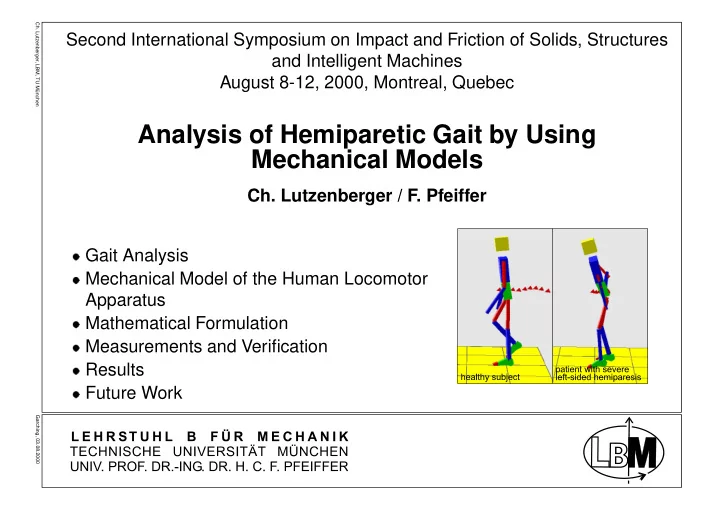
Analysis of Hemiparetic Gait by Using Mechanical Models

  • Ch. Lutzenberger / F. Pfeiffer
  • Gait Analysis
  • Mechanical Model of the Human Locomotor

Apparatus

  • Mathematical Formulation
  • Measurements and Verification
  • Results
  • Future Work
slide-2
SLIDE 2
  • 1. Gait Analysis
  • Ch. Lutzenberger, LBM, TU München

Garching, 03.08.2000

Purpose: reduction of gait deviations

  • diagnosis of gait deviations
  • definition of therapy
  • control and quantization of outcome
  • f therapy

Execution:

  • performed by a physical therapist or doctor
  • simulation and measurements provide

additional information: – cadence, step length – joint angles – forces, torques, ... – EMG profiles

more precise gait analysis

slide-3
SLIDE 3
  • 1. Gait Analysis
  • Ch. Lutzenberger, LBM, TU München

Garching, 03.08.2000

Common Gait Analysis

slide-4
SLIDE 4
  • 1. Gait Analysis
  • Ch. Lutzenberger, LBM, TU München

Garching, 03.08.2000

and Extended

Advantages of the extended approach:

  • additional quantities

for diagnosis – ground reaction forces – joint torques, power

  • better understanding and

therapy of gait deviations

  • no force plates needed
slide-5
SLIDE 5
  • 2. Mechanical Model of the Human Locomotor Apparatus
  • Ch. Lutzenberger, LBM, TU München

Garching, 03.08.2000

Model properties:

  • three-dimensional multibody-system
  • 13 rigid bodies
  • 12 joints with 3 degrees of freedom each
  • 42 degrees of freedom at all
  • joint torques
✂☎✄
  • ground reaction forces
✆✞✝✟

and torques

✂ ✝✟
  • parameter scaling for each patient
slide-6
SLIDE 6
  • 3. Mathematical Formulation
  • Ch. Lutzenberger, LBM, TU München

Garching, 03.08.2000

  • equations of motion for the single support phase
✂ ✠☛✡ ☞ ✌ ✡ ✍ ✎ ✠☛✡✑✏ ✒ ✡ ☞✔✓ ✕ ✖ ✖ ✆✗✝✟ ✘ ✕ ✖✚✙ ✂ ✝ ✟ ✘ ✛✜ ✢✤✣ ✛ ✕ ✖ ✙✦✥ ✢ ✂ ✄ ✥ ✢
  • equations of motion for the double support phase
✂ ✠☛✡ ☞ ✌ ✡ ✍ ✎ ✠☛✡✑✏ ✒ ✡ ☞✔✓ ✜ ✧ ✣ ✛ ★ ✕ ✖ ✖ ✥ ✧ ✆✗✝✟ ✥ ✧ ✘ ✕ ✖ ✙ ✥ ✧ ✂ ✝✟ ✥ ✧ ✩ ✘ ✛✜ ✢ ✣ ✛ ✕ ✖ ✙ ✥ ✢ ✂✪✄ ✥ ✢
  • ptimization
✫ ✓ ✬ ✭ ✮ ✖ ✝ ✟ ✯ ✛ ✮ ✝✟ ✘ ✬ ✭ ✰ ✖ ✝ ✟ ✯ ✜ ✰ ✝✟ ✘ ✬ ✭ ✰ ✖ ✄ ✯✲✱ ✰ ✄

Lagrangian function L

✳ ✓ ✫ ✘ ✴ ✖ ★✵ ✕ ✖ ✖ ✥ ✝ ✟ ✶ ✕ ✖✚✙ ✥ ✝✟ ✷✸ ✮ ✝✟ ✰ ✝✟ ✹ ✘ ✕ ✖ ✙✦✥ ✄ ✰ ✄ ✍ ✂ ✌ ✡ ✘ ✎ ✩
  • inverse dynamics
✡ ✠✻✺ ☞ ✏ ✒ ✡ ✠✻✺ ☞ ✏ ✌ ✡ ✠✻✺ ☞✽✼ ✆✗✝✟ ✥ ✄ ✠✻✺ ☞ ✏ ✂ ✝ ✟ ✥ ✄ ✠✻✺ ☞ ✏ ✂ ✄ ✥ ✧ ✠✻✺ ☞
slide-7
SLIDE 7
  • 4. Measurements and Verification
  • Ch. Lutzenberger, LBM, TU München

Garching, 03.08.2000

Measurements

  • performed in the neurological clinic in

Bad Aibling, Germany

  • contactless 3D motion analysis

system with 58 markers (Optotrak)

  • measurement of joint angles
  • computation of joint angular velocities

and accelerations by differentiation Verification of the Model

good agreement of simulation results (bold solid line) with measurements (dotted line) and calculations (solid line) from litera- ture

slide-8
SLIDE 8
  • 5. Results
  • Ch. Lutzenberger, LBM, TU München

Garching, 03.08.2000

Animation

Advantages compared to common recording techniques:

  • view the disturbed gait pattern

under different angles

  • zoom on details
  • ppose the impaired to a healthy

gait pattern

  • facil storage
slide-9
SLIDE 9
  • 5. Results
  • Ch. Lutzenberger, LBM, TU München

Garching, 03.08.2000

Evaluation of Degree of Hemiparesis

A: healthy subject B: patient with moderate hemiparesis C, D: patients with severe hemiparesis

Outcome of Therapy

A: healthy subject D1, D2, D3: patient D in different stages of physiotherapy (physio)

slide-10
SLIDE 10
  • 5. Results
  • Ch. Lutzenberger, LBM, TU München

Garching, 03.08.2000

Kinematic Characteristics of Hemiparetic Gait

  • excessive lateral movement
  • f body’s center of mass
  • high lateral ground reaction forces on the

affected side

  • low peak torques in all joints of the lower limb
  • lower peak torques on the affected than on

the unaffected side

  • energy for propulsion results mainly from

the unaffected side

slide-11
SLIDE 11
  • 6. Future Work
  • Ch. Lutzenberger, LBM, TU München

Garching, 03.08.2000

Model-based Functional Electrical Stimulation (FES) for Therapy of Hemiparesis Therapy of hemiparetics

  • physiotherapy
  • treadmill walking
  • new treatment: FES

FES: artificial stimulation of muscles on the affected side of the patient Advantage: significant improvement of therapy Goal: correct the impaired gait pattern