and background knowledge P A T R I C I A V E L A S C O B I L I N G - - PowerPoint PPT Presentation

and background knowledge
SMART_READER_LITE
LIVE PREVIEW

and background knowledge P A T R I C I A V E L A S C O B I L I N G - - PowerPoint PPT Presentation

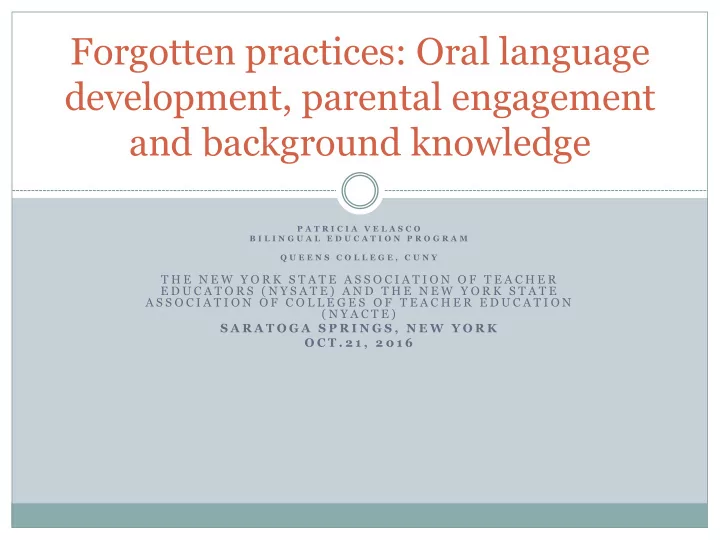
Forgotten practices: Oral language development, parental engagement and background knowledge P A T R I C I A V E L A S C O B I L I N G U A L E D U C A T I O N P R O G R A M Q U E E N S C O L L E G E , C U N Y T H E N E W Y O R K S T A


slide-1
SLIDE 1

P A T R I C I A V E L A S C O B I L I N G U A L E D U C A T I O N P R O G R A M Q U E E N S C O L L E G E , C U N Y

T H E N E W Y O R K S T A T E A S S O C I A T I O N O F T E A C H E R E D U C A T O R S ( N Y S A T E ) A N D T H E N E W Y O R K S T A T E A S S O C I A T I O N O F C O L L E G E S O F T E A C H E R E D U C A T I O N ( N Y A C T E ) S A R A T O G A S P R I N G S , N E W Y O R K O C T . 2 1 , 2 0 1 6

Forgotten practices: Oral language development, parental engagement and background knowledge

slide-2
SLIDE 2

Objectives

 Highlight the experience of teacher educators as we

attempt to bridge the theory to practice.

 To deconstruct and problematize what it means to

educate new teachers for increasingly diverse schools and classroom contexts.

 This presentation will focus on three aspects that have

been put aside or ignored:

 Oral language development  Parental engagement  Background knowledge and reading comprehension

slide-3
SLIDE 3

Oral language development

Oral language development is the foundation for student learning. Students vary in their ability to use their existing language in order to learn. The oral language knowledge and competency of some students might be substantially different from the demands of the curriculum. Escamilla and her colleagues consider that 25 % of the school day should be spent having conversations

slide-4
SLIDE 4

What is happening?

 Teachers and school administrators put pressure on

children to read and write without having developed the oral language that would allow them to learn and extend their background knowledge and clarify gaps in information.

 The CCSS have Speaking and Listening Standards

but these are not implemented because they are not ‘tested’ whereas reading and writing are.

slide-5
SLIDE 5

Parental involvement: Laundry list of behaviors

Parental engagement: Collaboration and erasing of boundaries

Attending parent teacher conferences, chaperoning field trips, participating in school activities (i.e. bake sales), parents having strict rules about TV watching and homework completion

 Social origin is used as a way of

accepting or rejecting and individual even before interaction takes place.

Parental involvement vs. parental engagement

slide-6
SLIDE 6

Can parental engagement be structured? If so, how?

Parental engagement is technically addressed into once a Week forty minutes, after school time slots. However, principals and teachers report that parents don’t come. The question that we need to be asking is: What does it take to form compassionate teachers who show empathy and are willing to have an open dialogue and interaction with parents who do not know how the American school system works? Many parents are looking for teachers who can help them navigate the American school system.

slide-7
SLIDE 7

Sharing a curriculum with parents Contacting parents through text messages

 Ms. Bard, a third grade

teacher, developed a social studies unit based on the country of

  • rigin where her

students where coming

  • from. The mothers took
  • ver and developed the

unit.

 Ms. Mohammad, a

second grade teacher, sends a video to the parents once every two weeks, explaining the curriculum that the class will be

  • developing. She reports

excellent results.

Two examples of parental engagement

slide-8
SLIDE 8

Background knowledge and reading comprehension

 Breadth of background knowledge. Pressley 2009 states

that “knowledge is not a singular entity, but consists of many diverse forms and dimensions . . . [and] what one knows is as likely to come from everyday out-of-school experiences as from formal learning”

 Depth or domain-specific background knowledge. As

children learn more about various fields of knowledge, they develop a specialized sense of particular areas of

  • study. This awareness is known as domain knowledge,

and it is related to the study of specific subject matter.

slide-9
SLIDE 9

“A rich diet of books: some easier, some more difficult” Snow, 2013

 Once a reading level has been assigned to a student, it technically

represents a measure that covers all different genres and topics.

In some cases, where schools don’t have the assessment tools in two languages, the reading level achieved in English is taken as a valid measure of reading ability in the two languages.

 The CCSS use lexiles (quantitative measure of vocabulary and sentence

complexity) to provide a text with a score and by assessing students’

  • ral reading a score a ‘match’ between the lexile level and the students

reading proficiency is established.

 There is no research, however, confirming that matching

students to texts improves the development of reading comprehension.

slide-10
SLIDE 10

An example of Depth or Domain Specific Background Knowledge

 Anchor Standard 10 in the Common Core Learning Standards

for Reading demands that students “read and comprehend literary and informational texts independently and proficiently.”

 NYSED Bilingual Common Core Initiative (BCCI) has

embedded the notion that domain specific background knowledge plays an important role in reading comprehension. The example that is portrayed in the BCCI refers to books about the human body that extend different levels and in different languages: https://www.engageny.org/resource/new-york-state-bilingual- common-core-initiative

slide-11
SLIDE 11
slide-12
SLIDE 12
slide-13
SLIDE 13