SLIDE 1
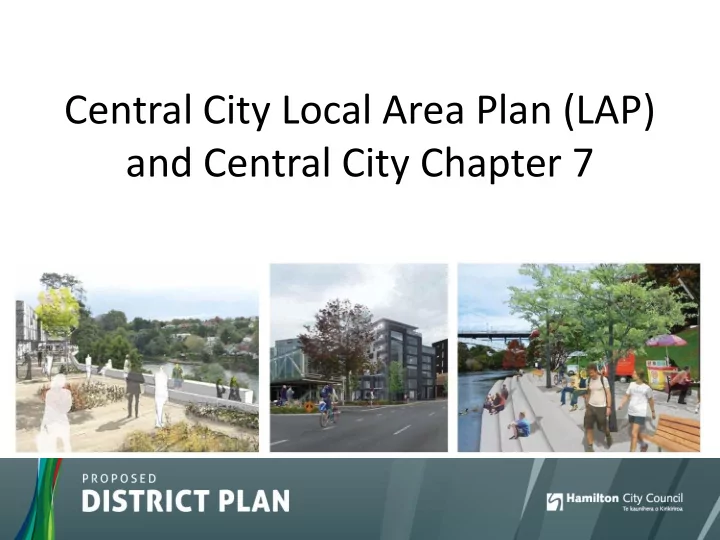
Central City Local Area Plan (LAP) and Central City Chapter 7
SLIDE 2 Presentation Overview
- Purpose of the LAP
- Overview of the Hamilton City Centre LAP process
- Urban design rationale for PDP provisions
- Key development sites
- Opoia precinct
SLIDE 3 Involvement
- LAP preparation – Oct 2010
- Chapter 7 District Plan – Sept 2011
- Response to submissions – Feb 2013
SLIDE 4 Purpose of the Hamilton City Centre LAP
- Establish a vision for the Central City
- Integrate existing strategies and development proposals
- Identify character precincts and future development framework
- Establish guiding urban design principles
- Provide the basis for the District Plan Policy Development
SLIDE 5 Why a Design Led Policy Approach?
Good design can add:
- Economic value, leading to economic growth
- A range of social, cultural and environmental
benefits, e.g.:
- attractive, safe environments that attract patronage
- Walkable environments and associated health benefits
- Enriched character
- Reduce energy consumption
SLIDE 6 Relevant Strategic Policy
- The FutureProof Sub-Regional Growth Strategy
- Hamilton City Strategies; CBD Future 2020 Vision
- Access Hamilton
- Proposed Waikato Regional Policy Statement
- Hamilton CityHeart Revitalisation Project
- Hamilton City Council Operative District Plan
SLIDE 7 Key issues
- CBD is large in comparison to population (low
intensity)
- Longitudinal nature of the Central City
- Large block sizes reduce permeability
- Lack of amenities
- Lack of activity fronting streets
- Vehicle dominance
- Lack of connection / relationship to the River
- Fragmented landownership
SLIDE 8
A Key Challenge – City Scale
SLIDE 9 LAP Structure
- Vision for the Central City
- Urban Structure
- Precincts
- Implementation
- Development Sites
SLIDE 10
LAP Structure – Vision
SLIDE 11 LAP Structure – Urban Structure
- Precinct Plan
- Movement network (pedestrian)
- Heritage and Character
- Active facades
- Land use
- Height
- Views and vistas
- Vehicle movement
- Development sites
SLIDE 12 LAP Structure – Urban Structure
- Precinct Plan
- Movement network (pedestrian)
- Heritage and Character
- Active facades
- Land use
- Height
- Views and vistas
- Vehicle movement
- Development sites
SLIDE 13 LAP Structure – Urban Structure
Character based approach to the amenity of streets Responds to:
Precincts
- Access Hamilton
- City wide movement
framework
SLIDE 14
- Precinct Plan
- Movement network (pedestrian)
- Heritage and Character
- Active facades
- Land use
- Height
- Views and vistas
- Vehicle movement
- Development sites
LAP Structure – Precincts
SLIDE 15 Height bonuses enabled for public benefit, e.g.:
- Open space
- Through site links
- Public art
LAP Structure – Riverfront Overlay
SLIDE 16 LAP Structure – Implementation
Local Area Plan Proposed District Plan (as notified)
SLIDE 17 Local Area Plan Proposed District Plan (as notified)
LAP Structure – Implementation
SLIDE 18 Consultation and Engagement
October 2010 to March 2012
- Workshops with Council’s Strategy & Policy Committee
- Landowners / representatives of key development sites
- The Property Council
- Opportunity Hamilton
- Local business ‘Breakfast Session’ with the Mayor
- Council staff including planning, transport and urban design and
Council asset managers
SLIDE 19 Consultation and Engagement
March 2012 onwards
- Open days with the wider community (below)
- Further workshops with Council’s Strategy & Policy Committee
- Further meetings with council staff including planning, transport and urban
design and Council asset managers
- Council planning consultants – specifically EMS Consultants
- Two workshops with the HCC’s Urban Design Panel.
SLIDE 20
Chapter 7 Rules and Standards Overview of rationale and analysis
SLIDE 21
- Restricted discretionary activity
- Costs are variable (e.g. not all good design is the
most expensive design)
- Benefits are experienced both by the developer and
the wider community (users of the environment)
New buildings, alterations and additions
SLIDE 22 New buildings, alterations and additions
Benefits:
- Increased public amenity and safety, resulting in
increased property value and investment uptake
- Attracting a variety of businesses, including those
which attract highly skilled workers
- Greater choice and adaptability, allowing building
stock to respond to economic trends
- enhancing local character, sense of place and
- wnership
- Environmental benefits
SLIDE 23 Maximum Height Control and Bonuses
Responds to:
assessment
Precincts
- City profile
- Views
- Existing view shafts and
views
- Optimisation of sun access
- Wider social, cultural and
environmental wellbeing of the city
SLIDE 24 Maximum Height Control and Bonuses
FutureProof economic assessment
SLIDE 25 Maximum Height Control and Bonuses
Incentives:
- Pedestrian arcades or plazas
- Areas of pocket parks, playgrounds or seating for public use
- Public art or sculpture approved by Council
- Through-site links
- Certification for
- Green Star – Design
SLIDE 26
Building Intensity (FAR)
SLIDE 27 Through-site links
Responds to:
- Large block sizes
- Economic and social benefits
- f a more walkable city
SLIDE 28
Through-site links
SLIDE 29
Riverfront Promenade
SLIDE 30
Active Facades
SLIDE 31 Residential apartment size
Review of best practice provisions
SLIDE 32 Key Development Sites
Key attributes considered included:
- Gateway location
- Location in relation to
transport
- Landownership
- Relationship to River
- Site size
- Potential for community
benefit
- Envisaged surrounding land
uses – e.g. residential in vicinity to a supermarket site
SLIDE 33
Key Development Sites - Alexandra St
SLIDE 34
Key Development Sites - Alexandra St
SLIDE 35 Key Development Sites – Bryce Street
Changes since notification of PDP:
closed
does not reflect the pending change in use
submissions seeking amendments
SLIDE 36 Opoia Precinct
- Identified as a key area for residential growth based on its physical relationship
with the Central City and Waikato River
- Affords excellent amenity and is within close walking distance to the centre of the
city
- Identified for Residential High Density in the Operative District Plan
- Currently the area consists predominately of low density residential development
SLIDE 37 Opoia Precinct
“Create opportunity for a high amenity, medium density residential precinct that,
- ver the medium to long term, grows as a key destination within the Central City,
supported by riverside dining opportunities and small scale retail.”
SLIDE 38
Opoia Precinct
“Create opportunity for a high amenity, medium density residential precinct that, over the medium to long term, grows as a key destination within the Central City, supported by riverside dining opportunities and small scale retail.”
SLIDE 39
Opoia Precinct
SLIDE 40 Opoia Precinct
- The PDP provisions acknowledge that there are a number of potential
development issues:
- commercial viability of the Central City
- Lack of existing connectivity with the surrounding environment
- issue with the number of vehicular movements and the inability for
the roading access cope with increased volumes.
- Recommended that commercial office activities be removed; however, it
is considered that a small number of local amenities such as a café or similar would not otherwise detract from the city centre
- Other issues be addressed by a comprehensive structure planning
approach
SLIDE 41 Opoia Precinct
Potential benefits include:
- Investment opportunities
- Social and cultural benefits associated with greater access to
the Waikato River, open space, community infrastructure and dining
- Increased number of residents within close proximity to city
centre
- Greater capital investment in local infrastructure and
amenities
SLIDE 42 Conclusions
- Strong analytical and research basis for the proposed
Chapter 7 provisions
- A design-led approach
- Proactive approach to promote the wellbeing of the
city over the long term
- The benefits significantly outweigh the costs.