And even give understanding what key - activities such as RIIM - - PowerPoint PPT Presentation

and even give understanding what key activities such as
SMART_READER_LITE
LIVE PREVIEW

And even give understanding what key - activities such as RIIM - - PowerPoint PPT Presentation

Session Overview Ways we do vs. the ways you do How Ideas of Kaizen are different from This session will offer an introduction to the various the Western ways of improvement aspects of KAIZEN or Problem Solving(PS), focusing on


slide-1
SLIDE 1

1

Quintessence of KAIZEN

  • May. 5 2017

Yutaka “JOE”Fukuyama, CMC RIIM ChuSanRen/ChuSanRen

(Central Japan Industries Association)

“Ways we do vs. the ways you do” How Ideas of “Kaizen” are different from the Western ways of improvement

1

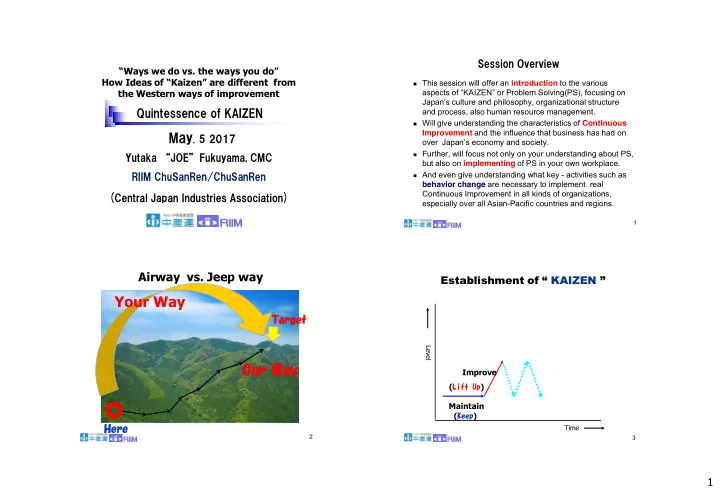
Session Overview

This session will offer an introduction to the various

aspects of “KAIZEN” or Problem Solving(PS), focusing on Japan’s culture and philosophy, organizational structure and process, also human resource management.

Will give understanding the characteristics of Continuous

Improvement and the influence that business has had on

  • ver Japan’s economy and society.

Further, will focus not only on your understanding about PS,

but also on implementing of PS in your own workplace.

And even give understanding what key - activities such as

behavior change are necessary to implement real Continuous Improvement in all kinds of organizations, especially over all Asian-Pacific countries and regions.

Her Here Targe get

Your Way Ou Our Wa Way

Airway vs. Jeep way

2 3

Establishment of “ KAIZEN ”

Maintain (Keep) Improve (Lift Up)

Level Time

slide-2
SLIDE 2

2

4

Why our system doesn’t work well?

Hu Human Reso source Sy System

Should be Current

Well Balanced

Philosophy Process People and Partners Problem Solving

. “ The Toyota Way ”

5

N E W W A Y O L D W A Y

Tug

  • f

War

Collapse of prices Changes in market Cultural differences

Japanes ese approa

  • ach on
  • n Quality

ty of

  • f Wo

Work

Why can’t we change?

Seniority In-House Labor Union Life-long Employment

J-Mgt. t.

Traditional

6

Frederic W. Taylor

Work measurement,

Work-factor analysis

⇒ 3 S

Henry Ford Alfred Sloan

From Automobile Industry

7 Where is the major emphasis of company strategy?

Efficiency Creativity Vitalization

“New Idea”

  • Leeway, amenity
  • Work creativity, innovation
  • New business development

“Activated”

  • Corporate internal diversification
  • Consensus

“Without waste”

  • Cost down
  • Productivity improvement
  • Quality stability, assurance

1970 1980 1990 2000

Major Emphasis on Strategy

The first Ford failed because of his firm conviction that a business did not need manager ers and manag agem ement

  • ent. All it needed, he believed, was the ow
  • wner

er-entrep eprene eneur with his “helpers.”

(P. Drucker “Management”)

slide-3
SLIDE 3

3

Change (“Practice of

  • f Management”

P.Dru ruck cker er)

There is a second demand the enterprise must make on the worker: that he be willing to accept change. Innovation is a necessary function of business enterprise; it is one

  • f its major social responsibilities. It requires, however, that people

change their work, their habits, their group relations.

8

The human being has a capacity to change beyond all other animals, but it is not unlimited. In the first place, while man can learn amazingly fast, his unlearning capacity is much lower (fortunately for the race). We know today that learning capacity does not disappear with age. But the more one has learned the more difficult is unlearning. Experience rather than age, in other words, is the bar to easy unlearning and with it to easy or fast learning of new things. The only way to get around this is by making ability to unlearn itself part of what a man learns. This requires that one learn by acquiring knowledge rather than simply by experience.

9

‘ Lead ’ Your Way vs. Our Way

The leadership from now on must not be standing in front and pulling just like the steam locomotive. For example, each carriage of Shinkansen runs in its own motor. It is controlling by synchronizing the revolution of each motor and running at same phase. (Nikkei, ’87 /Aug/17 )

  • Mr. Kume, former President of Nissan Motor

Before After

Shinkansen Steam Locomotive

10

Everybody Participates = “ Empowerment ”

Maximum Utilization of Everybody Everybody works for the same direction

  • 1. Create a company-wide policy by Top management
  • 2. Everyone understands the top policy
  • 3. Every manager must develop his/her own department

policy according to the top policy

  • 4. Everyone must have positive attitude and would like to

solve problems, depending not on the technical expertise but on management ideas The work of the manager, in other words, is complex. And every

  • ne of its categories requires different qualities and qualifications.

Setting objectives, for instance, is a problem of balances: a balance nce between en business ess results and the realizatio ion n of the principle ciples s one believes es in ; a balance between immedia iate e needs of business ness and those e of the future ; a balance between desirable e ends s and available le means. Setting g object ctiv ives es therefo fore e requires res analytica ical l and synthesi sizing zing ability. Organizing, too, requires analytical ability. For it demands the most economical use of scarce resources. Bu But it deals with human n beings; s; and therefo fore e it also stands s under the principle iple of justice ice and require res s integri

  • rity. Both analytica

cal and integrit ity are simila larly ly requir ired ed for the develo lopment ment of people. le. (“Practice of

  • f Management”)

“ BALANCE ”

11

slide-4
SLIDE 4

4

12

Weave a beautiful cloth

Warp Weft Hoshin Management (Policy Deployment) Functional Management (Function Deployment)

13

Ho Horenso (“Spinach”)

Report

A transmission activity between several persons to mutually understand the heart, feeling, thinking, opinion and facts.

Communication

14

PDCA Cycle

Plan Do Action Check

Go Go an and Se See fo for Yourself elf

Management System Control System

Operation System

Design Sales

Produce

Purch ase Equip ment Stock Deliv ery HR budje t

Pa Pass ove

  • ver & Dash of
  • ff (PODO

DO) From top to bottom

Total Control of Q, C, D, S, M, E

15

slide-5
SLIDE 5

5

16

How to hand over the baton (Takeover)

Runway

(Baton Passing Zone)

17

Integrate THE System

Zen-in Keiei

Mission Process・Results Understanding of Environmental Change Target・ Responsibility Cooperation Know Each Other Communication with each other Decide What to do

18

Focus on an Average Man

10~20% 10~20%

60~80%

1 3 5

New Target

Old Target

Japanese ‘Bottom Up’ Way Major

Few

Evaluation

Our Your

19

Middle Up and Down

Top Middle Lower Top Down(&Bottom Up)

Inform of Policy

Middle Up and Down Information Authority

Past Present Propose for making Policy

Information Authority

slide-6
SLIDE 6

6 Old and New leader model

20

(From now on) (Until now) Praise Reproach Listen Speak, Tell Statistical Assumption Confide Hide Develop Solution Find someone to blame Bolster up Repress Welcome question Do not entertain question Think in medium & long term Think only of short-term Think from the root Think just adjustment Trust (belief that human nature is fundamentally good) Distrust(view that human nature is fundamentally cunning) Generate the best solution (Open ended) Only one answer (Closed ended) Ar Art (Vision, Creative insights) Sc Science ( Analysis, Systematic evidence) Cr Craft (Experience, Practical Learning Management as Practice

Styles of Managing

  • H. Mintzberg “Managing”

So the place to be inside the triangle: effective managing requires some blend of art, craft, and science, whether in the person of the manager alone, or else in a management team that works together. In other words, management may not be a science, but it does need some of the order of science, while being rooted in the practically of craft, with some of the zest of art. p.127 Blending All Around The manager is close to the workflow, but also connects significantly to the outside world, and most importantly, blends them together. p.137 22

Japanese Way Of KAIZEN Practice

Learning by Doing Company-wide Problem Solving

To master Japanese “ Accomplishments ”

Keep (Maintain) Break (Improve) Leave (Innovate)

守 “Shu” 破 “Ha” 離 “Ri”

References

23 Taylor, F. W. “ Scientific Management ”, 1911 Druker, P. F. “ The Practice of Management ”, 1954 “ Management ”, 1973 Sloan, A. P. JR “ My Years with General Motors ”, 1963 Abegglen, J.C. “ The Japanese Factory ”, 1980 Koike, K. ‘ Learning and Incentive Systems in Contemporary Japanese Industry ’ in Masahiko Aoki and Ronald Dore, ends., The Japanese Firm : “The Sources of Competitive Strength ”, Oxford : Oxford University Press, 1994 Leika, J. K. “ The Toyota Way ”, 1978 Ohno, T “ Toyota Production System ”, 1978 Mintzberg ,H. “ Managing ”, 2009 Ken Blanchard, Spencer Johnson “ The One Minute Manager ” , 1986 Welch, J “JACK” 2001 Bloomsbury “ Pocket Dictionary of Business ” 2010 Oxford “ Oxford DICTIONARY OF BUSINESS ” (Second Edition) 1996 Revans, R “ The Theory of Practice in Management ” 1966 Rother, M “ TOYOTA KATA” 2010