and let f : N - n > r = IRl, I N 1 = R be a mapping. Then - - PDF document

and let f n
SMART_READER_LITE
LIVE PREVIEW

and let f : N - n > r = IRl, I N 1 = R be a mapping. Then - - PDF document

Pigeon-hole and double counting Chapter 22 Some mathematical principles, such as the two in the title of this chapter, are so obvious that you might think they would only produce equally obvious results. To convince you that "It ain't


slide-1
SLIDE 1

Pigeon-hole and double counting Chapter 22

Some mathematical principles, such as the two in the title of this chapter, are so obvious that you might think they would only produce equally

  • bvious results.

To convince you that "It ain't necessarily so" we illustrate them with examples that were suggested by Paul Erdiis to be included in The Book. We will encounter instances of them also in later chapters.

Pigeon-hole principle.

I f n objects are placed in r boxes, where r < n, then at least one of

the boxes contains more than one object.

P

  • Well. this is indeed obvious, there is nothing to prove. In the language of

mappings our principle reads as follows: Let N and R be two finite sets with I N 1 = n > r = IRl, and let f : N - R be a mapping. Then there exists some a E R with

1 f

( a ) )

_> 2. We may even state a stronger inequality: There exists some

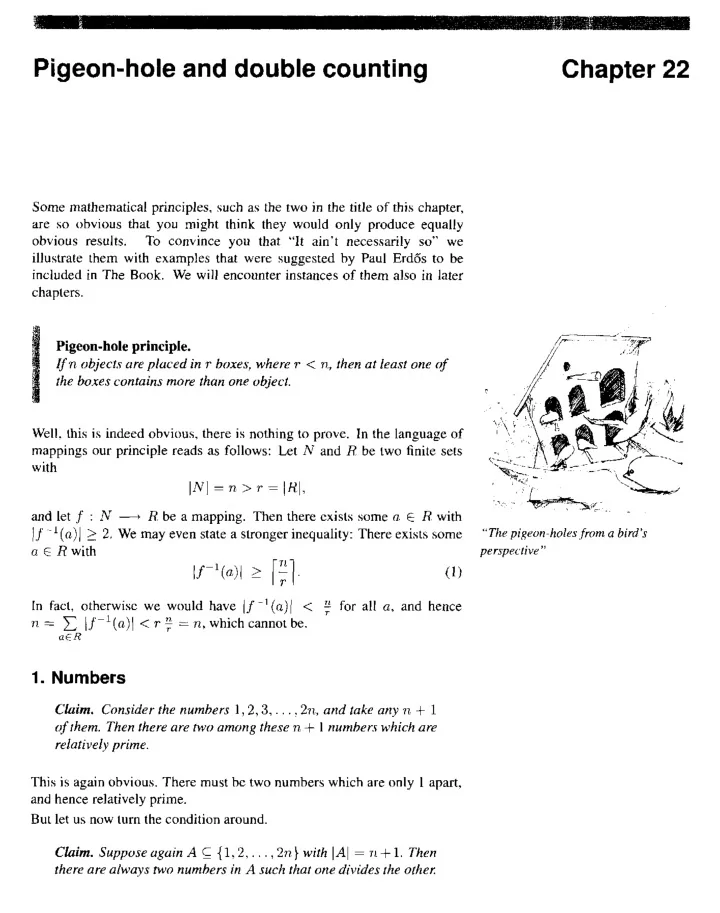
"The pigeon-holes from a brrd's

a E R with

perspective" In fact, otherwise we would have ( f

  • '(a)) <

for all a, and hence n = C 1 f -'(a)\ < r

=

n, which cannot be.

a t R

  • 1. Numbers
  • Claim. Consider the numbers 1 , 2 , 3 ,

. . . ,2n, and take any n + 1

  • f them. Then there are two among these n +

1 numbers which are

relatively prime. This is again obvious. There must be two numbers which are only 1 apart, and hence relatively prime. But let us now turn the condition around.

  • Claim. Suppose again A C

{ 1 , 2 ,

. .

. ,2n) with I A l = n +

  • 1. Then

there are always two numbers in A such that one divides the other:

slide-2
SLIDE 2

140 Pigeon-hole and double countinn This is not so clear. As ErdBs told us, he put this question to young Lajos PoSa during dinner, and when the meal was over, Lajos had the answer. It has remained one of Erdiis' favorite "initiation" questions to mathematics. The (affirmative) solution is provided by the pigeon-hole principle. Write

Both results are no longer true if one

every number a E A in the form a = 2", where m is an odd number

replaces n f l by n: For this consider

between 1 and 2n -

  • 1. Since there are n + 1 numbers in A, but only n

the sets {2.4,6.. . . .2n), respectively

different odd parts, therz must be two numbers in A with the same odd

{n+l, n+2,. . . .2n).

  • part. Hence one is a multiple of the other.
  • 2. Sequences

Here is another one of Erd6s' favorites, contained in a paper of Erdiis and Szekeres on Ramsey problems.

  • Claim. In any sequence a l ,

aa, . . .

,

a , , + l

  • f

mn +

1 distinct real numbers, there exists an increasing subsequence

  • f length m +

1,

  • r a decreasing subsequence
  • flength n +

1,

  • r both.

This time the application of the pigeon-hole principle is not immediate. Associate to each ai the number ti which is the length of a longest increas- ing subsequence starting at ai. If ti 2

m + 1 for some i, then we have

an increasing subsequence of length m + 1. Suppose then that ti 5 m for all i. The function f : ai ti mapping { a l , .

.

. ,

a,,,+l) to (1,. . .

,

m)

tells us by (1) that there is some s E (1,.

. . , m )

such that f (a,) = s for

mn

  • rn + 1 = n + 1 numbers ai. Let a,,, aj,, . .

.,a,,+, (jl < . . . < &+I) be these numbers. Now look at two consecutive numbers aJZ, aj,,, . If aj, < a,,+, , then we would obtain an increasing subsequence of length The reader may have fun in proving that

s starting at aj,,, ,

and consequently an increasing subsequence of length

for 7nn numbers the statement remains s + 1 starting at a,, ,

which cannot be since f (a,? ) = s. We thus obtain a

no longer true in general.

decreasing subsequence aj, > aj, > . . . > aj,,,

  • f length n + 1.

This simple-sounding result on monotone subsequences has a highly non-

  • bvious consequence on the dimension of graphs. We don't need here the

notion of dimension for general graphs, but only for complete graphs K,. It can be phrased in the following way. Let N = (1, . .

. , n), n > 3, and

consider m permutations T I , . . .

,

T, of N. We say that the permutations

7rt represent K, if to every three distinct numbers i ,

j, k there exists a per- mutation 7r in which k comes after both i and j. The dimension of Kn is then the smallest m for which a representation T I ,

.

. . , xm exists. As an example we have dim(K3) = 3 since any one of the three numbers must come last, as in TI = (1,2,3),

7r2 = (2,3,

I ) ,

TTT~

= (3,1,2).

What

slide-3
SLIDE 3

Pigeon-hole and double counting 141 about K4? Note first dim(K,) 5 dim(K,+l): just delete n + 1 in a representation of K,+l. So, dim(K4) > 3, and, in fact, dim(K4) = 3, by taking It is not quite so easy to prove dim(K5) = 4, but then, surprisingly, the dimension stays at 4 up to ,n = 12, while dini(Kly) = 5. So dim(K,) seems to be a pretty wild function. Well, it is not! With n going to infinity, dim(K, ) is, in fact, a very well-behaved function - and the key for finding a lower bound is the pigeon-hole principle. We claim Since, as we have seen, dim(K,) is a monotone function in n, it suffices to verify (2) for n = 2'" + 1, that is, we have to show that dim(K,) 2 p + 1 for n = 2,' + 1 Suppose, on the contrary, dim(K,) 5 p, and let T

I , . .

. ,

T , be representing

permutations of N = {1,2, . . . -2'" +

1).

Now we use our result on mono- tone subsequences p times. In .rrl there exists a monotone subsequence A1

  • f length 22"-1 + 1

(it does not matter whether increasing or decreasing). Look at this set A1 in Using our result again, we find a monotone sub- sequence A

2

  • f A

1 in 7r2 of length 22p-2 + 1, and A2 is, of course, also

monotone in TI. Continuing, we eventually find a subsequence A, of size

220 + 1

= 3 which is monotone in all permutations ~

i .

Let A, = (a,

b, c),

then either a < b < c or a > b > c in all n,. But this cannot be, since there must be a permutation where b comes after a and c. The right asymptotic growth was provided by Joel Spencer (upper bound) and by Erdds, SzemerCdi and Trotter (lower bound):

1

dim(K,)

= log, log, 71 + (- +

  • (1))

log, log, log2 n.

2 But this is not the whole story: Very recently, Morris and Hogten found a method which, in principle, establishes the precise value of dim(K,). Using their result and a computer one can obtain the values given in the

  • margin. This is truly astounding! Just consider how many permutations of

size 1422564 there are. How does one decide whether 7 or 8 of them are required to represent K1422564?

  • 3. Sums

Paul Erdds attributes the following nice application of the pigeon-hole principle to Andrew VQzsonyi and Marta Sved:

~ l : l 2 3

5 6 7 8 9 1 0 1 1 1 2 4

7r2:2 3 4 8 7 6 5 1 2 1 1 1 0 9 1 T S : ~ 4 1 1 1 1 2 9 1 0 6 5 8 7 2 ~ 4 : 4 1 2 1 0 9 1 2 1 1 7 8 5 6 3 These four permutations represent K12

  • Claim. Suppose we are given n integers a l ,

. . . ,

a,, which need not be distinct. Then there is alwa s a set of consecutive numbers

2

al;+l, ak+2? . . . , at whose sum Ci=k+l ai is a multiple of n.

slide-4
SLIDE 4

142 Pigeon-hole and double counting For the proof we set N = { 0 , 1 , . . .

,

n} and R = { 0 , 1 , . . .

,

n - 1). Con-

sider the map f : N +

R,

where f (m) is the remainder of a1 +

.

. . + a, upon division by n. Since I

N 1 =

n +

1 > n =

I RI, it follows that there are

two sums a1 + .

. . +

a k , a1 + .

. . +

ae ( k < t) with the same remainder, where the first sum may be the empty sum denoted by 0. It follows that has remainder 0 - end of proof. Let us turn to the second principle: counting in two ways. By this we mean the following.

Double counting.

Suppose that we are given two Jinite sets R and C and a subset

S C_ R x C. Whenever (p,

q) E S, then we say p and q are incident.

I f rp denotes the number of elements that are incident to p E R,

and c, denotes the number of elements that are incident to q E C, then Again, there is nothing to prove. The first sum classifies the pairs in S according to the first entry, while the second sum classifies the same pairs according to the second entry. There is a useful way to picture the set S. Consider the matrix A = (a,,), the incidence matrix of S, where the rows and columns of A are indexed by the elements of R and C, respectively, with With this set-up, r, is the sum of the p-th row of A and c, is the sum of the q-th column. Hence the first sum in (3) adds the entries of A (that is, counts the elements in S) by rows, and the second sum by columns. The following example should make this correspondence clear. Let R =

C = { 1 , 2 , .

. . ,8), and set S = {(i, j ) : i divides j ) . We then obtain the matrix in the margin, which only displays the 1's.

  • 4. Numbers again

Look at the table on the left. The number of 1's in column j is precisely the number of divisors of j ; let us denote this number by t ( j ) . Let us ask how