and ( ) ( ) , F , P , , P . 1 Combining both models, - - PDF document

and
SMART_READER_LITE
LIVE PREVIEW

and ( ) ( ) , F , P , , P . 1 Combining both models, - - PDF document

HEDGING METHODOLOGIES IN EQUITY-LINKED LIFE INSURANCE Alexander Melnikov University of Alberta, Edmonton e-mail: melnikov@ualberta.ca 1. Formulation of the Problem and Introductory Remarks. The contracts we are going to study have two types of


slide-1
SLIDE 1

1

HEDGING METHODOLOGIES IN EQUITY-LINKED LIFE INSURANCE Alexander Melnikov University of Alberta, Edmonton e-mail: melnikov@ualberta.ca

  • 1. Formulation of the Problem and

Introductory Remarks. The contracts we are going to study have two types

  • f uncertainty:
  • Uncertainty in the framework of given financial

market (market risk),

  • Mortality of insured.

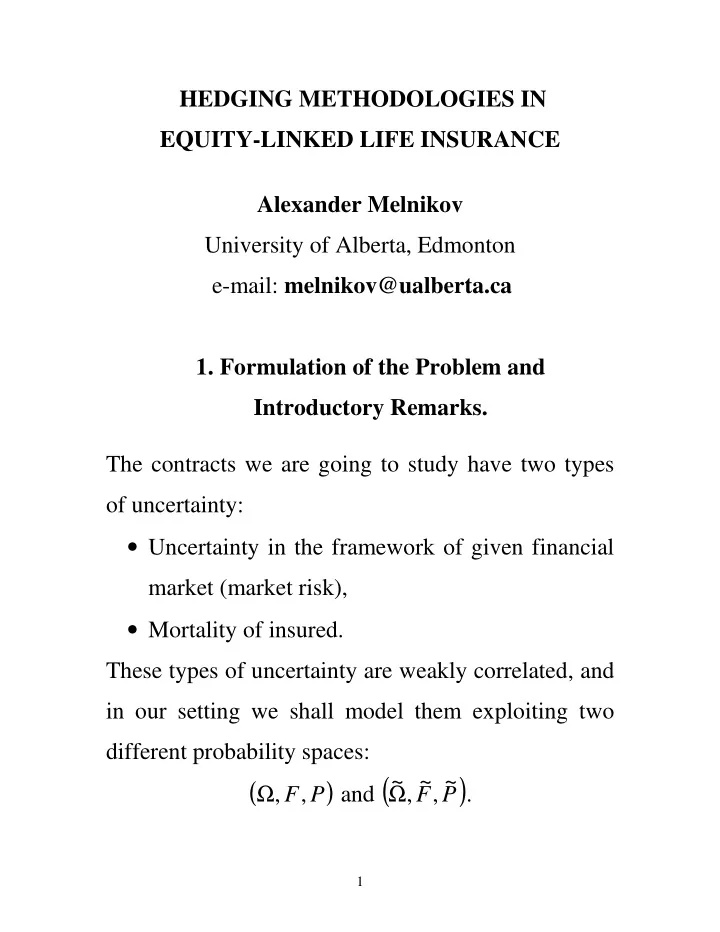
These types of uncertainty are weakly correlated, and in our setting we shall model them exploiting two different probability spaces:

( )

P F, , Ω and (

)

P F ~ , ~ , ~ Ω .

slide-2
SLIDE 2

2

Combining both models, we get the product space

( )

P P F F ~ , ~ , ~ × × Ω × Ω . Financial Market is represented by a pair of assets, non-risky B and risky S, that are identified by their prices (

)

t

B and (

)

t

S as stochastic processes on

( )

P F, , Ω . Assuming for simplicity 1 =

t

B , we describe a filtration

{ } ( )

0 ...,

,

= =

t t t

S S F σ F as the available information about prices at time t. To give a full description of the market, we should introduce a variety of admissible operations with the basic assets, B and S. Define a 2-dimensional stochastic process

( )

t t t

γ β π , = (usually predictable) adapted to F, as a portfolio, or a strategy with the value (capital)

t t t t t

S B X γ β

π

+ = .

slide-3
SLIDE 3

3

If

π t

X follows the equation

t t t t t

dS dB dX γ β

π

+ = , then we call π self-financing. Only portfolios with non-negative capital are admissible in the framework of the market. Any financial contract is identified with its potential liability (payoff) H , exercised at the end of a contract period [

]

T , . In fact, H is a

T

F -measurable random

  • variable. Any such nonnegative random variable H

is called a contingent claim. In financial economics, a contingent claim is called a derivative security of the European type. Remark: A larger class of derivative securities, the American type, is not considered here. The main problem is to find the current price of a given contingent claim during a contract period [

]

T , in order to manage the risk in the framework of the contract.

slide-4
SLIDE 4

4

An appropriate solution is found by hedging the contingent claims: to construct an admissible strategy * π so that

* π T

X is close enough to H in some probabilistic sense. Hedging gives us a possibility to determine the current price

t

C at time T t ≤ as the current capital

* π t t

X = C

  • f the hedging portfolio

* π . In particular,

* π

X = C represents the initial price of the claim.

slide-5
SLIDE 5

5

Types of hedging

  • 1. Perfect hedging:

{ } 1

*

= ≥ H X P

T π

.

  • 2. Mean-variance hedging:

( )

2 *

H X E

T − π

is minimal.

  • 3. Efficient hedging:

( ) { }

+

* π T

X H l E is minimal, where l is a loss function. In particular, for quantile hedging, we have

( )

( )( )

x I x l

=

,

and

{ }

H X P

T

* π

is maximal.

slide-6
SLIDE 6

6

How to calculate the price C? To answer this question, we use the martingale characterization of arbitrage and completeness of a financial market (in terms of existence and uniqueness of risk-neutral or martingale measures) given by the first and the second fundamental theorems in financial mathematics. So, we reduce the method of risk-neutral valuation of the contingent claim H to finding the price

t

C as ) | ( *

t t

F H E = C , where * E is an expectation w.r. to a single martingale measure * P (complete market) or ) | ( * sup

* t P t

F H E = C (incomplete market).

slide-7
SLIDE 7

7

Life insurance contracts based on risky assets The source of randomness in financial contracts is the evolution of stock prices. The source of randomness in life insurance is the mortality of clients. Denote

( )

x T a random variable representing the future lifetime of a client of age x.

( )

x T is given on

( )

P F ~ , ~ , ~ Ω . An insurance company can issue a mixed contract for the period [

]

T , , where the payoff function is a function of stock prices

T

S S ..., , and ( ) x T . This type of contract is called equity-linked life insurance contract. We will consider only pure endowment contracts with the following structure of payoffs:

( ) { }

T x T

I H x T H

>

⋅ = )) ( ( .

slide-8
SLIDE 8

8

Remarks: (1) Traditional life insurance deals with the deterministic payoff const K H = = . The price of the contract is equal to

x T p

K⋅ , where

( ) { }

T x T P px

T

> = ~ is a survival probability of the insured of age x. (2) Pure endowment with a fixed guarantee:

{ }

{ }

T x T T

I K S x T H

>

⋅ =

) (

, max )) ( ( , where S is a risky asset, K is a guarantee. (3) Pure endowment with a flexible guarantee:

{ }

{ }

T x T T T

I S S x T H

>

⋅ =

) ( 2 1 ,

max )) ( ( , where

1 T

S is the risky asset,

2 T

S is the flexible (may be also a risky asset) guarantee. Assume that S in (2) follows geometric Brownian Motion (Black-Scholes model): , , 2 exp

2

T t W t S S

t t

  • +

= σ σ µ where W is a Wiener process, µ is a rate of return on stock S, and σ is the volatility.

slide-9
SLIDE 9

9

A Brief History We note the papers by Brennan and Schwartz (1976,1979), Boyle and Schwartz (1977), which recognized a close connection of equity-linked life insurance with the option pricing theory (Black, Scholes, and Merton (1973)). They found that the payoff from equity-linked life insurance contract at expiration is identical to the payoff from a European call option plus some guaranteed amount. Hence, the appearance of Black-Scholes formula in such pricing is quite natural in the construction of the initial price and the value of the portfolio:

( ) ( ) [ ] ( ) ( ) [ ],

− + − +

− Φ − Φ + = − Φ + Φ = d K d S p K p d K d S p U

x T x T x T x T

, 2 ln

2

T T K S d σ σ ± =

±

( )

  • =

Φ

∞ − − x y

dy e x

2

2

2 1 π .

slide-10
SLIDE 10

10

Further developments: Delbaen (1986), Bacinello and Ortu (1993), Aase and Persson (1994). The important step was done by Moeller (1998, 2001, 2002) who applied the mean-variance hedging

  • technique. He obtained the following result:

( ) ( ) [ ]

− +

− Φ + Φ ⋅ = d K d S p l l T U

x T x x

) , ( and

( ) ( )

t x t x t T t x t

S t F p N l ,

*

′ − =

+ − −

γ give the initial price and optimal (in the mean- variance sense) hedging strategy for the contract of pure endowment with a guarantee K for a group of clients of age x, where x l is the size of the group of the insured with the remaining life times

( ) ( )

x T x T

x

l

,...,

1

,

( ) { }

( )

t T t x T P p I N

i t x t T l i t x T t

x i

− > + = =

+ − = ≤

  • )

( ~ ,

1

.

( )

x t F , satisfies the Black-Scholes fundamental equation (

)

= r

slide-11
SLIDE 11

11

( ) ( )

, 2 1 ,

2 2

= ′ ′ + ′ x t F x x t F

xx t

σ with the boundary condition

( ) { }

. , max , K x x T F = Remark: Our main focus is on calculating the premium

x TU for a single contract. Since for a group

  • f size x

l we get

x T x x

U l l T U ⋅ = ) , ( . Also, for every fixed T t ≤ we can repeat the logical steps for the interval ] , [ T t and find the corresponding premiums as a product

t x t T t x

U N l

+ −

⋅ − ) ( .

slide-12
SLIDE 12

12

2.Conditioned Contingent Claims in a semimartingale setting. Assume that the risky asset S is a semimartingale

T t t t F

S S

= ) , (

  • n (

)

P F , , , F Ω . A self-financing admissible strategy

( )

γ β π , = has a capital ≥ + =

  • t

u u t

dS X X γ

π π

. ) , ( P S M is a set of martingale measures of this

  • market. Firstly, we assume that

} { ) , (

*

P P S M = . Consider a nonnegative contingent claim H which is

t

F -measurable random variable with ∞ < H E

*

. According to the risk-neutral valuation methodology, , ) ( , ) ( ) | ( ) (

* *

H E H dS H F H E H

t u H u t t

= ≥ + = =

  • C

C C γ

( )

H H H

γ β π , = is a replicating portfolio (perfect hedge).

slide-13
SLIDE 13

13

Consider a nonnegative random variable τ defined

  • n another probability space (

)

P F ~ , ~ , ~ Ω and determine a conditioned contingent claim

{ }

T

I H H

>

⋅ =

τ

τ ) (

  • n the product space (

)

P P F F ~ , ~ , ~ × × Ω × Ω . To price ) (τ H we consider the value

{ }

) ( ) ( ) ( ~ )) ( ( ~ ) (

* *

H T p H I E H E H E E

T

C C C < ⋅ = ⋅ = × =

> τ

τ τ as a bound for the initial price of ) (τ H and define the set of successful hedging } ) ( : { ) , ( H X X X A

T

≥ =

π π π

ω π . If

H

π π = then 1 )) ), ( ( ( = π H A P C . We should consider a restricted set of strategies with the initial capital ) ( ) ( T p H X X ⋅ = ≤ C

π

. Thus, we cannot provide the above equality.

slide-14
SLIDE 14

14

To price a contingent claim ) (τ H , we should consider the following extreme problem: find an admissible strategy

*

π such that )) , ( ( max ) )) ( ( (

*

π τ

π π π

X A P H X P

T

= ≥ C under the restriction ) ( ) ( H X X C C < = ≤ τ

π

. This is exactly the problem of quantile hedging (Follmer and Leukert (1999, 2000)). According to this theory, the optimal strategy

( )

* * *

,γ β π = is a perfect hedge for the claim

* *

A A

I H H ⋅ = , where the set

T

F A ∈

*

has a maximal P-probability with

*

X HI E

A ≤

. This set is called a maximal successful hedging set . Remarks: In case of an incomplete market, the bound for the initial capital is given by ) ( ) ( ) ( sup ) (

* ) , ( *

T p H T p H E

P S M P

⋅ = ⋅

=

∈ ′

C C τ .

slide-15
SLIDE 15

15

  • 3. Pricing of contracts with a fixed guarantee.

Consider Black-Scholes model for the risky asset

  • +

=

t t

W t S S σ σ µ 2 exp

2

  • r

) (

t t t

dW dt S dS σ µ + = with the martingale measure

− = = T W dP dP Z P

T T 2 * *

2 1 exp : σ µ σ µ and t W W

t t

σ µ + =

*

, the new Wiener process with respect to

*

P . A pure endowment contract with a fixed guarantee is identified with the following contingent claim:

{ } { } { } { }.

) ( ) , max( )) ( (

) ( ) ( ) ( ) ( T x T T T x T T x T T T x T

I K S I K I K S I H x T H

> + > > >

⋅ − + ⋅ = = ⋅ = ⋅ = The initial price

x TU for this contract can be

calculated as

slide-16
SLIDE 16

16

)). ( ) ( ( ) ( )) ( (

* − + +

Φ − Φ ⋅ + ⋅ = = − ⋅ + ⋅ = = d K d S p K p K S E p K p x T U

x T x T T x T x T x T

C We can consider the quantity

+

− ⋅ = = ⋅ − ) ( )) ( (

*

K S E p x T K p U

T x T x T x T

C , as the bound of the initial capital available for a call

  • ption. Applying the methodology of quantile

hedging, we get

*

) ( ) (

* * A T T x T

I K S E K S E p ⋅ − = − ⋅

+ +

,

  • r the following convenient form for further actuarial

analysis of the contract: . ) ( ) (

* *

*

+ +

− ⋅ − = K S E I K S E p

T A T x T

The maximal successful hedging set

*

A has a special structure:

{ }

. ) ( ) (

1 1 *

2

> = − > =

+ + −

K S a S K S a Z A

T T T T σ µ

slide-17
SLIDE 17

17

There are two cases when the equation

+

− = ) (

1

2

K x a x

σ µ

has one or two solutions. Case

2

σ µ ≤ is reduced to

{ } {

}

b W c S A

T T

≤ = ≤ =

* *

, and . ) ( ) ( ) (

*

*

Φ −

  • +

− Φ − Φ − Φ = −

− + +

T b K T T b S d K d S I K S E

A T

σ Finally,

. ) ( ) ( 1

− +

Φ − Φ

Φ −

  • +

− Φ − = d K d S T b K T T b S px

T

σ

A constant b (or c) can be found from given probability of successful hedging: an insurance company can be agreed with a certain risk level ) 1 , ( ∈ ε such that ) ( 1

*

A P = −ε . Due to the structure of

*

A , we can find

slide-18
SLIDE 18

18

( )

Φ = T T b A P σ µ

*

and therefore T T b σ µ ε + − Φ =

) 1 (

1

. Illustrative Numerical Example Let’s fix a risk level 01 . = ε and specify other parameters of the model and the contract: years. 5 3, , 1 ; 110 ; 100 ; 3 . ; 08 . = = = = = T K S σ µ We can find that . 955106 . ; 94826 . ; 930095 .

5 3 1

= = =

x x x

p p p Using Life Tables (Bowers et al, 1997), we can reconstruct the appropriate age of the insured: 53 ; 62 ; 78 ≥ ≥ ≥ x x x years. Black-Scholes prices : 8.141; 16.876; 22.849. Quantile prices

ε

C : for 01 . = ε are 7.571; 16.003; 22.849 (5-7% lower); for 03 . = ε are 6.653; 14.514; 20.033 (12-18% lower).

slide-19
SLIDE 19

19

  • Remark. Consider cumulative claims

+ +

− ) ( K S l

T T x

, where

T x

l + is the number of insureds at time T from the group of size x l . The terminal capital of a quantile hedge

ε

π π =

  • f the

risk level ε satisfies to . 1 ) ) ( ( ε

π

− = − ≥

+

K S X P

T T

The maximal set of successful hedging is invariant w.r.to multiplication by a positive constant δ . Hence,

ε

π π = represents a quantile hedge for the claim

+

− ) ( K ST δ with the initial price

ε

δC . Take

x

l nα δ = , where

α

n is defined from the equality α

α

− = ≥

+

1 ) (

T x

l n P . Parameter ) 1 , ( ∈ α characterizes the level of mortality risk, and this probability is calculated with the help of Binomial Distribution with parameter

x T p . Independence T x

l + and the market implies

slide-20
SLIDE 20

20

). ( 1 ) 1 )( 1 ( ) ( ) ) ( ( ) ) ( ( α ε α ε

α α π π

+ − ≥ − − ≥ ≥ − ≥ ≥ − ≥

+ + + + T x T x T T T x T x

l n P K S l n X P K S l X l P So, with the help of strategy

ε

π π = and the initial price

ε α α ε

C l n C

x

=

,

  • ne can hedge the given

cumulative claim with the probability ) ( 1 α ε + − . For risk levels 03 . = ε , 02 . = α , 5 , 3 , 1 = T , and 100 =

x

l we have: 94 , 93 , 89 =

α

n and 831 . 18 ; 498 . 13 ; 921 . 5

, = α ε

C . Therefore, under the risk level at 5%, the initial contract price can be reduced by 18-28%. Case

2

σ µ > leads to two constants

2 1

c c < (or

2 1

b b < ). The structure of a successful set will be as follows

{ } { }

2 * 1 * *

b W b W A

T T

> ≤ =

  • and we can do the same as in the previous case.
slide-21
SLIDE 21

21

  • 4. Contracts with flexible guarantees.

The contract under consideration here has the structure

{ }

{ },

, max )) ( (

) ( 2 1 T x T T T

I S S x T H

>

⋅ = where , 2 , 1 , = i S

i t

follows the equation ). (

t i i i t i t

dW dt S dS σ µ + = The first asset

1

S is supposed to be more risky than the second one

2

S . Hence, we assume that

2 1

σ σ > and

2

S plays the role of the flexible guarantee. The market modelled in this case can be identified with a Black-Scholes model for the asset

1

S because

2

S can be expressed as a power function of

1

S . Hence, we can use a standard martingale measure

*

P with the density

slide-22
SLIDE 22

22

. 2 1 exp

2 1 1 1 1 *

− = = T W dP dP Z

T T

σ µ σ µ We can reduce the problem to the equality . ) ( ) (

2 1 * 2 1 *

*

+ +

− ⋅ − =

T T A T T x T

S S E I S S E p Assume that . and

2 1 2 1

σ σ σ σ << − < The structure of the successful hedging set

*

A is

{ }

2 1 2 2 1 1

, ) 1 ( 1 ) (

T T T T T T T T T

S S Y Y a S Z S S a Z =

> = − >

+ + −

. We represent as ,

2

const Y S Z

T T T

⋅ =

α

and find the characteristic equation defining

*

A as

+ −

− ⋅ = ) 1 (x a const x

α

, where

( ) ( )

. 1

2 2 2 1 2 2 2 1 2

≅ − − − + = − σ σ σ σ σ σ σ σ α Therefore, we can replace the equation above by

slide-23
SLIDE 23

23

+

− ⋅ = ) 1 (x a const x and find its unique solution . 1 > c So, we arrive to the equality

{ }

( ) ( ) ( ) ( ) ( ) ( ) ( ) ( )

, , ~ , ~ , ~ , , ~ , ~ , ~ , 1 ) ( ) (

2 1 2 2 1 1 2 1 2 2 1 1 2 1 * 2 1 *

T S S b S T S S b S T S c S b S T S c S b S S S E I S S E p

T T c Y T T x T

T

− + − + + ≤ +

Φ − Φ Φ − Φ − = − ⋅ − = where

( )

( ) ( )

. 2 ln , , , exp ~

2 1 2 2 1 2 1 2 1 1 1 2 2 1 2 2 * 2

T T S S T S S b T S S E S

T

σ σ σ σ σ µ σ µ σ − − ± =

= =

±

Both, the numerator and the denominator are variants

  • f Margrabe’s formula.

We can find c from the given level of risk ε :

( ) ( ) ( ) ( )

. ln 1

* , * *

2 *

ε σ µ ε

ε

ε a c a c Y P A P

T a

Φ = ≤ =

  • =

− .

slide-24
SLIDE 24

24

  • 5. Numerical Example.

Consider the financial indices the Russell 2000 (RUT-I) and the Dow Jones Industrial Average (DJIA) as risky assets

1

S and

2

S . We estimate (

)

1 1,σ

µ and (

)

2 2,σ

µ for these indices empirically, using daily observations of prices from August 1, 1997, to July 31, 2003: . 2089 . , 0417 . , 2232 . , 0481 .

2 2 1 1

= = = = σ µ σ µ The initial prices of these indices are 414.21 and 8194.04. Therefore, we use

1

21 . 414 04 . 8194

t

S ⋅ as the value

  • f the first asset to make initial values of both assets

the same 04 . 8194

0 =

S . Utilizing the formulae for c and

x T p with T=1, 3, 5,

10 and 05 . , 025 . , 01 . = ε , we get the

slide-25
SLIDE 25

25

corresponding survival probabilities for the contract with flexible guarantee (Table 1). We also do the same for the contract with fixed guarantee ) 1 . 1 ( S K ⋅ = (Table 2). Using Life Tables (Bowers et al, 1997), we define the corresponding age of the insured for these contracts (Tables 3 and 4). Whenever the risk that the company will fail to hedge successfully increases, the recommended ages rise as

  • well. This means that the insurance company should

compensate by choosing “safer” older clients. We also observed that with longer contract maturities, the company can widen its audience to younger clients. In both cases (fixed and flexible guarantees) quantile prices (for example, 025 . = ε ) are reduced by 7-8% and 9-12%. If the combined ( = α 025 . = ε ) risk is 5%, the corresponding price reduction will be 12- 18%.

slide-26
SLIDE 26

26

Survival Probabilities Table 1 01 . = ε 025 . = ε 05 . = ε T=1 0.9447 0.8774 0.7811 T=3 0.9511 0.8910 0.8041 T=5 0.9549 0.8989 0.8174 T=10 0.9605 0.9108 0.8378 Table 2 01 . = ε 025 . = ε 05 . = ε T=1 0.9733 0.9306 0.8585 T=3 0.9700 0.9247 0.8510 T=5 0.9706 0.9266 0.8553 T=10 0.9732 0.9332 0.8679

slide-27
SLIDE 27

27

Age of the Insured Table 3 01 . = ε 025 . = ε 05 . = ε T=1 78 87 94 T=3 61 71 79 T=5 53 63 71 T=10 41 50 58 Table 4 01 . = ε 025 . = ε 05 . = ε T=1 68 80 88 T=3 55 67 76 T=5 48 59 68 T=10 36 47 56

slide-28
SLIDE 28

28

  • 6. Further Developments.

We present here how our approach to the pricing of equity-linked life insurance contracts can be extended to other types of efficient hedging and other models

  • f financial market.

6.1. Efficient hedging with power loss function. . , , ) ( > ≥ = p x x x l

p

Model (with zero interest rate):

( )

. , 2 , 1 , T t i dW dt S dS

t i i i t i t

≤ = + = σ µ The optimal strategy

*

π for a given c.c. H is defined from

( )

=

+ + π π π T T

X H El X H El inf

*

,

slide-29
SLIDE 29

29

Where the inf is taken over all self-financing strategies with nonnegative values satisfying the budget restriction H E X X

*

< ≤

π

. For the mixed contract with

( ) ( )

( ) { }

T x T

I H x T H

>

⋅ = the bound

{ }

2 1 * *

, max

T T x T x T

S S E p H E p X = = . The efficient hedge

*

π for this problem exists and coincides with a perfect hedge for a modified c.c.

p

H with the structure

( )

H Z a H H

p T p p

∧ − =

−1 1

for 1 > p ,

{ }

p p T

H a Z p

I H H

− − >

⋅ =

1 1

for 1 < < p ,

{ }

p T

a Z p

I H H

>

⋅ =

1

for 1 = p , where Z is the density of the unique martingale measure

*

P , constant

p

a is determined from

*

X H E

p =

.

slide-30
SLIDE 30

30

We reduce the problem to efficient hedging of the

  • ption (

)

+

2 1 T T

S S and find the following key relation

( ) ( )

,

2 1 * 2 1 *

> − − =

+ +

p S S E S S E p

T T p T T x T

. We give the analysis of this equality. For example, in the case where 1 < < p and p − ≤1

2 1 1

σ µ , such considerations lead us to the formula:

( ) ( ) ( ) ( ) ( ) ( ) ( ) ( )

T S S b S T S S b S T S C S b S T S C S b S px

T

, ~ , ~ , ~ , , ~ , ~ , ~ , 1

2 1 2 2 1 1 2 1 2 2 1 1 − + − +

Φ − Φ Φ − Φ − = where constant C is the unique solution of the characteristic equation

( )

( )

, 1

1

≥ − ⋅ =

− + −

y y const y

p

p

α

with

( ) ( )

− − + = − p

p

1

2 1 1 2 1 2 2 1 1

σ µ σ σ σ σ µ α .

slide-31
SLIDE 31

31

6.2. Jump-Diffusion Model.

( )

. 1 , , , 2 , 1 , < > ≤ = Π − + =

− i i t i t i i i t i t

T t i d dW dt S dS ν σ ν σ µ Here, W is a Wiener process and Π is a Poisson process with intensity > λ . In the framework of this model, we can find the unique martingale measure

*

P with the density

( ) ( )

  • Π

+ − + − = λ λ λ λ α α

* * 2 * *

ln 2 exp

T T T

T T W Z where

2 1 1 2 1 2 2 1 * 2 1 1 2 2 1 1 2 *

, ν σ ν σ σ µ σ µ λ ν σ ν σ ν µ ν µ α − − = − − = . We can consider the same pricing problems for the given model. For example, quantile methodology leads to the key relation

slide-32
SLIDE 32

32

( ) ( )

+ +

− ⋅ − =

2 1 * 2 1 *

*

T T A T T x T

S S E I S S E p where

*

A is the maximal set of successful hedging for (

)

+

2 1 T T

S S . In case 1 2

1 *

≤ − σ α , we have the following expression for

x T p in terms of Margrabe’s formula

averaged by Poisson distribution:

( ) ( ) ( ) ( )

[ ]

( ) ( ) ( ) ( )

[ ]

− + ∞ − +

Φ − Φ Φ − Φ −

2 , 1 , 2 , 2 , 1 , 1 , * , 2 , 1 , 2 , 2 , 1 , 1 , * ,

, ~ , ~ ~ , ~ , ~ ~ , ~ , ~ ~ , ~ , ~ ~ 1 T S S b S T S S b S p T S C S b S T S C S b S p

n n n n n n T n n n n n n n T n

where

( )

( )

( )

, exp 1 ~ , !

* , * * ,

*

T S S n T e p

i n i i i n n T T n

λ ν ν λ

λ

− = =

and C is the unique solution of the equation

( )

, 1

1 *

2

≥ − ⋅ =

+ −

y y const y

σ α

.

slide-33
SLIDE 33

33

6.3. Quantile hedging in two-factors model generated by correlated Wiener processes.

( ) ( )

. , cov , , , 2 , 1 ,

2 1 2 1

t W W T t i dW dt S dS

t t i t i i i t i t

ρ σ σ σ µ = > > ≤ = + = This market is complete and the unique martingale measure

*

P has a density

( ) ( ) ( )

. 1 , 1 , 2 2 1 exp

2 2 1 1 2 2 1 2 2 2 1 2 1 1 2 1 2 1 2 2 2 1 2 1

ρ σ σ σ µ σ ρµ ϕ ρ σ σ σ µ σ ρµ ϕ ϕ ρϕ ϕ ϕ ϕ − − = − − =

  • +

+ − =

  • =

T W Z

i i T i T

Both assets

1

S and

2

S are martingales w.r. to

*

P . Exploiting this measure, we reproduce the same quantile technique for pricing

( ) ( )

{ }

( ) { }

T x T T T

I S S x T H

>

⋅ =

2 1 ,

max as in Section 4.

slide-34
SLIDE 34

34

Firstly, we find the initial price of this contract as

( )

+

− + =

2 1 * 2 T T x T x T x T

S S E p S p U reducing the problem to quantile hedging of

( )

+

2 1 T T

S S . Secondly, the quantile hedge

*

π is a perfect hedge for the modified c.c. (

)

*

2 1 A T T

I S S

+

− where

*

A is the maximal set of successful hedging for (

)

+

2 1 T T

S S . These considerations again lead to the key relation

( ) ( )

+ +

− ⋅ − =

2 1 * 2 1 *

*

T T A T T x T

S S E I S S E p . The set

*

A can be represented as

( )

⋅ ≥ =

+ −

1

* T T

Y const Y A

α

with

2 2 1 1

1 σ ϕ σ ϕ α − − = = .

slide-35
SLIDE 35

35

We again introduce the characteristic equation

( )

+ −

− ⋅ = 1 y const y

α

and find that for 1 ≤ −α this equation has the unique solution 1 ≥ C , and for 1 > −α there are two solutions

2 1

1 C C < ≤ . We consider only the first case and find that

{ }

C Y A

T ≤

=

*

. Using log-normality of

T

Y and Margrabe’s formula for

( )

+

2 1 * T T

S S E , we obtain

( ) ( ) ( ) ( ) ( ) ( ) ( ) ( )

T S S b S T S S b S T CS S b S T CS S b S px

T

, , , , , , , , 1

2 1 2 2 1 1 2 1 2 2 1 1 − + − +

Φ − Φ Φ − Φ − = where

( )

. 2 , 2 ln , ,

2 1 2 2 2 1 2 2 2 1 2 1

ρ σ σ σ σ σ σ σ − + = ± =

±

T T CS S T CS S b

slide-36
SLIDE 36

36

Applying this to the pricing of premium

x TU , we

arrive to the following equation

( ) ( ) ( ) ( ) ( ) ( ) ( ) ( ) ( ) ( ) ( ) ( )

[ ]

. , , , , , , , , , , , , 1

2 2 1 2 2 1 1 2 1 2 2 1 1 2 1 2 2 1 1

S T S S b S T S S b S T S S b S T S S b S T CS S b S T CS S b S U x

T

+ Φ − Φ ×

  • Φ

− Φ Φ − Φ − =

− + − + − +

Hedging strategy

*

π with the capital

2 * 2 1 * 1

*

t t t

dS dS dX γ γ

π

+ = can be calculated in a similar way. Using the independence of increments of Wiener processes, we calculate

*

π t

X as the conditional expected value

( )

, ,

*

2 1 *

T t F I S S E

t A T T

+

and get

( ) ( ) ( ) ( ) ( ) ( ) ( ) ( )

[ ]

. , , , , , , , , ,

2 1 2 1 * 2 2 1 2 1 * 1

t T CS S b t T S S b t T CS S b t T S S b

t t t t t t t t

− Φ − − Φ − = − Φ − − Φ =

− − + +

γ γ

slide-37
SLIDE 37

37

  • 7. Concluding Remarks.
  • 1. Some similar calculations can be done for Black-

Scholes model with stochastic volatility as a representative model of incomplete market.

  • 2. Further developments of this issue may include the

effect of transaction costs.

  • 3. We considered conditioned contingent claims

under assumption that “market” and “conditioned factor” τ are independent. This is not necessary. One can study conditioned contingent claims thinking about τ as a source of insider information:

τ t t

F F . As a measure of optimality of the strategy, the criteria of expected utility can be chosen.

  • 4. There exists a close connection with defaultable

derivatives and credit risks.

slide-38
SLIDE 38

38

  • 8. References

AASE, K. and PERSSON, S. 1994. “Pricing of unit-linked insurance policies.” Scandinavian Actuarial Journal 1: 26-52. BACINELLO, A.R. and ORTU, F. 1993. “Pricing of unit- linked life insurance with endegeneous minimum guarantees.” Insurance: Math. and Economics 12:245- 257. BOWERS, N.L., GERBER, H.U., HICKMAN, J.C., JONES D.A. and NESBITT, C.I. 1997. “Actuarial Mathematics.” Society of Actuaries, Schaumburg, Illinois. BOYLE, P.P. and SCHWARTZ, E.S. 1977. “Equilibrium prices of guarantees under equity-linked contracts.” Journal of Risk and Insurance 44: 639-680. BOYLE, P.P. and HARDY, M.R. 1997. “Reserving for maturity guarantees: Two approaches.” Insurance: Math. and Economics 21: 113-127. BRENNAN, M.J. and SCHWARTZ, E.S. 1976. “The pricing of equity-linked life insurance policies with an asset value guarantee.” Journal of Financial Economics 3: 195-213. BRENNAN, M.J. and SCHWARTZ, E.S. 1979. “Alternative investment strategies for the issuers of equity-linked life insurance with an asset value guarantee.” Journal of Business 52: 63-93. DELBAEN, F. 1986. “Equity-linked policies.” Bulletin Association Royal Actuaries Belges 80: 33-52.

slide-39
SLIDE 39

39

FOELLMER, H. and LEUKERT, P. 2000. “Efficient hedging: cost versus short-fall risk.” Finance Stochast. 4: 117-146. FOELLMER, H. and SCHIED, A. 2002. “Stochastic Finance: An introduction in discrete time.” Berlin – N.Y.: Walter de Gruyter. HARDY, M.R. 2003. “Investment guarantees: Modeling and risk-management for equity-linked life insurance.” J.Wiley. MARGRABE, W. 1978. “The value of an option to exchange one asset to another.” J. of finance 33: 177- 186. MELNIKOV, A., VOLKOV, S. and NECHAEV, M. 2002. “Mathematics of Financial Obligations.” American

  • Math. Soc.

MELNIKOV, A. 2003. “Risk analysis in Finance and Insurance.” Chapman&Hall/CRC. MELNIKOV, A. 2004.”Quantile hedging of equity-linked life insurance policies” Doklady Mathematics (Proceedings of Russian Acad.Sci). MELNIKOV, A. 2004.”On efficient hedging of equity- linked life insurance policies” Doklady Mathematics (Proceedings of Russian Acad.Sci.). MOELLER, T. 1998. “Risk-minimizing hedging strategies for unit-linked life-insurance contracts.” Astin Bulletin 28: 17-47. MOELLER, T. 2002. “Hedging equity-linked life insurance contracts.” North American Actuarial Journal 5: 79-95.

slide-40
SLIDE 40

40

Equity-linked life insurance

)) ( ( x T H

Pure endowment insurance

{ }

T x T

I H x T H

>

⋅ =

) (

)) ( (

Pure endowment with flexible guarantee

{ }

{ }

T x T T T

I S S x T H

>

⋅ =

) ( 2 1 ,

max )) ( ( Pure endowment with fixed guarantee

{ }

{ }

T x T T

I K S x T H

>

⋅ =

) (

, max )) ( (

  • Black-Scholes model
  • Jump-diffusion model

Prices and hedging strategies are given in terms of Black-Scholes formula and its Poisson averaging Illustrative one-factor model

  • (

)

2 , 1 , = + = i dW dt S dS

t i i i t i t

σ µ

Two-factor models Prices and hedging strategies are given in terms of Margrabe’s formula Jump-diffusion model

( )

2 , 1 , = Π − + =

i d dW dt S dS

t i t i i i t i t

ν σ µ

Black-Scholes model

( )

2 , 1 , = + = i dW dt S dS

i t i i i t i t

σ µ

Prices and hedging strategies are given in terms of Margrabe’s formula and its Poisson averaging