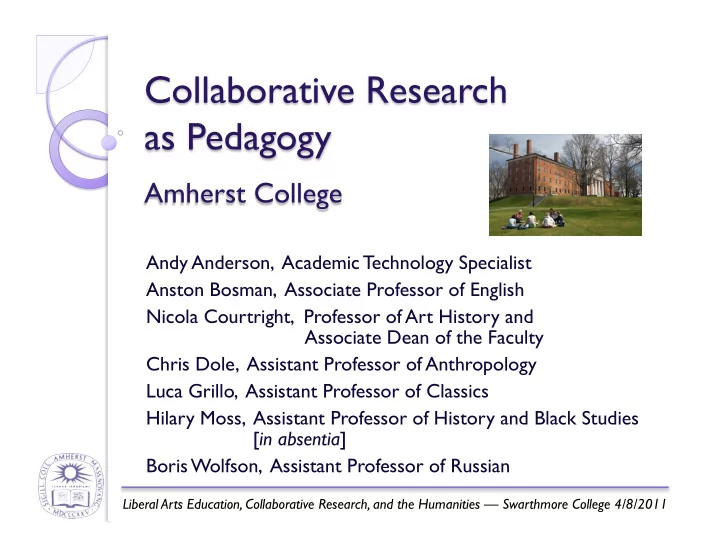
Andy Anderson, Academic Technology Specialist Anston Bosman, - - PowerPoint PPT Presentation

andy anderson academic technology specialist anston
SMART_READER_LITE
LIVE PREVIEW

Andy Anderson, Academic Technology Specialist Anston Bosman, - - PowerPoint PPT Presentation

Andy Anderson, Academic Technology Specialist Anston Bosman, Associate Professor of English Nicola Courtright, Professor of Art History and Associate Dean of the Faculty Chris Dole, Assistant Professor of Anthropology Luca Grillo,


slide-1
SLIDE 1

Andy Anderson, Academic Technology Specialist Anston Bosman, Associate Professor of English Nicola Courtright, Professor of Art History and Associate Dean of the Faculty Chris Dole, Assistant Professor of Anthropology Luca Grillo, Assistant Professor of Classics Hilary Moss, Assistant Professor of History and Black Studies [in absentia] Boris Wolfson, Assistant Professor of Russian

Liberal Arts Education, Collaborative Research, and the Humanities — Swarthmore College 4/8/2011

slide-2
SLIDE 2

1.

Background of the Mellon-funded collaborative research project (Nicola)

2.

The project itself; Two different kinds of courses:

  • Sophomore Tutorial
  • Pre-Thesis Research Tutorial

3.

Inventing and teaching our courses:

  • Current (Luca, Andy)
  • Future (Chris, Boris)

4.

Discussion: What does collaboration mean for us? Problems, pitfalls, rewards

Liberal Arts Education, Collaborative Research, and the Humanities — Swarthmore College 4/8/2011

slide-3
SLIDE 3

A research seminar designed to expose students to a range of methodologies, including archival analysis,

  • ral interviews, and geographic information systems.

Liberal Arts Education, Collaborative Research, and the Humanities — Swarthmore College 4/8/2011

slide-4
SLIDE 4

Students and parent at Tobin School, Cambridge

Web Page

slide-5
SLIDE 5

Web Page

slide-6
SLIDE 6

Web Page

slide-7
SLIDE 7

Web Page

(Restricted)

slide-8
SLIDE 8

Web Page

slide-9
SLIDE 9

Web Page

slide-10
SLIDE 10

Richard Kahlenberg The Century Foundation

Click on the image to the left to start a video snippet of a student interview in a web browser (if gibberish appears, reload the page). Web Page

slide-11
SLIDE 11

Tobin School Cafeteria, Cambridge

Web Page

slide-12
SLIDE 12

Web Page

slide-13
SLIDE 13

Web Page

slide-14
SLIDE 14

Web Page

slide-15
SLIDE 15
slide-16
SLIDE 16

Web Page

slide-17
SLIDE 17

Web Page

slide-18
SLIDE 18

UrbanRenewalArea = 0.13 Negro - 0.08 OwnerOccupied + 0.05 Before1940 - 0.03 HousingValue + 0.18 ± 0.05 ± 0.05 ± 0.05 ± 0.05 ± 0.49

Web Page

slide-19
SLIDE 19

Cambridgeport School, Cambridge

Web Page

slide-20
SLIDE 20

Peabody School, Cambridge

Web Page

slide-21
SLIDE 21

Why were the West Cambridge enrolment projections reported in the 1970 Elementary Schools Building Study so off-base?

Did race and/or class influence decisions about where to build new schools, renovate existing ones, or to close schools in the decade(s) before the implementation of controlled choice in Cambridge?

Considering the original demographics of Cambridge High and Latin School and Rindge School of Technical Arts, how did the merging of these two educational institutions effect the overall enrolment of the high school and the social, racial, and spatial make-up of the new integrated student body?

What motivated the reorganization of Cambridge High and Latin School and Rindge School of Technical Arts, and what issues were those who were involved in planning the reorganization considering?

What were the social, spatial and political tensions that caused the racial integration and linguistic integration movements to become counterproductive to one another, culminating with the failure of Bilingual Education within the Cambridge Public schools?

Why was the Kendall Square Urban Renewal Project controversial?

How did M.I.T. use its political leverage to influence the geographic choices of Inner Belt and how were M.I.T. students, faculty, and local community involved in the anti-Inner Belt campaign?

What role did MIT have in shaping Cambridge as a city in terms of race and space?

Cambridge Public Library

Web Page

slide-22
SLIDE 22

Web Page