Anglo-Chinese School (Junior) Primary 6 Breakfast Session 19 - - PowerPoint PPT Presentation

anglo chinese school junior
SMART_READER_LITE
LIVE PREVIEW

Anglo-Chinese School (Junior) Primary 6 Breakfast Session 19 - - PowerPoint PPT Presentation

Anglo-Chinese School (Junior) Primary 6 Breakfast Session 19 January 2018 1 Theme 2018 2 Raising this generation for the future Shepherding the Childs Heart Build attitudes and values Imparting the gift of joy and gratitude


slide-1
SLIDE 1

1

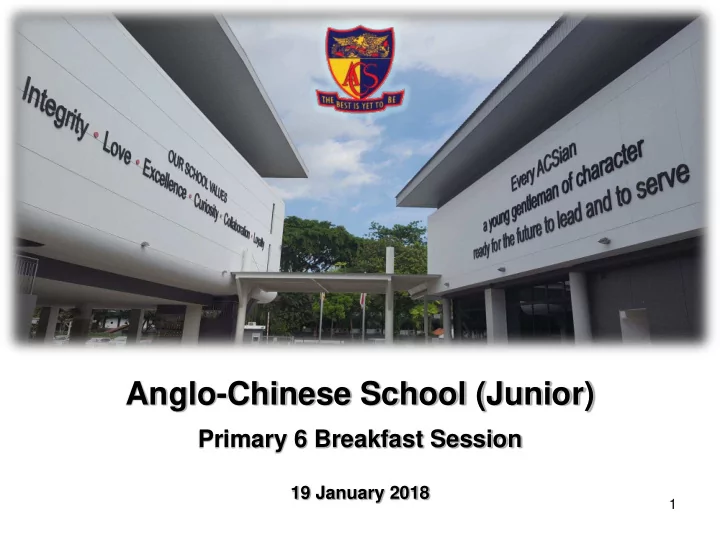
Anglo-Chinese School (Junior)

Primary 6 Breakfast Session

19 January 2018
slide-2
SLIDE 2

Theme 2018

2

slide-3
SLIDE 3

Raising this generation for the future

  • Shepherding the Child’s Heart

– Build attitudes and values

  • Imparting the gift of joy and gratitude
  • Role-modelling how to live for a cause greater

than self

3

Train up a child in the way he should go: and when he is old, he will not depart from it. Proverbs 22:6

slide-4
SLIDE 4

In partnership with Parents

  • Building Our School Together
  • Expertise required in many areas
  • For NEW volunteers, please sign up through school website

form 12 to 26 Jan 2018

  • For more information, contact the teacher-in-charge

4

Academic Development

  • - Training of Thinkers Captains /

Organisation of DI Competition

  • Chinese Oral /English Oral

Enriching School Life

  • Library
  • Aesthetics : Art and

Craft / Junior Superstar

  • Adventure Club
  • Teachers’ Day

Spiritual Support

  • Chapel
  • Parents’ Prayer Group

& Fathers’ Prayer Group

slide-5
SLIDE 5

5

slide-6
SLIDE 6

6

Form and co-Form Teachers

1. Provide pastoral care and ensure well-being of students 2. Facilitate lifeskills lessons and one-to-one interaction time with students 3. Communicate with parents and undertake administrative matters

slide-7
SLIDE 7

PSLE Preparations : Curriculum Time

  • 1. Equip pupils with skills to solve/answer PSLE questions

Answering techniques Understanding the requirements of the questions Synthesising knowledge

  • 2. Exposing pupils to a variety of PSLE questions

Topical Worksheets Practice papers (from other schools) Past PSLE Papers

  • 3. Targeted Coaching

Different strategies for different profile of pupils Eg: HP: More challenging/higher order questions to stretch them. MP/LP: Building on foundation and deeper understanding of topics/concepts/skills

  • 4. Harness creativity

Encourage different methods/ways to solve problems e.g. different heuristics/methods to solve a mathematical problem, application of science concepts to carry-out their own experiment based on a given aim and application of creative thinking when solving/answering some science questions.

slide-8
SLIDE 8

8

  • After-School Programme – Thoburn & Hinch

– Monday and Thursday, starting in Term 1 Week 4

  • Holiday Supplementary Classes

– 20/6 and 21/6 (8.30am to 1.00pm) – 6/9 and 7/9 (8.30am to 1.00pm)

Day Subject Time Thoburn – Target Group of students Hinch – Target Group of students

Monday Mathematics 2 to 2.50pm Selected All Monday Science 2.55 to 3.45pm Selected Selected Thursday HMT/MT 2 to 2.50pm Selected All Thursday English 2.55 to 3.45pm Selected Selected

PSLE Preparations : After School Support

slide-9
SLIDE 9

PSLE Preparations : Timeline

English, Mathematics, Science & Mother Tongue

Term 1 Term2 Term 3 Term 4

CA (Term 1 Week 8&9) SA1 (Term 2 Week 7&8) Prelims Oral (Term 3 Week 4) Prelims LC (Term 3 Week 5) PSLE Oral (Term 3 Week 8) Prelims (Term 3 Week 9&10) PSLE LC (Term 4 Week 1) PSLE Written (Term 4 Week 3&4)

  • Complete syllabus by Term 3 Week 3
  • Give students practice papers to consolidate learning till

Prelims

  • Practise PSLE booklets
  • Prelims paper is jointly set by ACSJ and ACSP to ensure high

standards

  • Teachers help pupils practise exam techniques/skills
  • 2 chances for examination conditioning – SA1 and Prelims held

in the School’s MPH in accordance to actual PSLE examination condition Targeted Practice : 1. Bridge learning gaps that are surfaced from the Prelims performance (Item Analysis) 2. Identify challenging questions from other school prelim papers that are good for exposure/ practice

slide-10
SLIDE 10

PSLE Preparations : Actual Exams

During the actual PSLE written examinations, we support each of our P6 boys through the following practices:

  • 1. Pastor prays for/ prays with boys at the beginning of each day
  • 2. Praying parent group who cover the boys in prayers (for protection)
  • 3. AED (Counselling) and (LBS) are on ready mode to provide support
  • 4. IP HODs will refresh some key instructions (for assurance)
  • 5. School provides PAH as holding area (for comfort)
slide-11
SLIDE 11

How Parents can help:

  • 1. Do ensure your child attends classes (after-school, holidays etc) regularly
  • 2. Do supervise your child’s homework completion regularly.
  • 3. Do remind your child not to lose important revision booklets/ documents

prepared by the different departments.

  • 4. Do monitor your child’s revision time after school.
  • 5. Do limit your child’s gadget time after school.
  • 6. Do provide positive assurance all the time to allay anxiety.
  • 7. Do encourage your child to start his revision early and consistently.
  • 8. Do provide for child’s holistic well-being (nutrition, exercise, sleep etc)
slide-12
SLIDE 12

PSLE – Placement Examination

  • Need to reflect the relative achievement

level of students with their peers.

  • Places students into different courses

according to their academic ability.

  • Enables posting to Secondary Schools

by merit and as far as possible into a school of their choice.

slide-13
SLIDE 13

What is the T-Score?

  • It

gives the relative standing

  • f

student’s performance as compared to the performance of all the other level students in that subject.

  • PSLE Aggregate Score is a sum of

the T-scores and NOT raw scores of the 4 subjects.

slide-14
SLIDE 14

Why not use Raw Scores?

  • Different subjects have different levels of

difficulty.

  • The raw score obtained shows how good the

student is in that subject, not how good he is compared to his peers.

  • Scoring the same mark, say 85%, in EL and

MTL could indicate very different capability of the learner in the respective subjects

slide-15
SLIDE 15

EL Ave = 60 MTL Ave = 80

85% John scores 85% in EL & MTL

Example

EL MTL

His performance in MT is very close to that of his peers. He did much better in EL as compared to

  • ther students.
slide-16
SLIDE 16

T-Score

Ave = 60

EL MTL

Ave = 80

50 85 85

 Converts average mark of each subject to a common

score of 50 points

 Converts the raw score to T-score by considering the

extent to which they differ from the average and the size of spread of the marks around the average

61 54

Raw Score to T-Score

slide-17
SLIDE 17

17

T-Score is the transformed score (that reflects the pupil’s standing relative to other pupils in that subject

x

is the pupil’s mark m is the average mark scored by all pupils who sat for the subject SD is the standard deviation (ie. the spread of marks around the average)

T-Score = 50 + 10(x – m) SD

slide-18
SLIDE 18

Overall PSLE Score

Aggregate Score = TEL + TMTL + TMATH + TSC = 61 + 54 + 55 + 58 = 228

slide-19
SLIDE 19

19

Pupils with 4As (2015)

Pupil English Math Science MT AGG Candidate A A A A A 219 Candidate B A A A A 225 Candidate C A A A A 228 Candidate D A A A A 235 Candidate E A A A A 243 Candidate F A A A A 248

slide-20
SLIDE 20

Direct School Admission (DSA)

  • The

DSA-Sec allows students to seek admission to a secondary school on the basis of talents and achievements that may not be demonstrated at the Primary School Leaving Examination (PSLE). The DSA-Sec enables students to enter suitable academic and non-academic programmes in Secondary Schools that can develop the students in these areas.

slide-21
SLIDE 21

DSA : NEW

  • Direct School Admission (DSA) places will be
  • increased. From the 2018 DSA Exercise (for the

2018 P6 cohort), all secondary schools will offer up to 20% of their non-IP places through DSA.

  • By the 2018 DSA Exercise (for the 2018 P6

cohort), schools will stop using general academic ability tests for DSA selection.

  • From the 2019 DSA Exercise (for the 2019 P6

cohort), DSA applications can be made via a common portal.

21

slide-22
SLIDE 22

Direct School Admission (DSA)

  • Students successfully allocated to their

DSA schools will not be allowed to participate in the annual S1 Posting Exercise to opt for secondary schools, and are expected to honour the commitment to the allocated DSA school for the entire duration of the programme. They will also not be allowed to transfer to another school after the release of the PSLE results.

slide-23
SLIDE 23

23

https://www.moe.gov.sg/admissions/direct- admissions/dsa-sec/overview

slide-24
SLIDE 24

24

Secondary School Application Process

  • Direct School Admission (DSA) Exercise

[Academic & Non-Academic Talent] a) Selection June-August b) Exercise Option October c) Results Release November

  • Secondary School Information Book

October

  • PSLE Results

Late November

  • Submission of Secondary School

Choices 3 days after results release

  • Secondary School Posting Results

Mid December

slide-25
SLIDE 25

25

Posting

Must indicate ACS(I) and ACS(BR) as first 2 choices in the option form in order to enjoy priority for admission

slide-26
SLIDE 26

Entry into affiliated schools New – 2019 PSLE Cohort

  • MOE will reserve 20% of places in each course

(Express, Normal (Academic) and Normal (Technical)) at every affiliated secondary school for application from students who do not benefit from affiliation priority.

  • Balance MOE’s commitment to preserving our

affiliated schools’ longstanding heritage and ethos with ensuring all publicly-funded schools remain open to all students, regardless of background and connection

26

slide-27
SLIDE 27

Entry into ACS schools

ACS (Independent) Offers IP (IB) and Express (O-levels)

Cut-off for IP varies from year to year Cut-off point for Express (Feeder schools) : 235

ACS (Barker) Offers Express, Normal (Academic) and Normal (Technical) Streams

Cut-off varies from year to year

27

Need to meet Cut-off Point to be admitted 20% for each course reserved for non-affiliates (NEW - 2019 PSLE cohort onwards)

slide-28
SLIDE 28

28

We aim to give…

  • A memorable year
  • Opportunities to build firm ties and friendships
  • Sound values education
  • Good preparation for academic challenges
  • Experiences to prepare ACSJ students for life

ahead