
SLIDE 1
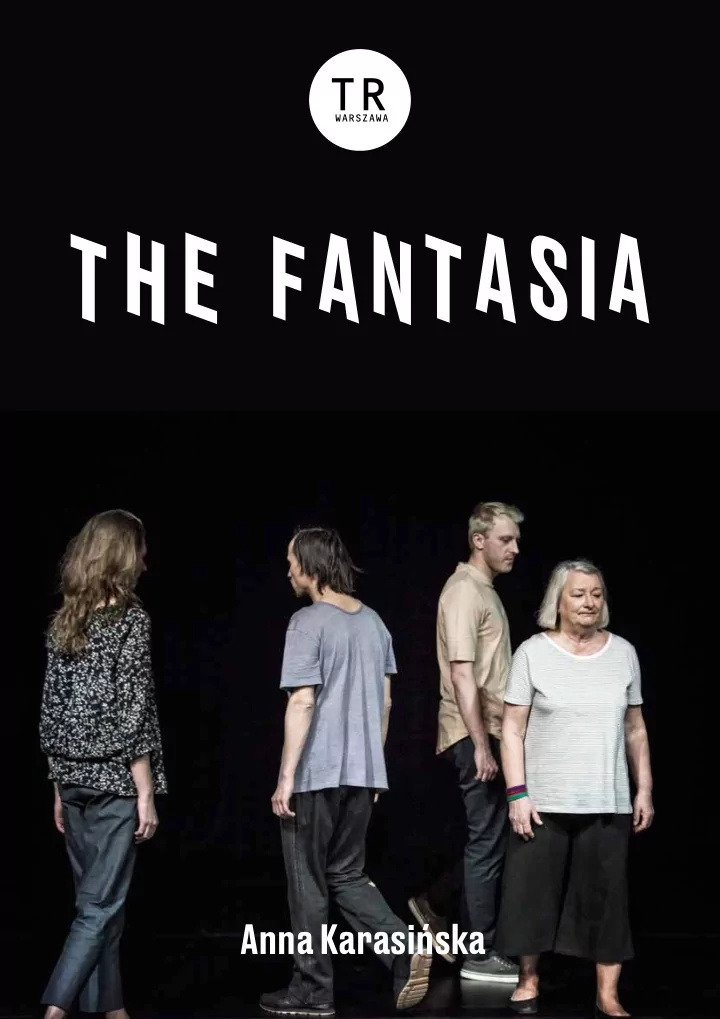
Anna Karasiska tr WarszaWa CREDITS director Anna Karasiska - - PDF document
Anna Karasiska tr WarszaWa CREDITS director Anna Karasiska dramaturgy Magdalena Rydzewska, Jacek Telenga set design and costumes Paula Grocholska choreography Magda Ptasznik light design Szymon Kluz cast Agata Buzek, Dobromir
karasińska the fantasia tr WarszaWa
director
dramaturgy
set design and costumes
choreography
light design
cast
karasińska the fantasia tr WarszaWa
anna KarasińsKa
karasińska the fantasia tr WarszaWa
Witold mrozek, gazeta Wyborcza
karasińska the fantasia tr WarszaWa
1 Term originated by Polish critic Tomasz Plata describing Karasińska as one of
directors who ‘are fatigue with the theatre establishment is their starting point – yet their final goal is always theatre itself, often reduced to its simplest forms and shown shorn of adornment’.
karasińska the fantasia tr WarszaWa
roman paWŁoWsKi head of programming department, tr Warszawa
karasińska the fantasia tr WarszaWa
karasińska the fantasia tr WarszaWa
karasińska the fantasia tr WarszaWa
karasińska the fantasia tr WarszaWa
The Fantasia is a play with imagination. simple play with a sophisticated simplicity, incredibly funny, and at times profoundly moving. the abstract play Fantasia is the return to tr Warszawa of anna Karasińska, author of the hit production of Ewelina’s Crying. yes, with Karasińska’s personality terms such as “abstract” and “hit production” can actually be used in the same sentence. as the title suggests, The Fantasia is a play with imagination. the director is present, though invisible. she is heard on the loudspeakers, live, addressing the audience directly. her words paint imaginary scenes actors, called out by name by the director, pick up on the go. the lab- like minimalism of performance is united here with the humour of semisilent stand-up comedy. The Fantasia could not work so spectacularly without its brilliant
characters, a woman not ashamed to dance to her favourite song, dobromir dymecki as, among others, a polar bear in Krupówki street, as well as the great newcomer to stage acting, Zofja Wichłacz, known for e.g. Warsaw ’ 44 [dir. Jan Komasa] and Afterimages [dir. Andrzej Wajda]. returning from the previous production are maria maj, adam Woronowicz, and rafał maćkowiak. the play is the quintessential emotional abstraction, or, in other words, an attempt to reduce drama to its basics, as with colour and texture in painting. it is all about acting compressed to situations or emotions drawn with a few quick strokes: a couple of facial expressions, a gesture, a pose. suggestive images in a handful of lines: theatre haiku anyone? Audience thrown into hastily constructed world the director’s words and actors’ bodies come together to reveal individual emotions and thoughts of an everyday quality, somewhat banal, slightly guilty: hidden and suddenly revealed. are they there in the movements and gestures of actors, or is our gaze that produces them, prompted by the voice-over narration? at times the spectator is plunged directly into the hastily constructed scene: “now Zosia is
karasińska the fantasia tr WarszaWa
playing someone who’s in love with you, but will never tell you.” and then there are the little nuisances, like staring at people on the public
morph into poetic micro-stories verging on magical realism. as a case in point, Wichłacz becomes a gold-medal winning champion of farewells: she has already said goodbye to her parents, her lover, and the whole street. maja, in turn, is a woman on her allotment who is suddenly chatted up by the dead lying underground. A play on dramatic form Fantasia completes the series that one could name a tetralogy on looking and empathizing. in the debut production of Ewelina’s Crying, tr actors played their own replacements, interns imagining what it is like to be tr actors. in The Second Performance at teatr polski in poznań, actors sitting on the stage acted all sorts of imaginary reactions and expectations of the audience. Finally, in Birthday Karasińska herself stood motionless on the stage, with voiceover playing her monologue on fear of public performances and embarrassment with one’s body that slowly proceeded to a description
in essence, it is a play with the dramatic form and imagination, statically positioned actors, and voiceover. “more of the same”? But isn’t saying that all Karasińska’s productions are similar tantamount to complaining that all traditional theatre performances are the same: after all, there’s always some text, characters, and a scenography?»
Witold mrozek, gazeta Wyborcza – stołeczna online/april 14
The Fantasia might speak only to the theatrical nerd who wants to see behind the wizard’s curtain, but it speaks very softly and very
fascinating and utterly charming slow burner. it’s all a game. it’s all a frame. none of it really happened. none of these people exist. even though all of it exists.
the arts review, chris o’rourke
karasińska the fantasia tr WarszaWa
the director anna Karasińska’s piece for tr Warszawa might best be described as a kind of inverse conjuring act: now you don’t see it, now you do. everything within its playful, largely improvised hour requires an imaginative collaboration: through a microphone, Karasińska gives each of her six performers a character, a context, perhaps a secret; they respond with some fabulously minimal reactions (one actor’s periodic disrobing notwithstanding), and the audience projects the rest. “switch,” Karasińska calls intermittently, and her amiable ensemble reposition on stage to begin a new tableau. irish times, peter crawley, october 2018 It’s the kind of play that cannot be recounted: it’s micro-theater by Anna Karasińska.” (…) the interpretative opportunities ofgered by the term micro-theater welcome discussions of the thought spaces explored by the director. the characters in her plays occupy a micro-world whose boundaries
karasińska the fantasia tr WarszaWa
are defjned by personal experience: the ostensibly irrelevant situations and mundane gestures that make up our everyday lives. the director typically begins with a quotidian detail and, using it as her axis, spins a tale that often takes an abstract turn. she often develops several mini- narratives in parallel, bringing them together to build ephemeral and elusive depictions of the world. Karasińska is consistent her efgorts to strip ofg the veneer of theater, to thoroughly deconstruct the theatrical illusion, thus proving that theater is limited by nothing but our imaginations. (…) anna Karasińska’s plays aren’t easy to “read”; answering the question “what are they about?” poses a challenge. they are largely experienced at the sensual and emotional level, particularly Fantasia and All Imaginary. (…) the viewer’s intellectual efgort often appears to play a backseat role, secondary to the emerging associations, thoughts, and emotions. the atmosphere of theatrical directness which the cast strives to create makes the actor-audience relationship a highly personal one. in result, the interpretative stances assumed by the viewer, while extraordinarily diverse (ranging from irritation to absolute rapture), undoubtedly become more engaging. the unpretentiousness and abundant self-ridicule in Karasińska’s productions are a breath of fresh air in polish theater. (…) the director
speaking directly to the singular viewer and his or her individual
attempt to address our unspectacular, everyday confrontations with the world. these encounters rarely warrant discussion. ultimately, they resemble a play that cannot be recounted, as Karasińska herself
attention to minor narratives, compositions made up of the minutiae
becomes an exercise of the imagination, allowing viewers to embark
Rozświetlamy Kulturę, agata Kędzia, october 2017
karasińska the fantasia tr WarszaWa
tr Warszawa’s programs integrate residents of Warsaw and visitors to the capital into the city’s cultural life, joining other theaters and cultural institutions in shaping a 21st-century civic identity and building Warsaw’s international position as an important center of artistic life. this is a theater that has carved out a space for itself on the map of Warsaw cultural institutions. the company led by grzegorz Jarzyna has developed contemporary stage forms and a new language of
polish theaters was created. here experience was gained by a group of artists, actors, producers and managers who today are shaping polish theater. tr Warszawa’s continuous development and artistic explorations mean that it plays an important role in creating culture. it generates new talents and ideas for the theater. it works with artists who create new directions in the theater. it raises socially important issues that are not yet being addressed on the stage. it develops the competences
tr Warszawa integrates new circles of participants in culture, building solid relations with them in the national and international worlds
tr Warszawa/atm studio, as well as outside its facilities, in other cultural institutions and organizations, and in non-theater spaces. Natalia Dzieduszycka managing director Grzegorz Jarzyna artistic director
karasińska the fantasia tr WarszaWa